




Abstract
Podocalyxin (PODXL) is a type I transmembrane sialoglycoprotein that is overexpressed in human cancers, including breast, oral, and lung. PODXL promotes tumor progression, and its expression is associated with poor prognosis. Since PODXL is expressed in normal cells, including kidney podocytes and vascular endothelial cells (VECs), cancer-specific monoclonal antibodies (mAbs) are necessary to reduce the adverse effects of antibody therapy on PODXL-expressing cancers. Previously, we established a cancer-specific mAb against PODXL, PcMab-60 (mouse IgM, kappa), by immunizing mice with soluble PODXL produced by LN229 glioblastoma cells. PcMab-60 reacted with PODXL-expressing cancer cells, but did not react with VECs. In this study, we investigated an epitope of PcMab-60 using flow cytometry, surface plasmon resonance (SPR), and enzyme-linked immunosorbent assay (ELISA). The results of SPR revealed that the PcMab-60 epitope consisted of Thr105, Arg109, Gly110, Gly111, Gly112, Ser113, Gly114, Asn115, Pro116, and Thr117. In contrast, the results of ELISA revealed that the PcMab-60 epitope consisted of Arg109, Gly110, Gly111, Gly112, Ser113, Gly114, Asn115, and Pro116. These results demonstrate the cancer-specific epitope, which was recognized by PcMab-60.
Introduction
Podocalyxin (PODXL) is a type I transmembrane sialoglycoprotein with a molecular weight of 150,000–200,000,(1–6) PODXL was identified as an apical membrane protein predominantly expressed in the kidney glomeruli.(7) PODXL consists of an extensively O-glycosylated and sialylated extracellular domain, a single-pass transmembrane domain, and a highly conserved cytoplasmic domain with a PDZ-binding region at the C-terminus.(8–10) PODXL is expressed on the surface of normal cells, including kidney podocytes, platelets, hematopoietic stem cells, and vascular endothelial cells.(7,11–13) PODXL is essential for maintaining open filtration pathways between neighboring podocyte foot processes through charge-repulsive effects of its highly negatively charged extracellular domain.(7) PODXL is also expressed in several human cancers, including breast,(14) oral,(15) and lung,(16,17) and plays crucial roles in tumor cell proliferation, invasion, and metastasis.(14,18)
Previously, we established a cancer-specific monoclonal antibody (CasMab) technology against cell surface proteins and developed some CasMabs, including anti-podoplanin monoclonal antibody (mAb; LpMab-2)(19) Recently, we successfully developed a novel CasMab against PODXL, PcMab-60 (mouse IgM, kappa), by immunizing mice with the cancer-derived soluble PODXL.(20) In that study, we converted the mouse IgM subclass of PcMab-60 into a mouse IgG2a subclass (60-mG2a) for antibody-dependent cellular cytotoxicity (ADCC). Then, we developed a core fucose-deficient type of 60-mG2a (60-mG2a-f) to potentiate the ADCC activity of PcMab-60. We showed that 60-mG2a-f has antitumor activity against a mouse xenograft of pancreatic cancer. The epitope of PcMab-60 has not been identified although the epitope identification of mAbs is essential to avoid unexpected cross-reactivity and develop an antibody drug.
In this study, we clarified the critical epitope of PcMab-60 using enzyme-linked immunosorbent assay (ELISA), flow cytometry, and surface plasmon resonance (SPR).
Materials and Methods
Cell lines
Chinese hamster ovary (CHO)-K1 cells were purchased from the American Type Culture Collection (ATCC, Manassas, VA, USA). PODXL mutant plasmids were transfected into cells using Lipofectamine 2000 (Thermo Fisher Scientific, Inc., Waltham, MA, USA) according to the manufacturer's instructions. Stable transfectants were sorted using a cell sorter (SH800; Sony Corp., Tokyo, Japan). Cells were cultured in RPMI 1640 medium (Nacalai Tesque, Inc., Kyoto, Japan) supplemented with 10% heat-inactivated fetal bovine serum (Thermo Fisher Scientific, Inc.), 100 U/mL penicillin, 100 μg/mL streptomycin, and 0.25 μg/mL amphotericin B (Nacalai Tesque, Inc.) at 37°C in a humidified atmosphere containing 5% CO2. Transfectants were cultivated in a medium containing 0.5 mg/mL G418 (Nacalai Tesque, Inc.).
Plasmid preparation
cDNA encoding the full-length open reading frame of PODXL was obtained through polymerase chain reaction (PCR) using cDNA derived from the LN229 cell line (ATCC) as a template. We produced PODXL deletion mutants (dN60, dN100, dN140, dN200, dN300, and dN400) using HotStar HiFidelity polymerase kit (Qiagen Inc., Hilden, Germany) with appropriate oligonucleotides. In-Fusion PCR cloning kit (Takara Bio, Inc., Shiga, Japan) was used to subclone PCR products into a pCAG-Neo vector (FUJIFILM Wako Pure Chemical Industries Ltd., Osaka, Japan) containing a signal sequence and PA tag (GVAMPGAEDDVV),(21) which is recognized by an anti-PA tag mAb (NZ-1).(22) All amino acid numbers were consistent with the NCBI reference sequence (NP_005388.2).
Flow cytometry
Cells were harvested by briefly exposing them to 0.25% trypsin/1 mM ethylenediaminetetraacetic acid (Nacalai Tesque, Inc.). After washing the cells with 0.1% bovine serum albumin (BSA) in phosphate-buffered saline (PBS), they were treated with PcMab-60 (10 μg/mL) or NZ-1 (1 μg/mL) for 30 min at 4°C and then with Alexa Fluor 488-conjugated antimouse IgG or antirat IgG (1:1000; Cell Signaling Technology, Inc., Danvers, MA, USA). Fluorescence data were collected using BD FACSLyric system (Becton, Dickinson and Company, Franklin Lakes, NJ, USA).
PODXL peptides
PODXL (Accession No. NP_005388.2) peptides, including 6 deletion mutants and 20 alanine-substituted peptides (Tables 1–3), were synthesized using PEPScreen (Sigma-Aldrich Corp., St. Louis, MO, USA).
Epitope Mapping of PcMab-60 by Enzyme-Linked Immunosorbent Assay Using Deletion Mutants
+++, OD655 ≥ 0.1; ++, OD655 ≥ 0.08; +, OD655 ≥ 0.06; −, OD655 < 0.06.
Epitope Mapping of PcMab-60 by Surface Plasmon Resonance Using Alanine-Substituted Peptides
ND, not determined.
Epitope Mapping of PcMab-60 by Enzyme-Linked Immunosorbent Assay Using Alanine-Substituted Peptides
+++, OD655 ≥ 0.1; ++, OD655 ≥ 0.08; +, OD655 ≥ 0.06; −, OD655 < 0.06.
Enzyme-linked immunosorbent assay
Synthesized PODXL peptides were immobilized in Nunc Maxisorp 96-well immunoplates (Thermo Fisher Scientific, Inc.) at a concentration of 10 μg/mL for 30 min at 37°C. After washing with PBS containing 0.05% Tween 20 (PBST) (Nacalai Tesque, Inc.), wells were blocked with 1% BSA-containing PBST for 30 min at 37°C. The plates were incubated with PcMab-60 (20 μg/mL), followed by a peroxidase-conjugated antimouse immunoglobulins (1:2000 diluted; Agilent Technologies, Inc., Santa Clara, CA, USA). Enzymatic reactions were conducted using ELISA POD Substrate TMB kit (Nacalai Tesque, Inc.). Optical density was measured at 655 nm using iMark microplate reader (Bio-Rad Laboratories, Inc., Berkeley, CA, USA).
Measurement of dissociation constants (KD) between PcMab-60 and alanine-substituted peptides using SPR
PcMab-60 was immobilized on the sensor chip CM5 according to the protocol described by Cytiva (Marlborough, MA, USA). In brief, PcMab-60 was diluted to 10 μg/mL using acetate buffer (pH 4.0: Cytiva) and immobilized using an amine-coupling reaction. The surface of the flow cell 2 of the sensor chip CM5 was treated with 1-ethyl-3-(3-dimethylaminopropyl)-carbodiimide and N-hydroxysuccinimide (NHS), followed by injecting PcMab-60. Unreacted NHS-ester was blocked with ethanolamine after PcMab-60 immobilization. KD values between PcMab-60 and alanine-substituted peptides given in Table 2 were measured using Biacore X100 (Cytiva) at 25°C. The buffer used was PBS containing 0.05% (v/v) Tween 20 and 1.4% (v/v) dimethyl sulfoxide (FUJIFILM Wako Pure Chemical Corporation). A single cycle kinetics method was used to measure binding signals. We conducted an equilibrium analysis to analyze the data and determine KD using BIAevaluation software (Cytiva).
Results
Determination of the PcMab-60 epitope using PODXL deletion mutants and synthesized peptides
To determine the PcMab-60 epitope, we constructed PODXL N-terminal deletion mutants (dN60, dN100, dN140, dN200, dN300, and dN400) with the PA tag at their N-terminus and expressed these mutants in CHO-K1 cells. Reactions between PcMab-60 and deletion mutants and between anti-PA tag mAb (NZ-1) and deletion mutants were characterized using flow cytometry. The results of flow cytometry showed that PcMab-60 reacted with dN60 and dN100, but did not react with dN140, dN200, dN300, and dN400 (Fig. 1A). All deletion mutants were detected by NZ-1 (Fig. 1B). Both PcMab-60 and NZ-1 did not recognize parental CHO-K1 cells (Fig. 1A, B). These results indicated that the N-terminus of PcMab-60 epitope existed between the 100–140 amino acids (aa) of PODXL (Fig. 1C).

Epitope mapping of PcMab-60 using deletion mutants.
Next, we prepared six peptides of 20 aa each (70–89, 80–99, 90–109, 100–119, 110–129, and 120–139 of PODXL; Table 1) and performed ELISA. PcMab-60 reacted with the 100–119 peptide (100-SGPVNTTVARGGGSGNPTTT-119), but did not react with other peptides (Table 1). This result indicated that the PcMab-60 epitope exists between the 100–119 aa of PODXL (Fig. 1C).
Epitope mapping using SPR
Next, we synthesized wild-type and 20 alanine-substituted PODXL peptides of 100–119 aa and determined the KD values using SPR. The KD values between 11 peptides (S100A, G101A, P102A, V103A, N104A, T106A, V107A, A108G, T118A, T119A, and wild-type 100–119) and PcMab-60 were determined to be ∼300–600 nM. However, the KD values between 10 peptides (T105A, R109A, G110A, G111A, G112A, S113A, G114A, N115A, P116A, and T117A) and PcMab-60 were not determined. The KD values for each peptide are given in Table 2. These results indicated that Thr105, Arg109, Gly110, Gly111, Gly112, Ser113, Gly114, Asn115, Pro116, and Thr117 are the critical epitope of PcMab-60 (Fig. 2A).
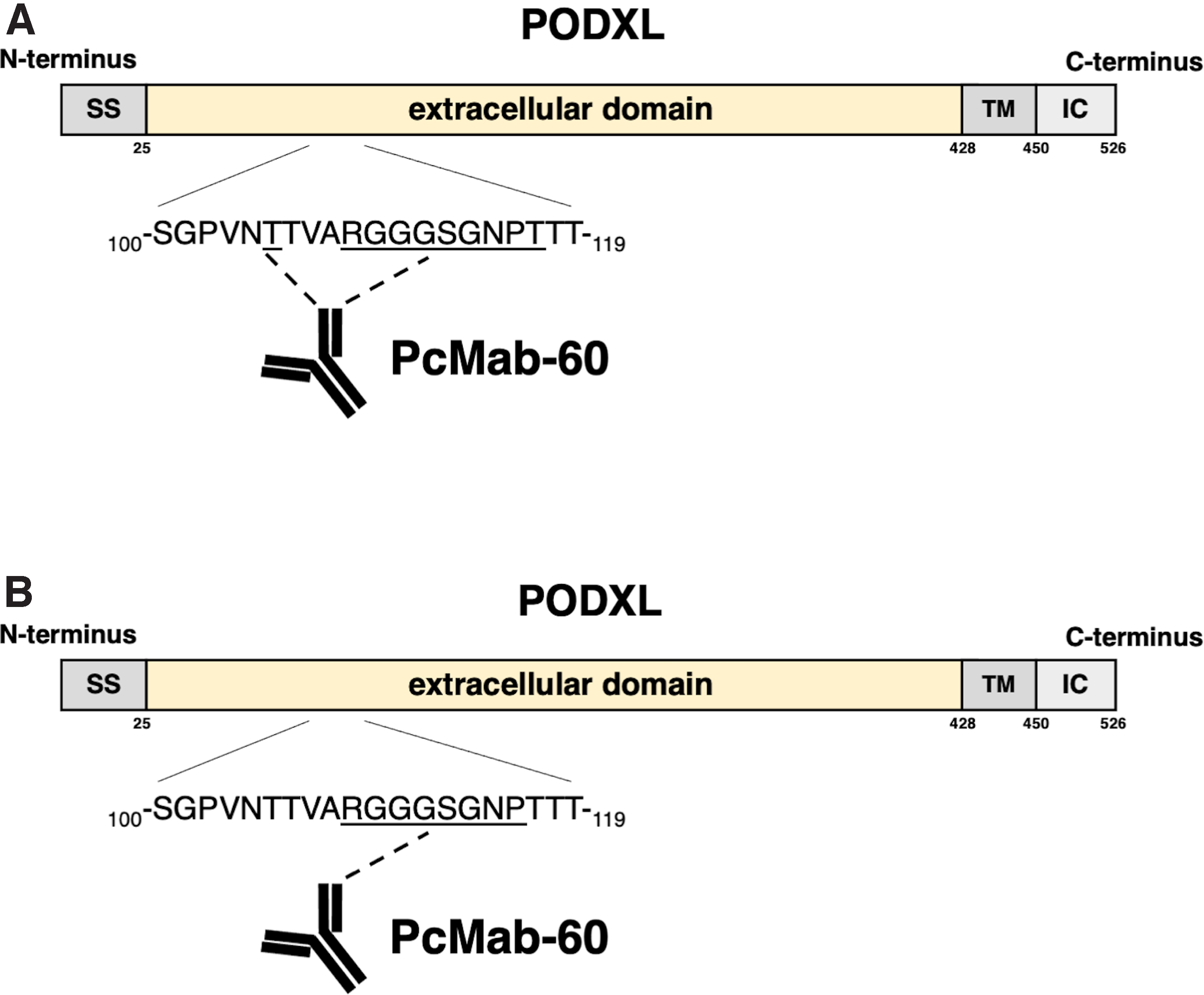
Schematic illustration of PcMab-60 epitope mapping using SPR
Epitope mapping using ELISA
We further evaluated the reactivity of PcMab-60 to the alanine-substituted PODXL peptides using ELISA. PcMab-60 reacted with S100A, G101A, P102A, V103A, N104A, T105A, T106A, V107A, A108G, T117A, T118A, and T119A, but not with R109A, G110A, G111A, G112A, S113A, G114A, N115A, and P116A (Table 3). The results of ELISA indicated that Arg109, Gly110, Gly111, Gly112, Ser113, Gly114, Asn115, and Pro116 are the critical epitope of PcMab-60 (Fig. 2B).
Discussion
In this study, we determined the epitope of PcMab-60 using flow cytometry, SPR, and ELISA. We determined Thr105, Arg109, Gly110, Gly111, Gly112, Ser113, Gly114, Asn115, Pro116, and Thr117 of PODXL as the critical epitope of PcMab-60 using SPR and Arg109, Gly110, Gly111, Gly112, Ser113, Gly114, Asn115, and Pro116 of PODXL as the critical epitope of PcMab-60 using ELISA. The epitope from Arg109 to Pro116 is common in both ELISA and SPR. In contrast, Thr105 and Thr117 are additionally determined in SPR analysis. PcMab-60 was immobilized on a sensor chip in SPR analysis. In contrast, peptides were immobilized on immunoplates in ELISA. Immobilized molecules were different between ELISA and SPR, which may influence the reactivity of PcMab-60 to these peptides.
In our previous study, we successfully developed antipodoplanin CasMabs, including LpMab-2, which specifically recognizes cancer-type podoplanin, but not normal-type podoplanin.(19) LpMab-2 recognized both the Thr55-Leu64 peptide of human podoplanin and cancer-type aberrant glycosylation of Thr55 and/or Ser56, which is well glycosylated in glioblastoma cells.(19) PcMab-60 reacted with PODXL-expressing pancreatic cancer cells, but not with normal cells.(20) In this study, SPR analysis revealed that the PcMab-60 epitope includes Thr105, Ser113, Asn115, and Thr117, which is different from the epitope recognized by previously established anti-PODXL mAb, PcMab-47 (mouse IgG1, kappa). PcMab-47 reacts with Asp207, His208, Leu209, and Met210 and recognizes both normal and cancer-type PODXL.(23) Therefore, the PcMab-60 epitope can be modified by O- and/or N-glycosylation in cells. In this study, we used synthesized peptides (no glycosylation) in SPR and ELISA analysis, which may influence the reactivity of PcMab-60. Further analyses of glycosylation at these sites and of the difference between normal and cancer cells are needed to understand the cancer-specific recognition to PODXL by PcMab-60.
Footnotes
Author Disclosure Statement
No competing financial interests exist.
Funding Information
This research was supported, in part, by Japan Agency for Medical Research and Development (AMED) under Grant Numbers JP21am0401013 (Y.K.), JP21am0101078 (Y.K.), and JP21bm1004001 (Y.K.), and by the Japan Society for the Promotion of Science (JSPS) Grants-in-Aid for Scientific Research (KAKENHI) Grant Numbers 21K15523 (to T.A.), 21K07168 (to M.K.K.), and 19K07705 (to Y.K.).