




Abstract
From February 2006 to January 2007, 150 chickens were collected from eight retail markets in Yaounde, and 90 (60%) tested positive for Salmonella. Seventy-nine chickens were contaminated with only one Salmonella serotype, 10 with two different serotypes, and 1 with four serotypes. The most prevalent serotypes were Enteritidis (47 strains) and Hadar (29 strains). The isolates were tested for their susceptibilities to amoxicillin, amoxicillin/clavulanic acid, cefoxitin, cefotaxime, gentamicin, streptomycin, tetracycline, chloramphenicol, sulfonamides, nalidixic acid, ciprofloxacin, and trimethoprim/sulfamethazole by disk diffusion assay. Minimum inhibitory concentrations of ampicillin, streptomycin, tetracycline, sulfonamides, and nalidixic acid were determined for the resistant strains by agar dilution method. Eleven isolates (10.7%) of the 103 tested were susceptible to all antimicrobials. Resistance was most observed to tetracycline (84.5%), streptomycin (44.7%), and nalidixic acid (34%). Forty-one isolates (39.8%) were multidrug resistant (resistant to three or more antimicrobials from different classes), of which 68.3% were Hadar and 21.9% Enteritidis. The most frequent resistant pattern in Hadar was streptomycin–tetracycline–nalidixic acid. These results highlight once more the need for surveillance of Salmonella contamination in poultry.
Introduction
Nontyphoidal salmonellosis is commonly associated with gastroenteritis in humans. On a global scale, about 1.3 billion cases of acute gastroenteritis are registered each year, resulting in 3 million deaths and a great financial loss. 30 The infection is usually self-limiting, but in some cases it could be serious and requires the use of antimicrobials.5,13
Emergence of antimicrobial resistance within Salmonella is a problem registered worldwide.13,22,33,40 Extensive use of antimicrobials in human and veterinary medicine has led to an increase in multidrug-resistant (MDR) strains. 9 Salmonella may acquire resistance in animals and animal products before transmission to humans through the food chain. 35 Therefore, antimicrobial resistance surveillance is essential in animals and their products to detect changes in the efficiency of drugs, to implement control measures on the use of drugs as growth promoters in animals, and to prevent further spread of MDR strains.
This study was aimed at evaluating the prevalence of Salmonella enterica serotypes in raw chicken meat obtained from retail markets in Yaounde (Cameroon) and at analyzing the level of antimicrobial resistance in these bacterial isolates.
Materials and Methods
Sample collection and bacteriological analysis
Sample collection
Chickens were purchased from the retail markets in Yaounde. Different markets were selected in Yaounde to ensure a complete coverage of all subdivisions (Fig. 1). These markets are the major sites of chicken supply to the local community. Sampling visits were made once a week from February 2006 to January 2007. On each sampling day, one, two, or three chickens were bought in one or two markets and from different sellers. The chickens were bought alive. They were killed, plucked, and eviscerated by sellers. The carcasses were immediately placed in a plastic bag and transported in a cool box to the laboratory, where samples were processed within 1 hour.
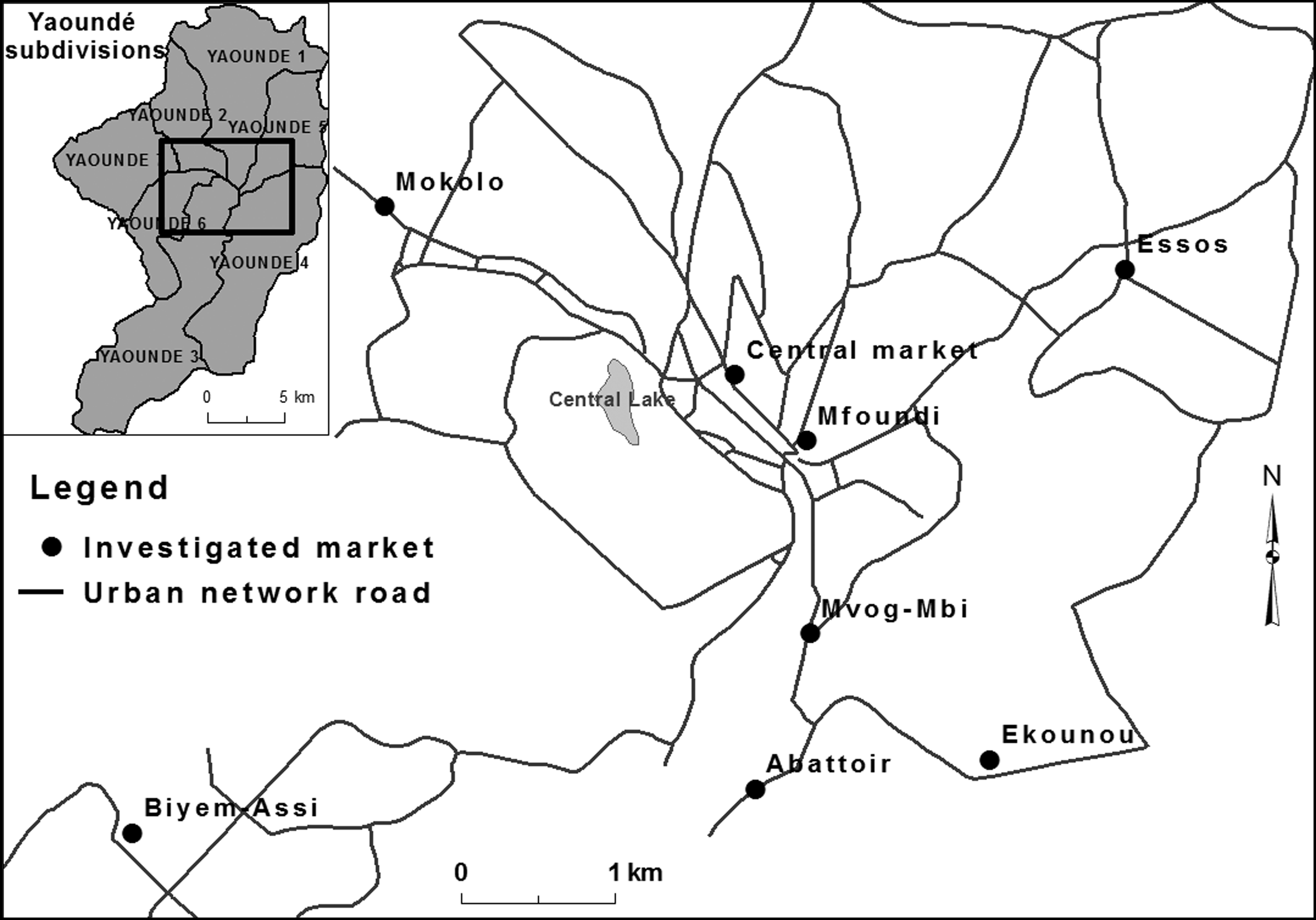
Map of Yaounde showing the investigated markets.
Bacteriological analysis
Salmonella isolation was conducted based on the methods described in the ISO 6579 standard. 20 Briefly, a 10-g portion of each chicken neck skin was introduced into sterile stomacher bags (Seward) containing 90 ml of sterile buffered peptone water, and the mixture was blended for 1 minute and incubated at 37°C for 24 hours. After this preenrichment step, 0.1 ml of the mixture was transferred to 10 ml of Rappaport Vassiliadis broth (Bio-Rad) and incubated at 41°C overnight. A loopful of the overnight enrichment broth was streaked onto Hektoen agar plates and incubated at 37°C for 24 hours. Five presumptive Salmonella colonies from each plate (blue-green colonies with black centers) were biochemically confirmed with the API 20E Strips (BioMerieux) and serotyped with the somatic O and flagella H Salmonella antisera, according to the Kauffman–White scheme.
Antimicrobial susceptibility testing
Antimicrobial susceptibility testing was performed on confirmed Salmonella strains using both the disk diffusion assay and the agar dilution method, in accordance with the guidelines of the Antibiogram Committee of the French Microbiology Society (CA-SFM). 15
Disk diffusion assay
Twelve antimicrobials were tested: amoxicillin (AMX: 25 μg), amoxicillin/clavulanic acid (AMC: 20/10 μg), cefoxitin (FOX: 30 μg), cefotaxime (CTX: 30 μg), gentamicin (GM: 15 μg), streptomycin (S: 10 μg), tetracycline (TE: 30 μg), chloramphenicol (C: 30 μg), sulfonamides (SSS: 200 μg), trimethoprim/sulfamethazole (SXT: 1.25/23.75 μg), nalidixic acid (NA: 30 μg), and ciprofloxacin (CIP: 5 μg) (Bio-Rad Laboratories). Zone sizes around disks were determined with a calibrated measuring device and were interpreted as sensitive, intermediate, or resistant, in accordance with CA-SFM. Escherichia coli ATCC 25922 was used as the quality control strain. The isolates with intermediate zones of resistance were interpreted as resistant; those resistant to three or more antimicrobials from different classes were defined as MDR.
Minimal inhibitory concentration determination
The minimal inhibitory concentrations (MICs) of resistant strains were determined using the twofold dilution method. The antimicrobials selected for the MIC determination were those that showed lowest activity to a high number of strains. Ampicillin (AM) was tested for the strains resistant to AMX; the other antimicrobials tested were S, TE, SSS, and NA. The antimicrobial powders were obtained from Sigma-Aldrich. Ten dilutions were tested for each antimicrobial. Resistance categories were determined according to CA-SFM. The recorded MICs were the lowest concentrations of antimicrobials that inhibited visible growth of the tested strains in standardized conditions.
Results
Eight selected markets were visited during the sampling period (February 2006 to January 2007) for a total of 105 times. A representative map of these markets is shown on Fig. 1. One hundred and fifty chickens were collected and examined for the presence of Salmonella: 4 at the abattoir, 10 at Accacia, 38 at the Central market, 2 at Ekounou, 11 at Essos, 35 at Mfoundi, 39 at mokolo, and 11 at Mvog-Mbi.
Prevalence of Salmonella
Of the 150 chickens tested, 90 (60%) were contaminated with Salmonella. All the sampling markets had Salmonella-contaminated chickens. A total of 103 Salmonella strains were recovered from these chickens with the following serotypes: Enteritidis (47), Hadar (29), Tilburg (4), Mikawasima (3), Bareilly (2), Cleveland (1), Colindale (1), Duesseldorf (1), Eko (1), Gwoza (1), Harburg (1), Hato (1), Hiduddify (1), Liverpool (1), Manhattan (1), Muenster (1), Reading (1), Saintpaul (1), and II (1), and 4 strains were not serotyped with the 87 (36 O, 51 H) antisera available in the laboratory. Of the five colonies picked up after culture on Hektoen plates, repeated serotypes were counted only once. Seventy-nine chickens were contaminated by only one serotype, whereas 10 were contaminated by two different serotypes (Hadar/Enteritidis, 5 chickens; Enteritidis/Bareilly, 1; Enteritidis/Harburg, 1; Duesseldorf/Hiduddify, 1; Manhattan/II, 1; Tilburg/nonserotyped Salmonella, 1). One chicken was contaminated by four different serotypes: Colindale, Muenster, Tilburg, and a nonserotyped Salmonella. The chicken contaminated by four different serotypes was obtained from the Central market. Four chickens out of the 10 contaminated with two serotypes each were bought from the Mokolo market.
Antimicrobial resistance patterns
From the 103 Salmonella isolates tested for their antimicrobial susceptibilities to AMX, AMC, FOX, CTX, GM, S, TE, C, SSS, SXT, NA, and CIP, 11 (10.7%) were susceptible to all antimicrobials. No strain was resistant to FOX, CTX, GM, and CIP. Resistance was most common to TE (84.5%), S (44.7%), and NA (34%) (Fig. 2).
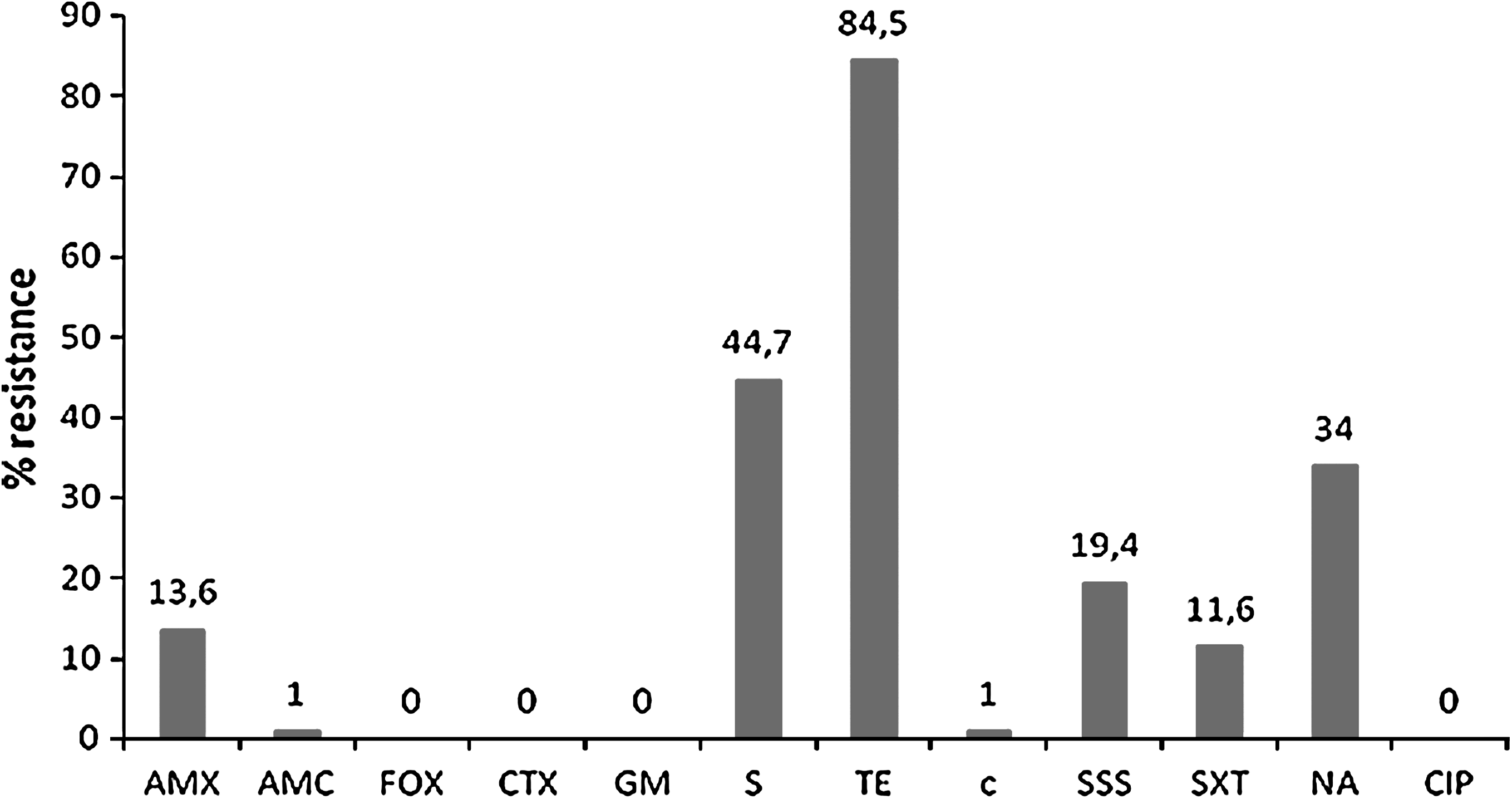
Proportion of resistance in Salmonella isolated from chickens in Yaounde. AMX, amoxicillin; AMC, amoxicillin/clavulanic acid; FOX, cefoxitin; CTX, cefotaxime; GM, gentamicin; S, streptomycin; TE, tetracycline; C, chloramphenicol; SSS, sulfonamides; SXT, trimethoprim/sulfamethazole; NA, nalidixic acid; CIP, ciprofloxacin.
The MIC of AM, S, TE, SSS, and NA determined for the resistant strains confirmed the results of the disk diffusion method. The MIC of AM varied from 32 to 4 μg/ml, with a MIC50 (concentration that inhibited 50% of the strains) of 4 μg/ml; that of S and TE varied, respectively, from 2048 to 4 μg/ml and 256 to 2 μg/ml; the MIC50 of S was 8 μg/ml and that of TE was 256 μg/ml. The MIC values of SSS were very high for all the resistant strains; the lowest value was 2048 μg/ml. For NA, MIC values varied from 32 to 8 μg/ml, with a MIC50 of 32 μg/ml.
The different resistance patterns obtained in these isolates are listed in Table 1. Enteritidis and the nonserotyped strains were mostly resistant to one antimicrobial, commonly TE. Hadar strains were mostly MDR (28 of the 29 isolates, 96.5%). The most common MDR phenotype was S-TE-NA (55.1% of Hadar and 17.5% of all isolates). The second most common MDR phenotype showed additional resistance to SSS and SXT (phenotype S-TE-SSS-SXT-NA); this was observed in 31% of Hadar serotype and 9.7% of all the isolates.
Percent of resistance in the selected serotype.
Percent of resistance in all Salmonella isolates.
AMX, amoxicillin; AMC, amoxicillin/clavulanic acid; C, chloramphenicol; NA, nalidixic acid; S, streptomycin; TE, tetracycline; SSS, sulfonamides; SXT, sulfamethozaxole/trimethoprim.
Discussion
Contamination of poultry by food-borne pathogens is always considered a major health concern in the poultry industry and in humans. This study, aimed at evaluating the prevalence of Salmonella in raw chicken skin in Yaounde, revealed that 60% of the chickens were contaminated with Salmonella. Such high proportions of Salmonella in chickens have been observed in some other developing countries: 68.2% in Ethiopia 36 and 72% in Thailand. 8 Otherwise, less than 50% of chickens contaminated with Salmonella have been reported in some other countries: 32% in Senegal 13 and 39.3% in Brazil. 31 Contamination of chickens with Salmonella can occur at different steps of the chain, including production, distribution, marketing, slaughtering, and processing or transportation. 17 In Cameroon, chicken production is usually carried out in small scale and quite close to residential areas, and there are few industrial farms; hence, the quality of chickens varies a lot, depending on the production conditions. The chickens bought for domestic consumption are generally cleaned in the markets, using the same bath of boiling water to pluck the feathers and the same surfaces for cleaning, all done in the open air. This practice is favorable for cross-contamination between chickens and also contamination from the environment. It is also known that contaminated foodstuffs are sources of kitchenware and surface contamination. 29
In this study, a variety of Salmonella serotypes were isolated, with a high prevalence of Enteritidis (45.6%). Enteritidis is in general the dominant Salmonella serotype isolated in poultry in many countries.2,7,16,18 Hadar, the second most important serotype in this study (28.1%), has also been frequently isolated in chickens.12,13,16,23 Eleven chickens in this study were contaminated by two (10) or four (1) different serotypes; the multicontamination of chickens with Salmonella had been observed in recent studies,9,19 and this highlights the interest of selecting many colonies for identification.
The antimicrobial susceptibility testing showed a good activity of CTX, GM, and CIP on all Salmonella isolates; these drugs, which are important for humans, are not used in veterinary medicine in Cameroon. 26 The results of this study revealed the presence of a significant number of resistant strains, especially to TE (84.5%), and this was mostly observed in Enteritidis. Data from England and Korea in 2002 showed that Enteritidis was less prone to develop multidrug resistance than other serotypes.21,39 All the NA-resistant isolates showed susceptibility to CIP; however, cross-reactions have been described in some countries.32,38 Resistance to AMX, C, and SXT was of great concern as these drugs are commonly used in human medicine and highlights a potential risk of therapeutic failure in human infections. 27 This is further complicated by the fact that the use of antimicrobials is unrestricted in Cameroon and many people practice self-medication with drugs bought from pharmacies from the markets. This study also revealed an important proportion of MDR strains, especially among Hadar isolates, the main resistance phenotype being S-TE-NA (62.3% of Hadar). This profile had been previously described in Senegal, 14 France, 11 and the United States. 28 The observed resistance may have been favored by the continuous use of antimicrobial as growth additives in poultry; nowadays, modern food animal production uses large amounts of antimicrobial agents at subtherapeutic levels for growth promotion and this provides favorable conditions for the persistence and spread of antimicrobial-resistant zoonotic bacteria. Antimicrobial resistance in zoonotic bacteria has affected therapeutic interventions in humans by a possible transfer of resistant strains to humans through food chain, 10 and this could also increase the burden of disease in humans by increasing the morbidity and mortality among cases. 37
In conclusion, this study, the first conducted in Cameroon to the best of our knowledge, provides substantial information about the prevalence and the antimicrobial resistance of Salmonella isolated from raw chickens in Yaounde. Salmonella were found on 60% of studied samples, the most common serotypes being Enteritidis and Hadar. The high prevalence of MDR strains is alarming and may indicate widespread use of antimicrobials in local poultry production or cross-contamination during distribution. The spread of resistant bacteria throughout the human food chain is of great public health concern in Cameroon because the affected drugs are commonly used in human medicine. These results could serve as the basis for a program on Salmonella monitoring and control that might be launched in Cameroon in a near future. These results could also help in the interpretation of resistance trends.
Footnotes
Acknowledgments
This research was supported by the Institute Pasteur Network through an Action Concertée Inter-Pasteurienne fund. The authors thank Mr. Joachim Etouna for help with map drawing and Dr. Anfumbon Kfutwah for help with English correction in the article.
Disclosure Statement
No competing financial interests exist.