




Abstract
The prevalence of Escherichia coli with putative extended-spectrum cephalosporin resistance was assessed in cattle, pigs, broilers, layers, and turkey slaughtered in Poland. The occurrence of random E. coli isolates recovered from MacConkey agar plates with non–wild-type minimal inhibitory concentrations for cefotaxime and ceftazidime reached 0.6% in layers, 2.3% in turkey, and 4.7% in broilers, whereas all cattle and pigs isolates fell into the wild-type subpopulation. The use of MacConkey agar supplemented with cefotaxime (2 mg/L) increased the recovery of resistant strains up to 33.3% of samples from pigs, 42.3% from layers, 48.0% from turkey, and 54.5% from broilers. Still, no cephalosporin-resistant E. coli was found in cattle. E-test identified extended-spectrum beta-lactamase (ESBL) and ampC-type resistance phenotypes in 15 and 33 strains, respectively. Molecular characterization identified CTX-M-1 gene in 13 ESBL strains, 5 of which possessed also TEM-1b. One strain harbored SHV-12 gene. CMY-2 was found in all of 20 tested ampC-type cephalosporinase-positive strains either alone (n = 14) or in combination with mutations in ampC promoter region (n = 6). CTX-M-1 and CMY-2 genes were noted also in five strains from laying hens and broilers originated from Belgium and Germany. Nosocomial infections in Poland are caused by E. coli carrying other determinants than those found in our study. Thus, our results indicate that animals colonized with cephalosporin-resistant strains might not be the major source of human infections in Poland. However, the contribution to community-acquired infections by spread of resistant clones or resistance genes may not be excluded.
Introduction
The study aimed at assessing of the prevalence of ESC resistance and characterization of resistance mechanisms in Escherichia coli isolated from healthy food-producing animals slaughtered in Poland.
Materials and Methods
Sampling and bacteriological examinations
Rectal/cloacal swabs (n = 880) were randomly collected in 2009 during slaughter from cattle, pigs, broilers, turkey, and layers (Fig. 1). In routine antimicrobial resistance monitoring (ARM), the swabs were directly streaked onto McConkey agar. Additionally, 129 of the samples were simultaneously screened on MacConkey agar supplemented with cefotaxime (2 mg/L) as described elsewhere. 16 Colonies showing typical E. coli morphology were confirmed in ONPG and indol tube tests.
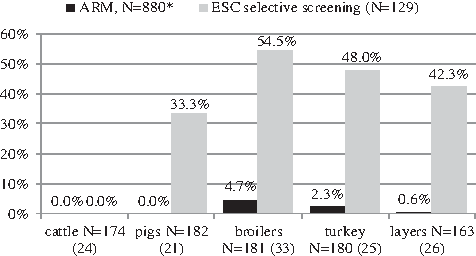
ESC prevalence in Escherichia coli isolated from food animals (digits in brackets stands for number of samples tested with screening method). *Because of random sampling, 2 samples were collected from imported broilers (SK), and 32 laying flocks originated from Belgium (n = 5), Czech Republic (n = 4), Germany (n = 10), Lithuania (n = 1), The Netherlands (n = 4), and Slovak Republic. ESC, extended-spectrum cephalosporin.
Antimicrobial susceptibility testing
Minimum inhibitory concentrations (MICs) were determined using customized Sensititer plates (Trek Diagnostic Systems) and interpreted according epidemiological cutoff values (http://eucast.org) to split bacterial population into wild-type (WT) and non–wild-type (NWT) strains. The latter group was considered to contain a resistance mechanism against the given antimicrobial, thus showing microbiological resistance. Isolates showing NWT MICs to ampicillin (NWT >8 mg/L), ceftazidime (NWT >0.25 mg/L), and cefotaxime (NWT >0.5 mg/L) were screened with E-tests (bioMerieux) to confirm possible ESC and differentiate between ESBL, MBL, and ampC-type phenotypes based on the synergy observed between, respectively, cefotaxime and clavulanic acid, imipenem and EDTA, and cefotetan and cloxacillin. 16
Cephalosporin-resistant strains
A single ESC-resistant strain from each sample was selected for molecular characterization of resistance mechanisms as previously described. 7 Fifteen ESBL-suspected strains were tested by PCR for SHV, TEM, CTX-M-1 group, CTX-M-2 group, and CTX-M-9 group genes. Twenty of 33 isolates showing ampC phenotype were screened for CMY-1 and CMY-2 genes and the ampC promoter was amplified in 14 of these. Sequencing of PCR amplicons was done at Macrogen Corporation and Vector NTI Advance 11 software was used for sequence analysis.
Results
The prevalence of E. coli with NWT MICs for both cephalosporins tested varied between the isolation sources (Fig. 1). Routine monitoring identified 13 ESC-positive samples: three ESBL producers were found in turkeys and ampC phenotype was noted in broilers (n = 8) and single turkey and layers isolates. Another 12 ESBL producers and 23 ampC-type resistances were noted in selective screening of pigs (4 and 3, respectively), layers (5 and 5), turkeys (2 and 6), and broilers (1 and 9). Resistance mechanism identification was in congruence with phenotypic identification (Table 1). CTX-M-1 beta-lactamase (n = 13) and CMY-2 cephalosporinase (n = 20) were most frequently found in some strains accompanied with TEM-1b (n = 5) and ampC mutations (n = 6). A single SHV-12–producing strain was noted and the genetic background of resistance was not identified in another single strain. Interestingly, three CTX-M1 and two CMY-2 producers were found in samples from imported animals. None of the strains was positive for CTX-M-2 group, CTX-M-9 group, or CMY-1.
Strains isolated from flocks imported from Belgium.
Strain isolated from flocks imported from Germany.
ESBL, extended-spectrum beta-lactamase.
Discussion
Our study showed that poultry and pigs might be a reservoir of third-generation cephalosporin-resistant E. coli. Compared with humans mostly colonized with a defined resistant strain,6,11 enteric bacteria in healthy animals constitute of mixed commensal population including a fraction of ESC strains.1,8–10 Previous studies have demonstrated that selective screening is needed for enhanced recovery of such isolates.3,16 Cephalosporin usage may select for higher prevalence of strains with NWT MICs and explain the observed differences in different animal reservoirs.3,10,13
Although we cannot distinctly conclude on the real prevalence of ESC in E. coli, the resistance mechanisms were identified. Like few other studies, ESBL-positive strains were less frequent compared with ampC-type cephalosporinase producers.5,13 In contrast with other studies,5,8,10 no ESC genes were found in cattle isolates. Surprisingly, a low diversity of resistance genes was found, although the strains were obtained over several months from various animal species at random, countrywide settings. Recent ESC studies have revealed a variety of genes present in animal gut flora and the ones found in our study have been already reported in wild, food-producing and companion animals, both in commensal E. coli and clinical cases.1–5,9,10,13 They were often found in associations1,12 including promoter mutations resulting in hyperproduction of chromosomal ampC beta-lactamases.3,12
This is the first study on the genetic background of ESC in commensal E. coli isolated from animals slaughtered in Poland, although numerous reports are available from other countries.1–5,7,9,13 Unsurprisingly, two predominant resistance mechanisms were also found in strains traced back to flocks originating from three other countries.
Animals via contaminated food or direct contact might contribute to human colonization with resistant bacteria. For example, CTX-M-1 beta-lactamase was previously reported in beef and poultry meat in Tunisia and chicken breast in the United Kingdom.8,15 The prevalence of TEM-52 in animals was correlated to human infections in Portugal.2,3 Because of plasmidic location of most of ESC resistance genes, numerous studies relate animal-to-man spread of ESC rather to plasmid transfer than clonal spread of bacteria.1,3,4,9–11 Having the above in mind as well as a variety of genes found in healthy humans,10,14 one may assume that transmission of ESC might occur within the food chain. This scenario may not be confirmed by our findings, supported with public health data on high prevalence of CTX-M-15 and M-3 nosocomial infections. 6 Similar discrepancies between ESC resistance genes found in man and food have been reported by Warren et al. 15
Our report adds new country to the worldwide landscape of ESC occurrence in indicator E. coli isolated from animals. The findings do not support food animals colonized with resistant strains as a major source of human infections, although they might contribute to international spread of resistance mechanisms and compromise animal welfare. At some point it might also challenge human health precisely with respect to community-acquired infections with ESC bacteria. This issue could be verified by simultaneous survey of animals, foods, and nondiseased individuals representative of the community.
Footnotes
Acknowledgments
The work at NVRI was supported by governmental funding of “Protection of animal and human health” (Ministry of Council Resolution No. 244/2008). Part of the research was performed at the EURL-AR at the National Food Institute in Copenhagen. The authors thank Lisbeth Andersen, Danuta Wnuk, and Anna Lalak for excellent technical assistance.
Disclosure Statement
No competing interests exist.