




Abstract
Extended-spectrum β-lactamases (ESBL) are plasmid-mediated enzymes that hydrolyze cephalosporins and monobactams. The lack of a standard method to detect ESBL in Enterobacter spp. has led to underestimating its frequency. The aim of this study was to evaluate ESBL detection in Enterobacter spp. By the double-disk synergy test (DDST) and combined disk test (CDT) assay using cefepime, cefotaxime, and ceftazime as substrates for ESBL, plus AmpC inhibitors in different associations. A total of 83 Enterobacter spp. ESBL and 31 non-ESBL Enterobacter spp. were tested, and a cutoff point ≥3 mm was defined using a receiver operating characteristic (ROC) curve for combined disc methods. All tests showed 100% specificity. The sensitivity was 89.2% for DDST and CDT without AmpC inibitor, 90.4% in the combined disc test in Mueller–Hinton agar containing phenylboronic acid (CDT-PBAA), and 94% in the combined disc test in Mueller–Hinton agar containing cloxacillin (CDT-CLXA). Cefepime was the best substrate, mainly when AmpC inhibitors were not used. However, superior results were achieved when all cephalosporins were evaluated together. In conclusion, to improve ESBL detection in Enterobacter spp., some modifications in phenotypic tests are needed, such as to reduce the distance between the discs to 20 mm in DDST, to use a cutoff point for ≥3 mm on the CDT, and to include a cefepime disk or an inhibitor of AmpC in all tests.
Introduction
Several different methods for ESBL detection in Klebsiella pneumoniae and Escherichia coli have been described, based on ESBL inhibition by clavulanate. 4 However, ESBLs are more difficult to detect in species that have AmpC chromosomal enzymes, such as Enterobacter spp. because these enzymes are induced by clavulanate and may mask the ESBL inhibition in these tests. 6 The lack of a standard methodology, approved by international official committees, may have led to the presence of ESBL in Enterobacter spp. being underestimated. This fact may contribute to the rapid dissemination of ESBL-producing organisms, because the presence of ESBL requires specific infection control measures that are not implemented when this transmissible mechanism of resistance is not reported. Moreover, patients harboring ESBL-producing organisms are successfully treated with carbapenems rather than fourth-generation cephalosporin, such as cefepime (FEP). 5 Some studies using ESBL-producing Klebsiella spp. and E. coli have shown that inappropriate therapy is the main cause of mortality in patients with these infections.18,21 Although reports assessing the impact of Enterobacter spp. infections are scarce, it has been described that treatment with carbapenems reduces mortality. 17
There are several strategies to improve the sensitivity of ESBL detection in Enterobacter spp. For example, FEP can be added to tests, because it is a poor substrate for AmpC, but is hydrolyzed by ESBL. The inclusion of AmpC inhibitors into the agar or in discs associated with clavulanic acid (CA) to inhibit AmpC and allow ESBL-detection in these species is also a possible alternative to improve the sensitivity. 6
In this study, six different phenotypic tests were evaluated regarding their sensitivity and specificity to detect ESBL production among Enterobacter spp. isolates.
Materials and Methods
Bacterial strains
A total of 114 isolates of Enterobacter spp., 83 ESBL-producing Enterobacter spp. and 31 non-ESBL-producing, collected between 2005 and 2008 from inpatients (one strain per patient) admitted to the Clinics Hospital at the Federal University of Paraná (HC/UFPR, Curitiba, South Brazil), were studied. Species identification and sensitivity tests were carried out using VITEK standard identification cards (bioMérieux, Hazelwood, MO). The Enterobacter spp. strains that have shown ceftazidime (CAZ) or cefotaxime (CTX) minimal inhibitory concentration (MIC) >1 μg/mL 3 were tested for ESBL genes by PCR and sequencing using previously described primers (blaTEM, blaSHV, blaCTX-M, blaGES, blaBES, blaOXA).1,15,16,19,22,23 The following controls E. coli RJ-15317 (blaCTX-M-2), E. cloacae PR-532 (blaPER-2), K. pneumoniae SP1 (blaTEM-3), and K. pneumoniae SP2 (blaSHV-5) were also run simultaneously. ESBL-positive strains were defined based on their genotype(s) obtained by PCR and sequencing. The ESBL genotypes obtained were: blaCTX-M-2 (64 isolates), blaSHV-12 (4 isolates); blaCTX-M-1, blaCTX-M-9 (2 isolates each); blaSHV-27; blaPER-2 and blaTEM-136 (1 isolate each); blaCTX-M-2 plus blaSHV-12 (4 isolates); blaCTX-M-2 plus blaCTX-M-9; blaCTX-M-2 plus blaSHV-5; blaCTX-M-9 plus blaSHV-5; blaCTX-M-9 plus blaSHV-12 (1 isolate each). All strains included in the study (ESBL positive and ESBL negative) revealed AmpC expression as detected by combined disc test (CDT) using phenylboronic acid (PBA; 300 μg) and cloxacillin (CLX; 500 μg) added to CAZ and CTX, using as criteria, the increasing of an inhibition zone >4 mm with PBA or CLX.
Tests for ESBL detection
Six different disc diffusion methods were all performed according to the Clinical and Laboratory Standards Institute (CLSI) guidelines for the disc diffusion susceptibility method. 2 All tests were performed in Mueller—Hinton agar (OXOID, Basingstoke, UK) using CAZ (30 μg), CTX (30 μg), and FEP (30 μg) (OXOID, Basingstoke, UK) discs.
Double-disk synergy test (DDST)
Cephalosporin discs were placed 20 mm away from an amoxicillin-CA disc (OXOID, Basingstoke, UK). Any increase or distortion of the inhibition zone was considered a positive result. 9
Combined disc test (CDT)
Each cephalosporin was tested alone and combined with 10 μg of CA (Sigma-Aldrich, St. Louis, MO).
Combined disc test associated with PBA on the disc (CDT-PBAD)
Each cephalosporin was tested combined with 300 μg of PBA and with PBA plus CA.
Combined disc test with CLX on the disc (CDT-CLXD)
Each cephalosporin was tested combined with 500 μg of CLX and with CLX plus CA.
Combined disc test in Mueller–Hinton agar containing PBA (CDT-PBAA)
This was a combined disc test, except that it is performed in Mueller–Hinton agar with the addition of PBA (300 μg/ml) (Sigma-Aldrich, St. Louis, MO).
Combined disc test in Mueller–Hinton agar containing CLX (CDT-CLXA)
This was a combined disc test, except that it is performed in Mueller–Hinton agar added with CLX (300 μg/mL) (Sigma-Aldrich, St. Louis, MO). The difference of the inhibition zone obtained with cephalosporin alone and the two discs combination was evaluated in all combined disc tests.
Statistical analyses
To determine the cutoff points that are associated with positive results for ESBL in all CDTs, receiver operating characteristic curves (ROC) were adjusted considering the presence of genes coding for ESBL production as the gold standard. This analysis was made for each method and each antibiotic. To define the cutoff, the area under the curve (AUC) was calculated, and the null hypothesis was defined as the AUC equal to 0.5 (no discrimination marker). To define the best markers (antibiotic and methods) for all tests (including DDST), sensitivity and specificity were estimated with corresponding 95% confidence. The analysis was done using the computer program SPSS v.14.0
Results
Fifteen test and substrate combinations assayed were analyzed by ROC curves. Nine of them presented the largest AUC with a cutoff ≥3 mm, whereas the remaining six showed the largest area under curve with a cutoff ≥1 mm. A specificity of 100% was obtained using a cutoff ≥3 mm for all tests, so the cutoff point ≥3 mm was chosen as appropriate for all tests. The sensitivity of each test analyzed in comparison to each antibiotic individually or analyzed with the results of all antibiotics together (indicated by “all”) is shown in Table 1. An illustration of all different phenotypic methods assayed can be seen in Fig. 1.
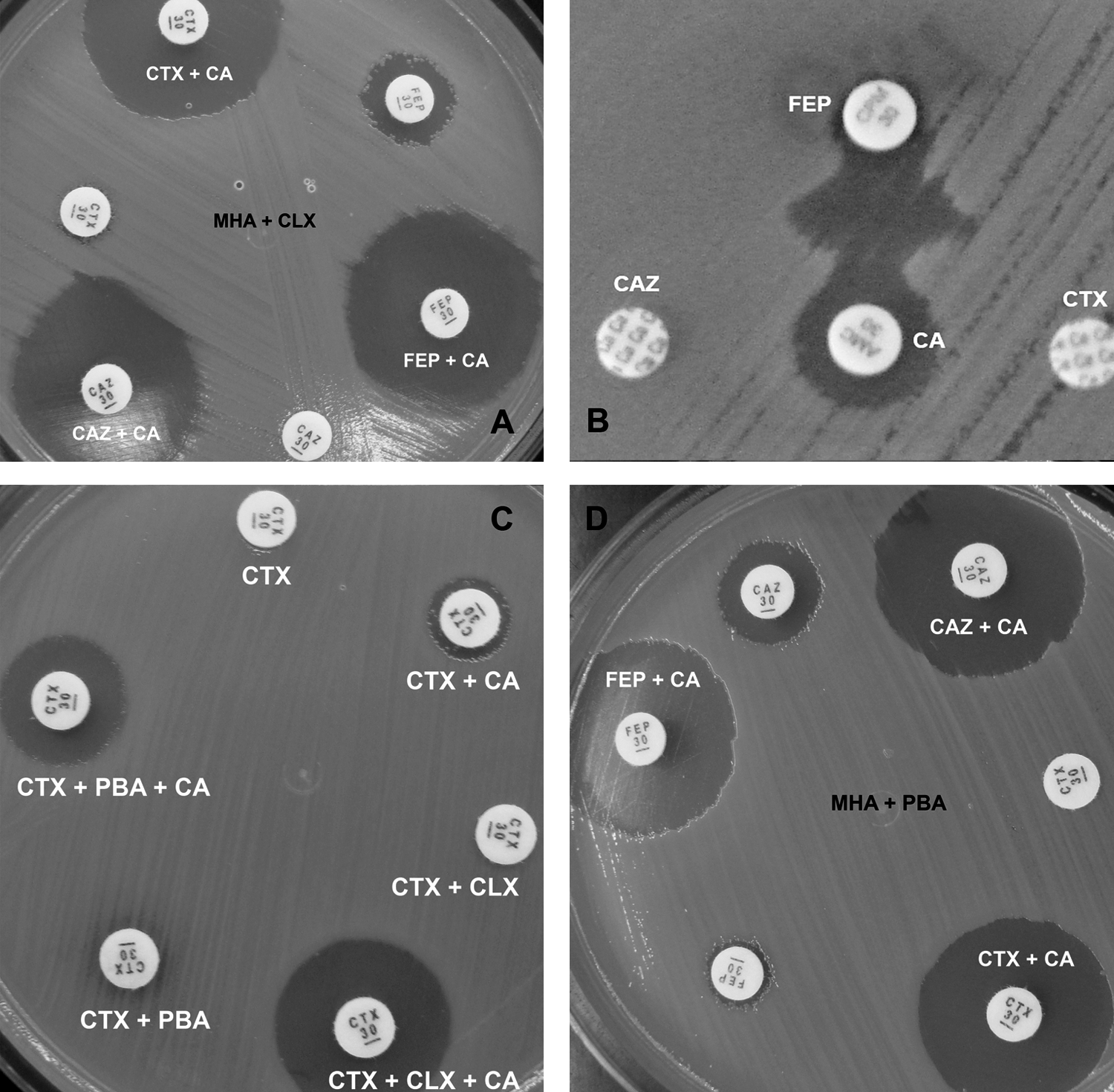
Methods for detection of extended-spectrum β-lactamases (ESBL) evaluated in this study. (
A cutoff of ≥3 mm was used in all disk tests. Because the specificity of all tests was 100% (0/31 negative isolates showed positive results), the specificity results were not shown in the table.
CTX, cefotaxime; CAZ, ceftazidime, FEP, cefepime; CLX, cloxacillin; APB, Phenylboronic acid; CA, clavulanic acid; MHA, Mueller–Hinton agar; CI, confidence interval; DDST, double-disk synergy test; CDT, combined disk CA; CDT-CLXD, combined disk CA+CLX; CDT-PBAD, combined disk CA+PBA; CDT-CLXA, combined disk MHA+CLX; CDT-PBAA, combined disk MHA+PBA.
When the species were evaluated individually, using the cutoff point ≥3 mm, all tests showed a higher sensitivity for Enterobacter aerogenes than for E. cloacae. There were also differences among the tests for ESBL detection according to the type of β-lactamase produced. Generally the detection of CTX-M revealed a higher sensitivity than the detection of TEM, SHV, and PER ESBL groups. In tests that employ AmpC inhibitors, CTX was the best substrate to detect CTX-M ESBL; on the other hand it was equivalent to CAZ in detecting other types of ESBL (TEM, SHV, and PER). Table 2 presents the combined disk test in agar containing CLX (the best sensitivity method) according to species and ESBL types.
The values were obtained using a cutoff of ≥3 mm. The specificity was 100% for all tests.
CTX, cefotaxime; CAZ, ceftazidime; FEP, cefepime; ESBL, extended-spectrum β-lactamases.
FEP can be used as a marker for the presence of ESBL in Enterobacter spp. in disk tests without AmpC inhibitor. A cutoff point of ≥21 mm has presented 100% sensitivity and 82.9% specificity.
Discussion
The most commonly used disk tests to detect ESBL in Klebsiella spp. and E. coli are the DDST and CDT, using CAZ, CTX, and sometimes, cefpodoxime as the substrate. These two methods can have their sensitivity improved for detection of ESBL in Enterobacter spp. by applying minor changes, such as the inclusion of FEP in the tests. The use of FEP as the substrate for detection of ESBL in AmpC producer species such as Enterobacter spp. has already been reported by different groups, 7 as well as other methods, including Etest® 12 and broth dilution. 10 FEP can also be used as a substrate in screening tests for the presence of ESBL in these species during antimicrobial susceptibility tests. 6 In this study, when no AmpC inhibitors were added to cephalosporin discs or Mueller–Hinton agar, the sensitivity of the DDST and CDT tests using FEP was 30.7% and 9.2% higher than using CTX, respectively. The difference in the sensitivity of the same tests (DDST and CDT) using FEP was even higher if the comparison is made with CAZ, mainly due to the predominance of CTX-M producers among the strains studied.
Other approaches to improve ESBL detection in Enterobacter spp. were the modification of the distance between the disks in the DDST and the use of a lower cutoff point in CDT (≥3 instead of ≥5 mm). The modification of the DDST has been described by Pitout et al. when Enterobacter spp. producing TEM and SHV ESBLs were evaluated, 14 and the change of the cutoff for CDT was suggested by Towne et al. 20 when Enterobacter spp. producing ESBL SHV-12 were evaluated. These modifications are simple, can be easily performed, and in this study achieved 100% specificity and 89.2% of sensitivity when the three cephalosporins discs were used together. Thus, most of the strains of Enterobacter spp. ESBL producers can be correctly identified, thus preventing their spread and inappropiate therapy.
The results of tests for ESBL detection using AmpC inhibitors showed higher sensitivity when the inhibitors were added to Mueller–Hinton agar than when they were added to cephalosporin discs. The addition of inhibitors to the disc did not improve test sensitivity when CAZ, CTX, and FEP were analyzed together and compared with the conventional CDT (without AmpC inhibitor). This may be explained by interference in the diffusion, due to the large amounts of substances added (cephalosporins plus CA plus PBA or CLX) to the same disk, which could not be properly absorbed.
On the other hand, the addition of inhibitors in the agar achieved the desired effect. The CDT in agar with PBA showed 90.2% sensitivity when the three cephalosporins were evaluated together. Meanwhile, the CDT in agar containing CLX yielded a sensitivity of 94%.
In a report conducted by Jeong at al., 11 which included 31 isolates of Enterobacter spp., they found different results when boronic acid (BA) was included in the disk. The study shows the sensitivity of 95% using a cutoff ≥5 mm. The main differences between the two studies (Jeong study and the present study) were the types of ESBL produced by the isolates. In the Jeong study, 11 the number of strains of each type of ESBL produced were SHV (25), TEM (21), CTX (8), and CTX + SHV (7) and in the present study were CTX-M (69), SHV (5), TEM (1), PER (1), and CTX-M + SHV (7). Apart from that, the BA concentration was higher (400 μg/mL) than the concentration used in this study (300 μg/mL), which was sufficient to inhibit the AmpC production.
The method that achieved the best result in this study was CDT in agar containing CLX. Some authors have recommended the addition of AmpC inhibitors to conventional tests to improve ESBL detection in Enterobacter spp. 10 When inhibitors of AmpC were included in the agar, the advantage obtained using FEP to detect ESBL in Enterobacter spp. decreased or sometimes disappeared. In these cases, CTX was the best substrate. The predominance of the CTX-M ESBL type in the strains studied may be the reason for CTX performance.
The evaluation of the tests for each species showed that the sensibility to detection of ESBL was higher for E. gergoviae and E. aerogenes than for E. cloacae. This result was observed in all methods (data not show). The AmpC hyperproduction is usually more stable in E. cloacae than in other Enterobacter species, 8 and the higher resistance to cephalosporins observed in the E. cloacae strains used in these tests can explain the higher interference in ESBL detection.
The detection of CTX-M type ESBL showed better results than the detection of other ESBL types in all methods (data not shown). More studies including equal number of strains containing each type of ESBL are necessary to evaluate if this difference is consistent, because the number of CTX-M type ESBL in this study was larger than the strains with other ESBL types. A recent study performed only with Enterobacter spp., SHV-12 producers, found a sensitivity of 88% in detecting these samples using CDT. 20
It was observed that CTX was the best substrate to detect CTX-M, whereas CAZ proved to be the best substrate to detect other ESBLs. This reinforces the importance of using at least two cephalosporins to detect all types of ESBL, because the preferred substrates for enzymes differ significantly. 4 The inclusion of FEP improved detection of AmpC producers, especially when AmpC inhibitors are not included in the test.
The phenotypic detection of ESBL in Enterobacter spp. is possible; however, some modifications in the conventional tests used for Klebsiella spp. and E. coli should be employed, such as a reduction to 20 mm in the distance between discs in DDST, using a cutoff point of ≥3 mm on CDT, and inclusion of a FEP disc or an inhibitor of AmpC in the tests. The best results were obtained with the CDT conducted in Mueller–Hinton agar containing CLX. Using these modifications, sensitivity and specificity can be improved, thus providing a more accurate detection of ESBL-producing organisms and a more effective treatment modality.
Footnotes
Acknowledgments
We would like to thanks Dr. Jorge Luiz Mello Sampaio and Dr. Ana Cristina Gales for providing control strains.
Disclosure Statement
The authors report no conflicts of interest.