




Abstract
This study concerned the occurrence of fecal bacteria with plasmid-mediated quinolone resistance (PMQR) genes in rooks (Corvus frugilegus, medium-sized corvid birds) wintering in continental Europe during winter 2010/2011. Samples of fresh rook feces were taken by cotton swabs at nine roosting places in eight European countries. Samples were transported to one laboratory and placed in buffered peptone water (BPW). The samples from BPW were enriched and subcultivated onto MacConkey agar (MCA) supplemented with ciprofloxacin (0.06 mg/L) to isolate fluoroquinolone-resistant bacteria. DNA was isolated from smears of bacterial colonies growing on MCA and tested by PCR for PMQR genes aac(6′)-Ib, qepA, qnrA, qnrB, qnrC, qnrD, qnrS, and oqxAB. All the PCR products were further analyzed by sequencing. Ciprofloxacin-resistant bacteria were isolated from 37% (392 positive/1,073 examined) of samples. Frequencies of samples with ciprofloxacin-resistant isolates ranged significantly from 3% to 92% in different countries. The qnrS1 gene was found in 154 samples and qnrS2 in 2 samples. The gene aac(6′)-Ib-cr was found in 16 samples. Thirteen samples were positive for qnrB genes in variants qnrB6 (one sample), qnrB18 (one), qnrB19 (one), qnrB29 (one), and qnrB49 (new variant) (one). Both the qnrD and oqxAB genes were detected in six samples. The genes qnrA, qnrC, and qepA were not found. Wintering omnivorous rooks in Europe were commonly colonized by bacteria supposedly Enterobacteriaceae with PMQR genes. Rooks may disseminate these epidemiologically important bacteria over long distances and pose a risk for environmental contamination.
Introduction
Wild bird populations sympatric to areas inhabited by people and areas with high density of livestock have been colonized with antibiotic-resistant strains that probably have been selected by antibiotic practice in humans and domestic animals. Antibiotic-resistant Escherichia coli isolates have been found in various corvids, including rooks (Corvus corone, C. frugilegus, C. macrorhynchos, Pica pica, and Pyrrhocorax pyrrhocorax).3,27,28,32,41 Corvids and gulls feeding on garbage dumps in urbanized areas are frequently colonized with antibiotic-resistant strains of E. coli and they are considered to be important reservoirs and vectors of these isolates in the environment.
The rook (Corvus frugilegus) is a migrating omnivorous corvid with Palearctic distribution. 12 Large numbers of these birds regularly winter in central and western Europe. Rooks winter mostly in lowlands and they traditionally keep gregarious roosting places. Rooks leave their roosting places during the day to search for food, usually within 10–25 km around their roosting places. In the past, rooks migrated for the winter so far as to such south European countries as Italy and Spain.4,39 Today, wintering rooks are rare in Italy and only a small sedentary population of rooks winters in Spain. The origin of those rooks wintering still in huge numbers in both central and western parts of continental Europe is mostly in eastern Europe—Russia, Belorussia, and Ukraine. Wintering rooks in central Europe can serve as reservoirs and vectors of E. coli and Salmonella isolates resistant to old-generation antibiotics and potentially can transmit these isolates over long distances during their migrations. 27
This study concerned bacterial strains resistant to fluoroquinolones, as such strains have emerged recently in gulls in Italy, Portugal, Greenland, and the Czech Republic.5,10,15,42 PMQR in E. coli isolates from wild birds has been reported very recently for mallards (Anas platyrhynchos), herring gulls (Larus argentatus), and great cormorants (Phalacrocorax carbo) in Poland and Czech Republic.26,45 Given the scavenging diet of rooks in winter and the long distances traveled, it may be postulated that rooks could be important vectors for disseminating bacteria with PMQR throughout Europe.
Materials and Methods
Rooks examined
Samples of rook feces were taken in roosting places throughout Europe during winter 2010/2011, except for France, where samples were collected on 8 April 2011 (Fig. 1). The roosts were used by hundreds or thousands of rooks together with various numbers of other corvids, such as jackdaws (C. monedula) or crows (C. corone and C. cornix). Fecal samples were collected at each location only once. They were picked up individually in the morning from a large plastic film exposed overnight on the ground beneath the roosting place. Rooks were dropping on the film during the evening when they arrived to the roosting place and in early morning when leaving the location. Samples were collected in the Czech Republic (Prerov, 49°28′ N, 17°27′ E, 12 December 2010, 150 samples), France (Pire sur Seiche, 48°00′ N, 1°25′ W, 8 April 2011, 31 samples), Germany (Wilhelmshaven, 53°32′ N, 8°04′ E, 5 February 2011, 100 samples), Italy (San Benedetto Po, 45°2′ N, 10°55′ E, 27 February 2011, 150 samples), Poland (Gdynia and near vicinity, 54°31′ N, 18°33′ E, 2–7 February 2011, 150 samples), Poland (Jaroslaw, 50°00′ N, 22°41′ E, 9 February 2011, 150 samples), Spain (La Baneza, 42°18′ N, 5°54′ W, 4 February 2011, 150 samples, sedentary population), Serbia (Novi Sad, 45°14′ N, 19°51′ E, 17 January 2011, 150 samples), and Switzerland (Bern, 46°56′ N, 7°26′ E, 8 February 2011, 49 samples).
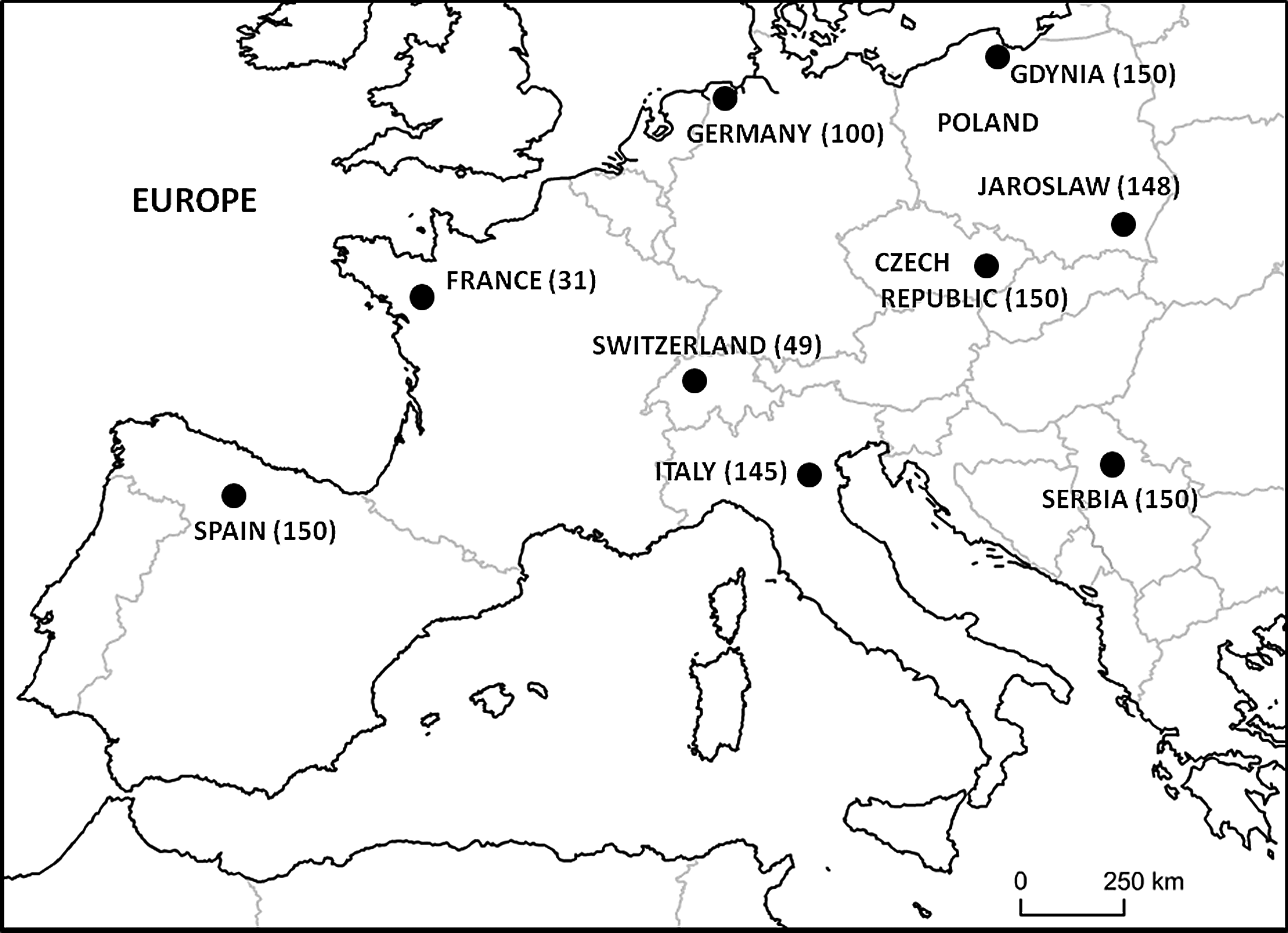
Map of Europe indicating where fecal samples from rooks (Corvus frugilegus) were collected during winter 2010/2011. Full circles indicate locations of sampling. At each location, the number of samples collected is presented in parentheses.
Bacteriological examinations and DNA analyses for detecting PMQR
Samples from fresh feces were taken by cotton swabs that were then transported in Amies transport medium to the laboratory and pre-enriched overnight in buffered peptone water (BPW) at 37°C. The samples from BPW were selectively enriched in MacConkey broth and subcultivated onto MacConkey agar (MCA) supplemented with ciprofloxacin (0.06 mg/L) to isolate fluoroquinolone-resistant enterobacteria.
DNA was isolated from smears of bacterial colonies growing on MCA with ciprofloxacin (one smear from one rook sample). The DNA from these colonies was tested by PCR for PMQR genes aac(6′)-Ib, qepA, qnrA, qnrB, qnrC, qnrD, qnrS, and oqxAB (Table 1).7,9,23,24,35,36,38,47 All the PCR products were further analyzed by sequencing (ABI 310 Genetic Analyzer, Applied Biosystems).
In each case of a sample where new variants of PMQR genes might possibly appear, a smear of unidentified bacteria from each sample was frozen at −80°C for later bacterial species determination. In such case, the bacteria were cultivated on MCA supplemented with ciprofloxacin (0.06 mg/L) and subsequently identified using the API 20E system (bioMerieux).
Results
In total, 1,073 samples of rook feces were collected. Ciprofloxacin-resistant bacteria supposedly Enterobacteriaceae were isolated from 392 (37%) samples (Table 2). Proportions of samples with bacteria resistant to ciprofloxacin ranged greatly—from 3% to 92%—in the different countries. The highest frequencies of ciprofloxacin-resistant Enterobacteriaceae bacteria of 92%, 69%, and 41% were found in the Czech Republic and the two locations in Poland, respectively. Numbers of samples with PMQR genes ranged from 0% to 60% in different countries and the highest frequencies of 60%, 27%, and 14% were again in the Czech Republic and the two locations in Poland, respectively.
The most numerous gene qnrS was found in 156 samples originating mainly from the Czech Republic and Poland. Sequence analysis of the qnrS genes showed the presence of two variants, qnrS1 and qnrS2. The gene qnrS1 occurred most frequently and was found in 154 samples, while qnrS2 was identified in two samples.
The fluoroquinolone-aminoglycoside resistance gene aac(6′)-Ib-cr was the gene second most frequently detected in rook feces. It was found in 16 (1.5%) samples. The aac(6′)-Ib-cr-positive samples originated mainly from the Czech Republic (eight samples) and Germany (seven). Thirteen samples were positive for the qnrB genes. These samples originated from the Czech Republic, Poland, and Italy. The qnrB genes were identified as the qnrB6 (one sample), qnrB18 (one), qnrB19 (nine), and qnrB29 (one) variants. A new variant of the qnrB gene was found in one sample. The nucleotide sequence of this gene was compared with other qnrB genes available in the GenBank database using BLAST sequence analysis (http://blast.ncbi.nlm.nih.gov/Blast.cgi). The new gene variant differed from the qnrB20 in two nucleotides (GenBank Accession No. AB379831), meaning one amino acid substitution (Ala156Thr). The new variant was classified as qnrB49. The full sequence of this gene is included in GenBank under the accession number JQ582718. Retrospective analysis of the sample positive for the qnrB new variant showed this new variant to be present in two isolates of Citrobacter freundii isolated from a rook fecal sample collected in San Benedetto Po, Italy, on 27 February 2011.
Both the genes qnrD and oqxAB were detected in six (0.6%) different samples, four of which were collected in the Czech Republic. The genes qnrA, qnrC, and qepA were not detected in any rook fecal sample.
Discussion
In 2003, a single clone of Shigella flexneri was found to be resistant to ciprofloxacin and this strain was also harboring a unique conjugative plasmid that transferred quinolone resistance. 16 Cloning identified an open reading frame encoding a 218-amino-acid protein of the pentapeptide repeat family that was named QnrS (the gene is named qnrS1). A qnrS variant, qnrS2, was detected on a plasmid from Salmonella enterica serovar Anatum. 14 The qnrS gene has been identified as the most prevalent PMQR gene. 25 This gene has been detected in quinolone-resistant human, poultry, and swine E. coli and Salmonella isolates.8,18,48 The qnrS1 gene was predominant in the fecal bacteria from rooks throughout Europe. Rooks excreted feces with these bacteria commonly in the Czech Republic, both Polish locations, Spain, Serbia, and Germany. We consider that the sources of these bacteria could be food animals and their products and/or excrements because Salmonella and/or E. coli isolates with the qnrS1 gene were found recently in food and turkeys in Germany; in cattle, pigs, chickens, and turkeys in Poland; in sheep in Italy; and in chickens in Spain. 46 The qnrS1 gene was predominant among the qnr genes found in S. enterica and E. coli isolates from animals, humans, food, and the environment in 13 European countries, 46 and these findings accord with the result in rooks.
Two samples of rook feces obtained in the Czech Republic were positive for the qnrS2 gene. This gene has been detected recently in Aeromonas spp. isolates recovered from diseased fish and water environments in different parts of Asia and in Switzerland, as well as from human clinical isolates in Spain.1,6,30,37 The gene qnrS2 has been found also in clinical isolates of Salmonella in Japan. 44 We report the qnrS2 gene in bacteria from wild birds for the first time.
The spectrum of qnrB genes is broader than those of qnrA and qnrS. 43 While studying strains of Klebsiella pneumoniae, Jacoby et al. 22 found the PMQR gene qnrB1. A number of other variants (from qnrB2 to qnrB48) were found subsequently among various Enterobacteriaceae (www.lahey.org/qnrstudies, accessed 13 February 2012). From all the qnrB genes, qnrB19 was predominant in the fecal bacteria obtained from rook feces. This gene has very recently been demonstrated to be prevalent in Enterobacteriaceae from food-producing animals in different parts of Europe and in Nigeria, from humans in South America and the Netherlands, and from horses in the Czech Republic.11,13,19,34,46 It seems that the frequency of the qnrB19 gene in rooks reflects the general situation in domestic animals and humans in Europe.
Moreover, the genes qnrB6, qnrB18, and qnrB29 were present in rook samples obtained from the Czech Republic and Poland. The gene qnrB6 has been detected mainly in clinical isolates of Enterobacteriaceae bacteria in China and Spain, in isolates obtained from dogs and ducks, and from the environment in China.29,40,49,50 Until now, the genes qnrB18 and qnrB29 had been found only in Citrobacter freundii isolates in Spain and Korea (GenBank Accession No. AM919399; GenBank Accession No. HM439649). Our rare findings of these genes provide the first evidence of their occurrence in European wildlife.
Six variants of qnrB (qnrB2, qnrB4, qnrB6, qnrB7, qnrB12, and qnrB19) were recently identified among PMQR Salmonella and/or E. coli isolates from Germany, Poland, and Spain. 46 Most of the qnrB-positive isolates in that study originated from turkeys. Hence, turkeys should be considered an important source for rooks of fecal bacteria carrying qnrB genes.
The new variant of the qnrB gene was found in Citrobacter freundii from a rook in Italy. Most known variants of the qnrB gene have been discovered from Citrobacter freundii, a potential reservoir for new variants of this gene. 21
Another gene, designated qnrD, was found in S. enterica isolates, and it was transferable on small plasmids of about 4.3 kb. 9 This gene encodes a 214-amino-acid pentapeptide repeat protein designated QnrD. Six samples of rook feces obtained in the Czech Republic and Poland were positive for qnrD. This gene was recently identified in PMQR Salmonella isolates from Italy and Spain. 46 Most of the qnrD-positive isolates in that study originated from laying hens in Spain, while some isolates with the qnrD gene originated from chickens, turkeys, and food in Italy. Hence, chickens and turkeys should be considered as sources of fecal bacteria carrying qnrD genes found in rooks. In addition, qnrD has been detected in E. coli isolates obtained from pigs in China and in clinical isolates of Proteus and Pseudomonas in Nigeria.33,49
An additional important PMQR gene is aac(6′)-Ib-cr. It encodes a specific aminoglycoside acetyltransferase, AAC(6′)-Ib-cr, that confers increase of minimum inhibitory concentration selectively for norfloxacin and ciprofloxacin. 38 The gene aac(6′)-Ib-cr, like its parent aac(6′)-Ib, is an integron cassette with an associated attC site. It is hence found in various integrons, but especially on IncFII plasmids expressing CTX-M-15 that have spread rapidly such that CTX-M-15 has become the predominant extended-spectrum beta-lactamase in many countries throughout the world. The gene aac(6′)-Ib-cr has been associated with other PMQR genes and with other beta-lactamases. In our study, aac(6′)-Ib-cr was the gene second most frequently detected in rook feces and mainly among those obtained in the Czech Republic and Germany. In a contrast to our study, the aac(6′)-Ib-cr gene has only exceptionally been identified in PMQR Enterobacteriaceae bacteria in Europe. 46
The plasmid-mediated quinolone transporter OqxAB was found in several samples. OqxAB is a multidrug efflux pump that confers resistance to quinolone, quinoxaline, and other agents, including chloramphenicol. Plasmid-mediated OqxAB has been detected in human clinical E. coli and the oqxAB gene was also found on the chromosome of K. pneumoniae. 24 Moreover, the oqxAB gene has been found in E. coli strains from pigs, chicken, farm workers, and a farm environment. 47 In our study, we report the first isolation of oqxAB gene in bacteria originating from wild animals.
Migratory birds in close contact with humans and domestic animals, such as rooks, can play an important role in the dispersion of E. coli and Salmonella isolates resistant to old-generation antimicrobials. 27 The sources colonizing rooks with these isolates could be food and/or drinking water. Direct observation in the field has shown rooks to have an omnivorous feeding pattern in agricultural, rural, and urban areas during winter. 20 Outside of the breeding season, huge flocks of this species forage in communal refuse dumps, which still exist in central and eastern Europe. 2 Thus, rooks could be colonized with antibiotic-resistant bacteria, including PMQR bacteria, from both animal and human sources even if their populations are not directly influenced by antibiotic practice. Consequently, once infected, rooks may disseminate these bacteria over long distances throughout Europe and pose a risk for environmental contamination.
Being congregative medium-sized birds, rooks excrete locally in various European countries large quantities of fecal coliforms. They are capable through their feces to contaminate environments inhabited by humans and domestic animals. It is important to prevent these birds from feeding on garbage dumps, the main suspected source of resistant bacteria and including bacteria with PMQR. Not to supply food for these birds is a simple way of limiting potential problems. The common occurrence of PMQR bacteria supposedly Enterobacteriaceae in populations of wild rooks, where there is no selective pressure, can imply that such resistance will be difficult to displace.
Footnotes
Acknowledgments
The authors thank Francisco de la Calzada, Joanna Drozdowska, Dragan Fabijan, Sebastian Franco, Susanne Homma, Iva Jamborova, Ruben Gonzales Janez, Jiri Klimes, Adam Konecny, Tomas Lang, Zuzana Markova, Veronika Oravcova, Radim Petro, Marko Sciban, Marie Slavikova, Eva Suchanova, and Raluca Uricariu for excellent cooperation in the field or in the laboratory. Our thanks go to Lars Hansen (University of Copenhagen, Denmark), and Lina Cavaco and Henrik Hasman (National Food Institute, Copenhagen, Denmark) for control strains. This study was funded by Grant No. MSM6215712402 of the Ministry of Education, Youth and Sports of the Czech Republic, and the project “CEITEC—Central European Institute of Technology” (CZ.1.05/1.1.00/02.0068) from the European Regional Development Fund.
Disclosure Statement
No competing financial interests exist.