




Abstract
The aim of this study was to investigate, for the first time, the combinations of carbapenem resistance mechanisms in clinical isolates of extended-spectrum beta-lactamase (ESBL)-producing Pseudomonas aeruginosa in a Chinese hospital. Pulsed-field gel electrophoresis revealed the presence of eight clonal types among the 15 ESBL producers. Multilocus sequence typing of two isolates harboured blaIMP-1 identified the clonal strain as ST325. All these genes were found either alone or simultaneously in the strains in the following five different arrangements:<blaOXA-10>; <blaOXA-10, blaIMP-1>; <blaPER-1, blaOXA-10>; <blaPER-1, blaPSE-1>; <blaOXA-10, blaTEM-1>. Regarding mutation-driven resistance, all, but four of the isolates had a relevant decrease of oprD expression. In addition, 73.3% of the isolates overexpressed mexB, 40% mexD, and 33.3% mexY. A specific combination of overexpressed mexB or mexY and alteration in loop L710 of OprD were significantly associated with meropenem resistance. In conclusion, combination of several mutation-driven mechanisms leading to OprD inactivation and overexpression of efflux systems was the main carbapenem resistance mechanism among the ESBL-producing P. aeruginosa isolates, but acquisition of a transferable resistance determinant such as metallo-β-lactamase could be problematic in clinical settings in China.
Introduction
To gain a better understanding of the contribution of several mechanisms to carbapenem resistance in ESBL-producing P. aeruginosa isolates from China, this study examined the expression of oprD and several efflux pump genes as well as sequence variations of the oprD gene and the presence of MBL genes in ESBL-producing P. aeruginosa isolates.
Materials and Methods
Strains and susceptibility testing
A total of 83 nonduplicate P. aeruginosa isolates was collected from a Chinese tertiary hospital during the period from July 2010 to July 2011. Fifteen isolates P. aeruginosa previously characterized as ESBL producers were studied. Bacterial identification and antimicrobial susceptibility were performed using the MicroScan Walkaway 96SI automatized System (Dade Behring, Inc.), which were translated into clinical categories according to the interpretive criteria of the Clinical and Laboratory Standards Institute. 1 P. aeruginosa ATCC 27853 was used as a control throughout.
Phenotypic detection of ESBLs and MBLs
Combination disc tests were performed to seek ESBL producers, comparing the inhibition zones of discs containing ceftazidime (30 μg) alone and with clavulanate (30+10 μg) on Mueller-Hinton agar (Difco) with 400 mg/L phenylboronic acid added to inhibit interference by AmpC cephalosporinase. Inocula and conditions were as in disc testing and a zone expansion >5 mm in the presence of clavulanate was taken to imply ESBL production. 9 Isolates were screened for MBL production by a combined disk test and double disk synergy test (DDST) as described previously. 10
Detection of genes encoding acquired β-lactamases
Isolates were screened by PCR targeting blaSHV, blaTEM, blaOXA, blaPER, blaCTX-M, blaVEB, blaKPC, and blaGES alleles, as described previously.6,7 In addition, blaMBL alleles that encode enzymes of the IMP, VIM, GIM, SPM, and SIM groups were sought by PCR.4,5 Sequence analyses were performed with the BLAST program at the National Center for Biotechnology Information server (http://ncbi.nlm.nih.gov/).
Quantification of gene expression by reverse-transcription-polymerase chain reaction
Total RNA was prepared using the TRIzol Max™ method (TaKaRa). Real-time reverse-transcription-polymerase chain reaction was performed using the PrimeScript™ RT Reagent Kit (TaKaRa). The primers of mexB, mexD, mexY, and oprD for PCR amplification of cDNA were according to Wang et al. 21 Expression of the endogenous control gene rpsL was used to normalize data. Relative quantification was determined by the 2−ΔΔCT method, where CT is the cycle threshold. Normalized expression of each gene of interest was calibrated against the corresponding mRNA expression by P. aeruginosa PAO1; results are given as the relative expression of mRNA compared with that of P. aeruginosa PAO1. In all cases, the mean values of mRNA expression obtained in three experiments were considered.
Sequencing of the oprD gene and outer membrane protein analysis
The presence of inactivating mutations in oprD was investigated through PCR amplification of the entire gene with specific primers followed by sequencing, as described before. 12 The nucleotide sequences were transcribed into the amino acid sequence using the Vector NTI Advanced 9.0.0 (InforMax; Invitrogen). Nucleotide and amino acid sequences were compared with those of the reference strain PAO1. Bacterial outer membrane proteins (OMPs) were examined using a previously reported method. 8
Genotyping
Genomic DNA was digested overnight with 10 U of SpeI (TaKaRa) and was subjected to pulsed-field gel electrophoresis (PFGE) as described previously. 14 Results were interpreted using BioNumerics 5.1 software according to the criteria of Tenover et al. 19 PFGE patterns were compared with the Fingerprinting II software version 3.0 (Bio-Rad Laboratories) using the Dice coefficient, according to the manufacturer's instructions, and a dendrogram was constructed using the Unweighted Pair Group Method with arithmetic mean algorithm.
For MBL-positive isolates, multilocus sequence typing (MLST) was performed on several representatives of each pulsotype as described previously. 22 Nucleotide sequences were determined for both strands and compared with existing sequences in the MLST database (http://pubmlst.org/paeruginosa/) for assignment of allelic numbers and STs.
Statistical analysis
Strains were considered to be MexAB-OprM hyperproducers and OprD hypoproducers if the relative expression levels were >2.5 and <0.4, respectively. 21 However, strains were considered positive for mexD or mexY overexpression when the corresponding mRNA level was at least 10-fold higher compared with PAO1.
Results
Molecular typing and susceptibility to antibiotics
PFGE revealed a remarkable clonal diversity, with up to eight different patterns identified among the 15 isolates. The PFGE patterns are shown in Fig. 1. A dendrogram was constructed to show the degree of relatedness among the strains of eight clusters designated A to H. MLST experiments showed that two MBL-positive isolates shared an identical ST, ST235. All isolates showed resistance to ceftazidime and imipenem, while only seven (46.7%) were resistant to meropenem. Furthermore, 100% (15/15) of the strains met the criteria commonly used for the definition of multidrug resistance. 16 Combination disc tests for ESBLs were applied to the 15 isolates, with 15 (100%) giving a positive result, while DDST tests gave positive MBL results for 2/15 (13.3%). Table 1 summarizes the antimicrobial susceptibility profiles, molecular typing, and gene expression data.
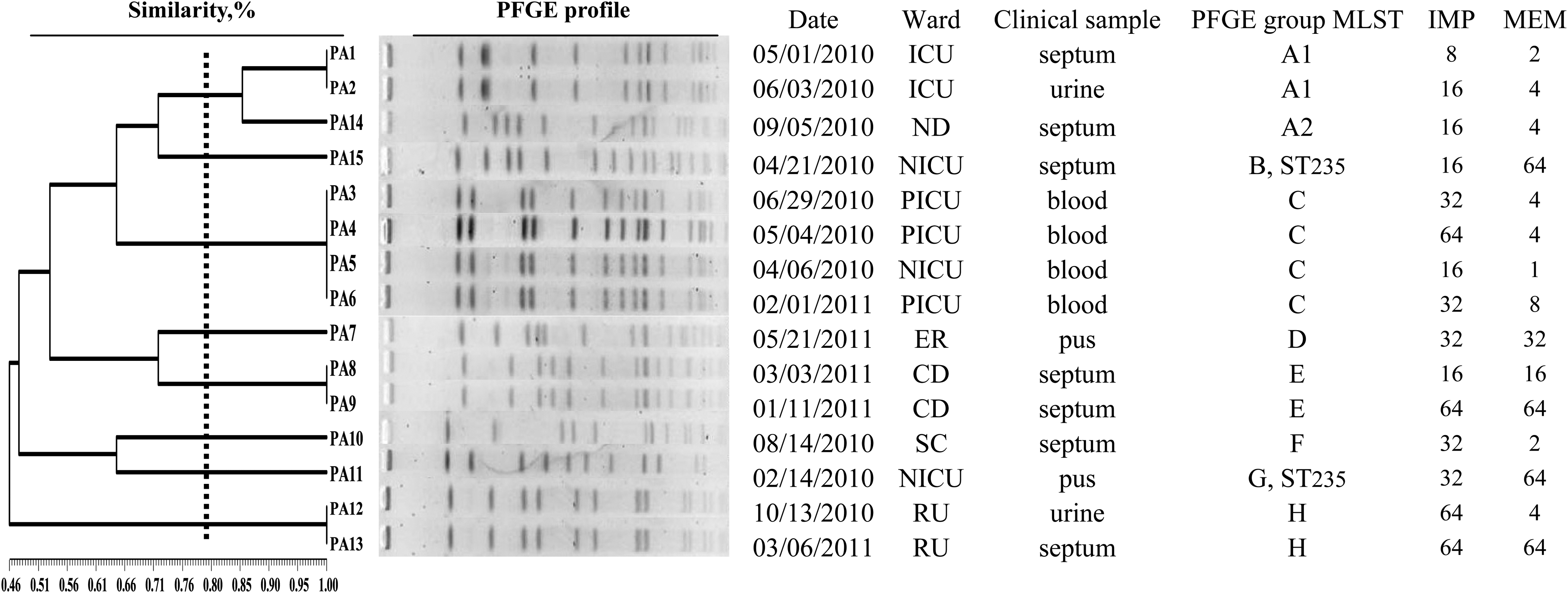
The unweighted pair group method with arithmetic mean dendrogram for percentage of similarity among PFGE profiles of SpeI-digested DNA from Pseudomonas aeruginosa isolates producing extended-spectrum beta-lactamase. A large strain cluster with >80% similarity is encircled. PFGE, pulsed-field gel electrophoresis; ER, emergence room; PICU, pediatric intensive care unit; NICU, neonatal intensive care unit; ND, neurology department; CD, cardiology department; SC, surgical ward; RU, respiratory unit.
ESBL, extended-spectrum beta-lactamase; MBL, metallo-β-lactamase; CAZ, ceftazidime; CTX, cefotaxime; FEP, cefepime; AZT, aztreonam; PIP, piperacillin; TZP, piperacillin-tazobactam; IMP, imipenem; MEM, meropenem; CIP, ciprofloxacin; LEV, levofloxacin; TCC, ticarcillin-clavulanic acid; TOB, tobramycin; AMK, amikacin; ND, not determined.
Characterization of acquired β-lactamases and prevalence of carbapenemases
Genes encoding ESBLs were detected in all the isolates exhibiting an ESBL phenotype. The blaOXA-10-like genes were found in 13 isolates (86.7%), variously accompanying the genes for PER, PSE,TEM, and/or IMP beta-lactamases. blaPER-1 was found in five isolates, blaPSE-1 was detected in three isolates, and blaTEM-1 was detected in one isolate. blaSHV and blaCTX-M alleles were not detected. Five isolates harbored both blaOXA-10-like and blaPER-1. Two carried blaOXA-10-like with blaIMP-1. Two had blaPER-1 and blaPSE-1 genes. And one isolate contained blaOXA-10-like and blaTEM-1 (Table 1). blaIMP-1 was found in two isolates giving a positive MBL test, whereas blaVIM, blaGIM, blaSIM, blaSPM, blaKPC, and blaNDM alleles were not detected.
Porin OprD studies
In this study, 73.3% (11/15) of the ESBL-producing isolates showed decreased transcription of oprD to variable degrees; in 53.3% (8/15) of the isolates, the reduction was significant (<0.4-fold compared with P. aeruginosa PAO1) and in three isolates (20%), oprD transcription was zero or very low (<0.01 compared with P. aeruginosa PAO1). Reduced expression of OprD was also assessed by OMP analysis (data not shown). These data therefore confirm that OprD inactivation is a nearly universal signature of imipenem resistance.
Correlation of these oprD nucleotide sequences, the mRNA levels of oprD, and the molecular characterization are shown in Table 1. Amino acid changes were found in loops 1 and 2 of OprD (amino acid D43N, T103S, K115T, and F170L), but the isolate had normal amounts of oprD mRNA. These amino acid changes were frequent in the cluster A strains tested in this study, while these changes could not reduce the expression of OprD (data not shown). It is suggested that these amino acid changes are not correlated with the transcription levels of oprD. The OprD types of six strains resistant to meropenem showed a stretch of 12 amino acid residues located in loop L15 (formerly loop L7) replaced by a sequence of 10 amino acid residues (372-VDSSSSYAGL-384). These data show that decreased expression of the oprD gene contributes to resistance to imipenem, but that the contribution to meropenem resistance is somewhat limited. To confirm this conclusion, more P. aeruginosa isolates need to be studied further.
Transcription of MexAB-OprM, MexCD-OprJ, and MexXY-OprM
Among the efflux systems, mexB overexpression (73.3%) was the most prevalent mechanism, followed by mexD (40%) and mexY (33.3%). Regarding meropenem-resistant isolates, a highly significant link to mexY and mexB overexpression was documented for the first time: isolates with meropenem minimum inhibitory concentration (MICs) of 1∼8 μg/ml produced mexY mRNA levels of 0.02–4.8-fold that of PAO1, while four isolates with meropenem MICs of 32–64 μg/ml produced mexY mRNA levels of 12.03–160.9-fold, one of these P. aeruginosa isolates possessed blaIMP-1 genes. Additionally, eight isolates with meropenem MICs of 8–64 μg/ml were more likely to have increased expression of mexB than were the seven isolates with meropenem MICs of 1–4 μg/ml (p<0.05).
Mutations in at least two genes (mexR and nalC) reportedly lead to increased expression of MexAB-OprM. 20 We found numerous mutations in these genes in all clinical isolates (Table 1). Three isolates had a Val126Glu change in MexR; however, mexB expression in these isolates was similar to that in isolates lacking the mutation. Thus, there was no evidence of a correlation of hyperexpression of the MexAB-OprM and MexR mutation. NalC Gly71Glu and Se209Arg were found in nine strains, but these varied widely in resistance, including seven- up to 10-fold change in mexB expression. Ser209Arg in NalC is known to have an impact on efflux activity, 12 whereas Gly71Glu is considered insignificant. The significance of this combination for mexB expression merits further investigation.
The relationship of carbapenem resistance with efflux system overexpression and OprD reduction was investigated between the ESBL-producers and the non-ESBL isolates (Table 2). While 8 (53.3%) of the 15 ESBL-producers overexpressed one or more genes of the efflux systems and reduced oprD, overexpression of at least one gene and reduced oprD was found only in 4 (16%) non-ESBL isolates. Overexpression of the mexY gene was observed in five ESBL-producers (33.3%), but no non-ESBL isolates overexpressed the mexY gene. Interestingly, the same link to mexB overexpression was observed (Table 2).
Discussion
This study aimed to investigate the mechanisms underlying carbapenem resistance in a collection of ESBL-producing P. aeruginosa isolates. Although subject to several limitations, discussed below, this study does reveal something important, namely, that most ESBL-producing P. aeruginosa isolates from one hospital in China exhibiting coresistance to carbapenem is due to upregulation of efflux or reduced OprD.
The ESBLs reported for P. aeruginosa are SHV, TEM, PER, VEB, BEL, GES, OXA, and, more recently, CTX-M types.17,23 In this study, OXA types were predominant, followed by PER and PSE types. The dominance of OXA types among the ESBLs of P. aeruginosa disagrees with data reported previously. 15 It is striking that OXA-10 like was found in four different beta-lactamase combinations (alone, with PER-1, TEM-1, or PSE-1 enzymes), implying to some extent that it is well established. The coexistence of blaOXA-10-like with blaIMP-1 in P. aeruginosa was observed, and is presently reported for the first time. Nevertheless, the absence of the genes for CTX-M and SHV ESBLs was confirmed by PCR, supporting the ESBL screening tests and refuting this concern.
An important issue to consider for understanding resistance dynamics is the interconnections between the different resistance mechanisms. Previous studies have indicated that mutational inactivation of oprD is known to be the main mechanism of imipenem resistance in the absence of acquired carbapenemases. 13 In the present study, 13.3% of the ESBL-producing P. aeruginosa isolates were found to be MBL producers. However, decreased expression of oprD was found in 73.3% of the isolates regardless of the presence of other factors. In 4 (11.3%) of such OprD-reduced isolates, expression levels of oprD could be reduced by more than 1,000 times compared with the control strain. Although the percentage of isolates showing oprD reduction was higher in the ESBL-producers (73.3%) than in the non-ESBL-producers (60%), the difference was not statistically significant. The discrepancy may be due to the small number of ESBL-producers evaluated in the present study.
According to the findings of the current study, up to 100% of the isolates overexpressed at least one of the mechanisms, with mexB (73.3%), mexD (40%), or mexY (33.3%) being the genes more frequently overexpressed. It should be noted, however, that the first large outbreak of a P. aeruginosa strain hyperproducing MexXY-OprM was recently reported in a Chinese hospital. External loop 7 is especially important for the uptake of meropenem. 2 In our study, 13 isolates with overexpression of mexX or mexB showed meropenem MIC 2∼64 mg/L, whereas eight out of them showed meropenem MIC 8–64 mg/L had concomitant alterations in loop L710 of OprD and increase of mexB or mexY mRNA. Our results confirm and extend the data from a previous study showing that meropenem appeared to be significantly affected by overexpression of mexB or mexY and alteration in loop L710 of OprD. Future studies, including more such isolates may be able to provide more definite information. Molecular typing by PFGE showed a wide diversity of patterns. All isolates from blood presented a high coefficient of similarity and closely related PFGE patterns, suggesting a close genetic relationship. The spread of blaIMP-1-positive isolates observed in the study was caused by a member of the ST258 clone using MLST analysis, suggesting that clonal expansion played a predominant role in the dissemination of these isolates.
In summary, this study demonstrates that combination of several mechanisms leading to OprD inactivation as well as overexpression of efflux systems may contribute to most carbapenem resistance in ESBL-producing P. aeruginosa isolates in a Chinese hospital, whereas MBL production, although increasing, is still infrequent.
Footnotes
Disclosure Statement
No competing financial interests exist.