




Abstract
Antimicrobial resistance (AMR) represents a serious problem globally, but it is especially pronounced in the tropics, where pressure of infectious diseases is high. We examined resistance in Escherichia coli colonizing gastrointestinal tracts of 17 dogs which have never received antimicrobial treatment, living in central rural Angola. Emphasis was placed on extended-spectrum beta-lactamases (ESBL) and plasmid-mediated quinolone resistance (PMQR). Resistance-carrying plasmids were characterized in size, group of incompatibility and ability to conjugate. Isolates were compared by their pulsed-field gel electrophoresis (PFGE) profiles. Detailed description of 19 E. coli isolates with either ESBL or PMQR genes carried on multiresistant plasmids of different groups of incompatibility indicates that dogs, despite never being treated by antibiotics, are important reservoirs and transmitters of AMR in the study area.
Introduction
M
Surveillance is the cornerstone of our understanding to the epidemiology of antimicrobial resistance and a starting point for intervention design. 15 Dogs living in tropical developing countries have repeatedly been recognized as relevant indicator organisms for microbial pathogens, since they share environment and water sources with human communities whilst at the same time often scavenging for food in human waste areas, including free defecation zones. 12 In a warm and humid tropical climate, which is conductive for the survival and spread of bacteria, such behavior can lead to an accumulation of resistance genes within the normal gastrointestinal microflora of these domestic animals. High rates of resistance, including the ESBL and PMQR determinants, have previously been reported in Escherichia coli obtained from dogs of nomadic pastoralists in Northern Kenya. 2 This short communication aims to describe phenotypic and genotypic characteristics of gastrointestinal E. coli with ESBL and/or PMQR genes found in dogs in rural central Angola.
Material and Methods
Rectal swabs from 17 stray dogs (assigned IDs 20 to 36) were obtained in and around the town of Catabola (Bié, Central Angola; 18,000 inhabitants). Animals were handled by an instructed assistant, according to the Directive 86/609/EEC on the Protection of Animals Used for Experimental and Other Scientific Purposes. Dogs were chosen randomly in the town center. The overall population of stray dogs in the town is not known, but is estimated to be several hundred. Previous antibiotic therapy in these dogs is highly unlikely. All samples were preserved in Amies medium until delivered to the laboratory. Swabs were cultivated on MacConkey agar with cefotaxime (2 mg/L) and in parallel on MacConkey agar with ciprofloxacin (0.05 mg/L) to detect ESBL-producing E. coli and E. coli possessing PMQR genes respectively. Biochemical identification of E. coli colonies was performed by API20S (Biomerieux). A single colony was isolated from each plate. Obtained isolates were characterized as described previously. 2 In brief, the isolates were tested for susceptibility to 12 antibiotics by disc-diffusion method: ampicillin (10 μg), cephalotin (30 μg), amoxicillin–clavulanate (20+10 μg), ceftazidime (30 μg), trimethoprim–sulfamethoxazole (1.25+23.75 μg), sulphonamides compounds (300 μg), gentamicin (10 μg), nalidixic acid (30 μg), ciprofloxacin (5 μg), streptomycin (30 μg), tetracycline (30 μg), and chloramphenicol (30 μg). 8 Production of ESBL was tested by a double-disc synergy test. 8 Phylogroups, resistance genes, and integrons were searched by PCR as summarized elsewhere. 11 Clonal relatedness of the isolates with ESBL or PMQR genes was assessed by XbaI pulse-field gel electrophoresis (PFGE)-generated dendrogram. 7 Sequence types were determined by multilocus sequence typing. 16 Conjugation transfer of ESBL and PMQR genes was made to plasmid-free, rifampin- and azid-resistant E. coli MT102RN, and Salmonella Typhimurium SL5325. 13 Plasmid DNA from ESBL-producing and PMQR-harboring isolates was extracted by rapid alkaline method 4 and introduced into competent E. coli DH5α (Invitrogen) by heat-shock transformation (42°C for 45 sec). Transformants were selected on Luria-Bertani agar with 0.05 mg ciprofloxacin or 2 mg cefotaxime, according to the genes expected. Plasmids carrying the ESBL/PMQR genes were characterized in size by S1 nuclease PFGE and replicon typed.5,10
Results
Coliform colonies were obtained from 16 out of 17 swabs cultivated. One coliform colony obtained on MCA-ciprofloxacin (34cip) was identified as Citrobacter freundii, and one grown on MCA-cefotaxime (35cfx) turned out to be Enterobacter cloacae. These non-E. coli isolates were not characterized further. ESBL-producing E. coli was detected in 12 (75%) samples, and E. coli with PMQR genes was obtained from nine (56%) samples. Cultivation of 7 out of 17 samples (numbers 20, 23, 25, 27, 28, 29, and 33) resulted in two E. coli isolates, of which one had an ESBL gene and the other had PMQR gene (discriminated as 20cfx/20cip). By means of sequencing, all ESBLs were characterized as type CTX-M-15, while PMQR genes were represented by qepA, qnrS1, qnrB19, or aac(6′)-Ib-cr. All except one of the examined strains were multiresistant, with 2–10 resistance genes detected. Resistance-carrying plasmids (characterized where single plasmid-harboring transformants or tranconjugants were obtained) varied in size, incompatibility group, and combinations of resistance genes carried (Fig. 1). The CTX-M-15 beta-lactamase was detected on large plasmids of the FIB, Y, N, I1 incompatibility groups. Four samples had the gene qepA carried on plasmids of the FIB incompatibility group. Some of the investigated plasmids were not typable by primers described previously.5,10 Plasmids of seven isolates carrying the blaCTX-M-15 gene or the qepA gene were conjugative to recipient cells. The variability of PFGE patterns was high, showing more than 95% relatedness only in one pair of all examined strains (Fig. 1). The 19 investigated isolates represented 12 different sequence types with six of them (ST 3653, ST 3687, ST 3690, ST 3694, and ST 3726) new in the MLST database at the ERI, University College Cork (http://mlst.ucc.ie/mlst/). The majority of the isolates belonged to phylogenetic group A, with two exceptions in group B1.
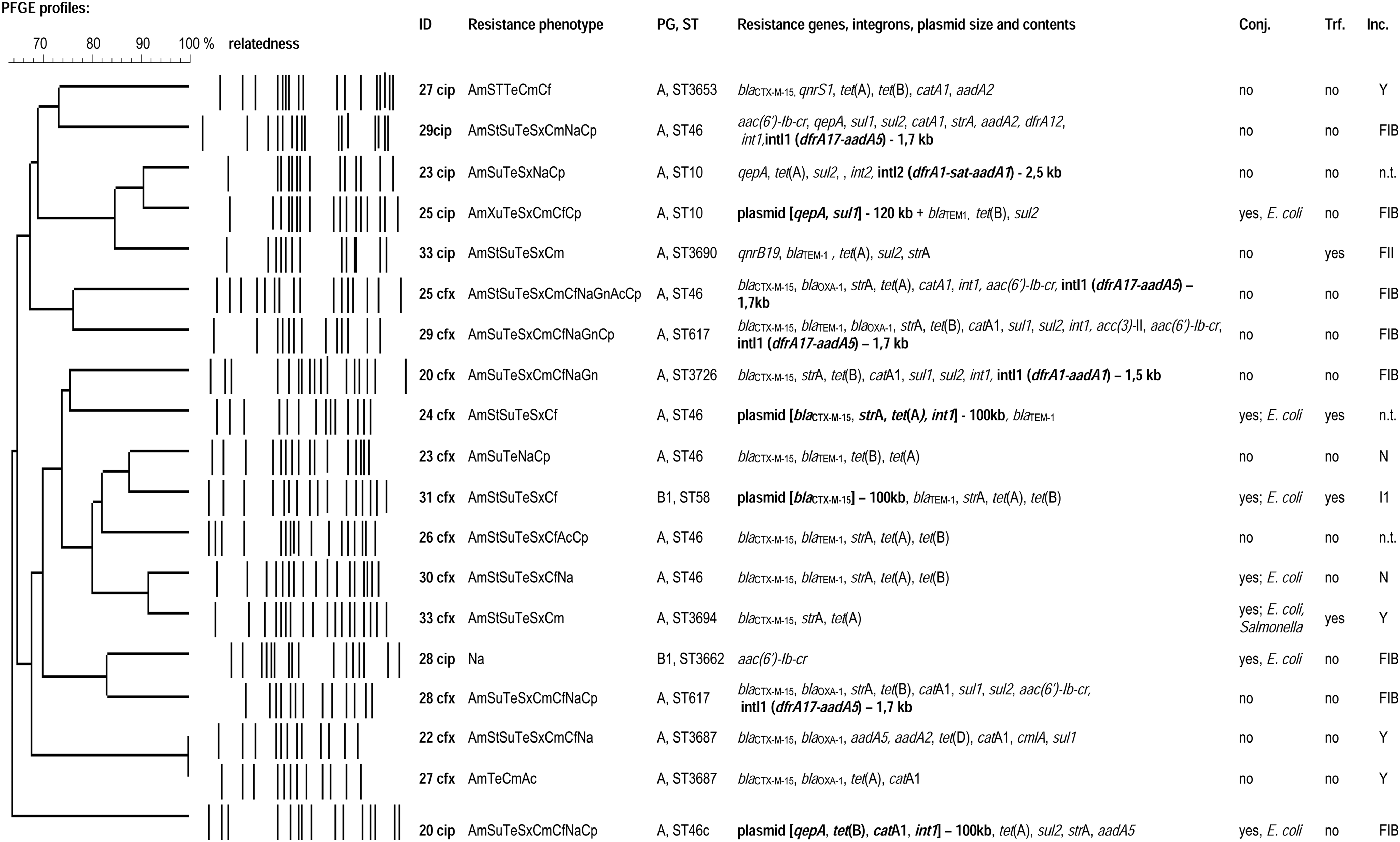
Phenotypic and genotypic characteristics of analyzed E. coli strains. Dogs were assigned IDs 20–36. Isolates with the suffix “cfx” were obtained on MCA-cefotaxime; isolates with the suffix “cip” were grown on MCA-ciprofloxacin. Isolates with an identical Arabic number originate from the same animal. Left column: dendrogram of analyzed E. coli isolates' PFGE profiles generated by cluster analysis of the Dice similarity indices in the BioNumerics fingerprinting software. Am, ampicillin; St, streptomycin; Su, sulfonamides compounds; Na, nalidixic acid; Te, tetracycline; Sx, trimethoprim–sulfomethoxazole; Cm, chloramphenicol; Cf, cefalotin; Cp, ciprofloxacin; Ac, amoxicillin–clavulanate; Gn, gentamicin; Cz, ceftazidime; ID, identification number; PG, phylogenetic group; ST, sequence type; Conj., conjugation to E. coli or Salmonella Braedenrup; Trf., transformation to DH5a cells; Inc., plasmid incompatibility group. Plasmids (in bold) were characterized (as for the size and Inc. group) in single-plasmid harboring transformants or transconjugants; resistance genes found on one plasmid are in square brackets, plasmid size follows the hyphen. IntI1, class 1 integron; IntI2, class 2 integron. Gene cassettes detected on one integron are within parentheses, with integron size following the hyphen.
Discussion
Although the size of the sample set examined was limited, the prevalence of highly resistant isolates found in the stray dogs is worrisome. The high diversity of phenotypic and genotypic profiles of the investigated isolates indicates that high resistance rates in the study area do not represent the success of a single multiresistant bacterial clone, but have evolved by dissemination of various bacterial strains. The genetic diversity of plasmids also implies that resistance in the studied isolates has been acquired in multiple ways. The majority of plasmids carrying the CTX-M-15 beta-lactamase belonged to the FIB group of incompatibility. However, even less common plasmids with Y replicon were detected. Six ESBL- or PMQR-carrying plasmids showed the ability to conjugate to recipient E. coli and S. typhimurium. Considering their putative ability to conjugate to pathogenic bacterial species, these plasmids are of high epidemiological importance.
Several studies have described occurrence of community- or hospital-associated multiresistant bacterial isolates (mainly of Vibrio sp.) in people in Angola.6,9,14 However, to our knowledge, this is the first report about ESBL in the country. Since administration of antibiotics, especially costly ones such as fluoroquinolones or third-generation cephalosporins, to dogs in rural Angola is unlikely, colonization of them by ESBL- and PMQR-harboring bacteria could be indirect evidence of their occurrence in humans. Quantitative data on the consumption of antimicrobial agents by humans in Angola are not available, but fluoroquinolone ciprofloxacin and third-generation cephalosporin ceftriaxone are available in the country.3,14 Although these two antibiotics are costly and might not be accessible to the public, their use in hospitals can lead to the selection of bacteria with ESBL- and/or PMQR-carrying plasmids. Plasmids described in this study carried genes coding for resistance to widely available drugs such as sulfonamides, tetracyclines, or gentamicin. It is likely that, once introduced to an area, the spread of such plasmids is also perpetuated by antibiotics less costly than fluoroquinolones or third-generation cephalosporins. Poor hygienic conditions, lack of sanitary facilities, and dogs scavenging for food in waste are the major factors contributing to bacterial exchange between humans and dogs. As stray dogs move around freely and travel relatively long distances, they can play an important role in resistance epidemiology as reservoirs and vectors of multiresistant bacteria acquired from and transferable to humans. A similar situation was observed in Northern Kenya 2 and could be applied to other African rural regions.
Footnotes
Acknowledgments
We thank the team of the Czech University of Life Sciences Prague in Angola, implementing the project Support of Agricultural Vocational Training School in Catabola, Angola, financed within Czech Development Cooperation, for assistance with sample collection, and to the project management for allowing this study to happen. The study was supported by project CEITEC—Central European Institute of Technology (CZ.1.05/1.1.00/02.0068) from the European Regional Development Fund. M.D. was supported by the Operational Program Education for Competitiveness (CZ.1.07/2.3.00/30.0014) from the European Social Fund.
Author Disclosure Statement
No competing financial interests exist.