




Abstract
The role of wild animals, particularly migratory birds, in the dissemination of antibiotic-resistant bacteria between geographically distant ecosystems is usually underestimated. The aim of this work was to characterize the Escherichia coli population from Franklin's gull feces, focusing on the extended-spectrum β-lactamase (ESBL)-producing strains. In the summer of 2011, 124 fecal swabs from seagulls (1 of each) migrating from the United States and Canada to the coast of Antofagasta, north of Chile, were collected. Samples were seeded on MacConkey agar supplemented with 2 μg/ml of cefotaxime and a single colony from each plate was tested for ESBL production by the double-disk ESBL synergy test. Antibiotic susceptibility was determined by the disk diffusion method and blaESBL genes were amplified and sequenced. The genetic diversity of isolates was explored by pulsed-field gel electrophoresis (PFGE)-XbaI and multilocus sequence typing. A total of 91 E. coli isolates with high rates of antibiotic resistance were identified. Carbapenemase production was not detected, whereas 67 of the 91 (54%) isolates exhibited an ESBL phenotype due to the presence of CTX-M-15 (61.3%), CTX-M-2 (19.3%), CTX-M-22 (16.1%), and CTX-M-3 (1.6%) coding genes. High genetic diversity was observed, with 30 PFGE patterns and 23 sequence types (STs), including ST131 (18%), ST44 (15%), ST617 (9%), and ST10 (9%). Results presented here are complementary to those previously reported by Hernández et al. in the same gull species, but located in the Central Region of Chile. Differences observed between gulls from both areas lead us to hypothesize that gulls from the northern location retain, as gut carriers, those resistant bacteria acquired in the United States and/or Canada.
Introduction
E
ESBL enzymes are mostly widespread among Enterobacteriaceae in Europe and North America, although at present they are disseminated worldwide. The mobile genetic elements in which blaESBL genes are located contribute to their successful spread among different species, but dispersion of certain epidemic or even endemic bacterial lineages such as Escherichia coli ST131 29 has also contributed to their prevalence. In South America, the first CTX-M variants described corresponded to the CTX-M-2 and CTX-M-1 as well as to the CTX-M-9 and CTX-M-8 groups. However, the emergence of CTX-M-15 in the last years has been reported.2,31 In Chile, the overall prevalence of ESBL-producing Enterobacteriaceae isolates in humans is at 23%, 12 although with large local differences. In this regard, in Antofagasta (northern Chile) we detected only 4% of ESBL-producing E. coli isolates in patients with community-acquired urinary tract infection. 1
In spite of differences among local settings causing various epidemiological scenarios in each country/region, the current increase in human travels favors the worldwide spread of bacterial strains and their resistance genetic determinants. The role of wild animals, particularly migratory birds, in the dissemination of antibiotic-resistant bacteria between geographically distant ecosystems is usually underestimated. The presence of ESBL-producing E. coli isolates in bird feces, including poultry, 14 birds of prey, 26 farm birds, 23 and wild birds, has been reported.5,15,16,32,37 Recently, Hernández et al., 18 in the central and the southern zones of Chile (Cocón and Talcahuano) found a higher ESBL-producing E. coli fecal carriage rate in the Franklin's gulls (Leucophaeus pipixcan) than in human samples. The Franklin's gull is a coastal seabird that resides in the northern Great Plains around British Columbia (Canada) as well as in Montana, the Dakotas, and western Minnesota. In winter, they migrate along the Pacific coast to Central and South America, 22 including the Chilean coast. 21 The aim of this study was to explore the dissemination pattern of the ESBL-producing E. coli population of Franklin's gulls on the Antofagasta coast and to hypothesize about the possible migratory links of this resistance spread.
Materials and Methods
Samples and bacterial identification
An individual cloacal Cary–Blair medium-containing swab was collected from each of a total of 124 gulls in human-restricted access areas of the coastal city of Antofagasta. Samples were immediately pre-enriched in Brain Heart Infusion broth (Oxoid, Cambridge, United Kingdom) for 18 hr at 37°C, directly seeded in parallel in MacConkey agar plates (Oxoid) either supplemented or not with 2 μg/ml of cefotaxime, and incubated at 37°C for 48 hr. Colonies were further identified by classical biochemical tests and the mass spectrometry MALDI-TOF system (Bruker, Hilden, Germany).
Antibiotic susceptibility
Susceptibility to ampicillin (10 μg), cefuroxime (30 μg), cefotaxime (30 μg), ceftazidime (30 μg), gentamicin (10 μg), cefadroxil (30 μg), aztreonam (30 μg), ertapenem (30 μg), norfloxacin (10 μg), nalidixic acid (30 μg), nitrofurantoin (100 μg), chloramphenicol (30 μg), tetracycline (30 μg), pipemidic acid (20 μg), amikacin (30 μg), streptomycin (10 μg), and trimethoprim–sulfamethoxazole (SxT) (25 μg) was determined by the disk diffusion method following the CLSI guidelines and breakpoints.
7
Minimum inhibitory concentration of cefotaxime was determined by Etest
ESBL characterization
Carriage of blaESBL genes was determined by the polymerase chain reaction (PCR) using specific primers and conditions, as previously described. 36 Amplicons were purified by the ExoSAP-IT® purification kit (USB Corp., Cleveland, OH), sequenced at the Macrogen Service (Macrogen Europe, Amsterdam, The Netherlands), and compared with the ESBL database of the LAHEY website (www.lahey.org) and GenBank (http://blast.ncbi.nlm.nih.gov/).
Genetic transference of ESBL genes was tested by filter mating assays using E. coli J53 Azide® as the recipient strain at a donor:recipient ratio of 1:2. Transconjugants were selected in MacConkey agar plates containing sodium azide (100 μg/ml) and cefotaxime (2 μg/ml). Conjugation was confirmed by the double-disk test using Mueller-Hinton agar plates and by specific PCR amplification.
Genetic diversity of strains
Pulsed-field gel electrophoresis (PFGE) was carried out in a CHEF-DR II (Bio-Rad, La Jolla, CA) apparatus with the following settings: XbaI digestion, 2.2 sec to 54.2 sec, for 20 hr, and 6 V/cm2. Both Tenover criteria and dendrogram construction based on the Dice's coefficient were used to explore differences in the band profiles.
Multilocus sequence typing (MLST) was performed in the 64 ESBL-producing isolates following the Achtmans's scheme (http://mlst.ucc.ie/mlst/dbs/Ecoli). The minimum spanning tree was constructed by the Phyloviz software.
Results
A total of 91 E. coli isolates were recovered from the 124 cloacal swabs. They exhibited high rates of resistance to both nalidixic acid and pipemidic acid (91%), and norfloxacin (72%), tetracycline (70%), SxT (73%), and streptomycin (45%); resistance to third-generation cephalosporins was extremely high (54%). Contrarily, lower resistance levels were detected for gentamicin (15%) and chloramphenicol (10%), with full susceptibility against the remaining antibiotics. No carbapenemase production was detected, whereas 67 of the 91 (54%) isolates exhibited an ESBL phenotype being all resistant to cefotaxime.
Genetic diversity of the 67 cefotaxime-resistant isolates yielded 30 different PFGE band patterns (Fig. 1). MLST studies identified 23 sequence types (STs) (Fig. 2). Interestingly, the most prevalent clone was ST131 (18%), followed by ST44 (15%), ST617 (6, 9%), ST10 (9%), ST38 (7.5%), ST665 (6%), ST350 (4.5%), and ST540 and ST405 (3%, each). Additionally, 7 previously undescribed STs were reported with a unique isolate each (from ST4184 to ST4190). Among isolates grouped in the same ST, the PFGE analysis demonstrated an unrelated variety of patterns, disregarding any significant over-representation of the same strain (Fig. 1).
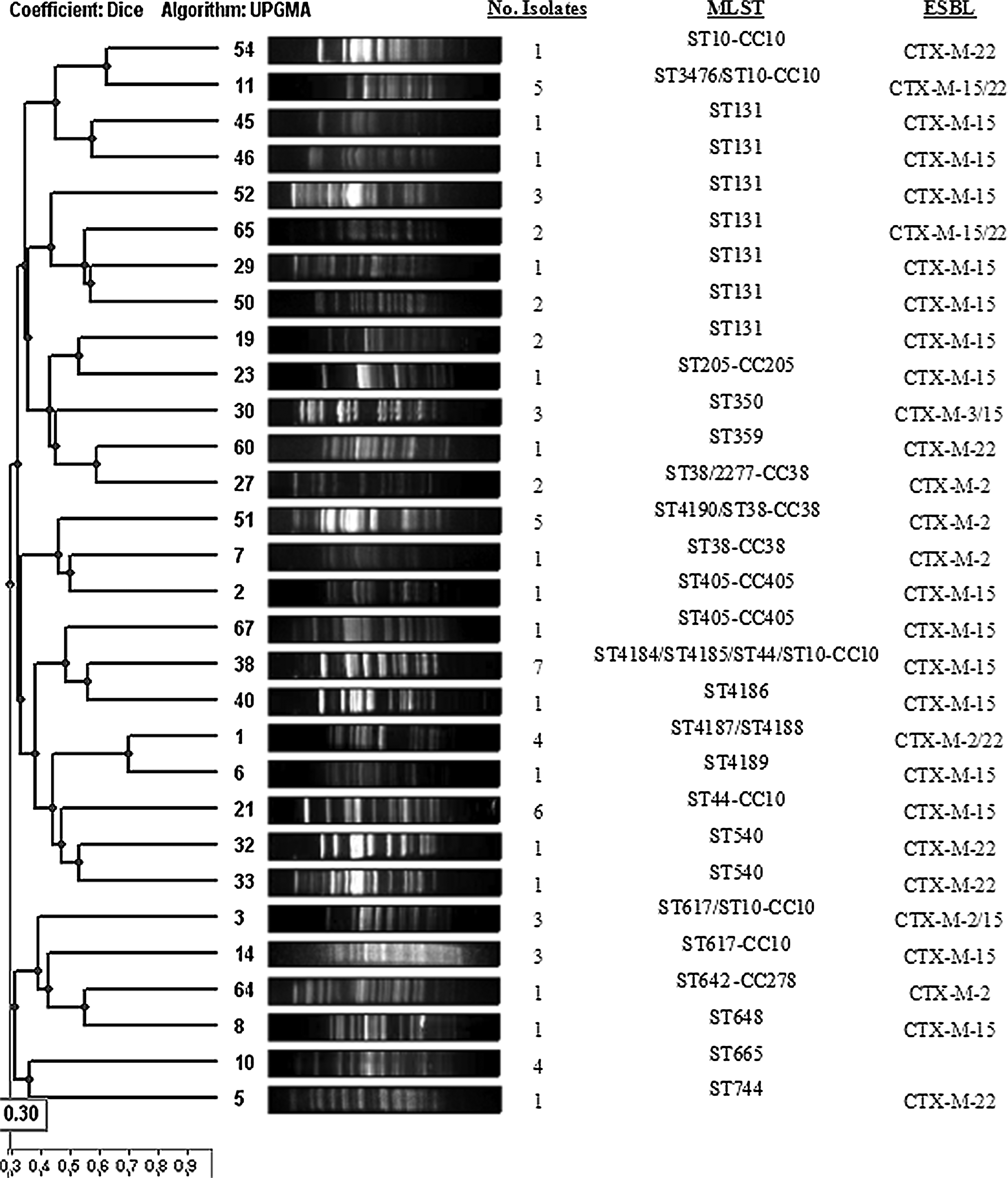
Dendrogram of the 30 pulsed-field gel electrophoresis patterns detected among the 67 extended-spectrum β-lactamase (ESBL)-producing Escherichia coli isolates and their characteristics.
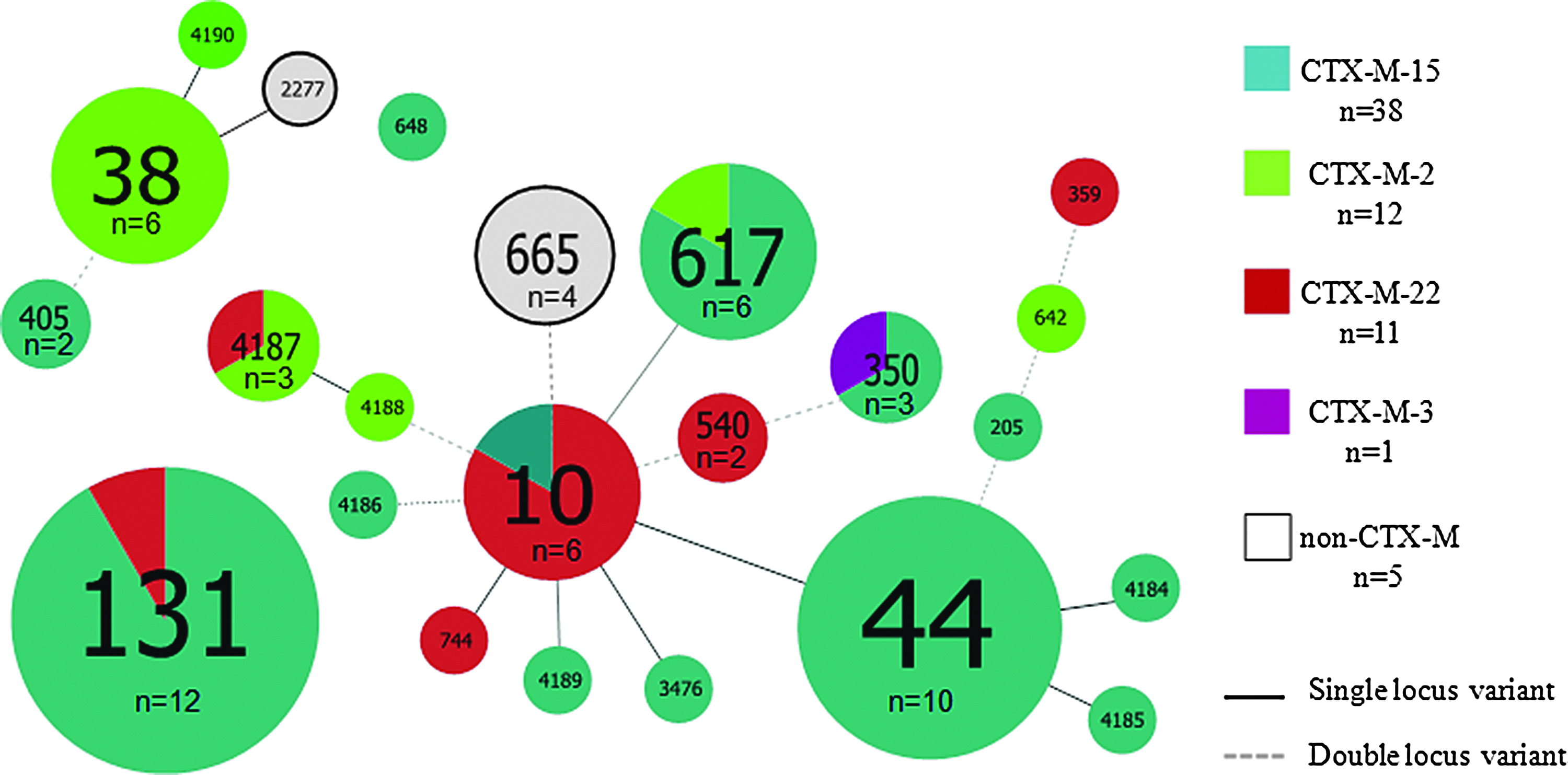
Minimum spanning tree representing the different genetic lineages found by multilocus sequence typing (MLST) (numbers inside the balls) and the corresponding CTX-M gene detected. Color images available online at www.liebertpub.com/mdr
The blaCTX-M genes were amplified in 62 of the 67 ESBL-producing E. coli isolates, corresponding to the CTX-M-15 (61.3%), CTX-M-2 (19.3%), CTX-M-22 (16.1%), and CTX-M-3 group (1.6%). The blaTEM-1 gene was also detected in 28 isolates (41.8%), blaTEM-40 in 5 isolates (7.4%), and blaTEM-198 in one isolate (1.5%). Among the 38 isolates carrying the CTX-M-15 enzyme, up to 14 different STs were detected, 10 of them being represented by a single isolate. The other lineages were ST131 (n=11), ST44 (n=10), ST617 (n=5), and ST405 (n=2). Over-representation of the same strain was ruled out by using PFGE analysis, identifying 19 unrelated PFGE profiles. Successful transference by conjugation of the blaCTX-M-15 gene was obtained in all the 19 isolates.
Discussion
The relevance of different environmental settings in ESBL-mediated resistance dissemination is usually reflected in subsequent epidemiological studies demonstrating that most of them are of human origin. However, both domestic and free-living animals also contribute to this scenario with a significant impact on public health. When considering antibiotic-resistant bacteria and the genetic determinants involved, epidemiological control measures based on local environmental features are essential to limit their dissemination. Certain regions of the United States and Canada exhibit high rates of antimicrobial resistance in hospital and community environments.6,25 On the contrary, in South American countries antimicrobial rates remain low, but epidemiological studies are still limited.2,31 Similarly, South American countries exhibit generally high antimicrobial resistance rates, although epidemiological studies are still limited.2,31
According to the results obtained in the present study, we hypothesize that the antibiotic-resistant bacteria detected in the gut microbiota of gulls were that acquired in their countries of origin, partly excreted during their migration. Therefore, the microbiota could, to some extent, be replaced by the local strains circulating in the country of destination. This hypothesis is supported by a recent study undertaken in the central part of Chile, Concón, and Talcahuano (2,000 km south of Antofagasta). 18 A wide range of antimicrobial resistance rates have been previously described in isolates colonizing free-living birds, either migratory or not,3,4,9,13,17,20,28,30,33 partly resembling that of the country in which the bird is captured. 34 Moreover, bacterial exchange between humans and animals has been frequently described.
The most relevant result of the present work is the isolation of predominant human-related epidemic strains in the gull's feces as well as resistant PFGE unrelated isolates belonging to the ST131 and the Clonal Complex 10 containing the CTX-M-15 enzyme. Interestingly, these lineages are highly prevalent in humans in the United States and Canada,6,8,25 whereas they have been scarcely found in Chile,1,18 suggesting the vehiculation of CTX-M-15-producing E. coli by migratory birds. In fact, in the work by Hernández et al., it was reported a higher dominance of CTX-M-1 (78% of the ESB-producing E. coli isolates from birds) being CTX-M-15, the second in prevalence (16%). The detection of previously undescribed E. coli STs, 7/67 in our work and 23/100 in the Henández et al. report, 18 also points to the fact of a possible bacterial exchange between the gulls and the environment or to the existence of birds' adapted lineages that acquired the foreign blaESBL genes. An important question to be undoubtedly certified is whether the gulls acquire the ESBL-containing organisms in their countries of origin or not, and the way in which they are so efficiently colonized by local bacterial flora. Franklin's gulls eat mostly insects, earthworms, and small fishes, and are considered rare scavengers of sewage dumps. However, the result of this study might force us to further investigate this point. In summary, we hypothesized that in northern Chile, the migratory gulls retain in their gut the resistant bacteria acquired in Canada/United States.
Footnotes
Acknowledgments
This work was partially funded by the project CODEI-5393, DGI, from the Antofagasta University of Chile and supported by the Ministerio de Economía y Competitividad, Instituto de Salud Carlos III—cofinanced by the European Development Regional Fund “A way to achieve Europe” ERDF, the Spanish Network for the Research in Infectious Diseases (REIPI RD12/0015), and the European Commission Project EvoTAR-282004.
Disclosure Statement
No competing financial interests exist.