




Abstract
We compared the occurrences of 3rd-generation cephalosporin-resistant (3GCr), tetracycline-resistant (TETr), and trimethoprim–sulfamethoxazole-resistant (COTr) Escherichia coli, 3GCr and nalidixic acid-resistant (NALr) Salmonella enterica, and erythromycin-resistant (ERYr) enterococci from the fecal samples of ceftiofur-treated (n = 162) and nonantimicrobial-treated (n = 207) comingled beef cows ≥8 years old, for which complete antimicrobial treatment records were available. The prevalence of 3GCr (17%; n = 369), TETr (88%), COTr E. coli (22%), and ERYr enterococci (69%) was not significantly (p > 0.05) associated with ceftiofur treatment, prior history of other antimicrobial treatments, or duration of time between last antimicrobial treatment and sampling. 3GCr and NALr S. enterica were not detected. The prevalence of tetB was significantly (p < 0.05) higher compared with tetA among TETr E. coli. However, the prevalence of tetA was significantly (p < 0.05) higher than tetB among 3GCr and COTr E. coli. There was a significant (p < 0.05) association between tetM and ermB among ERYr enterococci. In conclusion, occurrences of 3GCr, TETr, and COTr E. coli and ERYr enterococci in comingled antimicrobial-treated and nonantimicrobial-treated beef cows were not associated with ceftiofur or other antimicrobial use, indicating that other factors influenced the observed levels of antimicrobial-resistant bacteria in feces of beef cows.
Introduction
T
Factors other than antimicrobial treatment may contribute significantly to the occurrence of ARB associated with livestock environments.16,17 ARB are ubiquitous in soils and other environments16,17 and their numbers can be increased by supplying nutrients for growth through fecal deposition.18,19 Beef cows present an interesting opportunity to study this paradigm. These animals receive many of the same treatments as animals in confined animal feeding operations, but the available nutrients in the excreted manure are spread over a larger land area and may not provide much potential for growth to ARB intrinsic to pasture soils.
A particular antimicrobial treatment of interest is ceftiofur, a 3rd-generation cephalosporin (3GC). In the United States, it is approved for the treatment of bovine respiratory disease complex, bovine interdigital necrobacillosis, and acute metritis in cattle. Although ceftiofur is used exclusively in veterinary medicine, its use is a potential public health concern because of its structural similarity and identical mode of action with the 3GCs, ceftriaxone and cefotaxime, which are drugs of choice for the treatment of invasive salmonellosis in children. 20
We studied resistance to cefotaxime as well as tetracycline, erythromycin, nalidixic acid, and trimethoprim–sulfamethoxazole since their antimicrobial classes, 3GCs, tetracyclines, macrolides, quinolones, and folate synthesis pathway inhibitors, respectively, are used in animal production. Moreover, all of these antimicrobial classes are considered medically important antimicrobials by the U.S. Food and Drug Administration (FDA). 21 3GCs, quinolones, and macrolides are classified as critically important antibiotics, while tetracyclines are classified as highly important classes of antibiotics in human medicine both by FDA 21 and WHO. 22 Tetracycline resistance is widespread and there are concerns about coresistance between tetracycline and 3GCs3,23,24 as the genes conferring resistance to 3GC (blaCMY-2) and tetracycline (tetA) are colocated on transmissible plasmids. 25 Folate synthesis pathway inhibitors are categorized as a highly important antimicrobial class by WHO classification, but are considered critically important by FDA.
The objective of the present study was to determine if the fecal occurrences of 3GC-resistant (3GCr), tetracycline-resistant (TETr), and trimethoprim–sulfamethoxazole-resistant (COTr) Escherichia coli, 3GCr and nalidixic acid-resistant (NALr) Salmonella enterica (hereafter referred to as Salmonella), and erythromycin-resistant (ERYr) enterococci differed between ceftiofur-treated and nonantimicrobial-treated, comingled beef cows ≥8 years old. Resistant bacterial colonies also were screened for resistance genes by polymerase chain reaction (PCR).
Materials and Methods
Study population and sample collection
This experiment (#3040-42000-014-06) was approved by the U.S. Meat Animal Research Center (USMARC) Animal Care and Use Committee.
We conducted a cross-sectional study on AMR of E. coli, Salmonella, and enterococci in ceftiofur-treated and nonantimicrobial-treated beef cows. E. coli and enterococci are present in beef products and are part of the commensal flora of cattle gastrointestinal system. As such, the National Antimicrobial Resistance Monitoring System (NARMS) isolates E. coli and enterococci and then determines their antimicrobial susceptibilities as indicator organisms for the occurrence of AMR in gram-negative and gram-positive bacteria, respectively. While enterococci are intrinsically resistant to cephalosporins, ERYr enterococci are prevalent in agricultural and municipal wastes. 18
The beef cows were raised on pasture at the Roman L. Hruska USMARC in Clay Center, Nebraska. The study population consisted of 369 cows born between 2002 and 2006, distributed among four breeding cohorts that had 518 beef cows. A breeding cohort was defined as a group of cows kept on communal pasture. Cows in these four breeding cohorts, from which the study cows were selected, were part of a single large USMARC beef cow population (n ≈ 6,000). All breeding cohorts were managed identically. The ceftiofur-treated group consisted of 162 cows that were treated with ceftiofur as well as other therapeutic antimicrobials. The nonantimicrobial-treated group consisted of 207 cows that never received therapeutic antimicrobial treatment. A total of 144 cows that did not receive ceftiofur, but did receive other antimicrobial treatments, were present in the four breeding cohorts, but were not sampled. In addition, from 374 cows preselected for the study based on health records, five cows (two from the ceftiofur-treated group and three cows from the nonantimicrobial-treated group) were not available for sampling. These were excluded and consequently 369 cows (162 ceftiofur-treated and 207 nonantimicrobial-treated) were sampled and analyzed. The distribution of the study cows by antimicrobial treatment status, breeding cohort, and birth cohort is given in Table 1. Complete medical histories and antimicrobial treatment records were maintained for this cattle population.
Ceftiofur-treated cows were administered ceftiofur crystalline-free acid (Excede; Zoetis, Inc., Kalamazoo, MI) or ceftiofur sodium (Naxcel; Zoetis, Inc.). All 2006 birth cohort cows received in-feed chlortetracycline when weaned (during fall 2006 and spring 2007), and other birth cohort cows did not receive any in-feed or in-water antimicrobials. Fecal grab samples were collected from individual cows per rectum by using obstetrical gloves when cows were restrained in a squeeze chute for pregnancy testing from September to November 2014. Samples were individually bagged and kept on ice during sample collection and were transported to the laboratory for microbiological analyses.
Sample processing
From each fecal sample, 10 g of feces was transferred to filter barrier bags to which 90 ml of tryptic soy broth (TSB, Difco; Becton Dickinson, Sparks, MD) with phosphate buffer (TSB+PO4; 30 g of TSB, 2.31 g of KH2PO4, and 12.54 g of K2HPO4; Sigma-Aldrich, St. Louis, MO) was added. From each fecal suspension, a 1-ml aliquot was removed and used for enumeration. The remaining fecal suspension was incubated at 25°C for 2 hr, then at 42°C for 6 hr, and held at 4°C. Secondary enrichments were then made from the primary cultures for prevalence determination as described below. All antimicrobials used in this study were obtained from Sigma-Aldrich unless otherwise stated.
Enumeration and detection of nontype-specific E. coli, 3GCr E. coli, TETr E. coli, and COTr E. coli
To enumerate nontype-specific (NTS) E. coli, 3GCr E. coli, TETr E. coli, and COTr E. coli, 50 μl of fecal dilutions was spiral plated, using Autoplate 4000 (Spiral Biotech, Norwood, MA) onto CHROMAgar E. coli (DRG International, Mountainside, NJ) with no antimicrobial (CEC), or supplemented with 2 mg/L of cefotaxime (CEC+CTX), 4 mg/L trimethoprim and 76 mg/L sulfamethoxazole (CEC+COT), or 32 mg/L tetracycline (CEC+TET), respectively. The concentration of cefotaxime was based on recommendations by European Food Safety Authority 26 and this concentration previously has been used to isolate 3GCr fecal E. coli from animals.6,18 The concentrations of trimethoprim and sulfamethoxazole were based on resistance breakpoints described in the NARMS retail meat report. 27 The concentration of tetracycline was used at one dilution higher than the recommended resistance breakpoint 27 based on prior pilot study in our laboratory. All plates were incubated at 37°C overnight.9,18 Blue colonies were enumerated by using ProtoCOL 3 automated colony counter (Symbiosis, Frederick, MD) as presumptive E. coli. To determine the prevalence of NTS E. coli, 3GCr E. coli, TETr E. coli, and COTr E. coli, 0.5 ml of the primary enrichment was inoculated into 2.5 ml MacConkey broth with no antimicrobial (MCB; Becton Dickinson, Franklin Lakes, NJ), MCB supplemented with 2.4 mg/L cefotaxime (MCB+CTX), 38.4 mg/L tetracycline (MCB+TET), or MCB supplemented with 4.8 mg/L trimethoprim and 91.2 mg/L sulfamethoxazole (MCB+COT) and incubated at 42°C for 18 hr. These concentrations were used as previously described based on prior optimization protocols in our laboratories.6,18 MCB, MCB+CTX, MCB+TET, and MCB+COT secondary enrichments were streaked onto CEC, CEC+CTX, CEC+TET, and CEC+COT agar plates, respectively, and incubated at 37°C for 18 hr.9,18
From both enumeration and prevalence plates, up to two presumptive colonies per plate were inoculated into TSB and incubated at 37°C overnight, followed by the addition of glycerol to a final concentration of 15% to allow preservation at −20°C. Before freezing, DNA lysates were prepared by transferring 10 μl of each overnight culture to 100 μl of lysis buffer (150 ml of protease and 12 ml of lysis buffer) and heating the samples for 20 min at 37°C, then 10 min at 95°C with minor modification (DuPont Qualicon, Inc., Wilmington, DE). The DNA lysates were used for PCR for species confirmation and for the detection of resistance genes. Presumptive E. coli colonies were confirmed by multiplex PCR that targets lacY, lacZ, cyd, and uidA genes by using previously published primers and protocols. 28
Enumeration, detection, and characterization of Salmonella
For the enumeration of NTS Salmonella, 3GCr Salmonella, and NALr Salmonella, fecal suspensions were spiral plated onto xylose lysine deoxycholate (XLD) agar (Remel, Lenexa, MO) plus 4.6 ml/L tergitol, 15 mg/L novobiocin and 5 mg/L cefsulodin (XLDtnc), XLD agar plus 2 mg/L cefotaxime (XLD+CTX), and XLD agar plus 32 mg/L nalidixic acid (XLD+NAL), respectively. Plates were incubated at 37°C overnight and then held at 25°C for 72 hr to allow for H2S production.9,18 Black colonies were considered presumptive Salmonella. For the detection of Salmonella, a 1-ml aliquot of the pre-enrichment was mixed with 20 μl of Salmonella-specific immunomagnetic separation beads (Dynal, Lake Success, NY). Salmonella was then eluted into 3 ml of Rappaport-Vassiliadis soy peptone broth (RVS; Remel) and incubated at 42°C for 18 hr.9,18 Following incubation, RVS broth-enriched cultures were streaked onto XLDtnc, XLD+CTX, and XLD+NAL plates and incubated at 37°C for 18 hr.
Presumptive Salmonella colonies were confirmed by PCR of the invA gene29,30 from the DNA lysate prepared from an overnight TSB culture incubated at 37°C, as described above for E. coli. Salmonella isolates were serotyped with xMAP Salmonella serotyping assay kit, following the manufacturer's instructions (Luminex Corporation, Austin, TX). Salmonella isolates were tested for their susceptibilities to a panel of 14 antimicrobials by broth microdilution method using NARMS custom-made CMV3AGNF plates (Sensititre®; Trek Diagnostic Systems, Inc., Cleveland, OH). The interpretative criteria and breakpoints used were as described in the recent NARMS retail meat report. 27 The antimicrobials (and their resistance breakpoints expressed as μg/ml) were amoxicillin–clavulanic acid (≥32/16), ampicillin (≥32), azithromycin (≥32), cefoxitin (≥32), ceftiofur (≥8), ceftriaxone (≥4), chloramphenicol (≥32), ciprofloxacin (≥1), gentamicin (≥16), nalidixic acid (≥32), streptomycin (≥64), sulfisoxazole (≥512), tetracycline (≥16), and trimethoprim–sulfamethoxazole (≥4/76).
Enumeration, detection, and characterization of NTS and ERYr enterococci
NTS and ERYr enterococci were enumerated on enterococcosel agar (EA; Becton Dickinson, Sparks, MD) and EA plus 8 mg/L erythromycin (EA+ERY), respectively. The plates were incubated at 37°C overnight. 18 Characteristic colonies with brownish-black to black halos were enumerated as presumptive Enterococcus spp. For the determination of the prevalence of NTS and ERYr enterococci, 0.5 ml of the pre-enriched culture was transferred to 2.5 ml of enterococcosel broth (ECB; Becton Dickinson, Sparks, MD) and incubated at 37°C overnight. ECB enterococci enrichments were streaked onto EA and EA+ERY plates and incubated at 37°C overnight. Up to two presumptive colonies both from enumeration and prevalence plates were inoculated into TSB for overnight incubation at 37°C. DNA lysates were prepared by transferring 10 μl of each overnight culture to 100 μl of lysis buffer and heating the samples for 1 hr at 55°C, then for 10 min at 95°C with minor modification (DuPont Qualicon, Inc.). The DNA lysates were used for PCR to confirm presumptive colonies 31 and to detect resistance genes.
Susceptibility testing of NTS E. coli and enterococci
To determine the proportion of NTS E. coli that were TETr, frozen cultures of PCR-confirmed NTS E. coli colonies were thawed, then streaked onto tryptic soy agar (TSA; Becton Dickinson, Sparks, MD), and incubated at 37°C overnight. A single isolated colony from each plate was then inoculated into TSB in 96-deep well blocks and incubated at 37°C overnight. Each overnight culture was stamped onto CEC and CEC+TET plates using a 48-pin Boekel microplate replicator (Boekel Scientific, Feasterville, PA) and incubated at 37°C overnight. In addition, DNA lysates were prepared from this overnight TSB culture as described above for PCR for the detection of AMR genes.
To determine the proportions of NTS enterococci that were ERYr and TETr, PCR-confirmed NTS enterococci colonies were thawed, then streaked onto TSA (Becton Dickinson, Sparks, MD), and incubated at 37°C overnight. A single isolated colony from each plate was then inoculated into TSB in 96-deep well blocks and incubated at 37°C overnight. Each overnight culture was stamped onto EA+ERY plates and EA supplemented with tetracycline (32 mg/L tetracycline; EA+TET) plates using a 48-pin Boekel microplate replicator and incubated at 37°C overnight. From the same overnight TSB culture, DNA lysates for the isolates were prepared as described above for PCR for the detection of AMR genes.
Detection of AMR genes
The DNA lysates from PCR-confirmed NTS E. coli isolates (n = 729), TETr E. coli colonies (n = 732), 3GCr E. coli colonies (n = 127), and COTr E. coli colonies (n = 168) were tested for two tetracycline resistance genes (tetA and tetB) by duplex PCR as described. 23 3GCr E. coli were tested for the presence of blaCMY-2 32 and blaCTX-M. 33 COTr E. coli were tested for trimethoprim (dfr1, dfr5, dfr7/17, and dfr12) and sulfonamide (sul1, sul2, and sul3) resistance genes. 34 DNA lysates from the PCR-confirmed NTS enterococci isolates (n = 1,007) and ERYr enterococci colonies (n = 507) were PCR screened for the presence of tetM and ermB genes.35,36
Statistical analyses
Enumeration data, expressed as CFU/g of feces, were converted to log10 CFU/g of feces for analysis. The lower limit of detection for enumeration was 2.3 log CFU/g, while theoretical lower limit of detection was −2.0 log CFU/g of feces. Only fecal samples that yielded enumerable bacteria (≥2.3 log CFU/g) were included in this analysis. Mixed-effects linear regression was used to model the fixed effects of ceftiofur treatment and birth cohort and random effects of breeding cohort with unstructured covariance structure. The effects of total number of any antimicrobial administrations, total number of ceftiofur administrations, total number of other specific antimicrobial administrations, and length of time since last antimicrobial treatments on the log10 CFU counts of TETr E. coli (both absolute and normalized to total E. coli counts) were assessed with generalized estimating equations (GEE) with identity link. Binary outcomes for the prevalence of 3GCr, TETr, and COTr E. coli and ERYr enterococci, as well as the prevalence of resistance genes, were modeled with mixed-effects logistic regression with the fixed effects of ceftiofur treatment and birth cohort and random effect of breeding cohort. The effects of total number of antimicrobial administrations, total number of ceftiofur administrations, total number of other specific antibiotics administered, and length of time since last antimicrobial treatments on the prevalence of 3GCr, TETr, and COTr E. coli and ERYr enterococci were assessed by GEE with logit link. All statistical analyses were conducted in STATA 13 (StataCorp LP, College Station, TX). Bonferroni adjustments were used for multiple comparisons whenever applicable, and p-values <0.05 were considered significant.
Results
Descriptive statistics
The number of cows within ceftiofur-treated and nonantimicrobial-treated groups did not significantly (p > 0.05) differ among the four breeding cohorts, nor by birth cohort. The number of cows that received different antimicrobials in the ceftiofur-treated group is shown in Table 2. Among the 162 ceftiofur-treated cows, 94 (58%) cows received no other therapeutic antimicrobial. The median duration between last antimicrobial treatment and sampling ranged from 51 months for ceftiofur to 102 months for florfenicol (Table 3). Among ceftiofur-treated cows (n = 162), 103 (64%) cows received Naxcel, 44 (27%) received Excede, and the remaining 15 (9%) cows received both formulations. The disease conditions, for which antimicrobials were indicated, are presented in Supplementary Table S1 (Supplementary Data are available online at www.liebertpub.com/mdr). The number of treatments with oxytetracycline, penicillins, and sulfonamides was higher in cows that were not sampled than in ceftiofur-treated cows that were sampled (Supplementary Table S2). The distribution of the number of antimicrobial treatments among the ceftiofur-treated cows until sampling is shown in Supplementary Table S3.
Occurrence of NTS E. coli, 3GCr E. coli, TETr E. coli, and COTr E. coli
NTS E. coli and TETr E. coli were enumerable (≥2.3 log CFU/g) from 93.5% and 30.6% of the fecal samples (n = 369), respectively. 3GCr and COTr E. coli were enumerable only from the same two cows, both from the nonantimicrobial-treated group. The mean log10 CFU count of NTS E. coli did not significantly (p > 0.05) differ between ceftiofur-treated and nonantimicrobial-treated cows, nor among the birth cohorts (Fig. 1A). The mean log10 CFU count of TETr E. coli also did not significantly differ (p > 0.05) between ceftiofur-treated and nonantimicrobial-treated cows or among the birth cohorts, both in absolute terms (Fig. 1B) or when normalized to total NTS E. coli log10 CFU (Fig. 1C). The mean log10 CFU of TETr E. coli was not significantly (p > 0.05) associated with prior history of any antimicrobial treatment, frequency of treatment, the number of antimicrobials given, or duration of time since the last antimicrobial treatment (data not shown).
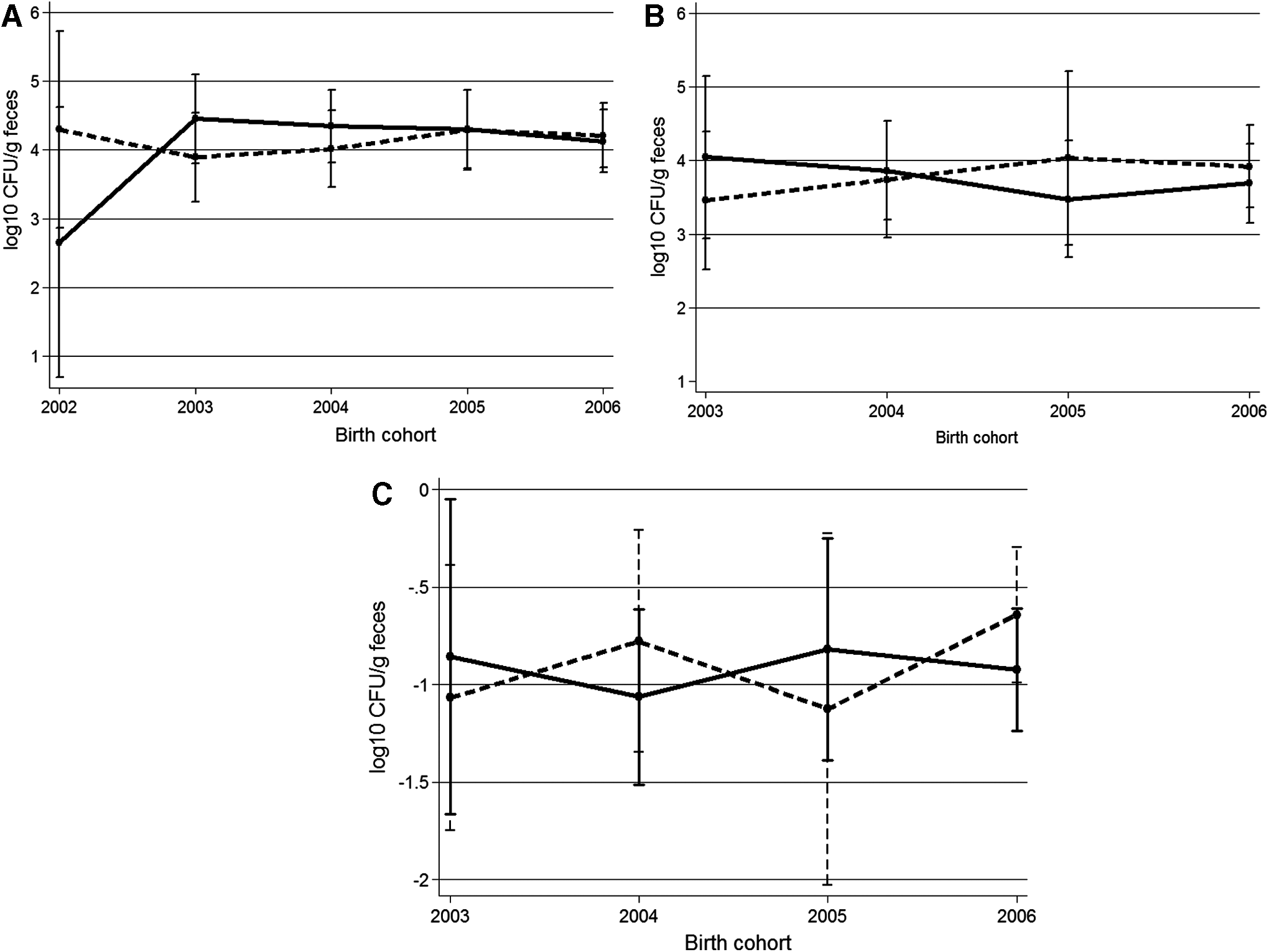
Log10 CFUs/g of feces from ceftiofur-treated and nonantimicrobial-treated beef cows. Solid line represents the nonantimicrobial-treated group; dashed line represents the ceftiofur-treated group.
Across all cows studied (n = 369), overall prevalence of TETr, 3GCr, and COTr E. coli was 88.4%, 16.8%, and 22.5%, respectively. The prevalence of TETr, 3GCr, and COTr E. coli did not significantly (p > 0.05) differ between ceftiofur-treated and nonantimicrobial-treated cows (Fig. 2). The prevalence of TETr, 3GCr, and COTr E. coli was not associated (p > 0.05) with prior history of any antimicrobial treatment, frequency of any antimicrobial treatment, number of antimicrobials given, or the duration of time since last antimicrobial treatment.

Prevalence of antimicrobial resistance in E. coli from ceftiofur-treated and nonantimicrobial-treated beef cows. Solid line represents the nonantimicrobial-treated group; dashed line represents the ceftiofur-treated group.
AMR gene content of 3GCr, TETr, and COTr E. coli colonies
The prevalence of the resistance genes among 3GCr, TETr, and COTr E. coli colonies is shown in Table 4. Of the 127 3GCr E. coli colonies tested, the prevalence of blaCMY-2 (59%; 95% CI: 50.0–67.7%) was significantly higher compared with blaCTX-M (38%; 95% CI: 29.3–46.8%). Together, blaCMY-2 and blaCTX-M were detected in 96.9% of the phenotypically 3GCr E. coli colonies (n = 127). Ceftiofur treatment did not have effect on the detection of blaCMY-2 (p = 0.06); however, the proportion of blaCTX-M-positive 3GCr E. coli was significantly (p = 0.012) higher among 3GCr E. coli colonies (n = 51) obtained from ceftiofur-treated cows compared with 3GCr E. coli colonies (n = 76) that were obtained from nonantimicrobial-treated cows (51% vs. 29%, respectively). Forty-seven percent (95% CI: 38.2–56.3%) of 3GCr E. coli colonies were positive for tetA, while only 1.6% (95% CI: 0.2–5.7) of them were positive for tetB. All blaCTX-M 3GCr E. coli were tetA positive; while only 15% (n = 75) of blaCMY-2-positive 3GCr E. coli were positive for tetA. It should be noted that the observed median time from ceftiofur treatment to sampling was 51 months. Studies have shown that the level of AMR associated with feedlot cattle returns to a baseline level 2–5 weeks after withdrawal of treatment.3–6
3GCr, 3rd-generation cephalosporin-resistant; COTr, trimethoprim–sulfamethoxazole-resistant; ERYr, erythromycin-resistant; NTS, nontype-specific; TETr, tetracycline-resistant.
Of 729 NTS E. coli isolates tested, 17.7% (95% CI = 11.4–23.8%) were TETr. The proportions of TETr isolates did not significantly (p > 0.05) differ between ceftiofur-treated and nonantimicrobial-treated cows, nor among the birth cohorts. The prevalence of tetA and tetB among NTS E. coli isolates and TETr E. coli colonies did not significantly (p > 0.05) differ between ceftiofur-treated and nonantimicrobial-treated cows (Table 4). In addition, there was no ceftiofur treatment effect on the detection of trimethoprim and sulfonamide resistance genes (p > 0.05). The most commonly detected trimethoprim resistance gene was dfr1 (76%), and sul1 (81%) was the most common sulfonamide resistance gene detected among COTr E. coli (n = 168). The prevalence of tetA among COTr E. coli was marginally higher (p = 0.043) in the ceftiofur-treated cows compared with nonantimicrobial-treated cows. However, the presence of tetB among COTr E. coli was marginally higher (p = 0.043) in the nonantimicrobial-treated cows than in the ceftiofur-treated cows.
Occurrence of NTS, 3GCr, and NALr Salmonella
NTS Salmonella was detected from only two samples after enrichment and was not enumerable from any sample. Four Salmonella serotype Enteritidis isolates were recovered from a nonantimicrobial-treated cow born in 2004. Two of these isolates were resistant to ampicillin, amoxicillin–clavulanic acid, cefoxitin, and azithromycin, while the other two were pan-susceptible. Two pan-susceptible Salmonella serotype Bareilly isolates were recovered from a ceftiofur-treated cow born in 2003. 3GCr Salmonella and NALr Salmonella were not detected.
Occurrence of NTS enterococci and ERYr enterococci
NTS enterococci were enumerable from 91% of the fecal samples (n = 369) tested. However, ERYr enterococci were enumerable only from five fecal samples. Mean log10 CFU count of NTS enterococci did not significantly (p > 0.05) differ between ceftiofur-treated and nonantimicrobial-treated groups, nor by birth cohort (Fig. 3A). The mean concentration of NTS enterococci increased from 3.05 log10 CFU/g in the 2002 birth cohort to 3.59 log10 CFU/g in the 2006 birth cohort (Fig. 3A). The mean prevalence of ERYr enterococci was 68.8% (n = 369). ERYr enterococci prevalence did not significantly (p > 0.05) differ between ceftiofur-treated and nonantimicrobial-treated cows, nor among the birth cohorts (Fig. 3B). Prevalence of ERYr enterococci was not significantly (p > 0.05) associated with prior history of any antimicrobial treatment, frequency of treatment with ceftiofur, penicillins, and folate pathway inhibitors, number of antimicrobials given, or duration of time since last antimicrobial treatment. However, the prevalence of ERYr enterococci was significantly (p = 0.032) associated with the frequency of tetracycline treatment; it tended to increase as the frequency of tetracycline treatment increased.
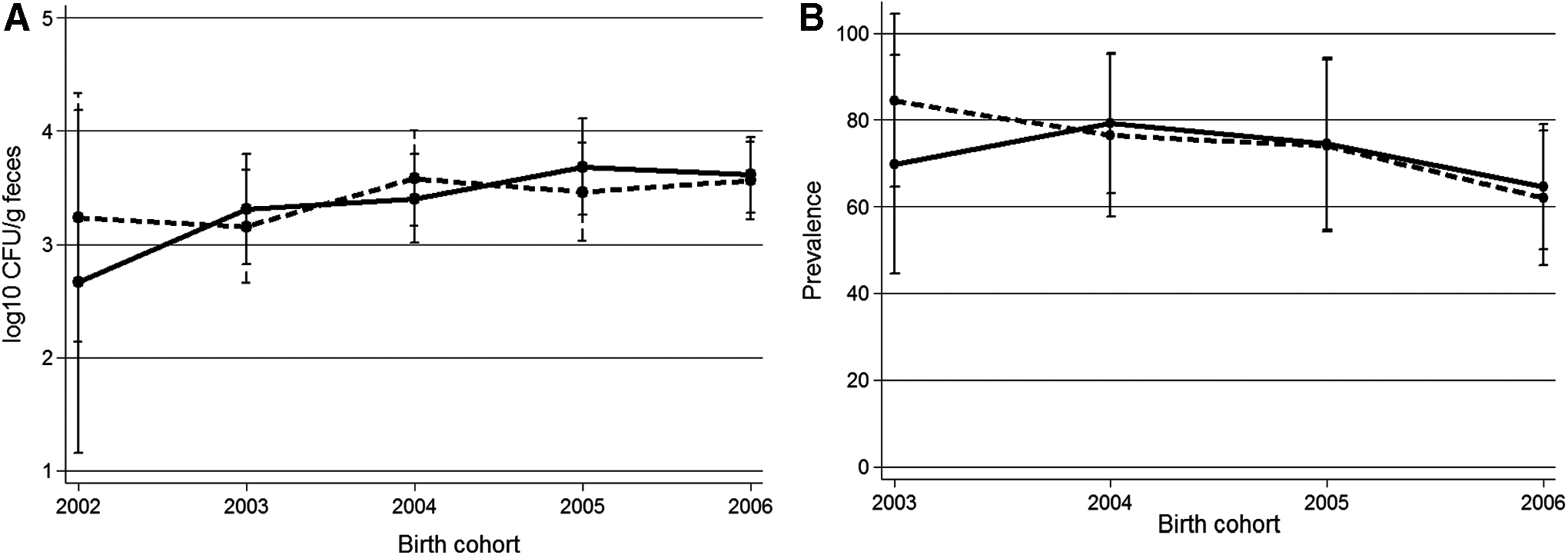
CFU counts of NTS enterococci and the prevalence of erythromycin-resistant enterococci isolated from ceftiofur-treated and nonantimicrobial-treated beef cows. Solid line represents the nonantimicrobial-treated group; dashed line represents the ceftiofur-treated group.
Phenotypic and genotypic ERYr and TETr of NTS and ERYr enterococci isolates
A total of 1,007 NTS enterococci isolates were examined for phenotypic and genotypic tetracycline and erythromycin resistance. Phenotypic TETr was detected in 16% of the NTS enterococci isolates, and tetM was detected from 9% of NTS enterococci isolates. There was a significant (p < 0.001) positive association between phenotypically observed TETr and the presence of tetM as tetM was detected from 55% of TETr NTS enterococci isolates (n = 160). Two percent of the NTS enterococci isolates were phenotypically ERYr, and ermB was detected from 2.1% of the NTS enterococci isolates. Among the ERYr NTS enterococci isolates (n = 20), 90% of them were positive for ermB with strong positive association between ERYr and ermB carriage (p < 0.001). All ERYr NTS isolates also were TETr with positive association between TETr and ERYr (Fisher's exact p < 0.001). There also was positive association (p < 0.001) between tetM and ermB carriage: tetM was detected from 57% of ermB-positive (n = 21) isolates compared with 8% detection among ermB-negative isolates (n = 988). However, there was no difference between ceftiofur-treated and nonantimicrobial-treated cows in the prevalence of ermB and tetM (Table 4).
For ERYr enterococci, ermB and tetM were each detected from 76% (n = 507) of the colonies tested (Table 4). Of the 387 ermB-positive isolates, 77.5% were also positive for tetM. The prevalence of ermB was significantly (p = 0.028) higher in ceftiofur-treated cows compared with nonantimicrobial-treated cows (80.6% vs. 72.3%). However, the prevalence of tetM was significantly (p < 0.001) higher in nonantimicrobial-treated cows compared with ceftiofur-treated cows (82.2% vs. 68.5%) (Table 4).
Discussion
Our primary goal was to determine the concentrations and prevalence of ARB (E. coli, Salmonella, and enterococci) in beef cows that were ≥8 years old and if the occurrences of ARB were associated with antimicrobial treatment. Multiple AMR studies3–5 have been conducted in beef cattle feedlots, but there is paucity of information on AMR in beef cow–calf operations. Our study provides information on the background level of AMR in the beef cow herds that supply beef calves to feedlots. We focused on older cows, which if culled, are presented for slaughter at cull beef-processing plants, presenting potential food safety risk from ARB associated with culled beef cows. Cows 8 years or older were studied on the assumption that older cows are more likely to be culled compared with younger cows from the breeding herd as a result of aging, reproductive performance, or physical injury; average age at culling typically is between 6 and 8 years. 37 Our study design was supported by the fact that a higher proportion of cows (26% [176/690; 95% CI: 22–29%]) were culled from cows born in or before 2006 when compared with cows born after 2006 (8% [379/5,079; 95% CI: 6.8–8.2%]) in the present study.
In the current study, the concentrations of 3GCr E. coli, COTr E. coli, 3GCr S. enterica, and ERYr enterococci in fecal samples from beef cows either were not enumerable or enumerable only from few samples, indicating low levels of bacteria resistant to the selected antimicrobials. This is of note as the study population represents 269 antimicrobial treatments and 162 of those treatments were 3GC administrations (Table 3). Because the concentrations of these target organisms were usually below the limit of detection for the enumeration assay, enrichment of the bacterial populations was required to provide prevalence estimates. As such, only a few cells may produce a positive detection. With the increased sensitivity of detection after enrichment, observed prevalence was 3GCr E. coli (17%), COTr E. coli (22%), 3GCr Salmonella (0%), and NALr Salmonella (0%). However, TETr E. coli were enumerable from 31% of the fecal samples and TETr E. coli prevalence was 88%, indicating the high level of TETr E. coli among beef cows. While only 1% of fecal samples had enumerable ERYr enterococci, ERYr enterococci were found in 69% of cows.
Lack of apparent differences in the occurrence of ARB between ceftiofur-treated and nonantimicrobial-treated cows could be attributed to two main effects: (1) mixing treated and nontreated cows in the same herd3,6,13 and (2) animal-level effects on ARB due to antimicrobial administration are short-lived.3–6 This would affect the association between ceftiofur treatment and AMR toward the null of no association. Even though cows were individually treated, there also could be an effect at the group level. It should be noted that there were 162 cows in the study population that received ceftiofur treatments (Table 2); yet, there were only two cows that had levels of 3GCr E. coli above 200 CFU/g of feces (the lowest limit of detection for the enumeration assay) and they were from the nonantimicrobial-treated group. These ceftiofur treatments resulted in a 3GCr E. coli prevalence of 17%. Since the prevalence assay utilizes primary and secondary enrichment steps, it takes only a few target cells to produce a positive result and still these treatments did not lead to a majority of the samples harboring detectable levels of 3GCr E. coli. Furthermore, the levels of 3GCr E. coli found in this study are equivalent to the low levels of 3GCr E. coli found in soil samples from environments (relict prairie and urban lake) not considered to be directly impacted by municipal or agricultural wastes. 18 While this comparison is between fecal samples and soil samples, the enumeration and enrichment detection methods used for each study were nearly identical.
Studies reporting AMR in beef cows are limited. In pooled fecal samples collected from feedlot cattle and cow–calf farms in Ontario, Canada, Carson et al. 15 reported lower AMR in E. coli isolates from the cow–calf farms compared with that obtained from feedlot cattle. However, it is difficult to make direct comparison because of methodological differences where Carson et al. 15 used isolate-based inferences after testing individual isolates for their antimicrobial susceptibility. In the present study, sample-based inferences were used through a direct plating method incorporating pre-enrichment and enrichment steps, in which a fecal sample was considered positive for ARB if it yielded at least one resistant bacterial colony by either method. Despite methodological differences in the sampling technique (pooled vs. individual animal sampling) and susceptibility testing methods, Carson et al. reported lower prevalence of ceftiofur resistance (0%), trimethoprim–sulfamethoxazole resistance (2.5%), and tetracycline resistance (9.6%) compared with the prevalence of 3GCr E. coli (17%), COTr E. coli (22%), and TETr E. coli (88%) observed in our study. In this study, we also screened the NTS E. coli isolates for AMR, thereby generating a comparable data set with that of Carson et al. We found that 17.6%, 0%, and 0% of the isolates (n = 729) were resistant to tetracycline, 3GC, and trimethoprim–sulfamethoxazole, respectively, which were very similar to the results reported by Carson et al.
To our knowledge, the present study is the first that reports AMR from individually sampled beef cows. Clearly, factors other than antimicrobial use play an important role for the occurrence and persistence of resistant bacteria. For instance, we observed high prevalence of TETr E. coli, but we did not observe a significant difference between tetracycline-treated and nontetracycline-treated groups among the ceftiofur-treated cows. Walk et al. 38 concluded that tetracycline resistance genetic determinants had established a steady state and that their presence was unrelated to antimicrobial usage. A similar mechanism may be responsible for the high prevalence of ERYr enterococci (66%) in the absence of macrolide treatments as the study population received only one macrolide treatment occurring 97 months before sampling. Other factors potentially contributing to the occurrence of ARB include coselection and genetic linkage between AMR determinants. 39 For instance, we observed in enterococci isolates that TETr was coselected with ERYr and that tetM and ermB carriage were strongly associated. Similarly, previously published studies23,24 reported strong association between TETr and 3GCr E. coli and between tetA and blaCMY-2. In this study, we also observed that tetA is more associated with 3GCr and COTr in E. coli than tetB, suggesting that tetA tends to be more likely to be coselected with other antimicrobials. It has been reported in E. coli from swine that while tetA was significantly associated with multidrug resistance (MDR), tetB was not associated with MDR. 23 Conversely, in TETr E. coli isolated from tetracycline-containing media and determined by susceptibility testing, tetB is approximately two to three times as prevalent as tetA. This suggests that MDR E. coli was not common in the beef cow population studied. 23
To conclude, in an attempt to correlate antimicrobial treatment records with AMR occurrence, we found indications that factors other than antimicrobial use strongly influenced the levels of ARB in feces of beef cows. Surprisingly, the most common antimicrobial treatment (162 uses of ceftiofur) resulted in 3GCr E. coli prevalence (17%) similar to that of untreated soil, while ERYr enterococci were detected in 69% of the samples with only one macrolide treatment in the entire study group. Further study is needed to identify the factors other than AMR selective pressure that contribute to changes in AMR bacterial populations associated with beef cows.
Footnotes
Acknowledgments
The authors thank Trent Ahlers, Kerry Brader, Julie Dyer, Frank Reno, Alberto Alvarado, Sarah Knox, and Darell Light for their technical support and Jody Gallagher for her secretarial support.
Disclosure Statement
No competing financial interests exist. Names are necessary to report factually on available data; however, the USDA neither guarantees nor warrants the standard of the product, and the use of the name by USDA implies no approval of the product to the exclusion of others that may also be suitable. USDA is an equal opportunity provider and employer.
References
Supplementary Material
Please find the following supplemental material available below.
For Open Access articles published under a Creative Commons License, all supplemental material carries the same license as the article it is associated with.
For non-Open Access articles published, all supplemental material carries a non-exclusive license, and permission requests for re-use of supplemental material or any part of supplemental material shall be sent directly to the copyright owner as specified in the copyright notice associated with the article.
