




Abstract
Six carbapenem-resistant isolates of Acinetobacter baumannii were recovered from untreated and treated municipal wastewater of the capital city of Zagreb, Croatia. Molecular identification of environmental isolates of A. baumannii was performed by amplification, sequencing, and phylogenetic analyses of rpoB gene. The presence of blaOXA genes encoding OXA-type carbapenemases (OXA-51-like, OXA-23, and OXA-40-like) was confirmed by multiplex PCR and sequencing. Phylogenetic analyses corroborated the affiliation of detected blaOXA genes to three different clusters and showed association of environmental OXAs with those described from clinical isolates. This result suggests that isolates recovered from municipal wastewater are most probably of clinical origin. Furthermore, the presence of OXA-40-like (OXA-72) in an environmental A. baumannii isolate is reported for the first time. Persistence of A. baumannii harboring the clinically important OXAs in the wastewater treatment process poses a potentially significant source for horizontal gene transfer and implications for wider spread of antibiotic resistance genes.
Introduction
T
While it is known that A. baumannii can be readily isolated from patients and hospital environmental sources during outbreaks, the reservoirs for nosocomial infection with this pathogen still remain uncertain. Although this species can rarely be isolated from some environmental samples such as soil or water, its natural habitat outside the hospitals has not been clearly defined. 6 Distribution of oxacillinases is well documented in A. baumannii of clinical origin, while reports on the occurrence of oxacillinases in environmental isolates of A. baumannii are scarce. Besides hospitals, nursing homes can also act as a source of dissemination of blaOXA genes in the environment and the possible influx to the hospital settings. 7 It is not disputed that carbapenem resistance is a consequence of the overuse of carbapenem antibiotics, but this can only partly explain the growing trend of resistance in the world. In contrast, the first carbapenem-resistant isolates had appeared before carbapenem antibiotics started to be used in the United Kingdom. 8 The first environmental isolate of A. baumannii harboring the blaOXA-23 gene was described from the water of the Seine River. 9 Three isolates of OXA-23-producing A. baumannii were found in untreated hospital wastewater from Brazil. 10 One A. baumannii isolate from Lebanon harbored the blaOXA-143 gene. 11 One isolate of OXA-58-producing Acinetobacter johnsonii and three isolates of OXA-23-producing Acinetobacter towneri were recovered from environmental samples in Angola where carbapenems were not available on the market. 12 The presence of carbapenem-resistant isolates of A. baumannii in the environment is becoming a potential source for the spread of resistance genes and poses a serious problem.
In this study, we report the finding of six carbapenem-resistant isolates of A. baumannii recovered from untreated and treated municipal wastewater, with four of them producing acquired OXA-23 and OXA-40-like enzymes.
Materials and Methods
Isolation of A. baumannii
Sampling of influent and effluent wastewater was performed at the largest Croatian wastewater treatment plant of the capital city of Zagreb. This treatment plant is designed for the secondary treatment (by using the activated sludge) of municipal wastewater for 1,200,000 inhabitants. Municipal wastewater from combined sewage systems consists of domestic, industrial, untreated hospital, and storm wastewaters. The composite samples of influent and effluent wastewater were collected in June and October 2014 and in April and October 2014, respectively. The composites were prepared by using the automatic sampler from a 24-hr proportional flow of wastewater. Every 15 min, 138 ml of influent wastewater and 160 ml of effluent wastewater were sampled during 24 hr. The samples of wastewater were concentrated on the sterile membrane filters of pore size 0.45 μm in triplicate both before (10 ml of effluent) and after dilution (100–10−1 ml of effluent and 10−1–10−3 ml of influent) in sterile peptone water. Filters were directly placed on the plates of CHROMagar Acinetobacter supplemented with CR102 (CHROMagar) and 15 mg/L of cefsulodin sodium salt hydrate (Sigma-Aldrich). The plates were incubated at 42°C/48 hr. Presumptive colonies of A. baumannii were recultivated (42°C/24 hr) on the same selective plates and then on nutrient agar.
Identification and molecular characterization of A. baumannii isolates
Identification of A. baumannii was performed by routine bacteriological techniques and VITEK 2 system (BioMerieux). Isolates were confirmed by matrix-assisted laser desorption/ionization time of flight mass spectrometry MALDI-TOF MS (software version 3.0, Microflex LT; Bruker Daltonics) on cell extracts. 13 Molecular identification of A. baumannii was performed by amplification of a fragment of rpoB gene encoding RNA polymerase β-subunit by using the rpoB + 1627/rpoB-2231 primer pair as previously described. 14
All obtained amplicons were directly sequenced on both strands (commercial service, Macrogen, Inc.). Raw nucleotide sequences were assembled and edited by using Sequencher™ 4.7 software (www.genecodes.com/) and deposited in GenBank. Sequences were aligned with ClustalX 2.0 15 and phylogenetic analyses performed with MEGA5 software 16 by using the neighbor-joining method with a number of differences. Bootstrap analyses were performed (500 replicates) to estimate the stability of nodes and to support the inferred clades.
Antibiotic susceptibility was assessed by the disk diffusion method. The minimum inhibitory concentration (MIC) values were confirmed by the VITEK 2 system or E-tests (AB BIODISK) and interpreted according to the European Committee on Antimicrobial Susceptibility Testing criteria. 17 The carbapenemase activity was searched by the RAPIDEC Carba NP test (BioMerieux). The presence of genes of blaOXA lineage, which encode OXA-type carbapenemases, was confirmed by multiplex PCR with specific primers for blaOXA-51-like, blaOXA-40-like, blaOXA-23-like, and blaOXA-58-like genes, according to Woodford et al. 18 Amplified fragments of blaOXA genes were sequenced, edited, and analyzed as described previously for the rpoB gene.
Results
On two sampling occasions of influent and effluent wastewater, six A. baumannii were isolated; four from influent and two from effluent wastewater. All isolates were determined by the VITEK 2 system as the Acinetobacter calcoaceticus–A. baumannii complex. Identification of isolates by MALDI-TOF MS gave reliable score values (2.048–2.352) when compared to strains of bacteria in the MALDI Biotyper database. The fragment of rpoB gene of ∼600 bp was amplified from all A. baumannii isolates (data not shown). Sequencing and subsequent phylogenetic analyses confirmed the identification of recovered isolates as A. baumannii with 100% sequence identity to the reference sequence from the GenBank (Fig. 1).
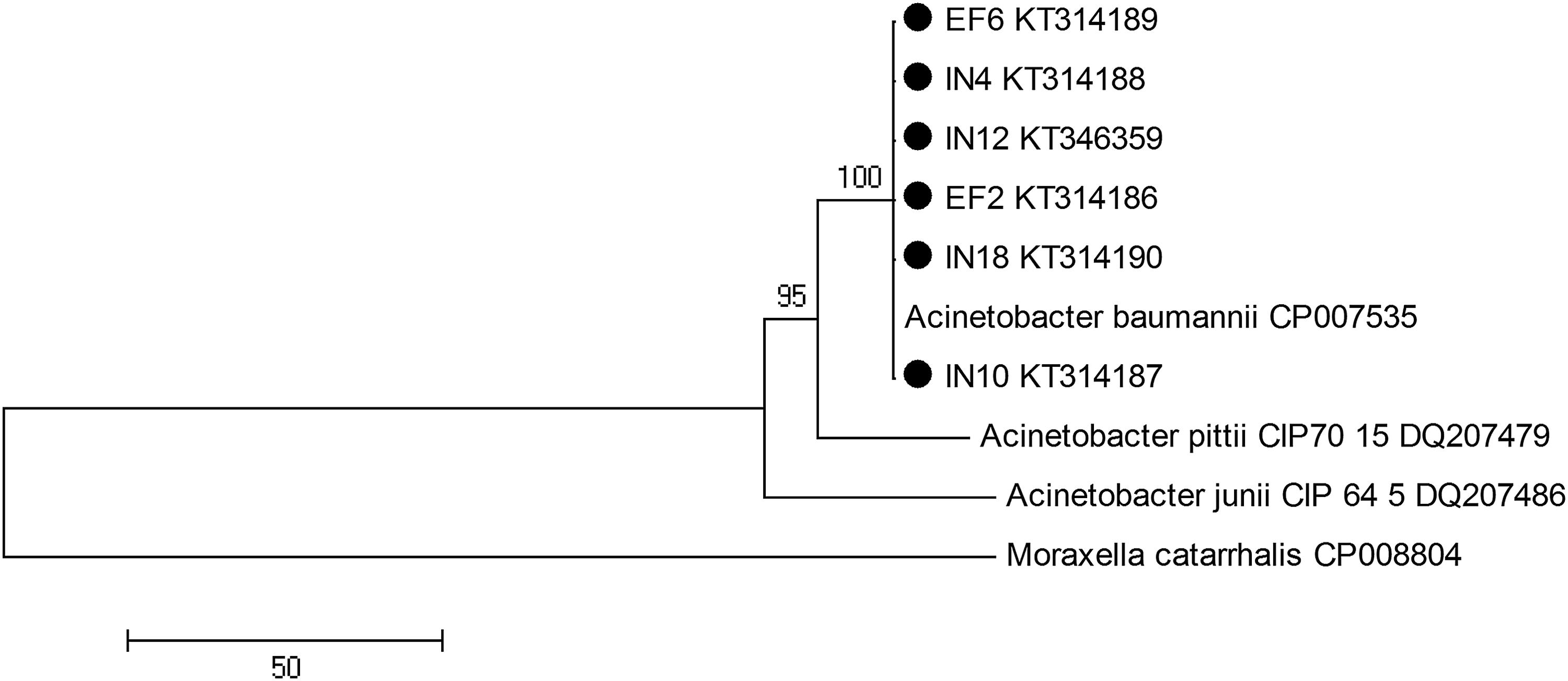
Phylogenetic tree (NJ method, number of differences) constructed on the basis of rpoB gene representing molecular identification of Acinetobacter baumannii strains. GenBank accession numbers are given next to the name of each strain. Moraxella catarrhalis rpoB gene sequence was used as an outgroup to root the tree. Black dots represent the sequences of strains analyzed in this study. NJ, neighbor-joining.
According to MIC values of tested antibiotics (Table 1), all isolates of A. baumannii were resistant to carbapenems and the majority of tested antibiotics, with the exception of trimethoprim–sulfamethoxazole, amikacin, and colistin. Therefore, all isolates were classified as multidrug resistant. The carbapenemase-induced carbapenem degradation by A. baumannii isolates from wastewater was confirmed by the Carba NP test. The presence of genes of blaOXA lineage, which encode OXA-type carbapenemases, was further confirmed by multiplex PCR. All A. baumannii isolates harbored the blaOXA-51 gene, isolates IN4, IN18, and EF2 harbored blaOXA-23, while one isolate (IN12) harbored the blaOXA-40-like gene (Table 1). Phylogenetic analyses of all amplified and sequenced blaOXA fragments clearly supported the affiliation of detected blaOXA genes to three different clusters: blaOXA-51-like, blaOXA-23, and blaOXA-40-like (Fig. 2). All blaOXA-51 gene sequences formed one branch and all except the one from EF6 isolate showed 100% sequence identity when compared to previously reported blaOXA-65, blaOXA-66, blaOXA-76, and other blaOXA-51-like sequences originating from clinical samples. Sequences of blaOXA-23 amplified from IN4, IN18, and EF2 isolates were shown to be identical as those from clinical isolates available in GenBank. For blaOXA-40-like from the isolate IN12, it was determined that it shared 100% sequence identity with the blaOXA-72 sequence also originating from clinical isolates (Fig. 2).
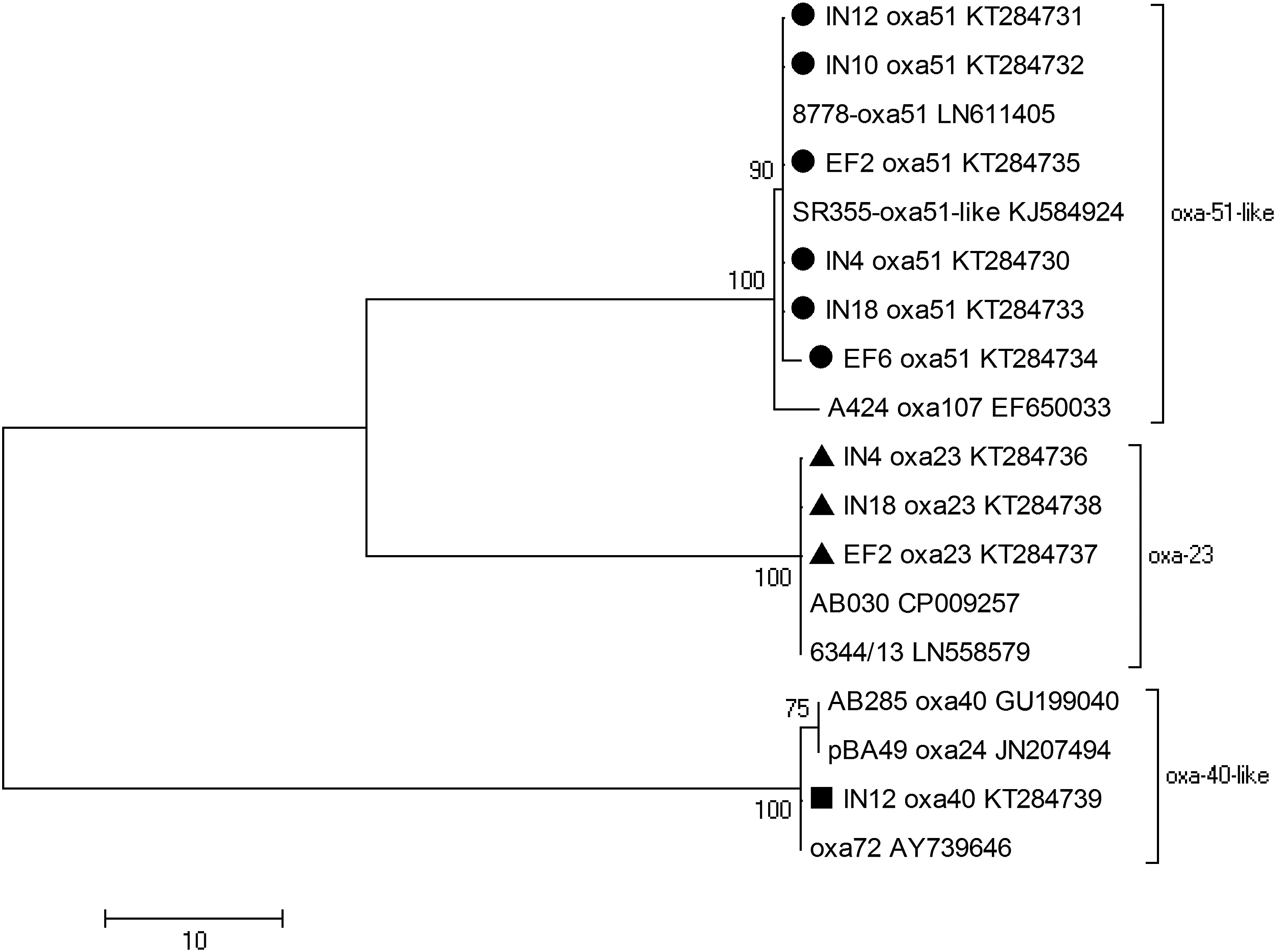
Unrooted phylogentic tree (NJ method, number of differences) constructed on the basis of blaOXA genes encoding OXA-type carbapenemases. GenBank accession numbers are given next to the name of each strain. Gene sequences of blaOXA-51 type are marked with black dots; the black triangles denote blaOXA-23 type, while the black square represents blaOXA-40-like gene sequence.
Isolates named as IN were isolated from influent wastewater in June and October 2014, and isolates named as EF were isolated from effluent wastewater in April and October 2014.
Resistant according to EUCAST criteria.
AMK, amikacin; CIP, ciprofloxacin; CST, colistin; GEN, gentamicin; IPM, imipenem; LVX, levofloxacin; MEM, meropenem; MIC, minimum inhibitory concentration; SXT, trimethoprim–sulfamethoxazole; TOB, tobramycin.
Discussion
The carbapenem resistance of all clinical A. baumannii isolates monitored in Croatian hospitals dramatically increased in the last few years, from 10% in 2008 to 78% in 2013. 19 The first outbreak of carbapenem-resistant isolates in Croatia has been proved in 2002 at the University Hospital Centre Split (UHCS) in southern Croatia. The analysis of carbapenem resistance mechanisms found that resistance was mediated by hyperproduction of OXA-107 (a variant of OXA-51 enzyme, precisely OXA-69) due to the ISAba1 location upstream of the gene. 20 This mechanism of resistance was also confirmed in some other hospitals in northern Croatia until 2008 and the isolates from that period belonged to the first predominant clone in the world, Global Clone GC1. In 2009, the first isolation of carbapenem-resistant strains belonging to Global Clone GC2 with acquired OXA-72 (an OXA-40-type enzyme) was proved at the UHCS in southern Croatia and later in northern Croatia, including the capital city of Zagreb.21,22 Sequencing of the blaOXA-51-like amplicons from these isolates in UHCS revealed the presence of the OXA-90 gene (a variant of OXA-66 inside OXA-51 group of enzyme).
In the scope of this study, the multidrug-resistant A. baumannii isolated from municipal wastewater harbored the blaOXA-51-like gene, which was closely related to the previously described blaOXA-66 in clinical isolates from Croatia.21,22 In this investigation, we identified the presence of acquired OXA-40-like carbapenem resistance gene in one environmental isolate of A. baumannii for the first time. This blaOXA-40-like gene belongs to the OXA-72 subgroup (Fig. 2), which was previously reported to be present in clinical isolates from different regions of Croatia, including the Zagreb area.21–23 The blaOXA-23-like gene was detected in three A. baumannii from wastewater (Fig. 2). Although expanded all over the world, the OXA-23 group of OXAs poses a minor role in carbapenem-resistant hospital-acquired infections caused by A. baumannii in Croatia. In the nationwide investigation in northern Croatia and Istria during 2009, only 6 of more than a 100 collected carbapenem-resistant isolates of A. baumannii possessed the blaOXA-23-like gene. 22
Our study suggests a potential risk of OXA-producing A. baumannii spread in Croatia through municipal wastewater and seems not to be restricted to the hospital settings. Moreover, the findings of OXAs in environmental isolates of A. baumannii related to clinical isolates suggest that wastewater isolates could originate from hospital wastewaters. In Croatia, the hospital wastewaters are not pretreated before their discharge into the sewage system. Since there are studies suggesting that plasmid-located blaOXA-23-like and blaOXA-40-like genes may be self-transferable,24,25 the untreated hospital wastewaters and consequently municipal wastewaters represent a potential epidemiological reservoir of carbapenem resistance genes. The possible impact on the occurrence of infection outside the hospital environment should be investigated.
Footnotes
Acknowledgments
This work has been supported by the University of Zagreb (Project No. 202751) and, in part, by the Croatian Science Foundation (Project No. IP-2014-09-5656).
This research fully complies with the ethical standards applicable for this Journal and the relevant national and international ethics-related rules and professional codes of conduct.
Disclosure Statement
No competing financial interests exist.