




Abstract
Acinetobacter baumannii is an emerging nosocomial pathogen with also emerging resistance to different antibiotics. Multidrug and pan drug-resistant clinical isolates were reported worldwide. Here we report the first evidence of pan drug-resistant environmental isolate of A. baumannii. The isolate was recovered from the effluent of secondary treated municipal wastewater of the City of Zagreb, Croatia. The isolate was resistant to penicillins/β-lactamase inhibitors, carbapenems, fluoroquinolones, aminoglycosides, folate pathway inhibitors, and polymyxins, except intermediately susceptible to minocycline and tigecycline. Intrinsic chromosomally located blaOXA-51-like gene and acquired plasmid-located blaOXA-23-like gene were related to clinical isolates. Pan drug-resistant A. baumannii can occur in natural environments outside of the hospital. Secondary treated municipal wastewater represents a potential epidemiological reservoir of pan drug-resistant A. baumannii and carbapenem resistance gene.
Introduction
M
In Croatia, the first clinical carbapenem-resistant isolate of A. baumannii was recovered in 2002 in southern part of Croatia. 6 Over the period of 7 years, carbapenem resistance in clinical isolates of A. baumannii did not exceed 30%, but since 2009, incidence of carbapenem resistance drastically increased, especially in two biggest clinical centers in northern and southern parts of Croatia. 7 Carbapenem resistance in A. baumannii has rapidly spread throughout Croatia, and in 2014 nonsusceptibility to carbapenems reached 82%. 8 This resulted in a change of treatment options for infections caused by MDR A. baumannii, foregrounding ampicillin/sulbactam and colistin as the only therapeutic choice. Recently published data confirmed the occurrence of environmental carbapenem-resistant isolates of A. baumannii related to clinical isolates in untreated and treated wastewater in Croatia. 9 However, to date there is no report on the occurrence of either clinical or environmental pan drug-resistant isolates of A. baumannii in Croatia. Here we report the first evidence of pan drug-resistant A. baumannii in treated wastewater in Zagreb, Croatia.
Materials and Methods
The composite 24 hr sample of effluent wastewater was collected on September 9, 2015 at the secondary type municipal wastewater treatment plant of the City of Zagreb, Croatia. 10 The isolation of A. baumannii was performed at 42°C/48 hr on CHROMagar Acinetobacter (CHROMagar) supplemented with CR102 and 15 mg/L cefsulodin sodium salt hydrate (Sigma-Aldrich). Identification of isolate was performed by routine bacteriological techniques, Vitek 2 system (BioMerieux), and MALDI-TOF MS (software version 3.0, Microflex LT; Bruker Daltonics) on cell extracts. 11 Molecular identification was performed by amplification of a fragment of rpoB gene encoding RNA polymerase β-subunit by using rpoB+1627/rpoB-2231 primer pair. 12 Amplified fragments were sequenced, edited, and analyzed as described previously. 9
Susceptibility testing was done by using Vitek 2 system and E-test, and minimum inhibitory concentrations (MICs) were interpreted according to EUCAST and CLSI criteria13,14 for all antibiotics with defined breakpoints for Acinetobacter spp., except tigecycline where breakpoints for Enterobacteriaceae were used. The presence of genes of blaOXA lineage that encode OXA-type carbapenemases was searched by multiplex polymerase chain reaction (PCR) with specific primers for blaOXA-51-like, blaOXA-40-like, blaOXA-23-like, and blaOXA-58-like genes. 15
Results and Discussion
The isolate of A. baumannii named EF7 was recovered from 0.5 ml of the secondary treated municipal wastewater of the City of Zagreb. By phenotypical analyses and Vitek 2 system, the isolate was determined as A. calcoaceticus–A. baumannii complex. MALDI-TOF MS analysis gave the score value of 2.150, which indicates the secure genus and probable species identification. Phylogenetic analysis of the ∼600 bp fragment of rpoB gene confirmed the identification of isolate as A. baumannii with 100% sequence identity (KX468061) to the reference sequence from GenBank (CP007535).
The isolate was resistant to all tested antibiotics (penicillins/β-lactamase inhibitors, carbapenems, fluoroquinolones, aminoglycosides, folate pathway inhibitors, and polymyxins) except intermediately susceptible to tetracyclines (Table 1), thus categorized as pan drug resistant. 16 The isolate remained intermediately susceptible to minocycline (MIC: 8 mg/L), which is not at market in Croatia, and tigecycline (MIC: 2 mg/L), which is recently present at the market in Croatia and is accepted as part of the combined treatment of MDR Acinetobacter infections. Environmental isolate EF7 showed very similar antibiotic resistance profile to pan drug-resistant clinical isolate of A. baumannii recovered in 2013 in Germany 5 with the exception of tigecycline resistance in the German isolate. The levels of antibiotic resistance of isolate EF7 were comparable with those of the clinical isolates of A. baumannii in Croatia,7,17 with exception that no clinical isolates resistant both to ampicillin/sulbactam and colistin were registered. Ampicillin/sulbactam and colistin were used in recommended therapy in Zagreb's hospitals in recent years, including the period of wastewater sampling. It is possible that the pan drug resistance was developed in hospital and isolate EF7 was discharged into sewage system.
Resistant.
Intermediate according to EUCAST and CLSI criteria.
AMK, amikacin; CIP, ciprofloxacin; CST, colistin; GEN, gentamicin; IMI, imipenem; LVX, levofloxacin; MEM, meropenem; MIC, minimum inhibitory concentration; MIN, minocycline;; SAM, ampicillin/sulbactam; SXT, trimethoprim/sulfamethoxazole; TGC, tigecycline; TIM, ticarcillin/clavulanic acid; TOB, tobramycin.
Multiplex PCR and sequencing confirmed the presence of both intrinsic chromosomally located blaOXA-51-like gene and acquired plasmid-located blaOXA-23-like gene. Sequences of blaOXA-51-like (KX468062) and blaOXA-23-like (KX468063) genes showed 100% identity with sequences from clinical isolates available in GenBank (Fig. 1), which suggest the potential origin of isolate EF7 in hospitalized patients or hospital wastewaters. 18 Untreated hospital wastewaters in Zagreb are directly discharged into sewage system, which is collected and treated at investigated central wastewater treatment plant. Removal of carbapenem-resistant bacteria and A. baumannii in the secondary wastewater treatment plant is moderate. 10 Thus, certain number of A. baumannii is released through the effluent wastewater into the natural recipient Sava River. In aquatic environmental conditions MDR A. baumannii has the potential to multiply and survive up to 50 days. 10 Therefore, the viable pan drug-resistant A. baumannii recovered from effluent wastewater could be easily spread through the natural water body, which could represent an environmental reservoir of this emerging pathogen. Moreover, since the plasmid-located blaOXA-23-like gene in isolate EF7 may be self-transferable, 19 the effluent wastewater represents a potential epidemiological reservoir of the carbapenem resistance gene. The impact of secondary treated municipal wastewaters on the occurrence of community-acquired A. baumannii infections outside the hospital environment should be further investigated.
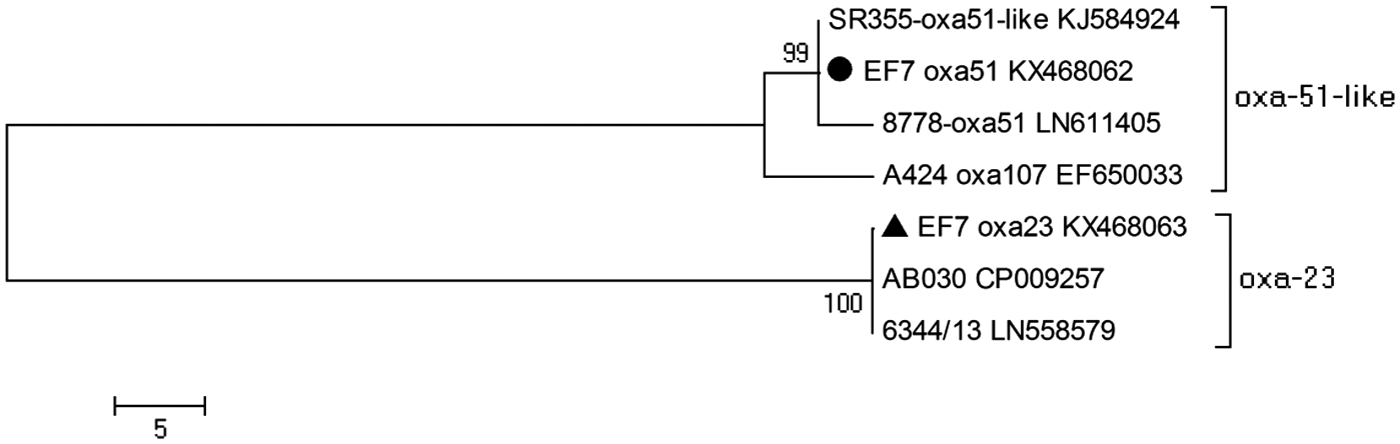
Unrooted phylogentic tree (NJ method, number of differences) constructed on the basis of blaOXA genes encoding OXA-type carbapenemases. GenBank accession numbers are given next to the name of each strain. Gene sequences of blaOXA-51 type are marked with a black dot and of blaOXA-23 type with a black triangle.
Footnotes
Acknowledgments
This work has been supported by the Croatian Science Foundation (Project No. IP-2014-09-5656). We thank M. Ganjto, Zagreb Wastewater Management and Operation Ltd. for providing the wastewater sample and S. Kazazic, Rudjer Boskovic Institute for MALDI-TOF MS identification.
Compliance with Ethical Standards
This research fully complies with Ethical Standards applicable for this journal and the relevant national and international ethics-related rules and professional codes of conduct.
Disclosure Statement
No competing financial interests exist.