




Abstract
This study aims to demonstrate the antibiotic resistance and its association with disinfectant and heavy metal resistance in 152 Salmonella isolates recovered from retail foods of animal origins. Susceptibility testing demonstrated that 92.8% isolates were resistant to at least one antibiotic, and the resistance was highest to oxytetracycline (80.9%), followed by trimethoprim (64.5%), amoxicillin (28.9%), ampicillin (28.3%), levofloxacin (21.7%), ciprofloxacin (16.4%), and gentamicin (10.5%), respectively. The blaTEM and tetA genes (44.7%) were commonly present. The qacF and qacEΔ1 genes were detected in 18.4% and 8.6% of all isolates. The Cu-resistance genes pcoR, pcoC, and pcoA were the most prevalent (20.4–40.8%), followed by Hg-resistance gene merA (17.8%) and As-resistance genes arsB (6.6%). The antibiotic resistance was highly associated with disinfectant or certain heavy metal resistance genes. Most notably, the association among Cu-resistance genes (pcoC, pcoR), disinfectant resistance genes (qacF, qacEΔ1), and tetracycline and sulfonamide resistance genes (tet, sul) was significant (p < 0.05). Pulsed-field gel electrophoresis revealed that Salmonella isolates was associated with supermarkets indicating the possibility of crosscontamination in farms or processing environment. This study indicated that retail meats may be a reservoir for the dissemination of antibiotic-resistant Salmonella and using disinfectants for decontamination or metals in livestock may provide a pressure for coselecting strains with acquired resistance to other antimicrobials.
Introduction
S
Approaches to prevent and control salmonellosis in livestock have been dependent on the use of antibiotics for many years. However, numerous antibiotic-resistant bacteria have been reported in different countries.11–13 Most of the antibiotic-resistant Salmonella are of zoonotic origin and acquire their resistance in food animal hosts, which might cause human infections through the food chain. 14 Therefore, antibiotic resistance in pathogenic bacteria from animals can be a serious threat to public health. 15
Disinfectants are extensively used to control infection and/or microbial contamination in food manufacturing facilities and environments. Among the different disinfectants currently available, quaternary ammonium compounds (QACs), such as benzalkonium chloride (BC) and cetylpyridinium chloride (CTPC), are used extensively because these compounds are nonirritating and noncorrosive with little toxicity and high antimicrobial efficacy over a wide pH range.16,17 The wide use and misuse of QACs in food environments can impose a selective pressure for bacteria and contribute to the emergence of disinfectant-resistant microbes. 18
Metal-containing compounds with antimicrobial or growth-promoting activity are also widely used as feed additive in food animals.19,20 Copper sulfate and organic arsenicals (e.g., phenylarsonic acid) are agents for therapy and growth, and mercury compounds have been usually used as disinfectants in food animal-producing environment for a number of years.20,21 Due to its stable and persistent features, when heavy metals accumulate to critical concentrations, they potentially trigger resistance to emerge within the food animal hosts. The heavy metal resistance genes (HMRGs) have also been identified in different environments. The genes that are responsible for resistance to arsenic (arsA), copper (copB), and zinc (czrC) have been observed in methicillin-resistant Staphylococcus aureus isolated from livestock. 20 Meanwhile, the genes czcA and arsB for cobalt and arsenic resistance, respectively, have been found in municipal wastewater treatment plants and associated with antibiotic resistance genes (ARGs). 22 Furthermore, the HMRGs appear to be predominantly plasmid mediated.21,23
Previously studies demonstrated that a relationship between the acquisition of HMRGs and ARGs, and antibiotic resistance may arise through coresistance or crossresistance to metals or coregulation of resistance pathways.20,24,25 The disinfectant resistance genes, as well as HMRGs, are commonly located in mobile genetic elements (MGEs).23,26,27 The widespread use of disinfectants has raised concerns over their possible involvement in the development of antimicrobial resistance, particularly coresistance to antibiotics.27,28 Therefore, under the pressure of concomitant use of antibiotics, heavy metals, and disinfectants, the potential coselection of resistance genes and the spread of acquired resistance is enhanced.22,29 However, little information was known about the occurrence of disinfectant and heavy metal resistance in Salmonella isolated from retail foods of animal origin. The current study investigated the prevalence of antibiotic, disinfectant, and heavy metal resistance in Salmonella isolates, determined the associations between antibiotic resistance and the presence of disinfectant (QACs) and/or HMRGs, and explored the genetic relatedness of Salmonella from retail foods of animal origin.
Materials and Methods
Sampling
A total of 327 raw meat samples, including pork (n = 137), chicken (n = 91), and beef (n = 99) were purchased from supermarkets in Sichuan Province between July 2013 and December 2014. The samples were aseptically collected in sterilized plastic bags and kept cold during transport from the supermarket to the laboratory.
Salmonella isolation and serotyping
The methods described by the United States Department of Agriculture Food Safety and Inspection Service were used to isolate Salmonella from retail foods of animal origin. 30 Briefly, 25 g portions of the products were used for culturing. Each sample was placed in separate sterile Erlenmeyer flasks with 225 ml buffered peptone water and incubated at 37°C in a water bath with shaking at 120 rpm for 6 h. After pre-enrichment, 10 and 1 ml of pre-enriched rinses were transferred to 100 ml each of the tetrathionate (TT; Beijing Land Bridge Technology Co., Ltd., Beijing, China) and Rappaport-Vassiliadis (RV; Beijing Land Bridge Technology Co., Ltd.) broths, respectively, and incubated at 42°C in a water bath with shaking at 160 rpm for 24 h. One loopful of overnight TT broth culture was streaked onto xylose lysine tergitol agar plates (Beijing Land Bridge Technology Co., Ltd.), whereas the RV broth was streaked onto agar of xylose lysine deoxycholate (Beijing Land Bridge Technology Co., Ltd.) and incubated at 37°C for 24 h.
Three presumptive Salmonella colonies from each plate were inoculated onto triple sugar iron (Beijing Land Bridge Technology Co., Ltd.) and urea agar slants (Beijing Land Bridge Technology Co., Ltd.). 30 After 24 h of incubation at 35°C, isolates with typical Salmonella phenotypes were confirmed by polymerase chain reaction (PCR). The PCR assays for identification of Salmonella were described previously. 30 A 284 bp PCR product targeting invA was amplified using the primers invA 139 (5′-GTGAAATTATCGCCA CGTTCGGGCAA-3′) and invA 141 (5′-TCATCGCACCGTCAAAGGAACC-3′). Amplicons were sequenced by Shanghai Sangon Bioengineering Co., Ltd. Nucleotide sequences were analyzed using BLAST software, which is available at the National Center for Biotechnology Information web-site (www.ncbi.nlm.nih.gov). If more than one isolate from each sample was Salmonella positive, only one was randomly selected and included in this study. 31 Confirmed isolates were stored in Tryptone Soya Broth (Hangzhou Microbial Reagent Co., Ltd.) containing 20% glycerol at −80°C until use. All isolates were further serotyped using commercial antisera purchased from Statens Serum Institute, Denmark, as described by the manufacturer.
Antibiotic resistance in Salmonella
The tested antibiotics were as follows: amoxicillin (AMX), amoxicillin/clavulanic acid (AMC), ampicillin (AMP), ceftiofur (EFT), oxytetracycline (OTC), ciprofloxacin (CIP), levofloxacin (LEV), trimethoprim (TMP), and gentamicin (GEN), all of which were purchased from Hangzhou Microbial Reagent Co., Ltd. The minimum inhibitory concentrations (MICs) were determined by using the agar dilution method, and breakpoints for antibiotic susceptible and/or resistant were determined as recommended by the Clinical and Laboratory Standards Institute (CLSI). 32 Escherichia coli ATCC 25922 and E. coli ATCC 35218 were used as the quality control strains. The resistance genes were examined through PCR using specific oligonucleotide primers as described previously.33–39 All results were confirmed by at least two independent experiments.
Disinfectant resistance in Salmonella
The disinfectants tested were BC (Chengdu Best-Reagent Company, Chengdu, China; ≥98% purity) and CTPC (J&K Chemical; ≥98% purity). The MICs of disinfectants were determined using the agar dilution method recommended by the CLSI.24,32 The range of concentrations used to determine the MICs of both disinfectants were 0.125 to 1,024 mg/L. E. coli ATCC 10536 was used as the quality control strain. The disinfectants' resistance genes [sugE(p), qacEΔ1, qacE, qacF, and qacG] were amplified and sequenced as described previously. 27
Detection of HMRGs
The 17 different HMRGs encoding for 9 heavy metal resistance were detected by PCR based on published methods.19–21,23,29,40–46 The positive controls that carried the resistance genes were confirmed using PCR followed by sequence analysis (Sangon Biotech, Shanghai, China).
Pulsed-field gel electrophoresis
All the isolates were selected for pulsed-field gel electrophoresis (PFGE) analysis using the PulseNet protocol (www.cdc.gov/pulsenet/PDF/ecoli-shigella-salmonella-pfge-protocol-508c.pdf). The XbaI-digested DNA fragments were analyzed using 1% agarose gels and a CHEF MAPPER electrophoresis system (Bio-Rad, Hercules, CA). The electrophoresis conditions were as previously described. 47 Salmonella enterica serovar, Braenderup H9812, was used as a marker. PFGE results were analyzed by BioNumerics software, and banding patterns were compared using Dice coefficients with a 1.5% band position tolerance.
Data analysis
Chi-squared test of independence or Fisher's exact test was performed to analyze data using SPSS v.12 (SPSS, Inc., 1989–2003). A p-value less than 0.05 was considered statistically significant for comparison.
Results
Prevalence and serotypes of Salmonella
Of the 327 retail meat samples, 46.5% (n = 152) were contaminated with Salmonella. The most common prevalence was observed in pork (n = 75, 54.7%), followed by chicken (n = 43, 47.3%) and beef (n = 34, 34.3%), respectively.
Among the 152 Salmonella isolates, 21 Salmonella serotypes were detected. Salmonella Derby was the most prevalent (28.9%, n = 44), followed by Salmonella Typhimurium (15.8%, n = 24), Salmonella Rissen (15.8%, n = 24), Salmonella Enteritidis (9.9%, n = 15), and Salmonella London (5.9%, n = 9). The top five serotypes accounted for more than 75% of the strains.
The distribution of serotypes varied by meat types (Table 1). In chicken, the predominant serotypes were Salmonella Enteritidis (34.9%, n = 15), Salmonella Derby (18.6%, n = 8), and Salmonella Typhimurium (9.3%, n = 4). Six serotypes, including Salmonella Enteritidis, Salmonella Agona, Salmonella Corvallis, Salmonella Hadar, Salmonella Indiana, and Salmonella Kouka, were only isolated from chicken. For pork samples, most isolates were contaminated with Salmonella Derby (32.0%, n = 24), followed by Salmonella Rissen (24.0%, n = 18), and Salmonella Typhimurium (14.7%, n = 11). The Uganda and Waycross serotypes were only detected in pork. In beef samples, the top three serotypes were Salmonella Derby (35.3%, n = 12), Salmonella Typhimurium (26.5%, n = 9), and Salmonella Rissen (8.8%, n = 3), whereas Salmonella Albany and Salmonella Give were only detected in beef.
Phenotype and genotype of antibiotic resistance in Salmonella
In general, 92.8% (n = 141) Salmonella isolates demonstrated resistance to at least one antibiotic and 43.4% (n = 66) were multidrug resistant (MDR, resistance to at least three classes of antibiotics). As shown in Fig. 1, of all the resistant isolates, 80.9% (n = 123) were resistant to OTC, followed by TMP (64.5%, n = 98), AMX (28.9%, n = 44), AMP (28.3%, n = 43), LEV (21.7%, n = 33), CIP (16.4%, n = 25), and GEN (10.5%, n = 16). Moreover, 48 resistance profiles were observed in the resistant isolates, and the top three frequent resistance profiles were OTC (17.7%, n = 25), OTC–TMP (17.7%, n = 25), and AMX–OTC–TMP (11.3%, n = 16). The frequency of antibiotic resistance varied depending on meat types (Fig. 1) and serotypes (Fig. 2). Notably, of the isolates from pork, 97.3% (n = 73) showed resistance to antibiotics, followed by 94.1% (n = 32) in beef, and 83.7% (n = 36) in chicken. The prevalence of MDR Salmonella also was highest in pork (49.3%, n = 37), followed by chicken (44.2%, n = 19) and beef (n = 10, 29.4%). Besides, the prevalence of resistance to OTC and TMP was observed significantly higher in pork isolates than in beef and chicken isolates (p < 0.001), whereas a higher prevalence of resistance to AMP was observed in the isolates from chicken than from pork and beef isolates (p < 0.001). Interestingly, all Salmonella Typhimurium (n = 24) were resistant to at least one antibiotic, and high frequency of antibiotic resistance to LEV (p < 0.001) and CIP (p < 0.05) was observed in Salmonella London compared with the other serotypes.
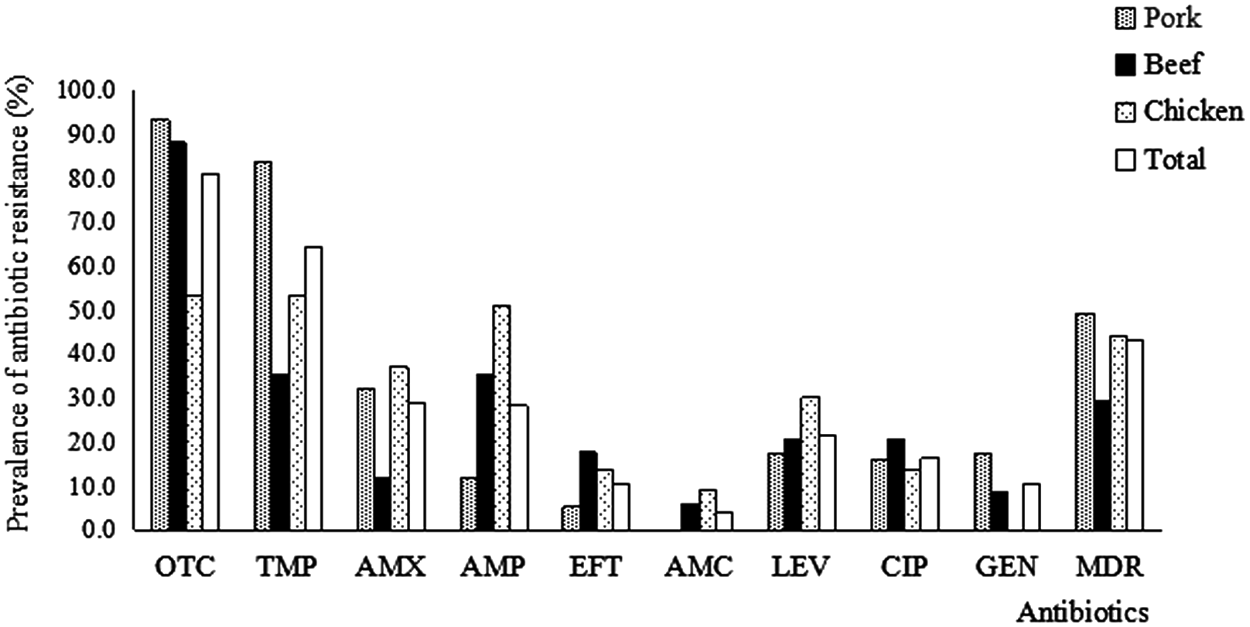
Antibiotic resistance of Salmonella isolated from different meat types. OTC, oxytetracycline; TMP, trimethoprim; AMX, amoxicillin; AMP, ampicillin; EFT, ceftiofur; AMC, amoxicillin/clavulanic acid; LEV, levofloxacin; CIP, ciprofloxacin; and GEN, gentamicin; MDR, multidrug resistance.

Antibiotic resistance of Salmonella isolated from different serotypes.
As shown in Fig. 3a, the blaTEM (44.7%, n = 34) gene was most common in β-lactam-resistant isolates. Of the aminoglycoside-resistant isolates, the ant(3")-Ia gene was detected in highest frequency (50%, n = 8). In tetracycline-resistant isolates, tetA (44.7%, n = 55) was the most prevalent. Notably, the prevalence of sul1, sul2, and sul3 were the same (20.4%, n = 20) in trimethoprim-resistant isolates. Only the qnrA gene was detected in 40% (n = 14) of quinolone-resistant isolates. Moreover, 68 ARGs combinations were observed in Salmonella, and the top three frequent resistance gene combinations were tetA (5.3%, n = 8), tetC (4.6%, n = 7), tetG (3.3%, n = 5), and tetA-tetG (3.3%, n = 5).
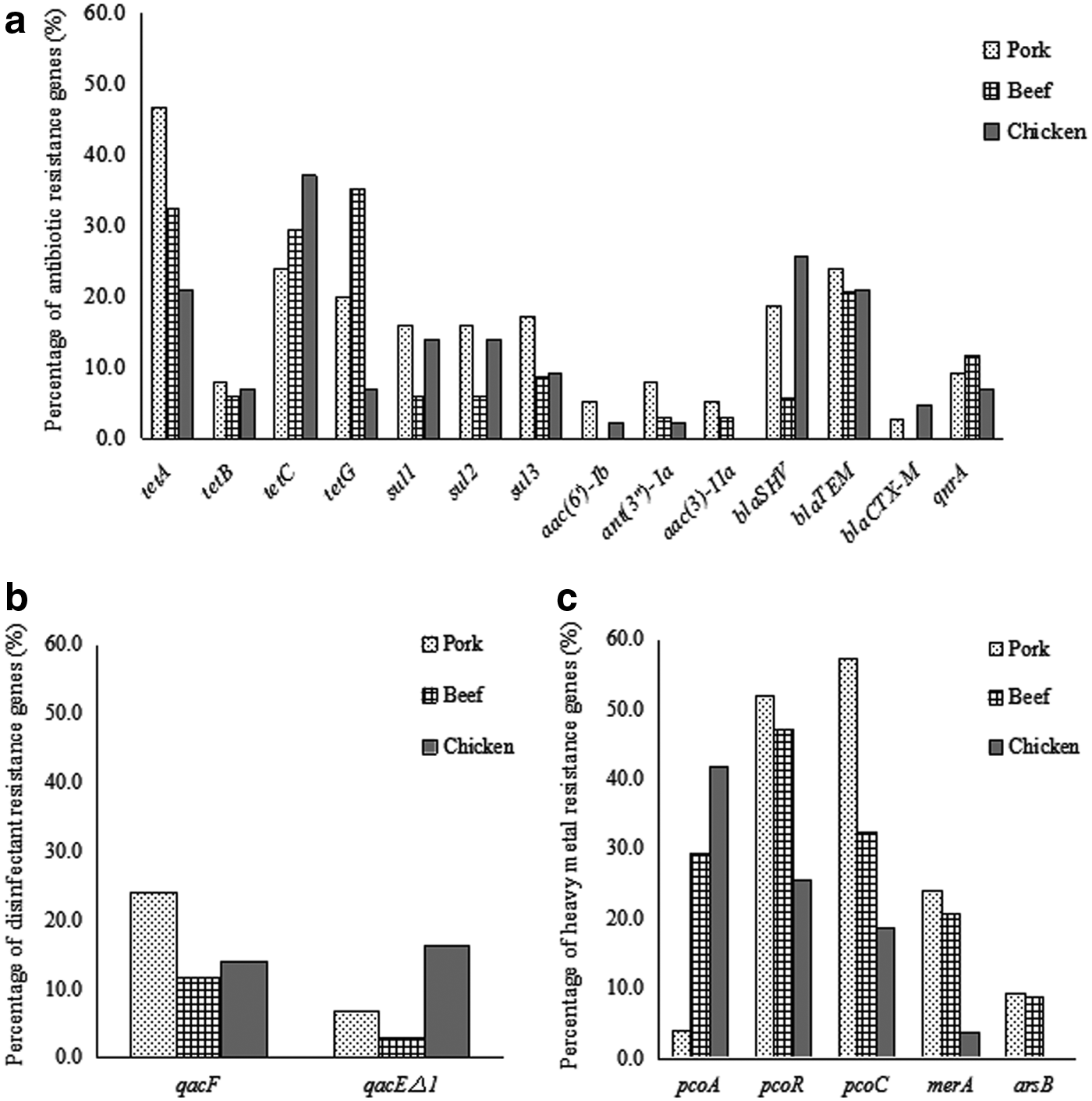
The prevalence of ARGs also varied by meat types and serotypes. The tetracycline-resistant genes, tetA, tetG, and tetC, were the most common genes in pork (46.7%, n = 35), beef (35.3%, n = 12), and chicken (37.3%, n = 16) isolates. Among different meat types, the prevalence of trimethoprim resistance genes and aminoglycoside resistance genes in pork isolates was the highest. Among different serotypes, Salmonella Rissen contained all ARGs genes tested and the prevalence of tetA, sul1, sul3, blaCTX-M, and ant(3")-Ia were the highest. However, most ARGs were absent in the isolates of Salmonella Enteritidis.
Phenotype and genotype of disinfectant resistance in Salmonella
Figure 4 showed the distribution of the MICs of disinfectants in Salmonella isolates from different retail meats. Our results revealed that the MICs of CTPC were 8 to 256 mg/L and BC were 8 to 128 mg/L. Generally, most Salmonella isolates exhibited MICs of 128 mg/L for CTPC (79.4%, n = 102) and BC (58.6%, n = 89). The chicken isolates (90.7%, n = 39) had higher MICs (128 mg/L) for BC than those from the beef (79.4%, n = 27) and pork (48.0%, n = 36) isolates (p < 0.001). Meanwhile, 76.0% (n = 57) of the isolates that originated from pork had higher MICs (128 mg/L) for CTPC than the 53.5% (n = 23) from chicken and the 20.6% (n = 9) from beef (p < 0.001). The MIC50 values and MIC90 values were the same in the isolates from different meat types (128 mg/L). In addition, the MIC ranges varied in the top five serotypes.
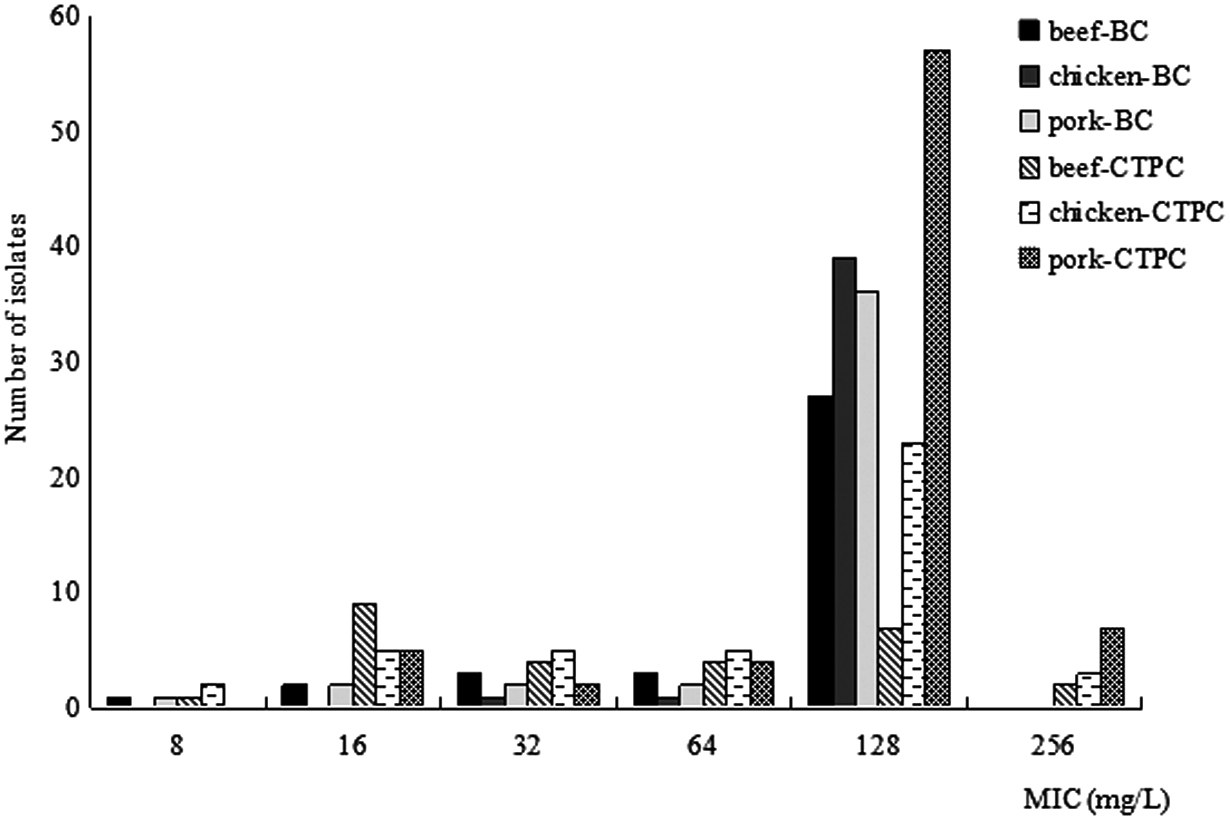
Distribution of quaternary ammonium compound MICs of disinfectants in Salmonella isolates from different retail meats. The corresponding values of BC and CTPC for the control strains were 16 and 16 mg/L, respectively. BC, benzalkonium chloride; CTPC, cetylpyridinium chloride; MIC, minimum inhibitory concentration.
The qacF and qacEΔ1 gene was detected in 18.4% (n = 28) and 8.6% (n = 13) of all the isolates, whereas the qacE, qacG, and sugE(p) genes were not detected in any isolates (Fig. 3b). The qacF was found the highest frequency in pork (24%, n = 18) and Salmonella Rissen (26.1%, n = 6). The qacEΔ1 gene was found the highest frequency in chicken (16.3%, n = 7) and Salmonella Rissen (26.1%, n = 6).
Prevalence of HMRGs
Totally, 58.55% (n = 89) of the isolates carried at least one HMRG. The Cu-resistance genes pcoR, pcoC, and pcoA were the most common, accounting for 43.4% (n = 66), 40.8% (n = 62), and 20.4% (n = 31), respectively (Fig. 3c). Besides, 17.8% (n = 27) and 6.6% (n = 10) of the isolates carried the Hg-resistance gene merA, and As-resistance gene arsB, respectively. A total of 14 gene combinations were found in all isolates. The top three resistance gene combinations were pcoC (n = 14), pcoR (n = 14), and pcoC-pcoR (n = 14) (Supplementary Table S1; Supplementary Data are available online at www.liebertpub.com/mdr).
The distribution of the gene combinations varied by meat types and serotypes. The pork isolates possessed most types of the gene combinations, in which pcoC (14.7%, n = 11) and pcoC-pcoR (13.3%, n = 10) were the main genotypes. The pcoR (11.6%, n = 5) and pcoC-pcoR (7.0%, n = 3) were the top two gene combinations in chicken isolates. The pcoR (14.7%, n = 5) and pcoR-pcoA-pcoC (14.7%, n = 5) were the top two gene combinations in beef isolates. The pcoC and pcoR were found in high prevalence in Salmonella Rissen (75.0%, n = 18). The merA and arsB were found in a frequency of 34.9% (n = 8) in Salmonella Typhimurium, and pcoA was detected in 47.8% (n = 11) of Salmonella Typhimurium. In Salmonella Rissen, only Cu-resistance genes were found, and only one isolate of Salmonella Enteritidis had the merA gene.
Association between disinfectant and antibiotic resistance
Most notably, the presence of disinfectant resistance genes was significantly associated with the trimethoprim and the related resistance genes sul (p < 0.05) (Supplementary Table S2). Among the qacF- and qacEΔ1-positive isolates, 100% (n = 28) and 93.3% (n = 12) of the isolates were resistant to at least one antibiotic, and 64.3% (n = 18) and 46.2% (n = 6) of the isolates were MDR, respectively. All the qacF-positive isolates contained β-lactam resistance genes and 85.7% (n = 24) had trimethoprim resistance genes. Meanwhile, 84.6% (n = 11) and 61.5% (n = 8) of the qacEΔ1-positive isolates possessed β-lactam and sulfonamide resistance genes, respectively.
Association between HMRGs and antibiotic resistance
In general, we found association between the presence of HMRGs and antibiotic resistance or ARGs (p < 0.05 or <0.001) (Supplementary Table S2). The gene pcoA was significantly associated with antibiotic resistance and the genes, including β-lactam and blaTEM, tetracycline and tetA, tetB, tetC, and aminoglycosides and ant(3")-Ia. The pcoC gene was significantly associated with the resistance to trimethoprim and sul3, and tetracycline and tetG. The pcoR gene was associated with tetracycline resistance and the genes tetA, tetC, and tetG. Moreover, the association among merA and tetracycline resistance and the gene tetG was significant. No significant association was observed between the presence of arsB and antibiotic resistance.
More particularly, the association among tetracycline resistance genes, disinfectant resistance genes, and Cu-resistance genes pcoC or pcoR, and sulfonamide resistance genes, disinfectant resistance genes, and Cu-resistance genes, pcoC or pcoR, was significant (p < 0.05).
PFGE typing
Up to 41 distinct PFGE clusters (using a cutoff value of 70%) were identified among the 152 Salmonella isolates (Supplementary Fig. S1). The dendrogram showed that isolates of the same serotypes were clustered together, except for a few individual isolates. The most common cluster 21 was comprised of 16 isolates of Salmonella Derby. Similar results were obtained in cluster 9 (Salmonella Typhimurium) and cluster 6 (Salmonella Rissen). PFGE clusters were also associated with supermarkets. In cluster 41, two Salmonella Anatum isolates originated from the same supermarket (WH). Moreover, 75% (n = 12) of the Salmonella Derby isolates (cluster 21) were obtained from the same supermarket located in different areas (including QJ, CJ, JJ, JJ1, and WJ). Similarly, cluster1, 12, 25, and 37 were clearly associated with the sampling supermarkets regardless of location. In addition, some PFGE clusters were also associated with meat types. For example, PFGE clusters 10, 22, and 40 were comprised of isolates recovering from pork, whereas clusters 1 and 28 were from chicken, and cluster 17 from beef. Thus, PFGE revealed that the Salmonella isolates were associated with the meat types and sampling supermarkets, indicating the possibility of crosscontamination in farms or processing environments. PFGE results also indicated that the resistance genes were widely distributed in isolates with different meat types and serotypes.
Discussion
Generally, Salmonella Derby, Salmonella Typhimurium, and Salmonella Rissen were the most common serotypes in our study, followed by Salmonella Enteritidis and Salmonella London. Salmonella Enteritidis and Salmonella Typhimurium were of the most common serotypes associated with human infections from food of animal origins and have been found among human isolates in Italy, 48 Spain, 49 and United States.50,51 Gantzhorn et al. 52 reported that Salmonella Derby and Salmonella Typhimurium were the most prevalent serotypes in Danish pig slaughterhouses. Salmonella Enteritidis and Salmonella London were the common prevalent serotypes in retail meats as well.7,13 In our study, Salmonella Enteritidis was only identified with high frequency in chicken, which was also the most prevalent serotype in chicken meat in the Shandong and Shaanxi province, China.7,53 Higher carriage of these Salmonella serotypes by animals may contribute to the contamination of retail meats in human food supply.
The increase of antimicrobial resistance in Salmonella from retail meats has become a common problem worldwide.13,53–55 Antibiotic resistance was common among the Salmonella isolates, particularly a high level of resistance to tetracycline (80.9%) and trimethoprim (64.5%). Similarly, the most frequent resistance profile of Salmonella isolated from pork and chicken meats in North Vietnam was tetracycline (58.5%), followed by sulfonamides (58.1%). 54 The Food and Drug Administration (FDA) has confirmed that Salmonella isolated from food animals showed highest resistance to tetracycline and sulfonamides. 56 The globalization of trade in retail meats could allow resistant Salmonella spread to different countries, which might increase the risk of the emergence and accumulation of antibiotic resistance worldwide. The Salmonella isolates from pork in our study showed higher resistance to antibiotics than from beef and chicken. All Salmonella Typhimurium isolates were resistant to at least one antibiotic. The results showed that the frequency of antibiotic resistance may be related with meat types and serotypes.54,55
The blaTEM, ant(3")-Ia, and tetA genes were the most common in β-lactam-, aminoglycoside-, and tetracycline-resistant genes in our isolates, respectively. A similar result was reported by Yahiaoui et al., 57 in which blaTEM was the most frequent β-lactam-resistant gene in E. coli. Moreover, a high prevalence of tetA (55.6%), tetB (91.7%), and ant(3")-Ia (67.5%) genes were observed in the S. enterica isolated from chicken and quail carcasses. 58 The distribution of ARGs varied by meat types. The genes tetA, tetG, and tetC, were the most common genes in pork, beef, and chicken isolates, respectively. There was a higher prevalence of trimethoprim- and gentamicin-resistant genes found in pork isolates than in chicken and beef isolates. Bacci et al. 58 also observed that a higher percentage of the ant(3")-Ia gene in Salmonella spp. isolated from quail and chicken carcasses than in those isolated from chicken meat, and the tetA and tetB genes were more frequent in chicken meat and carcasses isolates, respectively.
The majority of the Salmonella isolates showed MICs of 128 mg/L for CTPC (79.4%) and BC (58.6%). Our previous study demonstrated that 67.5% and 52.6% of the E. coli isolated from retail meats exhibited MICs of 4 to 128 and 32 mg/L for CTPC and BC, respectively. 59 In China, the disinfection requirements for a slaughterhouse (SB/T-10660-2012) stipulated the dosage of QACs in the range of 0.015% to 0.1% for slaughterhouses and meat production facilities. However, a previous study reported the increasing use of QACs with high concentration (10%), and susceptibilities to QACs have apparently increased among the bacteria isolated from retail meats or their production environments.18,52,59 The disinfectant resistance genes qacF and qacEΔ1 were detected in 18.4% and 8.6% of all the isolates, respectively. The qacF and qacEΔ1 genes were less common in E. coli isolated from retail meats.27,59 However, these two genes were located in MEGs and linked (coexisted) with different ARGs showing coresistance. 27 The widespread use of disinfectant may provide a selective environment for different degrees of adaptive resistance to Salmonella.
To best of our knowledge, limited research focused on the prevalence of varied HMRGs in Salmonella isolated from retail meats. The copper (228 mg/kg) and zinc (297 mg/kg) concentrations in feed of livestock and poultry were excessive in Liaoning, China. Comparing with the maximum limit value in Chinese standard (GB15199-94, GB13106-91), the copper concentration in chicken was twice as the standards and the zinc concentration obviously exceeded the limit. 60 While in Jiangsu province, concentrations of zinc and copper in animal feeds were 15.9–2041.8 and undetected–392.1 mg/kg, respectively. 61 Moreover, unlike antibiotics and QACs that are biodegradable through microorganisms,62–64 heavy metals are not subject to degradation and can subsequently represent a long-term selection pressure, which potentially contributes to the development and maintenance of resistance genes. 65 The Cu-resistance genes pcoR (43.42%), pcoC (40.79%), and pcoA (20.39%) were relatively higher than the Hg resistance gene merA (17.76%) and As resistance genes arsB (6.58%). Argudín et al. 20 found that among the methicillin-resistant S. aureus isolated from livestock, 4.1%, 0.3%, 23.4%, and 62.7% were positive for the genes arsA (As), cadD (Ca), copB (Cu), and czrC (Zn/Ca), respectively. The difference of genes in frequency may be related to the use of metal compounds as feed supplements at different farms. In addition, HMRGs have been observed in other environments. The genes of mer operon (merRTPABDE) were detected in Aeromonas salmonicida isolates recovered from juvenile Atlantic salmon (Salmo salar) aquaculture. 66 Besides, Roosa et al. 29 observed seven HMRGs (arsB, copA, czcA, czcC, czcD, nccA, and pbrT) among the DNA of sediments. The environment of origin (e.g., animal husbandry, sediments, or slaughter house) of the bacterial community might be a factor that contributes to the spread of HMRGs. 22
In general, we found significant associations among HMRGs, disinfectant resistance genes, antibiotic resistance, and related genes (p < 0.05). The HMRGs and ARGs, as well as the disinfectant resistant genes we tested, were usually located on MGEs, such as plasmid pRJ1004, transposon Tn4380, and Tn501.21,23,27,67,68 Besides, a higher proportion of plasmids hosted by Salmonella tended to carry the three classes of genes on the same plasmids. 69 The MGEs may potentially accrue different resistance genes through coresistance 22,62 and could be efficiently spread through bacteria community. We investigated the disinfectant resistance genes that were significantly associated with the sulfonamide resistance genes (p < 0.05). The class 1 integron contains the gene qacEΔ1 and sul1 resistance, 70 and coresistance may also occur involving the qacEΔ1, aadA2, and sul1 located in Tn5045. 68
Besides, the association between the presence of HMRGs and antibiotic resistance and related ARGs was significant (p < 0.05). Osman et al. 71 isolated an aquatic bacterium harboring a plasmid which contained genes conferring resistance to antibiotics and metals Cr and Co. The IncA/C plasmid isolated from Aeromonas salmonicida subsp., salmonicida carried mer and multiple ARGs. 66 The association among Cu-resistant genes (pcoA and pcoR), disinfectant-resistant genes, and tetracycline- and sulfonamide-resistant genes was significant (p < 0.05). Both Hg-resistance genes (merRTPCADE) and several antimicrobial-encoding genes (sul1, qacEΔ1, aadA1, and blaOXA-1) have been identified on plasmid pUO-StVR2 in Salmonella Typhimurium and these are linked with Transposon 21. 72 Whole genome sequencing was performed in our study and will confirm the location of these genes in the near future.
Conclusions
In conclusion, this study demonstrated that antimicrobial resistance was common among the Salmonella isolates from retail food of animal origin. Antibiotic, disinfectant, and heavy metal resistance varied by meat types and serotypes. The antibiotic resistance was highly associated with disinfectant or HMRGs. The farms or processing environment may be a major source for crosscontamination with Salmonella. Therefore, the retail meats may be a reservoir for the dissemination of antibiotic-resistant Salmonella and using disinfectants for decontamination or metals in livestock may provide a pressure for coselecting strains with acquired resistance to other antimicrobials.
Footnotes
Disclaimer
The views expressed in this article are those of the author(s) and do not necessarily reflect the official policy of the Department of Health and Human Services, the U.S. Food and Drug Administration, or the U.S. Government. Reference to any commercial materials, equipment, or process does not in any way constitute approval, endorsement, or recommendation by the Food and Drug Administration.
Acknowledgments
This work was supported by the National Natural Science Foundation of China (31400066, 31671954), Science and Technology Department of Sichuan province (2017JY0118), and the Program for Changjiang Scholars and Innovative Research Team in University (IRT13083). The authors are grateful to Dr. Maureen Davidson for helpful comments and article review.
Disclosure Statement
No competing financial interests exist.
References
Supplementary Material
Please find the following supplemental material available below.
For Open Access articles published under a Creative Commons License, all supplemental material carries the same license as the article it is associated with.
For non-Open Access articles published, all supplemental material carries a non-exclusive license, and permission requests for re-use of supplemental material or any part of supplemental material shall be sent directly to the copyright owner as specified in the copyright notice associated with the article.
