




Abstract
A plasmid pCY-CTX carrying a phage-like backbone from an extensively drug-resistant Enterobacter cloacae strain Guangzhou-ECL001 (previously known as CY01) was identified in this study. By Illumina MiSeq 2 × 250-bp paired-end sequencing, de novo assembly, and PCR, full sequence of pCY-CTX was obtained. Plasmid pCY-CTX was a circular plasmid with a length of 116,700 bp, harboring 136 putative open reading frames with the average G + C content of 50.8%. The backbone of pCY-CTX showed high identity to previously reported phage-like plasmid pHCM2 and phage SSU5. In addition, pCY-CTX contained a distinctive ISEcp1-mediated Tn2 region with two resistance genes blaTEM-1 and blaCTX-M-3. Transposition unit “ISEcp1- blaCTX-M-3- orf477” was inserted into the Tn2 structure, dividing Tn2 into two parts. This represents the first identification of a plasmid carrying a phage-like backbone and a distinctive ISEcp1-mediated Tn2 region within blaTEM-1 and blaCTX-M-3 in clinical E. cloacae. The finding of phage-like regions located in plasmids provides a new perspective in gene transfer associated with antimicrobial resistance.
Introduction
E
Although the correlation between phages and plasmids still remains unclear, up to date, a number of plasmids with phage-like elements have been described, including pRYCE21 (accession no.: AY598759), 8 pCD1, 11 pHCM2 (accession no.: AL513384), 12 pECOH89 (accession no.: HG530657), 13 pABTJ2 (accession no.: CP004359.1), 14 pG6809-1 (accession no.: KT345945), 15 p3499 (accession no.: CP010286), pCAV1741 (accession no.: CP011655), pKP12226 (accession no.: KP453775), and pG8786 (accession no.: AJ698720). 16 However, plasmids carrying resistance genes, as well as phage-like elements, were barely touched upon and insightfully analyzed, despite occasional observation in pECOH89 (carrying blaCTX-M-15) 13 from Escherichia coli, pRYCE21 (carrying blaCTX-M-10) 8 from Klebsiella pneumoniae, and pKP12226 (carrying a cluster of resistance genes) 17 from K. pneumoniae. Consequently, identification of novel phage-like plasmids containing resistance genes may suggest clinical significance in both resistance transfer and evolution between phages and plasmids. 18
Previously, a clinical VIM-1-producing Enterobacter cloacae strain Guangzhou-ECL001 (previously known as CY01) had been identified, and two resistance plasmids were characterized, including pCY-VIM (14 kb) and pCY-MdT (5.9 kb). However, the high minimum inhibitory concentrations (MICs) to penicillin and cephalosporin antibiotics in Enterobacter cloacae strain Guangzhou-ECL001 highly suggested the possibility of other mobile genetic elements. As a consequence, further insightful investigation on Enterobacter cloacae strain Guangzhou-ECL001 was performed by whole-genome sequencing. In this study, a novel plasmid pCY-CTX from Enterobacter cloacae Guangzhou-ECL001 was identified, which carries a phage-like backbone and an ISEcp1-mediated Tn2 element containing two resistance genes, blaTEM-1 and blaCTX-M-3.
Materials and Methods
Case report, bacterial strain, and antimicrobial susceptibility testing
In May 2011, Enterobacter cloacae strain Guangzhou-ECL001 was isolated from cyst drainage fluid of an 89-year-old female patient suffering from multiple underlining diseases, including lung cancer, renal cysts, and hypertension, in the First Affiliated Hospital of Guangzhou Medical University (FAHGMU) in Guangzhou of Southern China. 19 Bacterial identification and MIC testing of 18 antimicrobials were performed as described previously with VITEK 2™ Automated System and Etest strips (bioMérieux, Marcy-l'Etoile, France). The antimicrobial results were further interpreted according to Clinical and Laboratory Standards Institution guidelines for Enterobacteriaceae.
Genome sequencing and assembly
Direct whole-genome sequencing has been well established to obtain full sequences of resistant plasmids (∼500 kb), and therefore, whole-genome sequencing was performed to gain insight into the resistant mechanism of Guangzhou-ECL001. Enterobacter cloacae strain Guangzhou-ECL001 was cultured in Luria-Bertani (LB) broth supplemented with 1 μg/ml of imipenem overnight. Total DNA was extracted with DNA Extraction Kits (Qiagen, Toronto, Canada) according to the manufacturer's protocol and qualified by NanoDrop 2000 (Thermo Scientific, Waltham, MA) and agarose gel electrophoresis. Genomic sequencing was conducted using the MiSeq platform (Illumina, San Diego, CA). In brief, DNA samples were subjected to DNA library construction using the NEBNext Sample Prep Kit (NEB, Ipswich, MA) with multiplex indexing. Fragment sizes of the DNA library were detected by Agilent Bioanalyzer 2100 (Agilent, Shanghai, China). Whole-genome sequencing was performed by a MiSeq 2 × 250-bp paired-end sequencing procedure (Illumina), generating paired-end 2 × 250-bp long sequence reads. De novo assembly was processed with the Edena assembler (Version 3.121122; University of Geneva, Geneva, Switzerland), totaling 127 contigs with a draft genome size of 5.37 Mb, a maximum contig of 499 Kb, and an N50 contig of 194 Kb, with the low-quality reads further filtered out and trimmed.
Genomic data analysis
Alignment was performed to indicate putative chromosomal contigs by Mauve (2.3.1). The ResFinder server (http://cge.cbs.dtu.dk/services/ResFinder) was applied to identify acquired resistant genes. The putative extrachromosomal contigs combining the identification with the genes encoding plasmid replication, partition, conjugative transfer, or resistance, were recognized as potential plasmid contigs. For these contigs, inverse PCR was conducted to obtain the flanking sequences of contigs, and PCR primers were then designed accordingly to close the gaps between the contigs to build single circular plasmid molecules. Additional sets of PCRs were carried out to confirm the circular status of predicted plasmids.
Plasmid sequence analysis
Open reading frame (ORF) finder was used to predict putative ORFs, and functional annotation was performed by Rapid Annotation using Subsystem Technology (RAST) software. IS was identified by IS Finder (www-is.biotoul.fr). Interestingly, some contigs harbored a plasmid replication gene (repA) and partition genes, as well as many phage-like ORFs, indicating that this present plasmid was a novel plasmid with phage-like elements 10 and, thus, designated as pCY-CTX. Nucleotide and protein sequence comparison was performed using BLAST against the GenBank databases. The map of gene organization was generated using the BLAST Ring Image Generator (BRIG) software (version 0.95) combining with WINPLAS.
Conjugation experiments
Conjugation was conducted using Enterobacter cloacae Guangzhou-ECL001 as the donor strain and rifampin-resistant Escherichia coli C600 as the recipient strain. In brief, 200 μl cultures of donor and recipient strains were inoculated separately into fresh LB broth until the optical density reached 0.5 McFarland. Donor and recipient strain were mixed at the ratio of 2:1, followed by static cultivation. After incubation at 35°C for 4 hours, transconjugants were selected by Mueller-Hinton agar plates supplemented with ceftazidime (2 mg/L) and rifampicin (100 mg/L).
Nucleotide accession numbers
The sequence of pCY-CTX has been annotated and submitted to the GenBank under accession number KX015668.
Results
Susceptibility testing and resistance genes
Enterobacter cloacae strain Guangzhou-ECL001 was an extensively drug-resistant pathogen, showing resistance against β-lactams, aminoglycosides, folate pathway inhibitors, tetracyclines, and fluoroquinolones, excluding colistin (Table 1). Twenty plasmid-mediated and five chromosomal-mediated resistance genes were defined from the assembled genomic data with the ResFinder. Resistance genes responsible for the above antibiotics are listed in Table 1, including four β-lactamase genes (blaVIM-1, blaTEM-1, blaCTX-M-3, and blaSHV-12), 19 in accordance with high MICs in β-lactam class antibiotics. In this study, a plasmid pCY-CTX bearing blaTEM-1 and blaCTX-M-3 genes, as well as phage-like elements, was identified in Enterobacter cloacae strain Guangzhou-ECL001 from genomic sequencing data by sequence analysis of potential plasmid contigs.
MIC, minimum inhibitory concentration; ND, not determined.
General features of pCY-CTX sequence
As an 116,700-bp circular plasmid, pCY-CTX harbored 136 putative ORFs, with 57.4% (78/136) encoding hypothetical proteins. The remaining 58 ORFs were coded for various proteins with known function, including replication and maintenance (35 ORFs), metabolism (9 ORFs), antibiotic resistance (3 ORFs), transposase function (3 ORFs), and others (8 ORFs). Gene coding replication protein A (repA), three partition proteins (one parA and two parB), and one regulator belonging to ArsR family were found. Three resistance genes, encoding putative dihydrofolate reductase (477 bp, position 14,636–15,112 bp), the TEM-1 (861 bp, position 84,961–85,821 bp), and CTX-M-3 (876 bp, position 874,786–86,603 bp) β-lactamases, were also identified in pCY-CTX. These two β-lactamase genes were located within an ISEcp1-mediated Tn2 region (position 81,052–89,390 bp). The G + C content of the whole plasmid was 50.8%, whereas the ISEcp1-mediated Tn2 region was 47.0%.
Phage-like backbone of pCY-CTX
Plasmid sequence analysis revealed that the majority of pCY-CTX shared high homology to previously reported phage-like plasmids, including pHCM2 (accession no.: AL513384, 76% query coverage, and 99% identity), pG6809-1 (accession no.: KT345945, 81% query coverage, and 98% identity), p34399 (accession no.: CP010286, 81% query coverage, and 98% identity), pCAV1741-110 (accession no.: CP011655, 76% query coverage, and 97% identity), and a Salmonella phage SSU5 (accession no.: JQ965645, 76% query coverage, and 93% identity).
Comparing the backbone of pCY-CTX (positions 1–27,128 bp and 89,594–116,700 bp) with the typical and cryptic phage-like plasmid pHCM2 and phage SSU5, 86.2% (56/65) and 69.2% (45/65) ORFs shared high identities (ranging from 90% to 99%) to those of pHCM2 and phage SSU5, respectively (Fig. 1). This region contained a large number of key features associated with replication and maintenance, including replication protein (repA), exonuclease (sbcD and sbcC), recombinase (recA), DNA polymerases, and a gene putative coding dihydrofolate reductase.
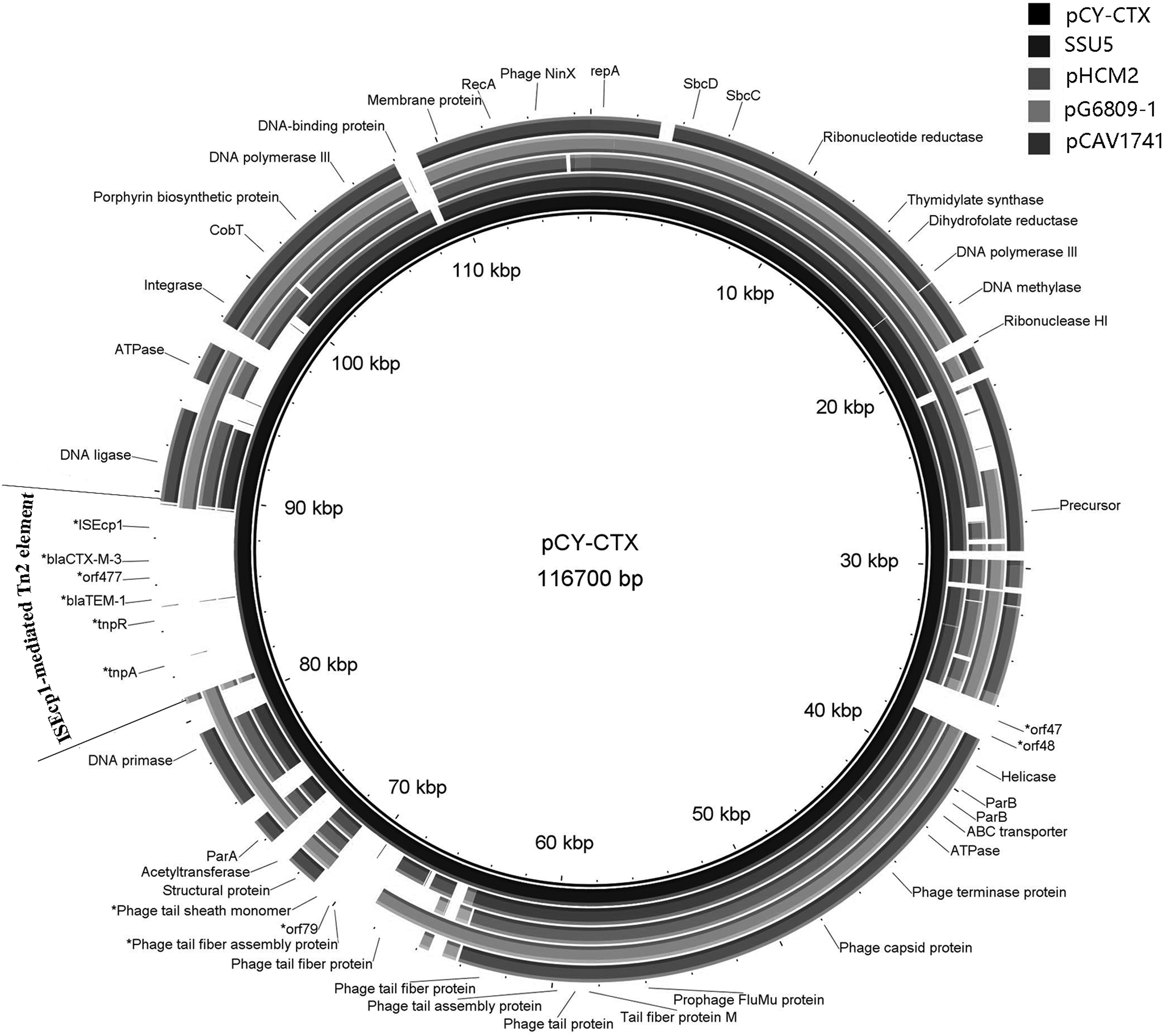
Map of plasmid pCY-CTX genome. The position and arrangement of selected open reading frames and products derived from bioinformatic analysis are shown above. Genes/products marked by “*” were unique in pCY-CTX compared to related plasmids.
For the adjacent region to the left (position 27,129–81,051 bp), 69.8% (44/63) and 68.3% (43/63) ORFs were similar to those of pHCM2 and phage SSU5, respectively, with identities ranging from 87% to 96%. A series of phage-related genes associated with DNA packing/morphogenesis (capsid protein, terminase, tail fiber protein, assembly, etc.) 20 were gathered in this region (Table 2), and most of them were also found in other phage-like plasmids and phage SSU5, excluding phage tail fiber assembly protein (position 69,606–70,037 bp) and phage tail sheath monomer (position 70,412–71,119 bp). Remarkably, three hypothetical proteins in this region, orf47, orf48, and orf79 (positions 36,180–36,980 bp, 37,024–37,548 bp, and 70,061–70,183 bp, respectively), were unique in pCY-CTX compared to other related plasmids as well (Fig. 1).
ISEcp1-mediated Tn2 element
Seven ORFs were identified within the ISEcp1-mediated Tn2 element, flanked by 38-bp inverted repeats (IR) (8,372 bp, position 81,052–89,075 bp; Fig. 1B). Two resistance genes blaCTX-M-3 and blaTEM-1 were located in this region. A complete ISEcp1 was found to be adjacent to blaCTX-M-3 and bound by a 14-bp IRL upstream (IRL: 5′-ACGTAGAATCTAGG-3′), with the absence of IRR. ISEcp1 belonged to the IS1380 family (www-is.biotoul.fr) and was commonly associated with the CTX-M type β-lactamases. 5 ISEcp1 had been previously proved to be capable of transposition using alternative nucleotide sequences resembling its IRl, which eventually led to horizontal transfer of diverse β-lactamase genes.21–23 Comparing with current transposons, transposition unit “ISEcp1- blaCTX-M-3- orf477” inserting into the Tn2 structure occurred at the downstream of blaTEM-1, creating 5-bp direct repeats (DRs) on both sides, which divided a complete entire Tn2 transposon into two regions of 4,862 bp and 129 bp. However, the insertion site was located in the noncoding region. Instead of consensus sequence, the 5-bp (5′-TCATA-3′) insertion site was an A+T–rich area which may target ISEcp1-mediated transfer. 21
Discussion
Plasmids carrying phage-like regions have been discovered in K. pneumoniae,8,17 Yersinia pestis,11,16 Salmonella typhi, 12 E. coli, 13 Acinetobacter baumannii, 14 Enterobacter hormaechei, and Citrobacter freundii. Compared to phage SSU5, plasmids pCY-CTX, pHCM2, pG6809-1, and pCAV1741-110 lacked the genes associated to phage life cycle (i.e., receptor-recognizing phage tail fiber adhesion, phage superinfection exclusion protein, and phage transcriptional regulator). The absence of key functional genes crucial for phage life cycle in phage-like plasmids likely explains their incapability of evolving into phages. 20 The linear phage N5 isolated from E. coli in 1964 has a unique linear plasmid lifestyle (repA-like replicase), as well as maintained a typical characteristic of phage (protelomerase), 24 suggesting the correlation between phages and plasmids. Recently, a plasmid pKP12226 isolated from K. pneumoniae, bearing a backbone originated from E. coli, a resistance region, and phage-like elements originated from phage P1, was reported in South Korea. 17 Interestingly, phage P1 showed little homology to phage SSU5 or phage N5. Thus, identification of pCY-CTX and other phage-like plasmids was strong evidences that exchange of groups of functional genes occurred between different phages and plasmids.
Since the first CTX-M enzyme (CTX-M-1, in E. coli) was reported in Germany in 1990, 4 this type of resistance genes, along with TEM type and SHV type, has become dominant worldwide. The CTX-M-3 β-lactamase was first reported in C. freundii isolates in Poland in 1996 25 and generally recognized as a wider distribution of CTX-M-1-related enzymes in Europe. 26 In China, the most common CTX-M enzymes were CTX-M-14, closely followed by CTX-M-3. Moreover, the location of blaCTX-M-3 gene was commonly found in conjugative plasmids, which indicated that horizontal gene transfer was the main mechanism of CTX-M-3 spread.27,28 In contrast, the recombination of blaCTX-M with ISs or transposases is contributing to the wide spread of CTX-M-producing isolates. 5 The adjacency of ISEcp1 and blaCTX-M found in the present study strongly suggested the ISEcp1-mediated dissemination of blaCTX-M genes, as indicated in previous studies.23,29
In addition, the distinctive ISEcp1-mediated Tn2 element in pCY-CTX was also found in some other Tn2-carrying plasmids, such as pENC580 from E. coli, pKo6 from K. pneumoniae, pKOX_R1 from K. michiganensis, pC15_K from K. pneumoniae, and phage P7 (Fig. 2). ISEcp1-mediated Tn2 elements in pCY-CTX, pENC580, and pKo6 showed high homology (with 99.9% query coverage and 99.9% identities). However, aside from blaCTX-M-3 and blaTEM-1, plasmids pENC580 and pKo6 also carried other genes resistant to aminoglycosides, quinolones, rifampicin, and trimethoprim.30,31 Plasmids pKOX_R1 and pC15_K were similar to pCY-CTX in Tn2-related region and blaCTX-M-3 gene, whereas carried truncated ISEcp1s. In contrast to ISEcp1-blaCTX-M, which was only reported in a few plasmids, Tn2-blaTEM is common in both plasmids and chromosomes. Most interestingly, pCY-CTX was found to share high homology to phage P7 in Tn2- blaTEM-1 region (99.9% identities), which added weight to the notion that gene transfer occurred between phages and plasmids. Simultaneously, the comparison analysis in Fig. 2 indicated that the ISEcp1-mediated Tn2 element in pCY-CTX was probably derived from two origins (Tn2-related part and ISEcp1-related part). Consequently, the current identification of pCY-CTX represented the first identification of a plasmid with a phage-like backbone and an ISEcp1-mediated Tn2 element carrying multiple resistance genes in clinical E. cloacae.

Comparison of ISEcp1-mediated Tn2 region of pCY-CTX among the related plasmids. Arrows indicate the directions of transcription. The 38-bp inverted sequences of Tn2 are shown as tall black bars. Blocks with stripes represented the 129-bp region. Sequences of 5-bp DRs are given. Gray shading represents identical sequence region.
For the conjugation between Enterobacter cloacae Guangzhou-ECL001 and Escherichia coli C600, no transconjugants were recovered on selective plates, indicating that pCY-CTX was nonconjugative under the specific conditions. This observation was in accordance with another phage-like plasmid pG8786 (accession no.: AJ698720.1), which carried the pHCM2-like region and shared 47% query coverage (95% identity) with pCY-CTX. 16 As plasmids with similar phage-like backbone were concerned (query coverage higher than 60% with pCY-CTX, including pHCM2, p34399, pG6809-1, and pCAV1741-110), none of self-transfer had been reported hitherto. Remarkably, a large prophage-like nonconjugative plasmid pBtic235 was recently found to be mobilized accompanied with a coresident plasmid. 32 Although a few exceptions had been reported on plasmids with phage-like structures which were conjugatively mobilized in suitable conditions,8,17 such plasmids were phylogenetically distant from pCY-CTX (<15% query coverage and derivation from different origin). Nevertheless, despite nonconjugation detected for pCY-CTX in this study, its identification in E. cloacae still represents the ultimate consequence of gene transfer likely due to transduction through a phage, although the unclarity in the origin and evolution of pCY-CTX requires further investigation.
Conclusions
In conclusion, the complete sequence of a novel plasmid pCY-CTX from the XDR Enterobacter cloacae strain Guangzhou-ECL001 was reported. This plasmid contained a similar backbone sequence to typical phage-like plasmids and an ISEcp1-mediated Tn2 element. It is suggested that pCY-CTX was a consequence of interactions among phages, plasmids, resistance genes, and bacterial hosts. 24 Carriage of mobile genetic elements, including ISs and transposons within this plasmid pCY-CTX with phage-like backbone, may facilitate the horizontal transfer of related resistance genes, leading to increasing resistance to clinical antibiotics.
Footnotes
Acknowledgments
This work was supported by the National Key Research and Development Program of China (2016YFD04012021), Guangdong Special Support Program (2016TQ03N682), Pearl River S&T Nova Program of Guangzhou (201710010061), National Natural Science Foundation of China (81201341, 31201362), Science and Technology Planning Project of Guangdong Province (2017A050501007), National Outstanding Doctoral Dissertation Funding (201459), the Fundamental Research Funds for the Central Universities (2017ZD092) and Open Research Fund of State Key Laboratory of Biological Fermentation Engineering of Beer (K2017001).
Authors' Contributions
Z.X. and D.C. designed experiments, conducted research, and wrote article. J.X. and L.Y. conducted bioinformatics analysis and acquired epidemiological data. B.P. and M.E.S. designed experiments and revised the article. All authors read and approved the final article.
Disclosure Statement
No competing financial interests exist.