




Abstract
Background:
Morbidity and mortality due to multidrug-resistant (MDR) bacteria are of great concern in burn patients. In this critical condition, synergism between antimicrobial peptides and conventional antibiotics would be a promising strategy. Accordingly, this study aimed to determine the therapeutic value of melittin as a natural peptide by examining its synergistic effect with conventional antibiotics against MDR isolates of Acinetobacter baumannii and Pseudomonas aeruginosa.
Materials and Methods:
Fifteen clinical isolates for each kind of bacteria were collected from burn patients. Antibiotic susceptibility of all isolates was evaluated by disk diffusion method. The minimum inhibitory concentration (MIC) and minimum bactericidal concentration for melittin, colistin, doripenem, doxycycline, and ceftazidime were also examined. Fractional inhibitory concentration (FIC) of melittin in combination with the antibiotics was determined for six MDR isolates. The cytotoxicity of melittin in combination with the antibiotics was examined on a normal human cell line.
Results:
The geometric means of MIC (GMMIC) for melittin and doripenem after combination were reduced to 61.5- and 51.5-fold, respectively, against MDR A. baumannii isolates. These reductions for melittin–doripenem and melittin–ceftazidime against MDR P. aeruginosa isolates were (63.5 and 58)-fold and (16 and 11)-fold, respectively. FIC for melittin–doripenem against A. baumannii and FIC for melittin–doripenem and melittin–ceftazidime against P. aeruginosa strains were ≤0.5. This issue caused a decrease of up to 104-, 68-, and 17-fold, respectively, in the cytotoxicity of melittin.
Conclusion:
In conclusion, the synergism of melittin at its nontoxic dose with doripenem and ceftazidime could be of great therapeutic value as a topical drug against burn infections caused by MDR bacteria.
Introduction
B
Streptococcus pyogenes in preantibiotic era was a leading cause of infection in burn patients. Later on, Staphylococcus aureus predominated. Nowadays, Pseudomonas aeruginosa is one of the leading etiological agents. At present, multidrug-resistant (MDR) microorganisms such as methicillin-resistant S. aureus, vancomycin-resistant Enterococcus spp., MDR-Enterobacteriaceae, carbapenemase-resistant P. aeruginosa, and MDR and pandrug-resistant Acinetobacter baumannii are the main causes of burn infections.5–9
A. baumannii and P. aeruginosa are the most prevalent bacteria in burn infections.10,11 The affected patients are reservoirs for these organisms that are typically resistant against most antibiotics. Carbapenems are the drugs of choice for treatment of A. baumannii infections, but the increased clinical use of these drugs has subsequently led to the progress of resistant strains.1,12 Resistance to antibiotics, including broad-spectrum penicillins, carbapenems, cephalosporins, fluoroquinolones, most aminoglycosides, tetracyclines, and chloramphenicol, has increased in A. baumannii worldwide, especially in Iran.12,13
Therefore, clinical isolates of A. baumannii have become a serious threat in nosocomial infections. 14
P. aeruginosa has intrinsic resistance to the numerous classes of antibiotics and treating the infections caused by this superbug is very difficult.15,16 Few new drugs are available to reduce or diminish P. aeruginosa infections. Furthermore, antibiotic resistance problem in A. baumannii and P. aeruginosa limits the treatment of their infections. In this case, combination therapy would be a good solution to overcome the issue of resistance.
So far, combination of colistin+doripenem17,18 and colistin+tobramycin19,20 has been assayed for P. aeruginosa. Colistin+tigecycline, 21 colistin+rifampicin, and cilistin+vancomycin combinations are suggested against MDR strains of A. baumannii. 22 Another way to overwhelm MDR bacteria is combining the antimicrobial peptides (AMPs) with routine antibiotics. In recent years, AMPs are considered as new developing antimicrobial agents that can serve as substitutes for antibiotics. AMPs individually can rapidly eradicate a broad spectrum of pathogens such as bacteria, viruses, fungi, and MDR pathogens.23–25 The effect of AMPs combined with antibiotics often increases the effect of single drugs.26–28
Melittin is one of the impressive AMPs in bee (Apis mellifera) venom, and it is the major component of the bee venom. It has a potent antibacterial activity and is also toxic to eukaryote cells. 29 Synergism of melittin and some of the antibiotics (e.g., vancomycin, oxacillin, and amikacin) against MRSA and VRE strains has been previously reported. 30
This study was aimed to assay the synergistic effects of melittin with conventional antibiotics (colistin, ceftazidime, doripenem, and doxycycline) against MDR strains of A. baumannii and P. aeruginosa isolated from burn patients.
Materials and Methods
Chemical reagents, antibiotics, media, and bacterial samples
The following chemicals 3-(4,5-dimethyl-2-thiazolyl)-2,5-diphenyl-2H-tetrazolium bromide (MTT) and dimethyl sulfoxide (DMSO) were purchased from Sigma-Aldrich (St. Louis, MO). RPMI-1640, fetal bovine serum, and antibiotics were purchased from Sigma-Aldrich (St. Louis). All the antibiotic disks were purchased from MAST Company (Mast Group, Merseyside, UK).
During the period between November 2016 and March 2017, a total of 50 clinical isolates for each of A. baumannii and P. aeruginosa was collected from burn patients in Shahid Motahari University hospital in Tehran, Iran.
Peptide synthesis
The peptide, melittin, was synthesized with c-terminal amidation at an external facility (Mimotopes Co., Clayton, Victoria, Australia) using routine Fmoc chemistry by solid-phase method. The purity of the synthetized peptide was >95%. The molecular weight of synthetic melittin was controlled using mass spectrometry in positive ion mode on a triple quad LC/MS instrument (Sciex API100 LC/MS instrument; PerkinElmer Co., Norwalk, CT).
Antibiotic susceptibility
Disk diffusion test
Antibiotic susceptibility of both A. baumannii and P. aeruginosa isolates was determined based on CLSI recommendation 31 using the following antibiotic disks including gentamicin (GM10), ciprofloxacin (CIP5), doxycycline (DXT30), ceftazidime (CAZ30), levofloxacin (LEV5), doripenem (DOR10), cefepime (CPM30), colistin (COL10), and piperacillin–tazobactam (PTZ110). P. aeruginosa ATCC 27853 and A. baumannii ATCC 19609 were used as control strains.
Minimum inhibitory concentration
The minimum inhibitory concentration (MIC) of antibiotics: colistin, doripenem, and doxycycline (for A. baumannii isolates), doripenem and ceftazidime (for P. aeruginosa isolates), melittin (for MDR strains of both A. baumannii and P. aeruginosa), and combination of melittin–antibiotics: melittin–colistin, melittin–doripenem, and melittin–doxycycline (for MDR strains of A. baumannii) and melittin–doripenem and melittin–ceftazidime (for MDR strains of P. aeruginosa) were examined using broth microdilution method according to CLSI recommendation. 31
First, 0.5 McFarland standard suspension was prepared by measuring the absorbance of bacterial suspension at a wavelength of 625 nm. Based on the routine 0.5 McFarland definition, suspension at optical density ranging from 0.08 to 0.1 is equal to 1–2 × 10⁸ CFU/mL, but to avoid variation in the number of examined bacteria, this parameter was set at 0.09.
In brief, serial dilutions of the antibiotics, melittin, and combination of antibiotics–melittin (both at MIC dose) were prepared at various concentrations. Then, 100 μL of the bacterial suspension at 1.5 × 10⁵ CFU was added to each well and incubated for 24 hr at a temperature of 37°C. Inhibition of bacterial growth was determined by measuring the absorbance at a wavelength of 625 nm using a microplate spectrophotometer (Epoch-BioTek Co., Winooski, VT) and visual inspection. Sterile MHB and bacterial suspension in Mueller Hinton Broth were used as negative and positive controls, respectively. P. aeruginosa ATCC 27853 and A. baumannii ATCC 19609 served as control MIC experiments and were repeated twice on all isolates.
Minimal bactericidal concentration
Minimum bactericidal concentrations (MBCs) assay for antibiotics (colistin, doripenem, and doxycycline for A. baumannii isolates and doripenem and ceftazidime for P. aeruginosa isolates), melittin (for MDR strains of both bacteria A. baumannii and P. aeruginosa), and melittin–antibiotics at MIC dose (melittin–colistin, melittin–doripenem, and melittin–doxycycline for MDR strains of A. baumannii and melittin–doripenem and melittin–ceftazidime for MDR strains of P. aeruginosa) were measured according to the CLSI recommendation. 31 To perform this test, 10 μL from each well was plated on Mueller Hinton agar and incubated at a temperature of 37°C for 24 hr, and the resultant colonies were counted after 18–24 hr.
The MBCs were determined as the lowest concentration of the peptides that killed 100% of the bacteria. P. aeruginosa ATCC 27853 and A. baumannii ATCC 19609 were used as control. MBC experiments were repeated twice on all isolates.
Synergistic effect of melittin and conventional antibiotics
Synergism and other drug interactions between melittin and antibiotics (doripenem, doxycycline, colistin, and ceftazidime) at MIC dose were evaluated against MDR strains of A. baumannii and P. aeruginosa in a 96-well microplate using MIC base protocol as previously described. 32
In brief, serial dilutions of the combination of antibiotics–melittin (both at MIC dose) were prepared at various concentrations. For this, melittin and antibiotics were mixed at their MIC dose in first well of the microplate and then serial dilution was prepared in MHB. In the following step, 100 μL of the bacterial suspension at 1.5 × 10⁵ CFU was added to each well and incubated for 24 hr at a temperature of 37°C. Inhibition of bacterial growth was determined by measuring the absorbance at a wavelength of 625 nm using a microplate spectrophotometer (Epoch-BioTek Co.) and visual inspection. Sterile MHB and bacterial suspension in MHB were used as negative and positive controls, respectively. P. aeruginosa ATCC 27853 and A. baumannii ATCC 19609 served as control MIC experiments and were repeated twice on all isolates.
Fractional inhibitory concentration (FIC) indices were calculated using the following formula: FIC = (MIC drug A in combination/MIC drug A alone)+(MIC drug B in combination/MIC drug B alone).
FIC indices will point to the kind of drug interaction if the following data are established:
Synergy, values n ≤ 0.5
Partial synergy, values 0.5 < n < 1
Additive effect, for a value n = 1
Indifferent effect, for values 1 < n < 4
Antagonistic effect, for a value 4 ≤ n. 32
Cytotoxicity assays
Cytotoxicity of melittin (at the MIC and synergistic dose) was assessed by MTT assay, as previously described.33,34 The HEK293 cells were cultured in Dulbecco's Modified Eagle's medium (DMEM) supplemented with 10% fetal calf serum and antibiotics (100 U/mL penicillin and 100 U/mL streptomycin). The cells were then incubated at 37°C, with 5% CO2 and 95% humidity.
In brief, the cells were seeded at a density of 4 × 10⁴ cells/well and incubated for 24 hr. Melittin (at MIC and synergistic dose) was added to the wells and incubated for 24 hr at 37°C. After this step, 20 μL of MTT (5 mg/mL) was added to each well and further incubated for 4 hr. The supernatants were then discarded followed by addition of 100 μL of DMSO to the wells. Finally, the absorbance was measured at a wavelength of 570 nm using a microplate spectrophotometer (Epoch-BioTek Co.). The percentage of cell death was calculated according to the following formula:
Results
Disk diffusion test
According to the disk diffusion experimental data, the antibiotic resistance rate of clinical strains of A. baumannii versus levofloxacin, ceftazidime, cefepime, doxycycline, doripenem, gentamicin, ciprofloxacin, and piperacillin–tazobactam was, respectively, about 48%, 98%, 94%, 40%, 80%, 80%, 84% and 64%. In this study, the highest and lowest antibiotic resistance among A. baumannii strains corresponded to ceftazidime (98%) and doxycycline (40%), respectively. Ceftazidime-susceptible strain was not observed among A. baumannii strains. Forty percent of strains were susceptible to doxycycline. Six strains of A. baumannii were MDR and were resistant to all examined antibiotics.
P. aeruginosa strains showed antibiotic resistances of about 56%, 92%, 72%, 28%, 74%, 68%, and 48% against ceftazidime, gentamicin, ciprofloxacin, piperacillin–tazobactam, levofloxacin, doripenem, and cefepime, respectively. The highest and lowest antibiotic resistance in P. aeruginosa strains corresponded to gentamicin and piperacillin–tazobactam, respectively. Five strains of P. aeruginosa were MDR and were resistant to all antibiotics.
MIC and MBC
The frequency distributions of MIC and MBC for doripenem and doxycycline for A. baumannii, and ceftazidime and doripenem for P. aeruginosa are summarized in Figs. 1 and 2. MIC and MBC of melittin for MDR isolates of both A. baumannii and P. aeruginosa are presented in Table 1.

Frequency distribution of MIC and MBC in 50 clinical isolates of Acinetobacter baumannii toward doripenem, colistin, and doxycycline. COL, colistin; MBC, minimal bactericidal concentration; MIC, minimum inhibitory concentration.
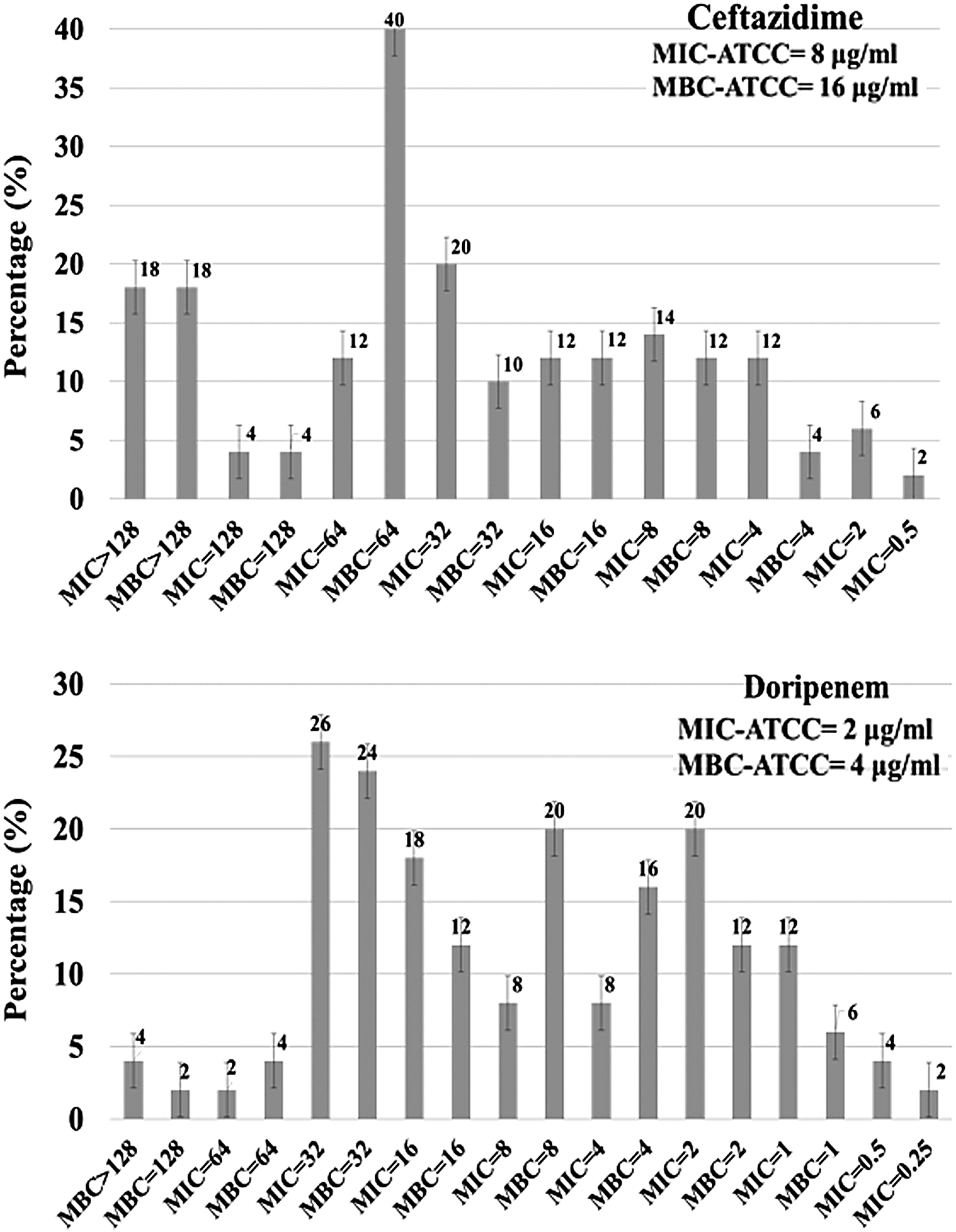
Frequency distribution of MIC and MBC in 50 clinical isolates of Pseudomonas aeruginosa toward ceftazidime and doripenem. CAZ, ceftazidime.
MBC, minimal bactericidal concentration; MDR, multidrug-resistant; MIC, minimum inhibitory concentration.
Synergism of melittin and antibiotics
According to the results, the combined form of melittin and doripenem (at MIC dose; 0.25 and 32 μg/mL) exhibited MIC ca. 0.007 and 1 μg/mL, respectively, against MDR1 strains of A. baumannii. The synergistic MIC for melittin and doripenem against MDR2, MDR3, MDR4, MDR5, and MDR6 strains of A. baumannii was, respectively, (0.007 and 1 μg/mL), (0.007 and 0.5 μg/mL), (0.007 and 0.5 μg/mL), (0.007 and 1 μg/mL), and (0.003 and 1 μg/mL). FIC indices related to melittin and doripenem were <0.5 in all MDR strains of A. baumannii; then, synergism effect occurred between melittin and doripenem versus MDR strains of A. baumannii. The mean appropriate proportion to induce synergism between melittin and doripenem against all MDR strains of A. baumannii is about 1:138.
The combined form of melittin and doxycycline (at MIC dose) showed synergistic MIC values of (0.25 and 32 μg/mL), (0.5 and 32 μg/mL), (0.5 and 32 μg/mL), (0.5 and 4 μg/mL), (0.25 and 32 μg/mL), and (0.25 and 32 μg/mL), respectively, against six MDR isolates of A. baumannii (MDR1–MDR6). FIC indices related to melittin and doxycycline in all strains were equal to 2. Hence, an indifferent effect occurred between melittin and doxycycline against MDR strains of A. baumannii.
The synergistic MIC for melittin and colistin against six MDR strains of A. baumannii (MDR1–MDR6) was, respectively, (0.25 and 4 μg/mL), (0.5 and 128 μg/mL), (0.5 and 128 μg/mL), (0.5 and 128 μg/mL), (0.25 and 128 μg/mL), and (0.25 and 128 μg/mL). FIC indices related to melittin and colistin in all strains were equal to 2. Hence, an indifferent effect occurred between melittin and colistin against MDR strains of A. baumannii (Table 2).
COL, colistin; DOR, doripenem; DXT, doxycycline; FIC, fractional inhibitory concentration; GM, geometric means; Mel, melittin.
The combined form of melittin and doripenem (at MIC dose) against five MDR isolates of P. aeruginosa (MDR1, MDR2, MDR3, MDR4, and MDR5) exhibited synergism at 0.06 and 0.5 μg/mL, 0.03 and 0.12 μg/mL, 0.125 and 0.25 μg/mL, 0.06 and 0.5 μg/mL, and 0.03 and 1 μg/mL, respectively. FIC indices related to melittin and doripenem were <0.5 in all MDR isolates of P. aeruginosa. This issue indicated a synergism effect between melittin and doripenem against MDR isolates of P. aeruginosa. The mean appropriate proportion to induce synergism between melittin and doripenem against all MDR strains of P. aeruginosa is about 1:8.
The synergistic antibacterial activities of melittin and ceftazidime against five MDR isolates of P. aeruginosa (MDR1–MDR5) were recorded at 0.12 and 1 μg/mL, 0.25 and 0.5 μg/mL, 0.12 and 0.5 μg/mL, 0.5 and 1 μg/mL, and 0.25 and 8 μg/mL, respectively. FIC indices related to melittin and ceftazidime in all strains were <0.5. Hence, synergism effect occurred between melittin and ceftazidime against MDR isolates of P. aeruginosa. The mean appropriate proportion to induce synergism between melittin and ceftazidime against all MDR strains of P. aeruginosa is about 1:9 (Table 3).
CEF, ceftazidime; MEL, melittin.
Cytotoxicity assays
The cytotoxicity results showed that melittin at geometric means (GM) equal to 0.37 μg/mL against A. baumannii (MDR) induced a 12.5% average (AVG) cytotoxicity in normal kidney cell lines (HEK293). Melittin+doripenem at GM = 0.006 μg/mL against A. baumannii (MDR) showed 0.12% (AVG) toxicity toward HEK293 cell line. Both groups of melittin+doxycycline and melittin+colistin at GM = 37 μg/mL against A. baumannii (MDR) showed 12.5% toxicity toward HEK293 cell line.
Melittin at GM = 3.8 μg/mL toward P. aeruginosa was found to be ca. 81.5% (AVG) toxic to the HEK293 cell line. The combination of melittin+doripenem and melittin+ceftazidime at GM = 0.06 and 0.24 μg/mL against P. aeruginosa showed 1.2% (AVG) and 4.8% (AVG) toxicity toward HEK293 cell line, respectively (Fig. 3).

Toxicity of melittin, melittin+doripenem, melittin+doxycycline, melittin+colistin, and melittin+ceftazidime toward HEK293 cell line at GM doses against MDR strains of A. baumannii and P. aeruginosa. GM, geometric means; MDR, multidrug-resistant.
Discussion
The combination of antibiotics is one way to overcome MDR strains of bacteria (e.g., A. baumannii and P. aeruginosa) and has recently been suggested to be used in combination with AMPs because of their synergistic activities. In practical examinations, synergistic activities of melittin (as an AMP) and some of antibiotics have been demonstrated in previous studies. 30 In this study, disk diffusion results exhibited that >50% of A. baumannii strains were resistant to ceftazidime, cefepime, doripenem, gentamicin, ciprofloxacin, and piperacillin–tazobactam, and also >90% of A. baumannii strains were resistant to ceftazidime and cefepime. The lowest antibiotic resistance in A. baumannii strains was related to doxycycline (40%). This study also showed that (30% and 56%), (24% and 26%), and (2% and 30%) of A. baumannii isolates had (MIC and MBC) of about >32 μg/mL toward colistin, doripenem, and doxycycline, respectively.
The result showed that A. baumannii strains are more resistant to colistin than doripenem and doxycycline, respectively. In this study, high prevalence of colistin-resistant A. baumannii (54%) might be due to the wide prescription of this antibiotic in the selected hospital. Anyway, this rate is in close conformity with another study in Iran.35–37
In a previous study, the resistant rates of A. baumannii isolates to ciprofloxacin, ceftazidime, cefepime, piperacillin–tazobactam, and gentamicin were reported as 97.5%, 92.5%, 92.5%, 92.5%, and 85%, respectively, 38 which is close to the resistant rates of ciprofloxacin, ceftazidime, cefepime, and gentamicin in this study. Lei Gao et al. showed that the resistant rates of A. baumannii to ceftazidime, cefepime, ciprofloxacin, and levofloxacin were 74%, 72.5%, 75.5%, and 63.5%, respectively, from 2013 to 2014, which is slightly lower than the results of this study. 39 In the study by Deylam Salehi et al. in 2017, 40 the percentage of resistance among A. baumannii isolates to gentamicin was 30%, ciprofloxacin 33%, ceftazidime 35%, and piperacillin–tazobactam 32%, which was lower than our results. In another study in Iran between 2012 and 2014, the resistance rates of A. baumannii isolates toward piperacillin–tazobactam, ceftazidime, gentamicin, doxycycline, and ciprofloxacin were, respectively, reported as 70%, 97%, 78.5%, 43%, and 72%, which was similar to our results, but concerning levofloxacin (99%), the result was higher than our data (48%). 41 Our results also are in conformity with the results of Akbari Dehbalaei who reported the percentage of resistance among A. baumannii as 79%, 92%, 73%, 56%, and 92% for piperacillin–tazobactam, ceftazidime, gentamicin, doxycycline, and ciprofloxacin, respectively. 42
According to experimental data, >50% of P. aeruginosa strains were resistant to levofloxacin, ceftazidime, doripenem, gentamicin, and ciprofloxacin and >90% of P. aeruginosa strains were resistant to gentamicin and 70% of strains were susceptible to colistin and piperacillin–tazobactam. The percentage (18% and 18%) and (2% and 4%) of P. aeruginosa strains had (MIC and MBC) values of about >128 and 64 μg/mL toward ceftazidime and doripenem, respectively.
According to MIC results, doripenem at a range of 2–32 μg/mL inhibited the majority of P. aeruginosa strains. And <5% of P. aeruginosa strains is required a higher dose of doripenem (>32 μg/mL) for inhibition. The growth of 18% of P. aeruginosa strains was inhibited with ceftazidime at higher dose (>128 μg/mL).
In a study conducted by Fazeli et al. in 2017, 43 in Iran (Isfahan), the resistance rate of P. aeruginosa strains to ceftazidime (75%), ciprofloxacin (99%), and gentamicin (100%) was exhibited, which was slightly higher than our results.
According to experimental data, GMMIC of the combined form of melittin and doripenem was reduced up to 61.6- and 51.3-fold, respectively, compared with MDR strains of A. baumannii. FIC indices of melittin and doripenem were <0.5 in all MDR strains of A. baumannii to which it indicates a significant synergism. The GMMIC of melittin–doxycycline and melittin–colistin in combined form was not changed, indicating an indifferent interaction between melittin and the examined antibiotics.
According to cytotoxicity results, the induced synergism between melittin and doripenem led to decrease in melittin consumption up to ca. 61.6-fold. This issue subsequently caused a decrease in its cytotoxicity up to ca. 104-fold. This represents that the combination of melittin and doripenem at MIC dose could be a good candidate for treatment of burn or other infections caused by A. baumannii. The induced synergism between doripenem and melittin most likely related to their site of action on bacterial cell wall. Melittin could create pore inside the outer membrane of gram negative bacteria such as A. baumannii and P. aeruginosa, which is described in previous studies.44,45 This mode of action of melittin likely facilitates the penetration of doripenem to reach the cell wall of bacteria, and at the next step, doripenem causes death of bacteria through inhibition of synthesis of the bacterial cell wall. Doripenem as a carbapenem is a beta-lactam antibiotic and induces death in the bacteria by inhibition of synthesis of the bacterial cell wall. 46
Melittin also showed a significant synergism with ceftazidime, which is a third-generation cephalosporin, and as a beta-lactam antibiotic against P. aeruginosa. Ceftazidime could likely induce synergism with melittin through mode of action similar to doripenem on A. baumannii as well as P. aeruginosa. So, we predicted the expected synergism of melittin with other beta-lactam antibiotics. These data are in conformity with Wu et al. in which they showed synergism between DP7 as an AMP and vancomycin. 26 In their report, DP7 also showed synergism with azithromycin, as a macrolide antibiotic, against P. aeruginosa. Melittin did not show synergism with doxycycline, which is a protein synthesis inhibitor in bacteria. In another study, a combination of raw honey and gentamicin has been shown, which is effective on bacterial ribosome, to have a significant synergistic effect against Escherichia coli and P. aeruginosa strains. 47
As a result of induced synergism, GMMIC of melittin and doripenem in combined form was reduced up to ca. 63.3- and 58-fold, respectively, against MDR strains of P. aeruginosa. GMMIC of melittin and ceftazidime in combined form was also decreased up to ca. 15.8- and 11.2-fold, respectively, against MDR isolates of P. aeruginosa. Certainly, diminution of the dosage of doripenem and ceftazidime in combination with melittin can reduce their side effects.
The dosage of melittin (GMMIC) in melittin–doripenem and melittin–ceftazidime combination was decreased significantly against MDR strains of P. aeruginosa. This diminution led to decrease in melittin cytotoxicity up to ca. 67.9- and 17-fold, respectively. These data highlight that both combinations (melittin–doripenem and melittin–ceftazidime) at MIC dose could be useful candidates for treatment of burn and other infections of P. aeruginosa. We suggest that to investigate the more probable synergism, different dosages of melittin and other beta-lactam and non-beta-lactam antibiotics should be tested against MDR strains of A. baumannii and P. aeruginosa.
Conclusion
This study showed that >90% and 40% of A. baumannii isolates from burn infections were resistant to ceftazidime, cefepime, and doxycycline, respectively. Also, >90% of P. aeruginosa strains isolated from burn infections were resistant to gentamicin, whereas 70% of strains were susceptible to colistin and piperacillin–tazobactam.
A dose (>32 μg/mL) of colistin, doripenem, and doxycycline was needed to eradicate the 56%, 26%, and 30% of A. baumannii strains isolated from burn infections, respectively. A higher dose (>128 μg/mL) of ceftazidime and doripenem can inhibit 18% and 4% of P. aeruginosa strains, respectively.
The combination of melittin–doripenem, melittin–doxycycline, and melittin–colistin at their MIC dose significantly caused a decrease in the GMMIC of both melittin and doripenem against MDR strains of A. baumannii. Therefore, synergism effect occurred between melittin and doripenem against MDR strains of A. baumannii. But, GMMIC of melittin–doxycycline and melittin–colistin was not decreased against MDR strains of A. baumannii. Thus, an indifferent interaction occurred between melittin–doxycycline and melittin–colistin against MDR strains of A. baumannii.
The induced synergism between melittin and doripenem against MDR strains of A. baumannii caused a decrease in melittin dose; thus, the cytotoxicity of melittin was significantly decreased.
The dose of melittin (GMMIC) in melittin–doripenem and melittin–ceftazidime combination was significantly decreased against MDR strains of P. aeruginosa. FIC indices demonstrated that the synergism effect occurred between melittin–doripenem and melittin–ceftazidime against MDR strains of P. aeruginosa. Diminution in melittin dose in combined form with antibiotics against P. aeruginosa causes a decrease in melittin cytotoxicity too.
Therefore, the combination of melittin–doripenem (for A. baumannii) and melittin–doripenem and melittin–ceftazidime (for P. aeruginosa) at their MIC dose could be useful candidates for treatment of burn infections.
Footnotes
Acknowledgments
This article is financially supported by “Research Department of the School of Medicine Shahid Beheshti University of Medical Science” (Grant No. 6697, Morality No.  ). The authors gratefully acknowledge the financial and laboratory facility support provided by the Shahid Beheshti University of Medical Science and Venom and Biotherapeutics Molecules Lab, Pasteur Institute of Iran.
Disclosure Statement
No competing financial interests exist.