




Abstract
Background:
An increasing pattern of fluoroquinolone resistance (FQR) among bacterial pathogens has been described worldwide. In this study, we compared the patterns of genetic mechanisms that confer FQR for Escherichia coli and Klebsiella pneumoniae isolated from the Assiut University Hospitals in Egypt.
Methods:
Eighty-seven clinical E. coli and K. pneumoniae isolates were tested for mutations in gyrA, gyrB, parC, and parE genes by polymerase chain reaction (PCR) amplification and DNA sequencing. The presence of plasmid-mediated quinolone resistance (PMQR) genes qnrA, qnrB, qnrS, aac(6′)-Ib, qepA was screened by PCR and characterized by conjugation. Correlations between different FQR mechanisms and ciprofloxacin minimal inhibitory concentration (MIC) levels were determined.
Results:
A higher number of quinolone resistance-determining region (QRDR) mutations was detected in E. coli, while the number of PMQR determinants was significantly higher in K. pneumoniae. However, K. pneumoniae showed stronger correlations than E. coli between MIC levels and number of mutations in the QRDR per isolate (rs = 0.8, p < 0.0001 and rs = 0.7, p < 0.0001, respectively) as well as between MIC levels and number of plasmids (rs = 0.4, p = 0.005 and rs = 0.3, p = 0.02, respectively).
Conclusions:
Although we observed a prevalence of chromosomal mutations for E. coli and the presence of plasmid-encoded genes for K. pneumoniae that resulted in FQR phenotype, high levels of FQR appeared to occur as a result of gradual accumulation of mutations in QRDR for both bacteria. To our best of knowledge, this is the first study to report and compare the correlation between FQ MIC levels and different genetic mechanisms for FQR in Enterobacteriaceae.
Introduction
F
FQR in Enterobacteriaceae is mediated mainly by the acquisition of mutations in genes that encode for DNA gyrase, topoisomerase IV, or the regulators of AcrAB efflux pump. The most common FQR mechanisms are mutations in the quinolone resistance-determining region (QRDR) of gyrA and gyrB, which encode for DNA gyrase, and parC and parE, which encode for topoisomerase IV. 1 In addition, FQR can be due to the acquisition of plasmid-mediated quinolone resistance (PMQR) genes including qnr, aac(6′)-Ib-cr, and qepA. Interestingly, plasmid-mediated FQR has been shown to emerge even in the absence of FQ therapy. 9
Epidemiological data on the emergence and prevalence of FQR Enterobacteriaceae in different countries suggest variations in the patterns of resistance mechanisms.10,11 These differences suggest a role of geographical influence on the emergence and dissemination of FQR mechanisms. Thus, it is important to determine the pattern(s) of prevalent FQR mechanisms in each part of the world.
Despite the widespread prevalence of FQR Enterobacteriaceae in Egypt, limited information is available about the genetic mechanisms of FQR in such pathogens.12–14 Our main objective for this study was to identify and compare the patterns of genetic mechanisms of FQR in E. coli and K. pneumoniae isolated from the Assiut University Hospitals in Egypt.
Materials and Methods
Bacterial isolates
Eighty-seven consecutive and non-repetitive isolates of E. coli and K. pneumoniae were obtained from the Assiut University Infection Control Laboratory between October 2014 and March 2015. All isolates were identified using the API® 20E system strips (BioMèrieux SA, France) and verified with the molecular analysis of gapA and 16S–23S ITS in E. coli and K. pneumoniae, respectively (Table 1). Bacteria were stored in glycerol at −80°C and freshly grown for each experiment.
Sequences of Primers Used for Polymerase Chain Reaction
Antimicrobial susceptibility testing
Antimicrobial susceptibility profile was determined for 14 antibiotics representing seven drug classes (ampicillin [10 μg], amoxicillin/clavulanic acid [30 μg], pipracillin [100 μg], cefpodoxime [10 μg], cefotriaxone [30 μg], cefoperazone [75 μg], imipenem [10 μg], ciprofloxacin [5 μg], levofloxacin [5 μg], gentamicin [10 μg], amikacin [30 μg], chloramphenicol [30 μg], tetracycline [30 μg], and trimethoprim/sulfamethoxazole [1.25/23.75 μg]; Oxoid Limited, United Kingdom) by Kirby-Bauer's disc diffusion method according to the specification of Clinical Laboratory Standard Institute (CLSI). 15 Each isolate was classified as expressing no drug resistance (NDR), resistance to a single drug class (SDR), or resistance to at least three or more classes of antibiotics (MDR). 16
In vitro susceptibility testing of E. coli and K. pneumoniae isolates to ciprofloxacin and levofloxacin was performed by broth microdilution method in accordance with CLSI. 15 Minimal inhibitory concentration (MIC) values (≥4, 2, and ≤1 μg/mL, and ≥8, 4, and ≤2 μg/mL) were used to define resistance, intermediate susceptibility, and susceptibility to ciprofloxacin and levofloxacin, respectively. FQR isolates were classified according to ciprofloxacin MICs into low-level FQR (MIC 4–16 μg/mL), intermediate-level FQR (MIC 32–64 μg/mL), and high-level FQR (MIC ≥128 μg/mL). E. coli ATCC 25922 was used as a quality control strain in the susceptibility tests.
DNA sequence analyses of QRDR
The gyrA, gyrB, parC, and parE genes of 45 E. coli isolates, and the gyrA, parC, and parE genes of 42 K. pneumoniae isolates were sequenced to identify potential mutations. The oligonucleotide primers used to amplify the genes by PCR are shown in Table 1. Genomic DNA was extracted by the boiling method, 17 and the genes of interest were amplified in a Bio-Rad T100 Thermocycler (Bio-Rad, Edison, NJ) using the Hot start thermostable Taq DNA polymerase (New England Biolabs, United Kingdom). PCR products were visualized in 2% agarose gels with ethidium bromide and imaged with the EZ imager (Bio-Rad).
The amplified DNA fragments were purified using a QIAquick PCR Purification Kit (Qiagen, Inc., Valencia, CA), and both strands were sequenced with the same primers used for PCR amplification. The DNA and deduced amino acid sequences were compared with those of E. coli K-12 substrain DH10B (GenBank NC_010473.1) and K. pneumoniae subsp. pneumoniae HS11286 (GenBank NC_016845.1) using the BLAST alignment tool (www.ncbi.nlm.nih.gov/blast). The number and types of mutation in each isolate were correlated to the MIC of ciprofloxacin.
Detection of PMQR determinants
PCR was used to detect the presence of qnr (A, B, and S), the aminoglycoside acetyltransferase (aac(6′)-Ib), and the efflux pump (qepA) genes. E. coli J53 strain containing pMG252, pMG298, pMG306, or pMG298 were used as qnrA, qnrB, qnrS, and aac(6′)-Ib-positive controls, respectively. E. coli J7261205 (pSTVqepA) was used as a positive control for qepA.20,24,25
Following amplification, the PCR products were visualized in 2% agarose gels with ethidium bromide and imaged with the EZ imager (Bio-Rad). To confirm the PCR results, both strands of the purified PCR products were sequenced. The DNA and the deduced amino acid sequences were compared with those available in the GenBank database. All aac(6′)-Ib-positive PCR products were further digested with FokI restriction enzyme (Jena Bioscience, Germany) to identify the aac(6′)-Ib-cr variant, which lacks the FokI restriction site present in the wild-type gene. 26
Conjugative transfer of PMQR genes
Potential conjugative transfer of PMQR determinants from E. coli and K. pneumoniae isolates was assessed using an azide-resistant E. coli J53 as the recipient. 27 Each PMQR containing isolate was grown in LB broth and incubated at 37°C to mid-logarithmic growth phase (OD600 0.4–0.6). Equal amounts of E. coli or K. pneumoniae donor cultures and E. coli recipient culture were mixed together, spotted on LB plates, and incubated overnight at 37°C to promote conjugation. Transconjugants were selected on LB agar containing sodium azide (100 mg/L) and ciprofloxacin (0.06 mg/L). Colonies were picked from the selection agar and analyzed by PCR to determine the presence of PMQR determinants.
Statistical analysis
E. coli and K. pneumoniae isolates harboring different FQR mechanisms were analyzed by SPSS (version 16). Comparison between the number of E. coli and K. pneumoniae isolates carrying QRDR mutations and PMQR genes was performed using chi-square test, and p-value <0.05 was considered significant. Correlations between different FQR mechanisms and ciprofloxacin MIC levels in both bacteria were determined using Spearman's rank order correlation test.
Results
Antimicrobial susceptibility
A total of 45 E. coli and 42 K. pneumoniae isolates were tested against 14 antibiotics representing seven different classes. For E. coli, 1 isolate was classified as NDR, 2 isolates as SDR (resistant only to β-lactams), and 42 (93.3%) as MDR as well as potent extended spectrum β-lactamase producers. In contrast, all K. pneumoniae isolates were MDR and potent extended spectrum β-lactamase producers.
As for fluoroquinolones susceptibility, only six (13.3%) of the tested E. coli isolates showed susceptibility to both ciprofloxacin (MICs ≤1 μg/mL) and levofloxacin (MICs ≤2 μg/mL). The remaining 39 isolates (86.7%) of E. coli showed moderate or high-level resistance to ciprofloxacin and levofloxacin with MICs ≥32 μg/mL (Table 2 and Fig. 1). With K. pneumoniae, nine (21.4%) isolates were susceptible to both ciprofloxacin and levofloxacin, while another eight (19%) isolates showed low-level resistance to ciprofloxacin (MICs 4–16 μg/mL) but intermediate susceptibility to levofloxacin (MICs 3–6 μg/mL). The remaining 22 (52.4%) isolates showed moderate or high-level resistance to both ciprofloxacin and levofloxacin (MICs ≥64 μg/mL) (Table 3 and Fig. 2)
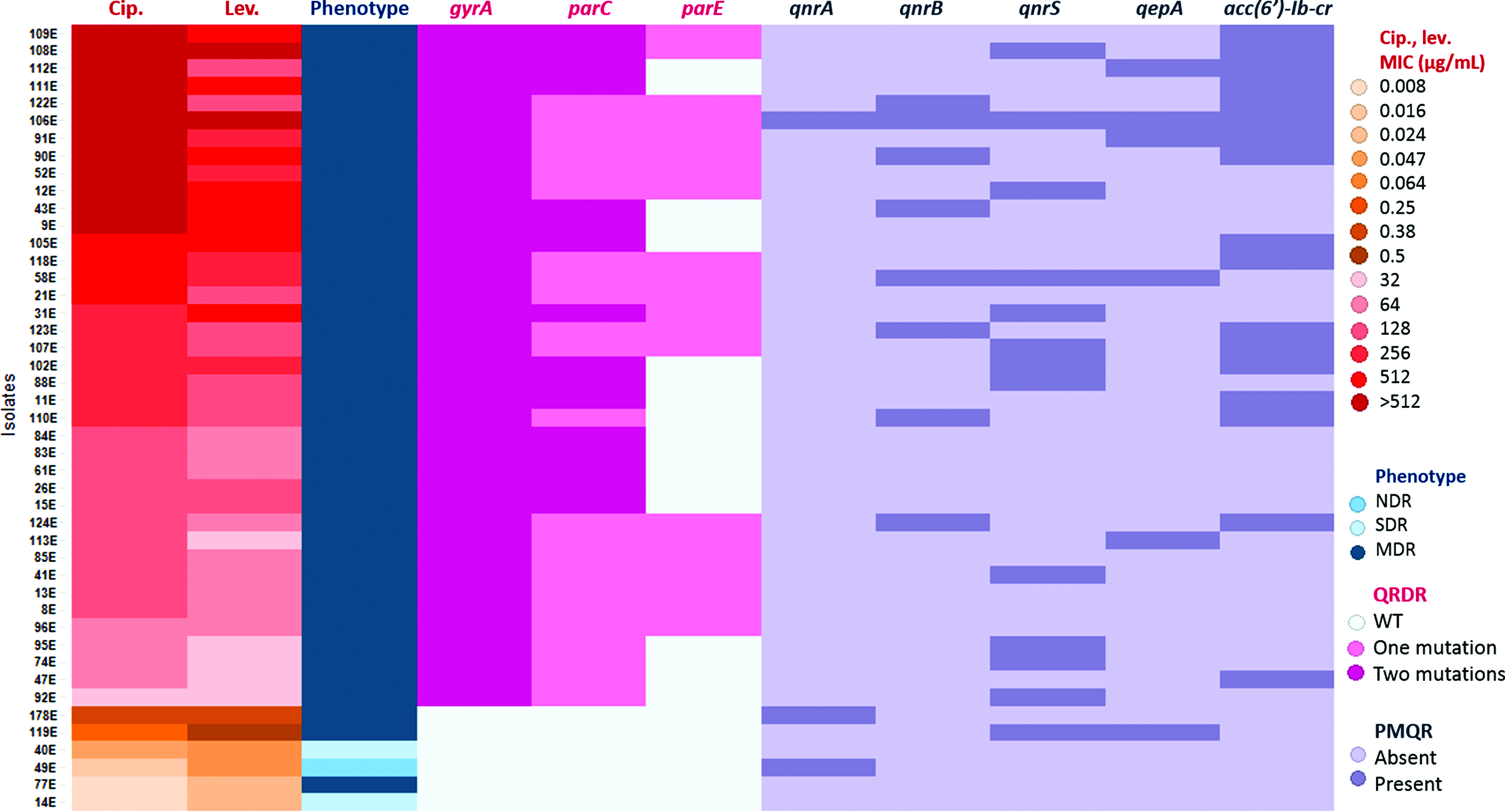
Heat map showing relations between different mechanisms of fluoroquinolone resistance, phenotype, and MICs to ciprofloxacin and levofloxacin among 45 Escherichia coli isolates. MIC, minimal inhibitory concentration. Color images are available online.
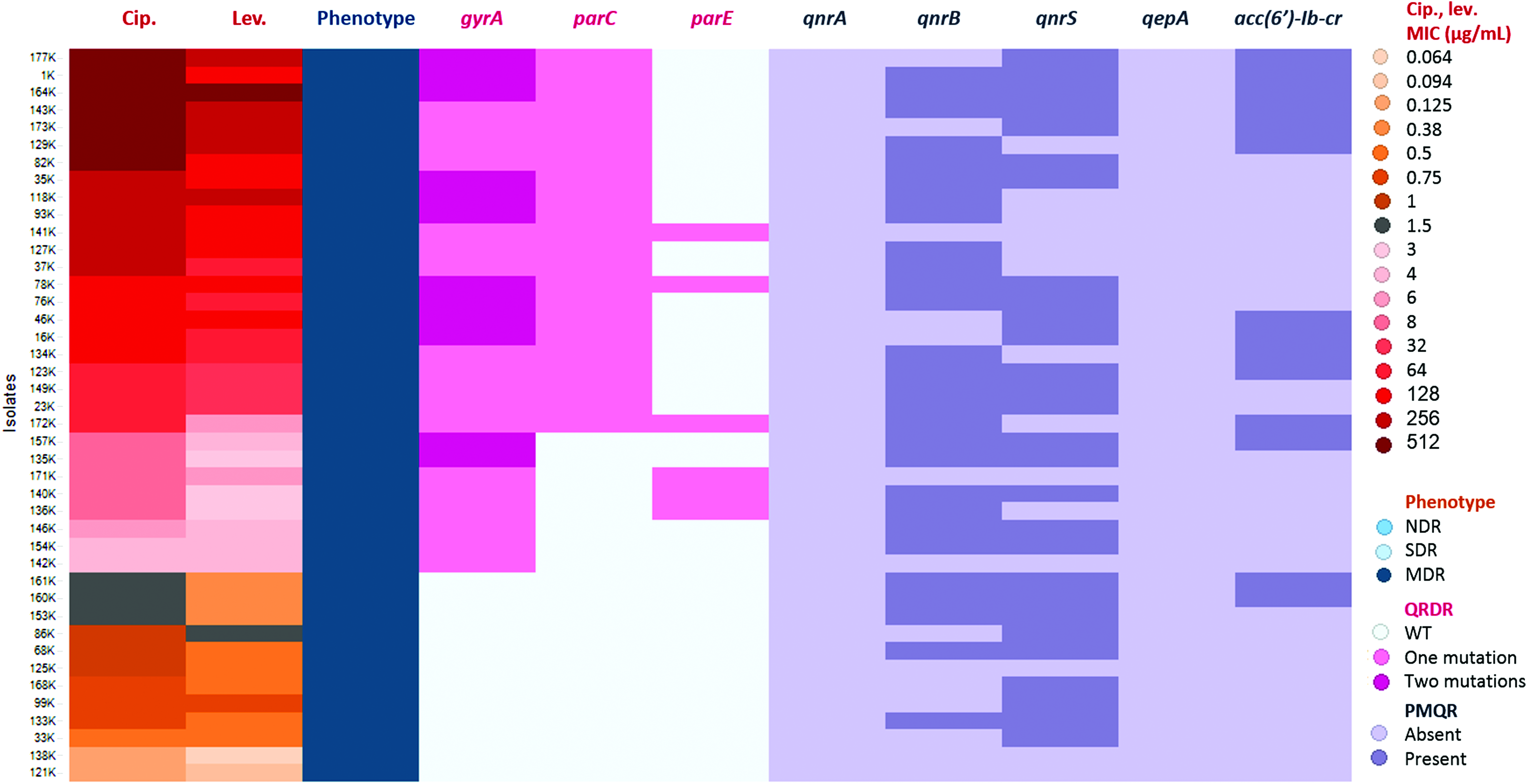
Heat map showing relations between different mechanisms of fluoroquinolone resistance, phenotype, and MICs to ciprofloxacin and levofloxacin among 42 Klebsiella pneumoniae isolates. Color images are available online.
Distribution of Mutations, Amino Acid Substitutions, and Plasmids Among Escherichia coli (n = 45) Isolates
Resistance levels based on MIC for ciprofloxacin: sensitive (≤1 mg/L), intermediate susceptibility (>1 to <4 mg/L), low-level resistance (4–16 mg/L), moderate-level resistance (32–64 mg/L), high-level resistance (≥128 mg/L).
No isolates showed mutations in gyrB gene.
PMQR: (−) absent; (+) present non-transmissible; (+*) present transmissible.
Cip, ciprofloxacin; Lev, levofloxacin; QRDR, quinolone resistance-determining regions; PMQR, plasmid-mediated quinolone resistance; WT, wild type.
Distribution of Mutations, Amino Acid Substitutions, and Plasmids Among K. pneumoniae (n = 42) Isolates
Resistance levels based on MIC for ciprofloxacin: sensitive (≤1 mg/L), intermediate susceptibility (>1 to <4 mg/L), low-level resistance (4–16 mg/L), moderate-level resistance (32–64 mg/L), high-level resistance (≥128 mg/L).
PMQR: (−) absent; (+) present non-transmissible; (+*) present transmissible.
Mutations in DNA gyrase and topoisomerase IV
Mutations in gyrA, parC, and parE were detected in all 39 FQR E. coli isolates (Table 2 and Fig. 1). Each of the 39 FQR E. coli isolates had at least two mutations within gyrA in addition to a third mutation in parC, while 31 FQR E. coli isolates harbored a fourth mutation in parC (13 isolates) or in parE (18 isolates). No mutation in parC or parE was found without the concomitant presence of at least two mutations in gyrA. It is worth noting that three (7.7%) FQR E. coli isolates harbored five mutations; two mutations in gyrA, two mutations in parC, and one mutation in parE. No gyrB mutation was observed in any of the E. coli isolates, and no mutation was detected in FQ-susceptible E. coli isolates.
In K. pneumoniae, none of the 12 ciprofloxacin-sensitive or intermediately susceptible isolates contained mutations in the three genes analyzed (Table 3 and Fig. 2). In contrast, all of the FQR K. pneumoniae isolates contained either a single or double mutations in gyrA with or without a mutation in parE. One high-level ciprofloxacin-resistant K. pneumoniae isolate harbored four mutations (two in gyrA, one in parC, and one in parE) with a novel mutation in parE (G425C).
Detection of PMQR determinants
Thirty (66.7%) E. coli isolates carried at least one PMQR determinant: three of these isolates (10%) were FQ-sensitive (FQS) with reduced susceptibility (MIC >0.008 μg/mL), while 27 (90%) isolates were MDR. Among the 30 plasmid-containing E. coli isolates, 3 (6.7%), 8 (17.8%), 13 (28.9%), 6 (13.3%), and 17 (31%) were positive for qnrA, qnrB, qnrS, qepA, and aac(6′)-Ib-cr, respectively (Table 2 and Fig. 1).
With K. pneumoniae, 37 isolates (88.1%) contained one or more PMQR determinants; six of these PMQR-positive isolates were FQS, while three showed intermediate FQ susceptibility, and 28 were FQR. Among PMQR containing K. pneumoniae strains, 29 (69%), 28 (66.7%), and 14 (33.3%) were positive for qnrB, qnrS, and aac(6′)-Ib-cr, respectively (Table 3 and Fig. 2).
Conjugative transfer of resistance genes
The PMQR genes from 17 of 30 (56.7%) E. coli donors were horizontally transferred to recipients through conjugation. PCR confirmed the presence of the same PMQR genes in transconjugants (Table 2). Successful transfer occurred in 2 of 3 qnrA, 3 of 13 qnrS, 1 of 6 qepA, 12 of 17 aac(6')-Ib-cr, and all 8 qnrB-positive isolates. Co-transfer of more than one PMQR gene occurred from six E. coli donors, while co-transfer of qnrB and aac(6')-Ib-cr occurred from five E. coli donors, and co-transfer of qnrA, qnrB, qepA, and aac(6')-Ib-cr occurred from one E. coli donor.
Transconjugants were obtained from all but one of the 37 (97.3%) PMQR-positive K. pneumoniae isolates. PCR confirmed the presence of the same PMQR genes in transconjugants (Table 3). Successful transfer occurred from 27 of 29 isolates for qnrB, 12 of 14 isolates for aac(6')-Ib-cr, and from all 28 qnrS-positive isolates. Co-transfer of more than one PMQR gene occurred from 25 of the 37 (67.6%) K. pneumoniae donors in which 14 donors transferred qnrB and qnrS, 4 transferred qnrS and aac(6')-Ib-cr, 1 transferred qnrB and aac(6')-Ib-cr, and 6 transferred qnrB, qnrS and aac(6')-Ib-cr.
Comparing patterns of FQR mechanisms in E. coli and K. pneumoniae isolates
Among all of the E. coli and K. pneumoniae isolates, 10 gyrA, 6 parC, and 2 parE distinct patterns of substitution mutations were identified (Tables 2 and 3). Of the 10 gyrA patterns, double substitution of S83L and D87N predominated in E. coli (38) isolates. In K. pneumoniae, 9 gyrA substitution mutations were identified with S83I as the most prevalent mutation (10 isolates). With parC, S80I substitution mutation predominated both in K. pneumoniae (21) and E. coli (23) isolates. S458A was the only parE substitution mutation detected in E. coli (21 of 39), and its corresponding mutation (S459A) was detected in five of the K. pneumoniae isolates. A G425C substitution mutation was detected in K. pneumoniae, but it was not found in E. coli.
The number of isolates carrying gyrA mutations was higher in E. coli than K. pneumoniae isolates [39 (86.7%) vs. 30 (71.4%); p < 0.001; Table 4]. Moreover, whereas all FQR E. coli isolates carried two mutations in gyrA, only 40% of the K. pneumoniae isolates carried two mutations and the other 60% carried only one mutation in gyrA. Similarly, the number of isolates carrying mutations in parC was higher for E. coli than K. pneumoniae isolates [39 (86.7%) vs. 22 (52.4%); p < 0.001; Table 4]. Furthermore, double mutations in parC were found in 16 of the 39 FQR E. coli isolates, but they were not detected in any of the K. pneumoniae isolates. Likewise, the number of isolates carrying a single mutation in parE was higher in E. coli than K. pneumoniae isolates [21 (46.7%) vs. 6 (14.3%); p = 0.001; Table 4]. Unexpectedly, the correlation between MIC level and mutations in both parC and gyrA was somewhat stronger in K. pneumoniae than in E. coli (rs = 0.9, p < 0.001 and rs = 0.7, p < 0.001 vs. rs = 0.5, p < 0.001 and rs = 0.6, p < 0.001, respectively; Table 5).
Comparison of Different Fluoroquinolone Resistance Mechanisms Between E. coli and K. pneumoniae Isolates
Chi-square test, significant p-value <0.05.
n = total number of isolates.
Total number/percentage of strains with gene mutation.
Total number of strains with mutation/s in one or more of the QRDR genes.
Total number of strains carrying one or more quinolone-resistant plasmids.
Highly significant.
Significant.
Correlations Between Different Fluoroquinolone Resistance Mechanisms and Ciprofloxacin MIC
Spearman's rank order correlation test.
rs, Spearman's rank correlation coefficient.
Significant p-value <0.05.
Bold rs values indicate a strength of correlation as follows: 0.3–< 0.5 a weak positive correlation, 0.5–< 0.7 a moderate positive correlation, > 0.7 a strong positive correlation.
Highly significant.
Significant.
QRDR, quinolone resistance-determining regions; PMQR, plasmid-mediated quinolone resistance; n, total number of isolates.
The number of accumulated mutations in E. coli was significantly higher compared with K. pneumoniae isolates (p < 0.001). The majority of FQR E. coli isolates (31) contained four QRDR mutations, while K. pneumoniae isolates carried one, two, or three mutations in the QRDR regions (3, 15, 11 isolates, respectively; Table 4). Nevertheless, K. pneumoniae showed stronger correlations than E. coli between MIC levels and number of mutations in QRDR per isolate (rs = 0.8, p < 0.001 and rs = 0.7, p < 0.001, respectively; Table 5).
The total number of isolates carrying one or more PMQR genes was significantly higher for K. pneumoniae than for E. coli (p < 0.001; Table 4). The qnr genes (B and S) were the most common PMQR genes found in K. pneumoniae isolates, and their presence was significantly higher than in E. coli (p < 0.001). The aac(6')-Ib-cr gene was the most common PMQR gene present in E. coli with no statistically significant difference compared with K. pneumoniae (p = 0.6; Table 4). A stronger correlation was detected between MIC level and number of plasmids per isolate among K. pneumoniae than E. coli (rs = 0.4, p = 0.005 and rs = 0.3, p = 0.02, respectively). However, the correlation between MIC level with qnrB and aac(6')-Ib-cr was weak to moderate for both bacteria (E. coli: rs = 0.3, p = 0.01 and rs = 0.5, p < 0.001; K. pneumoniae: rs = 0.4, p = 0.01 and rs = 0.4, p = 0.003, respectively; Table 5).
Interestingly, weak positive correlations were found between the occurrence of mutations between gyrA and aac(6')-Ib-cr in E. coli (rs = 0.3, p = 0.03) and aac(6')-Ib-cr and qnrB in K. pneumoniae (rs = 0.3, p = 0.03).
Discussion
Antimicrobial resistance is a major concern of public health. 28 MDR bacteria have been reported worldwide and are frequently treated with fluoroquinolones. However, the emergence of increased resistance to FQs is leading to treatment failure and limiting available therapeutic options.29,30 In this study, we investigated the patterns of molecular mechanisms of FQR in E. coli and K. pneumoniae isolated from the Assiut University Hospitals, Egypt.
Only a few studies have clearly described the sequence of QRDR mutations in E. coli and K. pneumoniae. The E. coli mutations identified in our study were somewhat similar to those described in previously studies.6,14,31,32 We showed that the presence of two gyrA and one parC mutations resulted in a moderate level of FQR. However, a fourth mutation raised the MIC level to ≥128 μg/mL. In addition, the presence of a fifth mutation further increased the MIC to >512 μg/mL. However, unlike the previously published studies, the fourth QRDR mutation could occur either in parC or parE in our study. No mutation was detected in any of the FQS isolates in the genes tested.
Although Fendukly et al. 31 stated that K. pneumoniae isolates had no apparent mutation pattern in the QRDR genes, our K. pneumoniae isolates carried mutations in QRDR genes that resulted in FQR. Our isolates carried a mutation at gyrAS80 that caused ciprofloxacin MIC to reach resistance breakpoint (MIC 4 μg/mL). Another mutation occurs either at position gyrAD87 or parES459 and leads to a twofold increase in MIC (8 μg/mL). Interestingly, addition of a parCS80 mutation to a gyrAS80 mutation boosted MIC up to ≥64 μg/mL.
Our main goal was to compare the different FQR mechanisms between E. coli and K. pneumoniae. In agreement with previous studies, our results demonstrated that the frequency of mutations in gyrA, parC, and parE genes was significantly higher in E. coli than in K. pneumoniae.33,34 Moreover, double mutations in gyrA and parC were predominant in E. coli, while K. pneumoniae isolates typically carried a single mutation in both genes.35–37 In contrast, a significantly higher prevalence of PMQR genes was detected in K. pneumoniae than in E. coli isolates. Moreover, significantly higher PMQR transmissibility was detected with K. pneumoniae donors in the current study, which may explain the predominance of PMQR genes among K. pneumoniae isolates, as previously reported.34,36
Our subsequent aim was to identify and compare the impact of QRDR mutations and presence of PMQR on FQ MIC levels in E. coli and K. pneumoniae. Although the number of QRDR mutations per isolate was significantly higher in E. coli, K. pneumoniae showed stronger correlations between the number of mutations in QRDR per isolate and FQ MIC levels. Moreover, despite the higher prevalence of plasmids in K. pneumoniae, the FQ MIC level of K. pneumoniae isolates showed a stronger correlation with the number of mutations in QRDR than with the number of plasmids per isolate. Furthermore, only a weak positive correlation was detected between qnrB and aac(6')-Ib-cr and FQ MIC level in both bacteria. In contrast, aac(6')-Ib-cr was found to be positively correlated with the occurrence of gyrA mutations in both pathogens. These findings differ from the previous results of Paltansing et al. 34 in which the authors determined that FQR in K. pneumoniae, unlike in E. coli, was principally mediated by plasmids rather than chromosomal mutations. Nevertheless, our results could be explained by the fact that mutations in gyrA and parC have greater influence on FQR for both E. coli and K. pneumoniae. 38 In contrast, the PMQR determinants are known to cause reduced susceptibility to FQ while enhancing the emergence of resistant mutants.9,39
To the best of our knowledge this is the first study to postulate that, while there is a predominance of chromosomally encoded resistance determinants in E. coli and plasmid-mediated resistance genes in K. pneumoniae, the stepwise increase in FQR for both bacteria occurs due to gradual accumulation of mutations in QRDR. Although the PMQR determinants, namely aac(6')-Ib-cr and qnrB, cause a slight increase in FQR, their main role appears to be facilitating the emergence and selection of resistant mutants, namely gyrA mutations, that lead to a higher level of FQR.
Funding Information
This study was supported by Science and Technology Development Fund (STDF) Basic and Applied Research Grant # 5584. In addition, the study was partially supported by the grant #1325 from the Faculty of Medicine Grant Office, Assiut University, and the Alabama Agricultural Extension Station grant #ALA0SUH.
Footnotes
Acknowledgments
We thank the members of the Infection Control Research Unit, College of Medicine, Assiut University, for their assistance in sample collection. In addition, we thank Dr. Laura Silo-Suh of Mercer University School of Medicine for critical reading of the article.
Ethical Statement
The Committee of Medical Ethics of the Faculty of Medicine, Assiut University, reviewed and approved this study (IRB No. 17300228) according to the latest revision of the Declaration of Helsinki, and informed consent was obtained from the patients.
Disclosure Statement
The authors declare no conflicts of interest.