




Abstract
Carbapenem-resistant Enterobacteriaceae (CREs)-mediated infections remain a huge public health concern. CREs produce enzymes such as metallo-β-lactamases (MBLs), which inactivate β-lactam antibiotics. Hence, developing efficient molecules capable of inhibiting these enzymes remains a way forward to overcoming this phenomenon. In this study, we demonstrate that pyridyl moieties favor the inhibitory activity of cyclic metal-chelating agents through in vitro screening, molecular modeling, and docking assays. Di-(2-picolyl) amine and tris-(2-picolyl) amine exhibited great efficacy against different types of MBLs and strong binding affinity for NDM-1, whereas 2-picolyl amine did not show activity at a concentration of 64 mg/L in combination with meropenem; it further showed the lowest binding affinity from computational molecular analysis, commensurating with the in vitro screening assays. The findings revealed that the pyridyl group plays a vital role in the inhibitory activity of the tested molecules against CREs and should be exploited as potential MBL inhibitors.
Introduction
β-lactam antibiotics, which include penicillins, cephalosporins, carbapenems, cephamycins, and monobactams, are the most prescribed drugs in clinical practice for treating bacterial infections due to their wide spectrum of activity and less toxicity. 1 However, to counter the effectiveness of β-lactams, microorganisms have developed enzymes called β-lactamases that are capable of hydrolyzing the amide bond of the β-lactam ring, thus rendering them inactive. 2 β-lactamases are classified into serine- or metallo-β-lactamases (SBLs or MBLs) depending on the molecule found at the enzyme's active site: serine amino acid is found at the active site of SBLs, whereas zinc atom(s) is present at MBLs' active site. 3
The alarming spread of β-lactamase-producing bacteria and the lack of novel antimicrobial agents continue to pose a huge burden worldwide. Gram-negative bacteria are most associated with resistance, limiting the use of β-lactam antibiotics as treatment options and leading to prolonged patient care, longer term of disability, increased resistance to antibiotics, higher financial burden, and mortalities.4,5 Combination therapies involving a β-lactam antibiotic and a β-lactamase inhibitor remain a major treatment option for infections caused by β-lactamase-producing organisms. 6 SBL inhibitors for Ambler class A β-lactamases such as KPC, GES, IMI, NMC, TEM, SHV, VEB, CTX-M, and PER 7 are already in clinical use and are efficient as combination therapies for SBL-positive infections. Such combinations include amoxicillin–clavulanate, ampicillin/cefoperazone–sulbactam, 8 piperacillin–tazobactam, 9 meropenem (MEM)–vaborbactam, 10 and the approved ceftazidime–avibactam.11,12 Numerous agents showing potential inhibitory activity against MBLs have been reported in the literature, but none has successfully passed clinical trials. Hence, no MBL inhibitor (MBLI)-β-lactam combination therapy is clinically available for MBL-positive bacterial infections.
Carbapenem-resistant Enterobacteriaceae (CREs) express resistance to carbapenems through several mechanisms, including expression of MBLs such as KPC, GES, NDM, VIM, IMP, and OXA-48-like enzymes,7,13 and have been reported as critical in the World Health Organization's Priority Pathogens List for the Research and Development of New Antibiotics. 14 Chelating agents are chemical entities with structures that permit their donor atoms to attach to metal ions. Employing chelators to sequester zinc atoms in the active sites of MBLs is a suitable approach to inhibiting MBLs' β-lactam hydrolysis activity.15,16 From this point of view, our research group aimed to investigate known metal-chelating agents, including 2-picolyl amine (MPA), di-(2-picolyl) amine (DPA), and tris-(2-picolyl) amine (TPA) as potential MBLIs, and to characterize the inhibitory effect of pyridyl moieties in these metal-chelating molecules.
Polypyridyls are acyclic chelators that have proven their ability to treat apoptosis-resistant human cancer in vitro due to their strong zinc chelating properties. 17 Examples of polypyridyls (Fig. 1) include DPA and N,N,N0,N-tetrakis (2-pyridymethyl) ethylene-diamine (TPEN) that has a higher affinity for zinc metals than DPA. 17
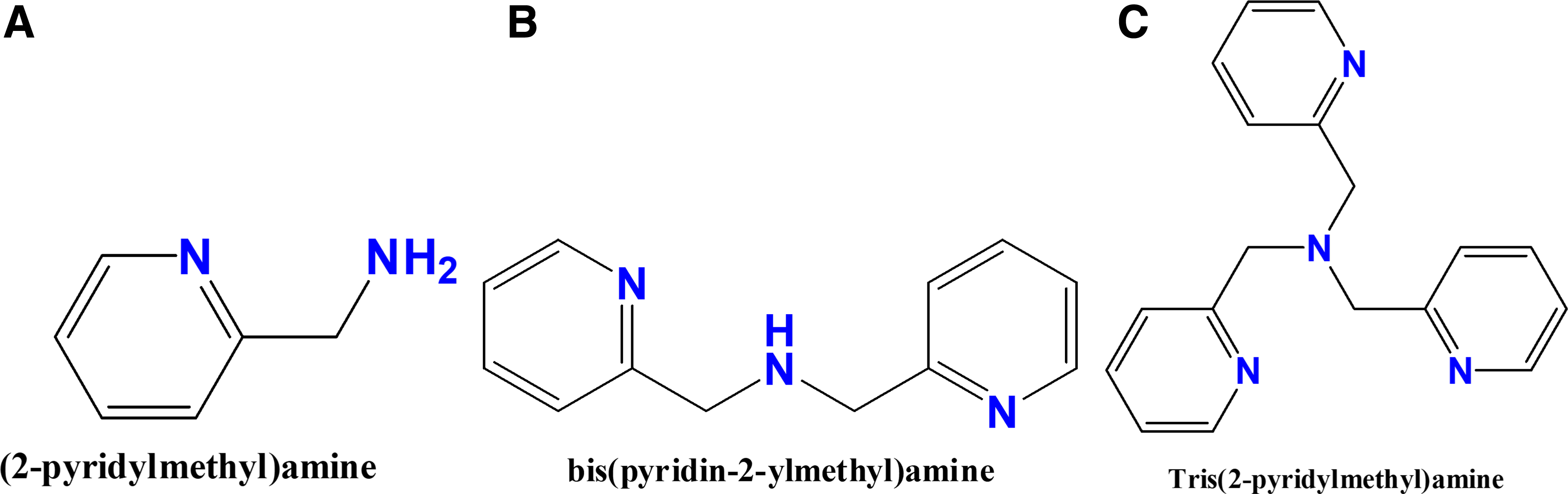
Chemical structures of pyridyls:
Materials and Methods
Materials
MEM, MPA, DPA, TPA, dimethyl sulfoxide (DMSO), human serum, cation-adjusted Mueller–Hinton broth (CAMHB) and Mueller–Hinton agar (MHA), and phosphate-buffered saline were purchased from Sigma Aldrich (St. Louis, MO).
Bacterial isolates
Thirty-three well-characterized South African clinical isolates producing CREs 18 and 15 reference CRE strains obtained from France (Institut Pasteur de France) were used in this study. 19 Seventeen of the clinical CREs used in this study were isogenic belonging to the same sequence type (Klebsiella pneumoniae ST101 [n = 6], ST2017 [n = 3] and Serratia marcescens SA1 [n = 8]) as shown in Table 1. Furthermore, some of the isolates exhibited similar resistome as they harbored the same circulating plasmids (data not shown).13,18 Escherichia coli ATCC 25922 purchased from the American Type Culture Collection (ATCC) was carbapenem-susceptible reference strain used as quality control.
Minimal Inhibitory Concentrations and Minimal Bactericidal Concentrations of Di-(2-Picolyl) Amine and Tris-(2-Picolyl) Amine Against South African Clinical Isolates
Untypeable strain.
DPA, di-(2-picolyl) amine; MBC, minimum bactericidal concentration; MBLs, metallo-β-lactamases; MEM, meropenem; MIC, minimum inhibitory concentration; TPA, tris-(2-picolyl) amine.
Minimum inhibitory concentrations, minimum bactericidal concentrations
Minimum inhibitory concentrations (MICs)/minimum bactericidal concentrations (MBCs) determinations were performed according to CLSI guidelines and protocols described by Keepers et al.20,21 In brief, serial dilutions of MEM and MBL inhibitors, from 0.015 to 16 mg/L and 1 to 64 mg/L, respectively, were made with CAMHB in 96-well microtiter plates using the checkerboard method. 22 Ten percent DMSO was used as solvents in dissolving the test compounds. A McFarland-standardized bacterial inoculum was inoculated into each microtiter well. The plates were then incubated for 18–22 h at 37°C under aerobic conditions. The MIC was determined as the lowest concentration at which there was no visible growth. Afterward, an aliquot of 100 μL was taken from the MIC assay wells in which no visible growth was observed and inoculated onto MHA plates for MBC determination by incubating at 37°C for 24 h. The MBC was determined as the lowest concentration of the test compound that resulted in a 99.9% decrease in bacterial viable count on the agar plates. Control wells were filled with the same volumes of solvent(s) used in dissolving the drug candidates, CAMHB, and bacteria. The experiments were performed in triplicate.
Serum effects on the MIC
The effects of serum on the MIC of TPA, which exhibited the best activity in combination with MEM (TPA–MEM), were determined using the already mentioned MIC method with slight modifications. 23 In this assay however, sterile-filtered serum from human male AB plasma was added to the broth (CAMHB) to prepare 50% human serum in the final culture broth. Reference CRE strains carrying different enzymes (NDM-1, NDM-4, VIM-1, IMP-1, and IMP-8) were used to conduct this experiment in triplicate.
Synergistic activity
The synergistic effect between TPA and MEM was determined by the combination assay as described previously with few modifications. 24 In brief, serial dilutions of MEM were titrated with a fixed concentration of TPA (4 mg/L). This 4 mg/L TPA concentration was the lowest concentration that had no effect on the growth of bacteria and considerably potentiated the activity of MEM against resistant bacteria. TPA and MEM were also tested individually to determine their MICs. The fractional inhibitory concentration (FIC) index was calculated as follows: FIC of MEM (MIC of MEM+TPA/MIC of MEM alone)+FIC of TPA (MIC of MEM+TPA/MIC of TPA alone). The effect/activity of a combination with an FIC index of ≤0.5 was considered synergistic, an FIC index of 1 was defined as additive, and an FIC index of >4 was characterized as antagonistic.
Time-kill assay
Time-kill kinetic assay was performed according to the CLSI guideline and previously described method.20,21 The TPA was evaluated for its killing kinetic properties against blaNDM-1-positive E. coli, blaVIM-1-positive E. coli, and blaIMP-1-positive Enterobacter cloacae. In brief, freshly prepared colonies were resuspended in CAMHB, adjusted to a 0.5 McFarland standard (∼1.5 × 10 8 CFU/mL), and further diluted by 1:20 in CAMHB so that the starting inoculum was ∼1.5 × 10 6 CFU/mL. MEM was added to the prepared bacterial suspensions at final concentrations corresponding to 1× , 4× , or 8× the MIC of MEM; a fixed TPA concentration of 4 mg/L was added. A growth control with no test compound was also included. The starting inoculum was determined from the growth control tube immediately after dilution and was recorded as the count at time zero. After addition of antibiotics, the starting inoculum was ∼1.5 × 10 6 CFU/mL. The tubes were incubated in an orbital-shaking incubator at 37°C and 180 rpm, and viability counts were performed at 1, 2, 4, 6, 8, and 24 h by removing 100 μL of the culture, diluting as appropriate, and plating on MHA. The agar plates were incubated at 37°C for at least 22 h. Colonies were counted, and the results were recorded as the number of CFU/mL. A ≥3log10 decrease in the number of CFU/mL was considered bactericidal. The assays were executed in triplicate.
Computational modeling analysis
System preparation
Crystal structures of NDM-1 (PDB ID: 3Q6X) were retrieved from the Research Collaboratory for Structural Bioinformatics (RCSB) Protein Data Bank (PDB) (www.rcsb.org/pdb). A ligand interaction map was generated using the web version of PoseView. 25
Molecular docking and dynamics simulation
Docking calculations were obtained using AutoDock Vina software. 26 Geister partial chargers were assigned and the AutoDock atom types were defined using the AutoDock graphical user interface supplied by MGL tools. 27 The docked conformations were generated using the Lamarckian genetic algorithm. 28 The reports for each calculation were in kcal/mol. This technique has been validated in previous studies. 29
Missing parameters for the ligand in the Cornell et al. force field were created 30 in the absence of available parameters. Optimization of the ligands was first performed at the HF/6-31G* level with the Gaussian 03 package. The restrained electrostatic potential (RESP) procedure 31 was used to calculate the partial atomic charges. General amber force field 32 parameters and RESP partial charges were assigned using the ANTECHAMBER module in the Amber14 package. Hydrogen atoms of the proteins were added using the Leap module in Amber12. The standard AMBER force field for bioorganic systems (ff03) was used to define the enzyme parameters. Counter ions were added to neutralize the charge enzyme. The system was enveloped in a box of equilibrated TIP3P water molecules with 8 Å distance around the enzyme. Cubic periodic boundary conditions were imposed and the long-range electrostatic interactions were treated with the particle mesh Ewald method 33 implemented in Amber12 with a nonbonding cutoff distance of 10 Å.
Initial energy minimization, with a restraint potential of 2 kcal/mol Å2 applied to the solute, was carried out using the steepest descent method in Amber12 for 1,000 iterations followed by conjugate gradient protocol for 2,000 steps. The entire system was then freely minimized for 1,000 iterations. Harmonic restraints with force constants 5 kcal/mol Å2 were applied to all solute atoms during the heating phase. A canonical ensemble constant number (N), volume (V), and temperature (T) molecular dynamic (MD) was carried out for 50 ps, during which the system was gradually annealed from 0 to 300 K using a Langevin thermostat with a coupling coefficient of 1/ps. Subsequently, the system was equilibrated at 300 K with a 2 fs time step for 100 ps while maintaining the force constants on the restrained solute. The SHAKE algorithm 34 was employed on all atoms covalently bonded to a hydrogen atom during equilibration and production runs. A production run was performed for 2 ns in an isothermal isobaric (NPT) ensemble using a Berendsen barostat with a target pressure of 1 bar and a pressure coupling constant of 2 ps with no restraints imposed. The coordinate file was saved every 1 ps and the trajectory was analyzed every 1 ps using Ptraj module implemented in Amber14.
Results and Discussion
Carbapenems have become the last-resort antibiotic for treating fatal and multidrug-resistant bacterial infections due to increased resistance to all class of antibiotics. In this study, we evaluated known metal-chelating agents as potential MBLIs and characterized the functionality of pyridyl moieties in the inhibitory effect of these molecules. Pyridyl analogues were investigated alone and/or in combination with carbapenem antibiotic (MEM) for their antimicrobial properties against carbapenemase-producing Enterobacteriaceae. MPA at a concentration of 64 mg/L did not potentiate the activity of MEM against the CRE isolates expressing acquired subclass B1 carbapenemases and MBL reference strains (data not shown). However, different concentrations of DPA and TPA considerably enhanced the efficacy of MEM against the MBL-producing bacteria (varying from 2 to 64 mg/L). The lowest concentration of DPA at which most of the MEM activity was restored was 16 mg/L, whereas 4 mg/L TPA was most potent with MEM.
None of the tested SBL producers, OXA-48-positive K. pneumoniae and KPC-2-positive E. cloacae, were affected by the three pyridyl groups in the metal chelators, substantiating the substrate spectrum of these compounds. MBCs of the combined MEM–DPA and MEM–TPA were conducted at a fixed concentration (16 and 4 mg/L, respectively), revealing the bactericidal property of the combination. The MBC/MIC ratio of the combination varied from one- to fourfold against both reference and clinical CRE isolates used in this study (Table 2). E. coli ATCC 25922 had no changes in the MIC values when treated with MEM alone and/or in combination with the polypyridyls, which demonstrates that the activity was selective for zinc-based MBL producers.
Inhibitory Activity of Tris-(2-Picolyl) Amine and Meropenem Alone and in Combination Against Reference Strains of Carbapenem-Resistant Enterobacteriaceae
NE, no inhibitory effect.
NA, not applicable.
ATCC, American Type Culture Collection; FIC, fractional inhibitory concentration.
Previously reported metal-chelating agents, EDTA, DOTA, and NOTA, showed similar results against MBLs as well as SBLs.16,35 Metal chelators are known for their strong affinity toward metal ions. MBLs possess zinc atom(s) at their active sites, which are possibly sequestrated by the polypyridyls, thus inactivating the enzymes' β-lactam hydrolysis property. These assertions were further supported by the application of molecular modeling, docking, and dynamic studies. The main mechanisms of resistance to carbapenems are porin downregulation plus extended spectrum ß-lactamases (ESBLs) hyperexpression, efflux, and carbapenemases. From previous study involving the same isolates, the role of efflux was ruled out.18,36 In another publication, we showed that inhibition of the MBLs resulted in a reversion of carbapenem MICs from resistant to susceptible values. 37 Although we did not undertake expression analysis to quantify the expression levels of the ESBLs and MBLs in these isolates, the data from the already stated publications show that the MBLs were responsible for the recorded MICs and their inhibition by the TPA led to the reductions recorded in MEM MICs. Future work will address the expression levels of the ESBLs and MBLs in the absence and presence of TPA to finally confirm this preliminary work.
The stability and the compactness of all the enzyme–ligands complexes were as shown in Fig. 2. Overall, the spectrum of root mean square deviation (RMSD) did not show considerable structural shifts, explaining the stability of the enzyme structure and the strength of ligand attachment inside the active site pocket. The average RMSD for all three complexes was 1.176 Å (MPA), 1.077 Å (DPA), and 1.013 Å (TPA), implying simulations were stable. The lower RMSD of NDM-1–TPA complex is an indication that TPA was binding better than the other two compounds with the most stable enzyme complex. The radius of gyration (Rg) of all the frames during the simulation run was plotted against time and the data were analyzed. The mean values for Rg were 17.04, 17.018, and 16.60 Å for MPA, DPA, and TPA, respectively, throughout the simulation. Rg enables one to assess the compactness changes of a ligand–enzyme complex observed corresponding to RMSD results with the NDM-1–TPA complex showing most compactness.
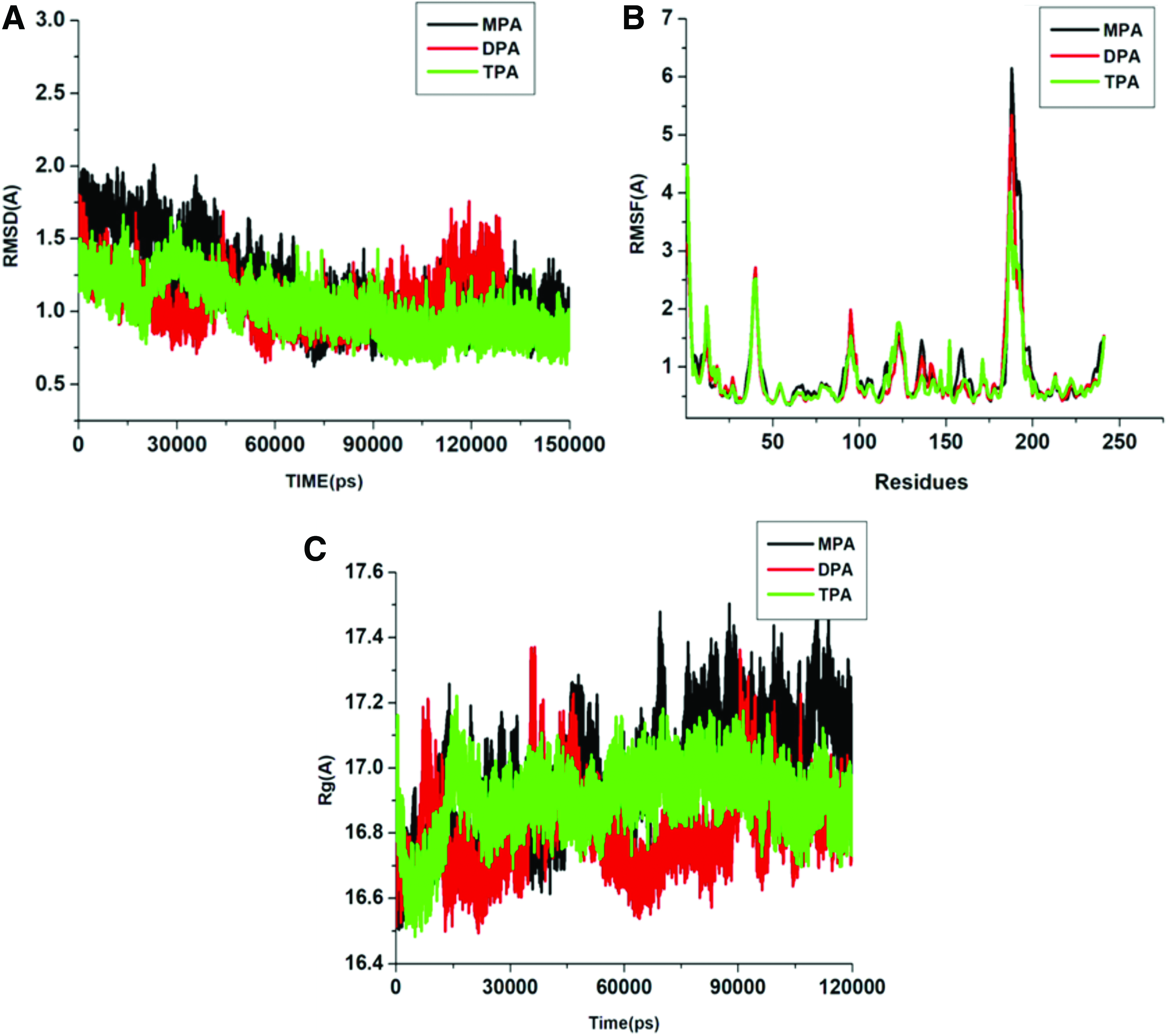
Root mean square fluctuation (RMSF) with respect to each residue in all three complexes was then calculated to explain the differences in flexibility. RMSF of protein residues contributing to the complex's structural fluctuations can be assessed by RMSFs of each residue. Analysis of the RMSF values shows that great differences among the different complexes were observed around the active site, implying different modes of binding for each ligand. The curve for the NDM-1–TPA complex was stable throughout the simulation period and fluctuations were negligible. The plot for the NDM-1–DPA and NDM-1–MPA complexes was, however, more fluctuating, inferring that the enzyme was losing its compactness due to the change in its conformation. MPA and DPA exhibited higher RMSFs than TPA; a similar trend was observed from Rg. This was further validated by the LigPlot images, showing that ligand 3 (TPA) possessing three pyridyl moieties more interacted with more active site residue(s) compared with ligand 1 (MPA) and ligand 2 (DPA) (Fig. 3), ligand 1 demonstrated the least interaction with the active site residue(s).
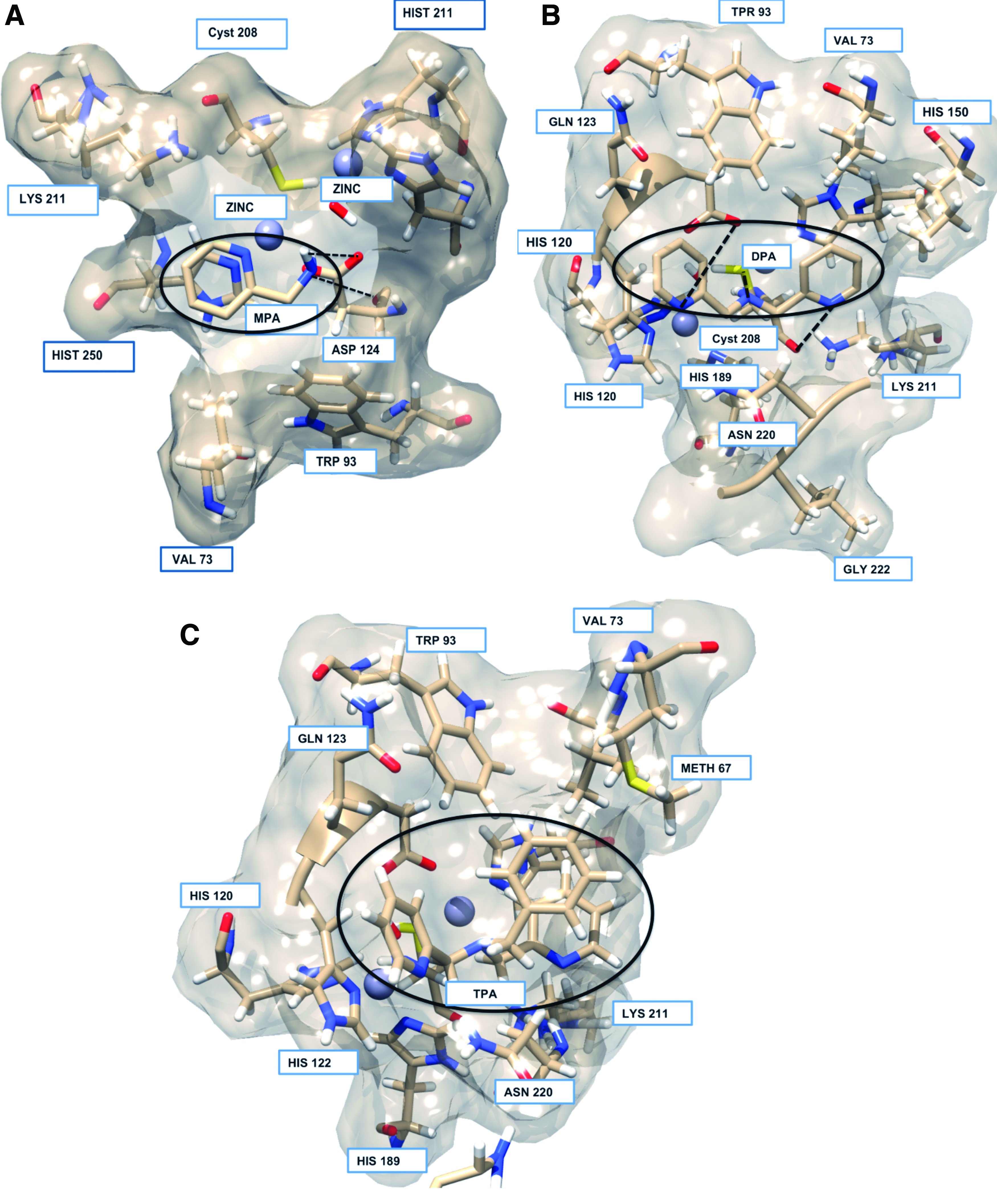
LigPlot analysis for NDM-1 complexes with
The free energy components responsible for the binding and attachment of the ligand to the enzyme were further explored separately to provide insights into driving forces for selective bindings of each ligand (Table 3). The binding free energy analysis showed that the intermolecular van der Waals and the electrostatic interaction were the forces binding both systems. The corresponding binding free energies for MPA, DPA, and TPA were −15.689 kcal/mol, −50.608 kcal/mol, and −60.260 kcal/mol, respectively. Whereas the van der Waals interactions were −35.491, −58.704, and −63.312 for MPA, DPA, and TPA, respectively, corresponding with the in vitro experiments where TPA showed the highest binding affinity, of all three molecules, to the NDM-1. However, the total solvation energy (ΔGsol) was unfavorable for all the complexes.
MM/GBSA Based on Binding Free Energy Profile of NDM-1 Complexed with 2-Picolyl Amine, Di-(2-Picolyl) Amine and Tris-(2-Picolyl) Amine
ΔGbind—binding energy; ΔEele—electrostatic; ΔEvdw—van der Waals; ΔEgas—gas phase energy; ΔGsol—total solvation energy.
MPA, 2-picolyl amine.
Furthermore, we evaluated the pharmacological properties of the most potent molecule (TPA) in combination with MEM, where all the tested isolates exhibited MBC/MIC ratio of ≤4, demonstrating the bactericidal activity of the combined molecules. MEM is known for its bactericidal property, which was maintained while in combination with TPA. This pharmacological property was further confirmed by the time-kill kinetic study. A decrease in the CFU/mL relative to the initial bacterial density of ∼10 6 CFU/mL was observed over the increasing time points (0, 1, 2, 4, 6, 8, and 24 h) and concentrations of the MIC values evaluated (1×, 4×, and 8× MICs) (Fig. 4). A 3log10 decrease in the CFU/mL was observed when bacterial cells were challenged with MEM–TPA at 1×, 4×, and 8× MICs after 4 h. The time-kill kinetics results indicated that the MEM–TPA combination had bactericidal activity against E. coli carrying NDM-1 and VIM-1 enzymes as well as E. cloacae producing IMP-1. This finding showed a killing time of 4 to 8 h, at concentrations of 4 × and 8 × time the MIC values. Acyclic dithiocarbamate compounds, NOTA, and its analogue, sodium 1,4,7-triazonane-1,4,7-tris(carboxylodithioate), that actively restored the efficacy of MEM against E. coli, Proteus mirabilis, Citrobacter freundii, and Klebsiella pneumonia producing blaNDM-1 also demonstrated bactericidal properties in the presence of MEM. 38

Time-kill kinetics at varying concentrations of MEM and fixed concentration of TPA (4 mg/L).
The effect of TPA and MEM on the CRE reference strains was evaluated to determine whether the combination exhibited additive, antagonistic, or synergistic properties. TPA alone inhibited the CRE reference strains at concentrations varying from 128 to ≥1,024 mg/L. MEM alone exhibited inhibitory concentrations of ≥8 mg/L, indicating a carbapenem-resistant phenotype. 21 Challenging these CRE strains with TPA in combination with MEM reactivated the effectiveness of the antibiotic, and a synergistic effect was observed between MEM and the polypyridyl, that is, TPA, against CREs, with an FIC index value of ≤0.5 (Table 2). A synergistic activity was observed with FIC index values varying from ≤0.005 to 0.25 (Table 2), which aligns with the potent MBLs inhibitor, Aspergillomarasmine A, a metal chelator that also synergizes with MEM against MBLs. 22
An assay determining serum's effect on MICs was carried out on the compound that showed better inhibitory activity. The MIC value of TPA in the presence of 50% human serum varied from one to two dilutions increase compared with that of the MIC in the absence of serum, indicating that there was no substantial effect of serum on the combination activity of TPA–MEM (Table 1). The insignificant effect of serum on the MICs can be attributed to MEM's low protein-binding properties 39 or that TPA and/or TPA–MEM combinations also have low plasma protein-binding properties. Further studies to evaluate the plasma protein-binding properties of TPA are necessary.
The ability of these polypyridyls to chelate intrinsic and extrinsic zinc ion(s), required for the structural and regulatory functioning of human cells and serum metallo enzymes such as the angiotension converting enzyme (ACE) enzymes, will render it unsafe for clinical usage due to the immeasurable side effects that will arise from ACE inhibition; hence, the in vivo effects of these moieties should be investigated further. However, other studies have reported that DPA and TPA, including TPA-based metal chelators, possess tolerable cytotoxic effects at MICs on living cells.35,40 Further research is currently being carried out to determine the effect of these polypyridyl MBL chelators on the bacterial cell membrane, their in vivo and in vitro pharmacokinetics and pharmacodynamics effects, as well as their effect on eukaryotic enzymes such ACE to determine their clinical efficacy and safety of these moieties as MBLIs.
Conclusion
The findings showed that pyridyl moieties play a vital role in the inhibitory activity of the tested molecules against CREs. In vitro screening assays and computational molecular analysis revealed that the acyclic metal chelators, polypyridyls (TPA and DPA), were more potent chelators exhibiting great inhibitory activity by binding tightly to the zinc ions at the active-site pockets of MBLs to inhibit the enzymes' β-lactam hydrolysis activity compared with the monopyridyl (MPA). TPA with three pyridyl moieties was identified as the most active molecule followed by DPA and MPA, respectively, as TPA can form three chelating rings per Zn ion giving better thermodynamic stability in the Zn (II)–TPA complex; DPA can form two chelating rings and MPA only one, leading to diminished stability (and hence reduced inhibitory activity) of their complexes with Zn (II). Further studies are undertaken to elucidate the actual mechanism of action, functionality, and safety of these pyridyl moieties in potentiating metal chelators into MBLIs.
Footnotes
Acknowledgments
We are grateful to the South African National Research Foundation (NRF), School of Health Sciences UKZN, and School of Applied Chemistry UJ M&D Global Excellence & Stature Scholarship for financial support.
Disclosure Statement
No competing financial interests exist.