




Abstract
Aims:
The aim of the study was to analyze the epidemiology of Acinetobacter baumannii and investigate the genetic characteristics of carbapenem-resistant A. baumannii (CRAB) isolates isolated from blood cultures in a regional hospital in Hong Kong.
Results:
Twenty blood culture isolates were collected from a regional hospital in Hong Kong from 2014 to 2017. Twenty isolates were grouped into five existing sequence types (STs) and five new STs within the following prevalence: ST195 was predominant with a prevalence of 45% (n = 9), followed by ST373 and ST447 (10%; n = 2 each), and ST176 and ST345 (5%; n = 1 each). Resistance to carbapenem antibiotics was 55% (n = 11). Six carbapenem-resistant isolates harbored blaOXA-23 genes and ISAba1 mobile elements. Polymerase chain reaction confirmed that ISAba1 is located upstream to the blaOXA-23 genes, suggesting an association between ISAba1 and blaOXA-23 genes with carbapenem resistance.
Conclusion:
This study is the first to report the emergence of CRAB ST195 harboring blaOXA-23 in Hong Kong.
Introduction
Acinetobacter baumannii is a Gram-negative pathogen that causes nosocomial infections, resulting in outbreaks. Studies have shown that A. baumannii can develop into multidrug-resistant, extensively drug-resistant, and pan drug-resistant strains.1–3 Carbapenems are potent drugs with strong antibiotic actions and low toxicity levels; however, in recent years, carbapenem-resistant strains of A. baumannii have emerged. Carbapenems are β-lactam antibiotics with lactam rings, and β-lactamases are a class of enzymes capable of breaking lactam rings of carbapenems, thus deactivating them. β-lactamases are classified into four classes A–D based on amino acid sequence. Class A, C, and D enzymes utilize serine for β-lactam hydrolysis, whereas class B metalloenzymes require divalent zinc ions for substrate hydrolysis. Class D β-lactamases, known as oxacillinases or OXA-type enzymes, have an active serine residue that cleaves the lactam ring and is, therefore, capable of acting against carbapenems. Increasing resistance to carbapenems mediated by production of class D β-lactamases with carbapenemase activity has been observed worldwide in the past decade.4–7 Different class D β-lactamases with carbapenemase gene clusters have been described in A. baumannii, which correspond to OXA-23, OXA-24, and OXA-58 genes.8–10 It is well known that the OXA-23 enzyme is responsible for carbapenem resistance and A. baumannii outbreaks.8,11 Insertion sequence A. baumannii 1 (ISAba1) belongs to the IS4 family have been described in the A. baumannii in association carbapenem resistance. Studies have linked the presence of the ISAba1 sequence upstream of the blaOXA-23 gene to carbapenem resistance.11–13
Spread of drug-resistant A. baumannii poses a serious public health to hospitalized patients.14–16 Therefore, it is very important to understand its epidemiology and characteristics to control potential outbreaks. Although the factors causing specific A. baumannii strains to become prevalent clones are poorly understood, epidemiology of the bacteria, its geographical distribution, and its prevalence can provide valuable information on the burden of disease. 14 Molecular type and strain identification can be used to determine differences in strains and if a new strain has emerged, as monitoring the emergence of new antimicrobial resistant strains can help elucidate the epidemic capacity of the bacteria.
A study showed that resistance to imipenem in intensive care units increased from 22.0% in 2000 to 66.8% in 2010 across five major hospitals in Taiwan. 17 Gao et al. reported a sharp increase in the rates of carbapenem-resistant A. baumannii (CRAB) isolates from 13.3% in 2003 to 70.5% in 2014 in China. 2 In addition, they found that the number of extensive drug-resistant isolates increased from 11.1% in 2004 to 60.4% in 2014. 2 The most commonly reported carbapenemase produced by the A. baumannii strains isolated in China are OXA-51, OXA-23, OXA-24, and OXA-58. 11
This study evaluated disease epidemiology and characteristics of A. baumannii strains in a regional hospital in Hong Kong to better inform strategies to overcome resistance specific to local settings.
Materials and Methods
Study design
This was a retrospective cross-sectional study in a regional hospital in Hong Kong S.A.R., near mainland China. The regional hospital, an acute care unit with 1,650 hospital beds, also provides all microbiology services to an acute network general hospital with 600 inpatient beds. The two hospitals serve >1.5 million people, accounting for >20% of the population in Hong Kong.
Bacterial isolates
Twenty nonduplicate A. baumannii blood culture isolates were collected from 2014 to 2017. The matrix-assisted laser desorption ionization time-of-flight method (Bruker) identified all isolates as belonging to the Acinetobacter species. They were further identified to species level by using a multiplex polymerase chain reaction (PCR)-based assay, which targets the internal fragments of the 16S–23S ribosomal RNA (rRNA) intergenic region, gyrB and recA genes. Protocols were performed as described previously. 18
Antimicrobial susceptibility testing
The Vitek 2 system (BioMerieux) assessed minimal inhibition concentrations for the following antibiotics, which included different classes of antibiotics shown to be effective for treatment of Acinetobacter infection: ceftazidime, ceftriaxone, piperacillin-tazobactam, cotrimoxazole, amikacin, gentamicin, ciprofloxacin, levofloxacin, doripenem, imipenem, colistin, and tigecycline. All antimicrobial susceptibility testing results were interpreted according to the Clinical and Laboratory Standards Institute guidelines, 19 except for tigecycline, which was assessed using the U.S. Food and Drug Administration-approved breakpoints for Enterobacteriaceae (≤2, 4, and ≥8 μg/mL for susceptible, intermediate, and resistant, respectively). 20
Molecular typing
Multilocus sequence typing (MLST) was performed on all A. baumannii isolates according to the Oxford scheme. 21 The MLST Acinetobacter database was used to analyze the DNA sequences of each allele and ST assignment (https://pubmlst.org/abaumannii).
Carbapenemase gene detection
PCR assay tested the isolates for the presence of the following carbapenemase genes: blaOXA-51, blaOXA-23, blaOXA-24, blaOXA-58, blaOXA-143, blaNDM, blaKPC, blaOXA-48 like, blaVIM, blaIMP, and blaIMI genes. The protocols were performed as described previously.8–10
Insertion sequences for carbapenem resistance
PCR assay first screened the isolate for the presence of the insertion sequences, ISAba1. If ISAba1 was positive, a combination of ISAba1 forward and the OXA-51 or OXA-23 reverse primers were used to detect the presence of ISAba1 relative to the upstream position of OXA-51 or OXA-23. 22
Results
MLST typing
Twenty isolates were grouped into five existing sequence types (STs) and five new STs. ST195 was predominant with a prevalence of 45% (n = 9), followed by ST373 and ST447 (10%; n = 2 each), and ST176 and ST345 (5%; n = 1 each) (Fig. 1).
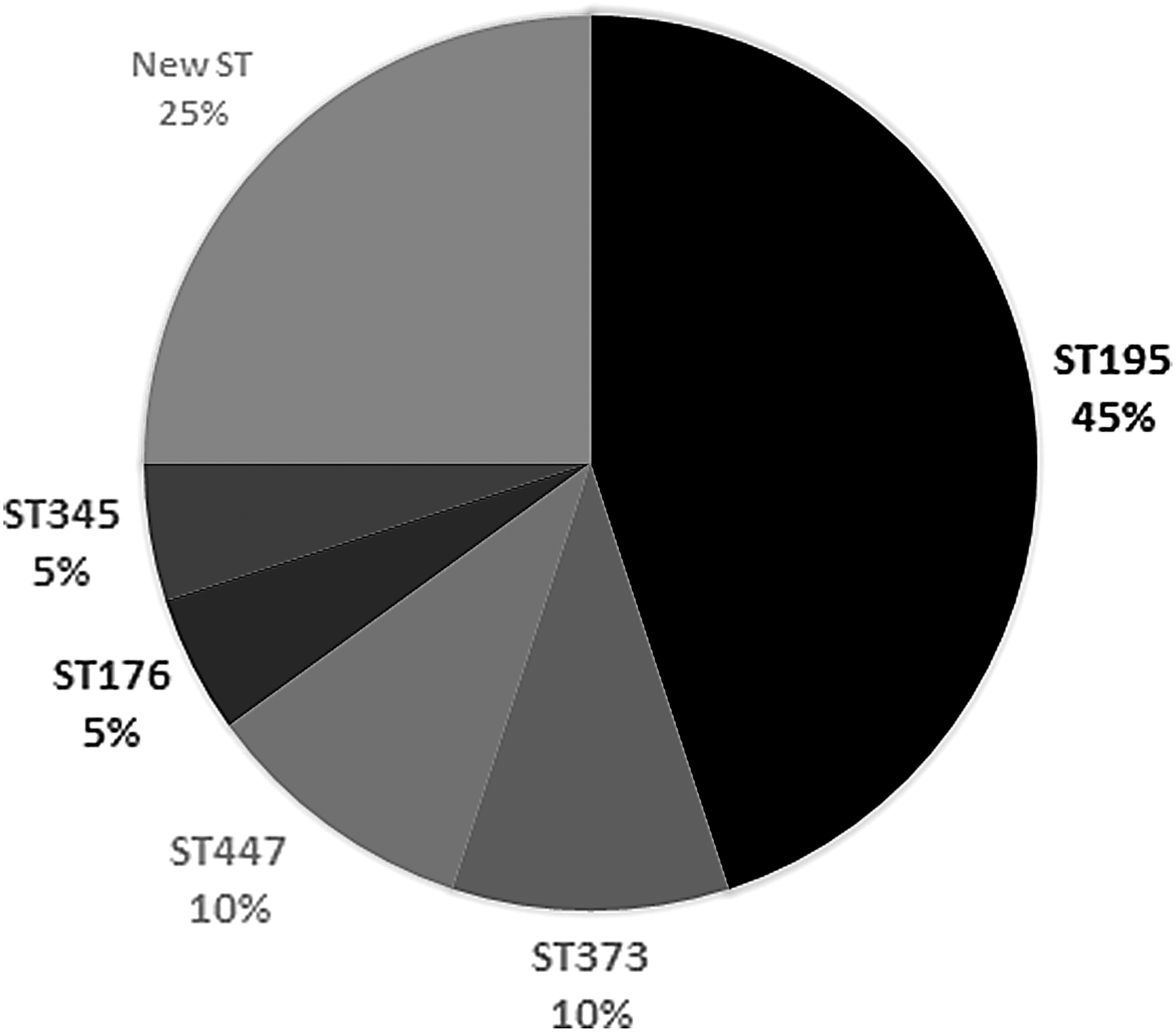
Percentage distribution of STs, N = 20. STs, sequence types.
Antimicrobial susceptibility testing
ETest (BioMerieux) confirmed that 11 isolates (55%) were resistant to carbapenems (doripenem and imipenem). The carbapenem-resistant isolates exhibited high resistance to piperacillin/tazobactam (100%), ciprofloxacin (100%), ceftazidime (91%), and ceftriaxone (82%); however, none of the isolates were resistant to tigecycline and colistin (Fig. 2).
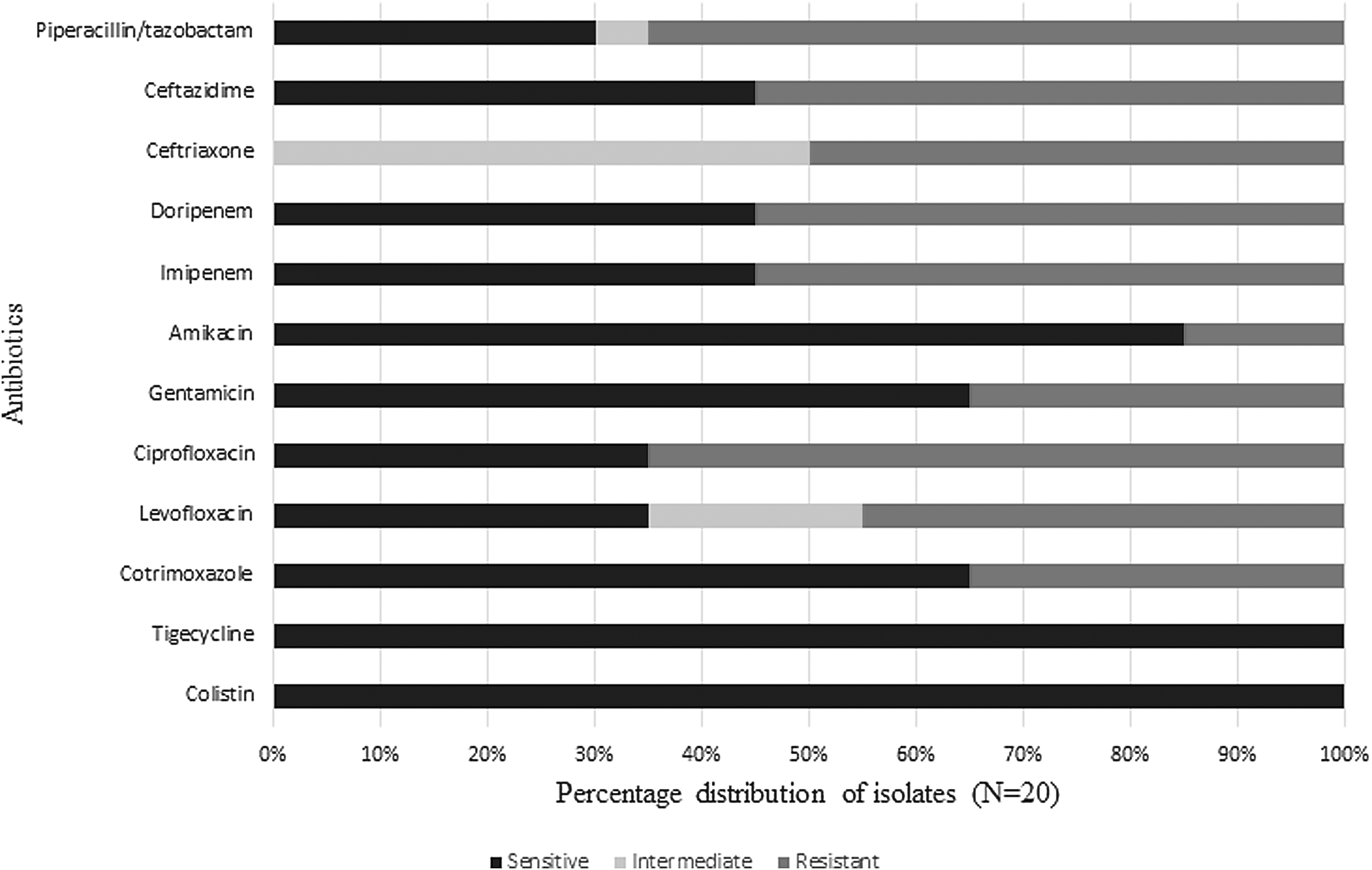
Percentage distribution of susceptibility results of isolates to antibiotics.
Presence of carbapenemase genes in A. baumannii
PCR was used to screen A. baumannii isolates for the presence of carbapenemase genes. OXA-51 was found to be the most predominant one, as it was detected in all the isolates of A. baumannii (n = 20). The second most prevalent carbapenemase gene was OXA-23, accounting for 82% of the CRAB isolates. The isolates were negative for OXA-24, OXA-58, and OXA-143. The results were negative for the carbapenemase genes KPC, NDM, IMP, IMI, VIM, and OXA-48.
Insertion sequences for carbapenem resistance
Fifty-five percent (11/20) of all isolates were positive for the ISAba1 element. Among 11 CRAB isolates, PCR confirmed that ISAba1 is situated upstream to OXA-23 in 6 isolates (55%) and that ISAba1 is upstream to OXA-51 in 3 isolates (27%) (Table 1).
Carbapenem Resistance of Different Sequence Types in Relation to Presence of Carbapenemase Genes, ISAba1, and Its Location
ST, sequence type.
Discussion
In this study, 82% (9/11) of carbapenem resistant isolates belong to ST195. This is the first to report the emergence of CRAB ST195 as the predominant strain in a local setting. Previous studies have not identified this strain as the prevalent MLST type in Hong Kong, although ST195 has been reported as an emerging strain in South China.1,23–31 This finding suggests a role for migration and geographical transmission in the spread of this bacteria. The two hospitals where samples were collected are located near the boundary of Hong Kong and South China, and people travel frequently between these regions. Therefore, there is a very high probability that patients admitted to the South China hospital brought the bacteria to Hong Kong. The cluster of isolates characterized by this study indicates a possible spread of clonal isolates of ST195 and indicates the need for future research to study molecular linkages and their spread throughout China to control for hospital outbreaks.
Oxacillinase production corresponding to OXA-23 expression is the common carbapenem resistance mechanism in A. baumannii reported worldwide. 32 In this study, we found that 11 out of 20 isolates were CRAB in which 9 isolates harbor the OXA-23. The expression of OXA-23 might be increased by the presence of the ISAba1 mobile elements upstream of the enzyme-encoding gene, which provides higher levels of resistance to carbapenems. 33 PCR confirmed that ISAba1 is located upstream to the OXA-23 in six isolates in this study, suggesting an association between ISAba1 and OXA-23 with carbapenem resistance. Although all of the 11 CRAB isolates were positive for OXA-51, only 3 isolates found ISAba1 upstream to OXA-51 of which 2 isolates also found ISAba1 upstream to OXA-23. Thus, ISAba1-OXA-51 may be related to intrinsic enzymes within A. baumannii, but was not as important as OXA-23 in contributing to the carbapenem resistance.
The strains in this study were susceptible to amikacin, gentamicin, cotrimoxazole, tigecycline, and colistin; however, 11 isolates (55%) were carbapenem resistant (imipenem and doripenem) in the 20 isolates of A. baumannii tested. Among the carbapenem-resistant strains, 82% harbor the OXA-23 gene, and 55% of isolates were detected with ISAba1 located upstream of the OXA-23 gene. Surveillance by the CHINET project demonstrated that the A. baumannii rate of imipenem resistance increased more than twofold between 2006 and 2013 to 62.8% in China. 34 Another surveillance report on antibiotic resistance in A. baumannii in China indicated that the prevalence of imipenem-resistant A. baumannii increased from 13.3% in 2004 to 70.5% in 2014 and that of extensively drug-resistant A. baumannii increased from 11.1% in 2004 to 60.4% in 2014. 5 Mirroring the national trend, the proportion of CRAB in Hong Kong increased from 3.3% in 2011 to 18.6% in 2013. In addition, the incidence of CRAB bacteremia increased rapidly from 0.27/100,000 patient-days in 2009 to 1.86/100,000 patient-days in 2013. An elevation in the number of CRAB bacteremia increases burden on the health care system, as elderly patients are at higher risk of infection. 28
All strains in this study were susceptible to colistin, which is the drug of choice for multidrug-resistant A. baumannii (MDRA). 35 Owing to the significant nephrotoxicity and neurotoxicity associated with colistin, tigecycline is also used to treat MDRA. 36 In this study, the MDRA strains were shown to be susceptible to tigecycline; however, the emergence of tigecycline resistance during treatment has also been reported. 37 According to our findings, as well as others, CRAB ST195 with OXA-23 carbapenemase-resistance mediated by ISAba1 is spreading in South China.1,8,38 To better understand the transmission of this strain, studies with larger number of isolates of a longer duration are needed to monitor clonal diversity.
There were several limitations in this study. First, this is a single-center study that may not represent other parts of Hong Kong. Second, the small sample size and short duration of this study limit broader interpretations.
In conclusion, this study is the first to report the emergence of CRAB ST195 harboring blaOXA-23 in Hong Kong.
Footnotes
Disclosure Statement
No competing financial interests exist.