




Abstract
Objective:
To determine the prevalence and genetic relatedness of blaCTX-M-type extended spectrum-β-lactamase (ESBL)-producing Escherichia coli at the human–animal interface in Pakistan.
Materials and Methods:
A total of 150 human, cattle, and poultry fecal samples (50 each) were screened for ESBL-producing E. coli using ESBL CHROMagar®. Bacterial species confirmation as well as determination of minimum inhibitory concentrations (μg/mL) to different antibiotics was performed using the automated VITEK®-2 compact system. Phenotypic confirmation of ESBL production was performed according to the Clinical Laboratory Standards Institute (CLSI) guidelines. Genetic analysis of blaCTX-M was carried out by PCR and DNA sequencing. Plasmids and clonal similarity of the E. coli strains were determined by PCR-based replicon typing and pulsed-field gel electrophoresis (PFGE), respectively.
Results:
Of 150 samples, 29 (19.3%) ESBL-producing E. coli were recovered, and majority of them originated from human (n = 16; 55%), followed by cattle (n = 9; 31%) and poultry (n = 4; 13.7%). blaCTX-M-15 was predominant ESBL genotype (n = 25; 86.2%), mainly identified from human (n = 15) and cattle (n = 9). This is also the first report of the occurrence of CTX-M-15 and CTX-M-55 in cattle and poultry E. coli isolates of Pakistan, respectively. The majority of the ESBL-producing E. coli (96.5%) showed a multidrug resistance phenotype. All isolates carried IncFII or IncFIA plasmids, and the phylogroup B1 was dominant (44.8%) followed by phylogroups A (31%), D (17.2%), and B2 (6.8%). PFGE revealed that isolates from different hosts were genetically unrelated.
Conclusion:
Presence of CTX-M-15-type ESBL-producing E. coli in different reservoirs is alarming and has the potential to impact both veterinary and human therapeutic treatment options.
Introduction
Antimicrobial resistance (AMR) is becoming an emerging threat to public health sector due to excessive antimicrobial exposure in human and veterinary medicine, particularly in developing countries such as Pakistan. 1 Globally, ∼63,000 tons of antibiotics are being used in livestock, which will further increase to 1,05,000 tons in 2030. 2 These practices contribute to the widespread increase of AMR pathogens in human, livestock, and the environment, which consequently leads to the prolonged hospital stay for patients, financial burden to the society, and even fatal consequences. 2 Infections of multidrug-resistant Escherichia coli are of great concern and challenge in medical and veterinary settings. 3 In particular, extended spectrum-β-lactamase (ESBL)-producing pathogenic E. coli can lead to common community-acquired infections, which often require hospitalization and enable resistance genes to move between different environments and hospital settings. 4 Clinically relevant ESBL-producing E. coli strains are not only restricted to humans, but they have also been reported in food-producing animals and the environment. 5 Dissemination of ESBL-producing E. coli in clinical and extra-clinical settings is mainly driven by plasmid and clonal expansion of certain lineages. 6 Furthermore, it has been shown that part of the burden associated with ESBL-producing E. coli in human is linked to antibiotic usage in food-producing animals.7,8
Among different types of ESBL, CTX-M types are considered the most common genetic variant among clinical and nonclinical isolates around the globe. 9 In particular, CTX-M-15 type of ESBL-producing E. coli is epidemiologically important in clinical settings, chicken, environment, and wildlife.10,11 In Pakistan, CTX-M has been reported as the most common ESBL genotype from clinical settings12,13 and poultry. 14 One Health approach has been proposed as a key to study transmission dynamics of AMR. Therefore, this study was designed to identify CTX-M-producing E. coli from humans, cattle, and poultry in Pakistan and to determine the genetic relatedness of isolates from different hosts.
Materials and Methods
Sample collection
The Institutional Bioethics/Biosafety Committee of the University of Agriculture, Faisalabad, has approved this study (D. No. 109/ORIC). A total of 150 convenience sample of humans and animals were collected from different locations from Faisalabad metropolis during February to March 2016. Pus (n = 25) and urine (n = 25) human samples were collected from Burn unit and Urology ward, respectively, from Allied Hospital, Faisalabad using aseptic techniques. 15 The mean age group of patients from urology and burn wards were 49.5 and 35.8, respectively. All the patients were under antibiotic therapy with the most commonly administered antibiotics were ceftriaxone and nitrofurantoin. Fecal swabs (n = 50) were collected from the rectum of 10 healthy cows from each of 5 cattle farms. In addition, cloacal swabs (n = 50) were randomly collected from free-range poultry found in the proximity of these farms. Geographical locations of these farms are displayed in Fig. 1. All the samples were collected and transported in Amies transport media under refrigerated conditions.
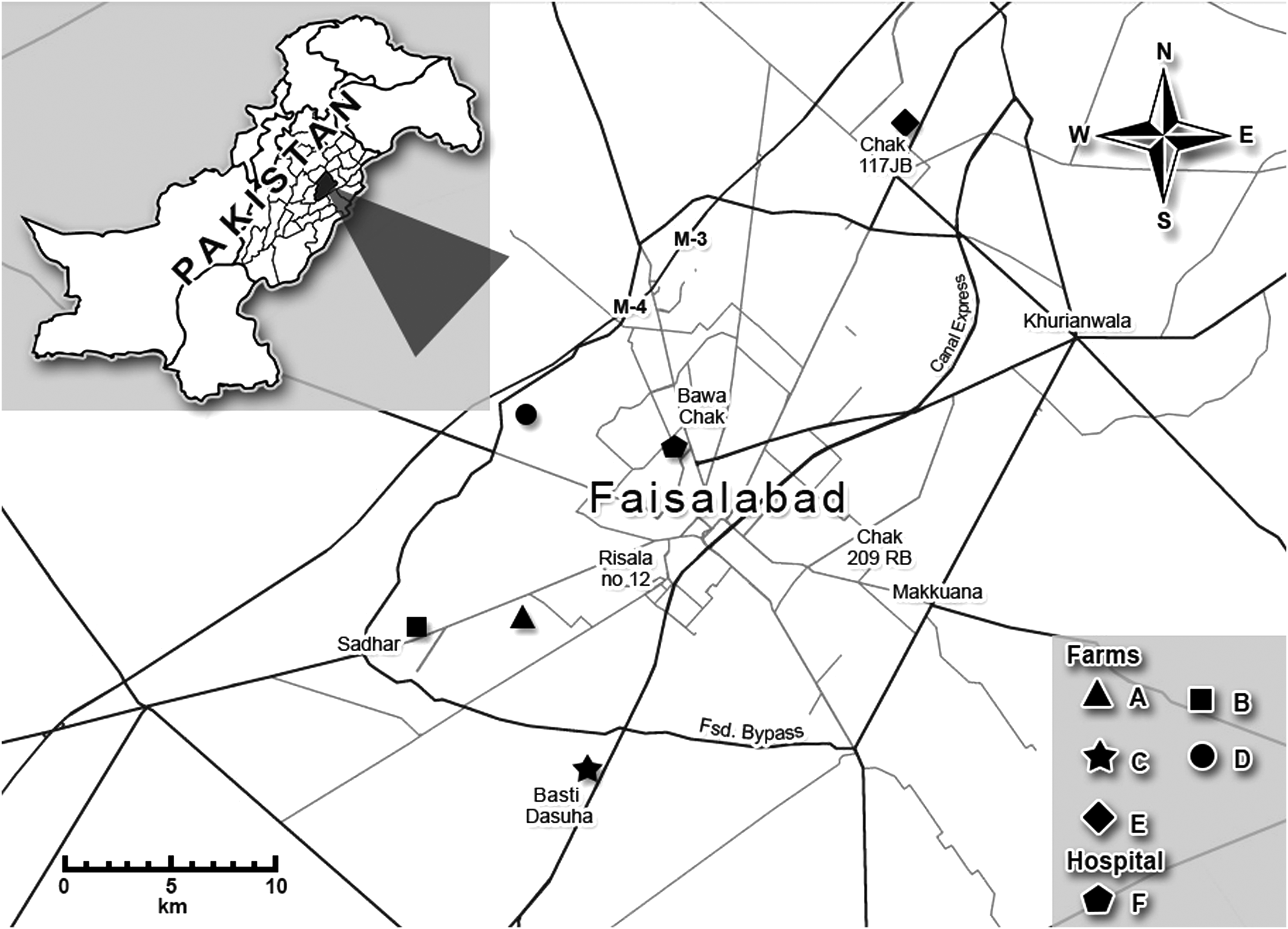
Geographical location of livestock sampling.
Identification of ESBL-producing E. coli
All the samples (n = 150) were primarily streaked on CHROMagar ESBL (CHROMagar, Paris, France) for presumptive detection of ESBL-producing E. coli. Biochemical confirmation of E. coli was done by the VITEK® 2 compact system using GN cards (bioMérieux, Nürtingen, Germany).
Antimicrobial susceptibility testing
Minimum inhibitory concentration (MIC; μg/mL) of 16 different antibiotics, including ampicillin, cefalexin, cefpirome, cefpodoxime, ceftiofur, amoxicillin/clavulanic acid, chloramphenicol, enrofloxacin, gentamicin, marbofloxacin, piperacillin, tetracycline, tobramycin, trimethoprim/sulfamethoxazole, imipenem, and polymyxin B, was determined against E. coli isolates using AST GN38 cards in VITEK 2 compact system (bioMérieux). Results of susceptibility testing were interpreted per Clinical Laboratory Standards Institute (CLSI) guidelines, 2016. Multidrug resistance (MDR) was defined as resistance to three or more different classes of antimicrobials.
Phenotypic confirmation of ESBL
Phenotypic confirmation of ESBL-producing E. coli was carried out with double disk synergy test per CLSI guidelines 2016. In brief, E. coli was inoculated onto Muller-Hinton agar (MHA) (Oxoid, Hampshire, United Kingdom) plate, and ceftazidime (30 μg) and ceftazidime with clavulanic acid (30/10 μg) disks were implanted. Bacteria will be considered the ESBL producer if ceftazidime in combination with clavulanic acid disk showed ≥5 mm zone of inhibition as compared with ceftazidime alone.
Phenotypic confirmation of carbapenamase activity
Phenotypic detection of carbapenemase activity was performed by Modified Hodge's test per CLSI guidelines 2016. Shortly, 0.5 McFarland E. coli (ATCC 25922) bacterial suspension was lawned on MHA plate. Ten micrograms of meropenem disk was placed in the middle of MHA plate, and tested E. coli, positive and negative bacterial controls were streaked from the margin of the disk to the margin of the MHA plate. Carbapenamase-positive bacteria permit meropenem-sensitive E. coli (ATCC 25922) to grow against the meropenem disk, which leads to a cloverleaf-like indentation. 1
Molecular detection of ESBL-encoding genes
Bacterial DNA was extracted using commercially available kit MasterPure™ Purification (Epicenter Biotechnologies, WI) per manufacturer's instruction. ESBL-encoding genes, blaTEM, blaSHV, and blaCTX-M, were identified by PCR as described previously. 16 The amplicon was separated on ethidium-bromide-stained 1.5% agarose gel and visualized under UV light by gel documentation instruments.
Bacterial DNA sequencing
The CTX-M-producing E. coli isolates were processed further using the PCR methodology described by Guerra and colleagues, 17 and PCR products were sequenced commercially by AGOWA GmbH (Berlin, Germany). Raw sequences were checked for quality and assigned to a CTX-M type using Ridom Seq Sphere 0.9.19.
Phylogenetic grouping of E. coli
PCR-based phylogenetic grouping of ESBL-producing E. coli was carried out by amplifying three genetic markers, chuA, yjaA, and DNA fragment TSPE4.C2 as described earlier. 18 E. coli are mainly divided into four main phylogenetic groups such as A, B1, B2, and D.
Plasmid conjugation experiment
Transferability of the blaCTX-M was carried out for randomly selected 10 ESBL-producing E. coli in this study. Conjugation experiment was performed using the sodium azide-resistant E. coli J53 strains as recipients. 19 The transconjugates were finally obtained on MHA supplemented with cefotaxime (2 mg/L) and sodium azide (150 mg/L). All transconjugates were subjected to PCR to confirm blaCTX-M gene.
Replicon typing of plasmids
Plasmid incompatibility (Inc) types were determined by PCR-based replicon typing as described earlier. 20
Pulsed-field gel electrophoresis
All the ESBL-producing E. coli were subjected to pulsed-field gel electrophoresis (PFGE) analysis using CHEF DRIII System (BioRad, Munich, Germany) as described in Pulse Net protocol of the Centers for Disease Control and Prevention, Atlanta, United States. 1 In brief, agarose-embedded DNA was digested with the restriction endonuclease XbaI at 37°C for 16 hr. Electrophoresis conditions were 6 V, with 2.2–54 sec pulses for 20 hr. Strain differentiation by PFGE analysis was achieved by comparison of band patterns using BioNumerics software (Version 7.1; Applied Math, Belgium). Dendrogram was generated according to the unweighted pair group method with arithmetic mean (UPGMA) based on Dice coefficients. Isolates were considered to belong to the same PFGE group if their Dice similarity index was ≥85%.
Results
ESBL-producing E. coli carriage
Of 150 samples, 29 (19.3%) E. coli were positive for ESBL production; among these 16 (55%) were from humans, 9 (31%) from cattle, and 4 (13.7%) from poultry (Table 1).
Phenotypic and Genotypic Characteristics of Extended Spectrum-β-Lactamase-Producing Escherichia coli from Human, Cattle, and Poultry
AMC, amoxicillin/clavulanic acid; AMP, ampicillin; C, chloramphenicol; CFT, ceftiofur; CN, cefalexin; CPD, cefpodoxime; CPO, cefpirome; ENR, enrofloxacin; ESBL, extended spectrum-β-lactamase; GM, gentamicin; IPM, imipenem; MRB, marbofloxacin; PB, polymyxin B; PIP, piperacillin; SXT, trimethoprim/sulfamethoxazole; TE, tetracycline; TM, tobramycin.
Phenotypic resistance of ESBL-producing E. coli
Of 29 ESBL-producing E. coli isolates, 28/29 (96.5%) showed an MDR phenotype. The most common non β-lactam resistance was found toward tetracycline (89.6%) and doxycycline (86.2%) (Table 1).
MIC of ESBL-producing E. coli
MIC testing (μg/mL) for all ESBL-producing E. coli resulted in high MICs not only among β-lactam antibiotics, including ampicillin (≥32 μg/mL), piperacillin (≥128 μg/mL), cefalexin (≥64 μg/mL), cefpodoxime (≥8 μg/mL), ceftiofur (≥8 μg/mL), but also among non-β-lactams such as enrofloxacin (≥4 μg/mL), gentamicin (≥16 μg/mL), marbofloxacin (≥4 μg/mL), and trimethoprim/sulfamethoxazole (≥320 μg/mL). The MIC values for the both chloramphenicol and tetracycline were ≥64 and ≥16 μg/mL against 17 and 25 isolates, respectively. Furthermore, the MIC values for imipenem were ≥4 and 2 μg/mL against 15 and 8 isolates, respectively. However, least resistance was observed against polymyxin B with MIC value <0.5 μg/mL (Table 2). Moreover, all the imipenem-resistant E. coli (n = 15) with MICs ≥4 μg/mL were positive for carbapenemase activity.
Minimum Inhibitory Concentrations (μg/mL) of Extended Spectrum-β-Lactamase-Producing Escherichia coli
Molecular identification of ESBL-producing E. coli
All the ESBL-producing E. coli carried blaCTX-M; however, 15 (51%) isolates carried the combination of blaCTX-M and blaTEM. DNA sequencing data of CTX-M revealed the presence of three different types of genotypes: blaCTX-M-15 (n = 25), blaCTX-M-1 (n = 2), and blaCTX-M-55 (n = 2). Subsequently, blaCTX-M-15-producing E. coli were mainly identified in human samples (n = 15), followed by cattle (n = 9) and poultry (n = 1). blaCTX-M-1-producing E. coli were found in one human and one poultry isolate, while two blaCTX-M-55-producing E. coli were only identified in poultry isolates (Table 1).
Plasmid conjugation and replicon typing
All the tested blaCTX-M-positive isolates demonstrated transferability to recipient strain. blaCTX-M gene was detected by PCR in all the transconjugates. PCR-based replicon typing of ESBL-producing E. coli revealed two major types of plasmids: IncFII and IncFIA. The IncFII was the most common (n = 19) plasmid type present in ESBL-producing E. coli isolates from all 3 hosts and IncFIA plasmid type was detected in 10 isolates (1 from cattle and 9 from humans), while none of the chicken isolates carried IncFIA plasmid replicon (Table 1).
Phylogenetic groups
PCR-based phylogenetic analysis showed that 13 (44.8%) ESBL-producing E. coli belonged to B1 phylogenetic group, 11 (37.9%) to group A, 4 (13.8%) to group D, and 1 (3.4%) to group B2. The phylogenetic groups B1 and A were detected in ESBL-producing E. coli isolates from both human and animal, while group B2 was only detected in two human isolates (Fig. 2).
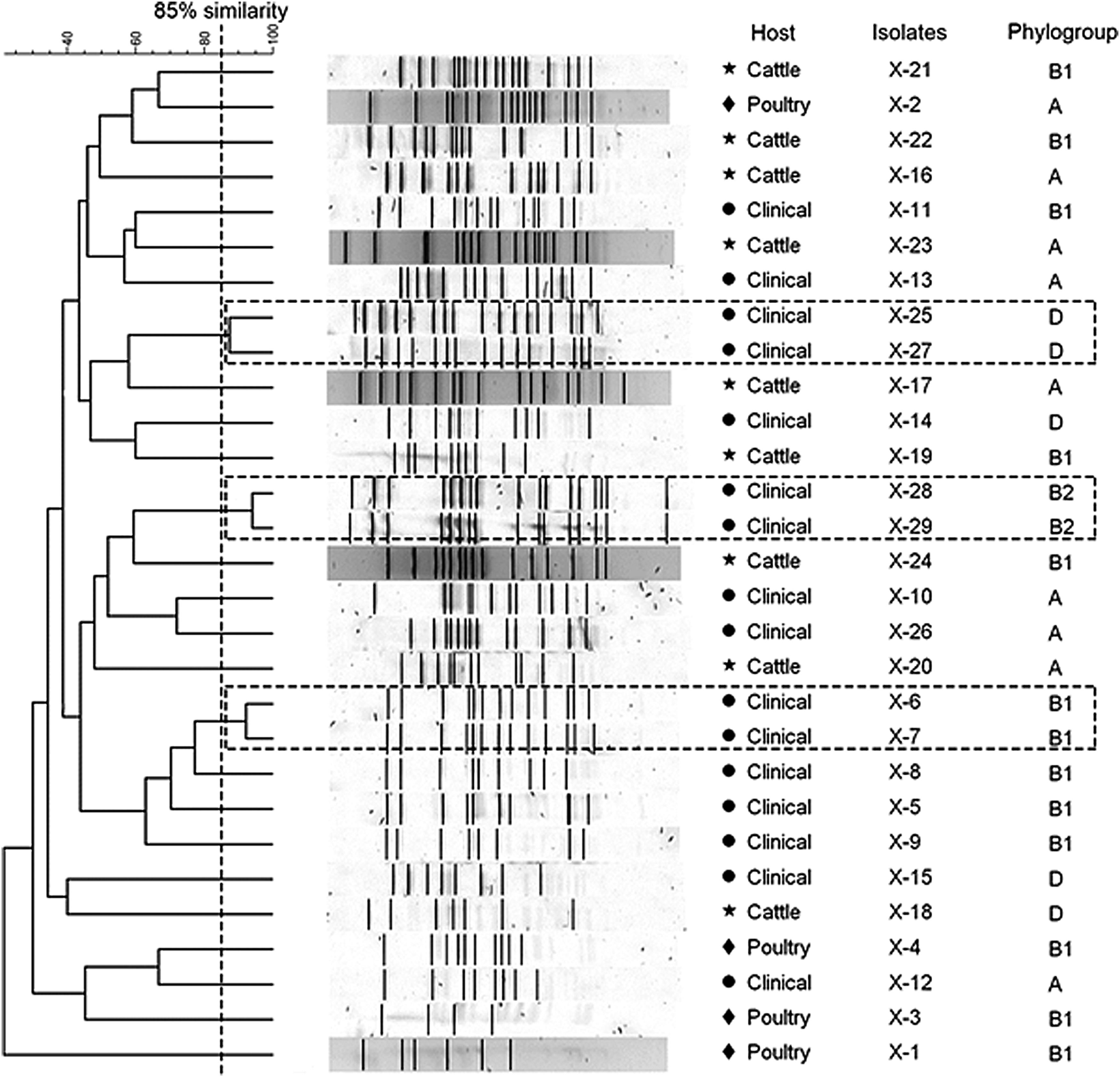
Dendrogram of PFGE patterns of 29 ESBL-producing Escherichia coli isolates. Dotted box indicates clonal group defined at 85% Dice similarity. ESBL, extended spectrum-β-lactamase; PFGE, pulsed-field gel electrophoresis.
PFGE analysis
PFGE analysis showed that most of the ESBL-producing E. coli were genetically unrelated. However, three pairs of human clinical isolates (X6 and X7; X25 and X27; X28 and X29) showed clonal relatedness. Each pair of the isolates in these clones shared common plasmid replicon type, phylogenetic group, and AMR profile (Fig. 2 and Table 1).
Discussion
Despite the highest burden of infectious diseases in low- and middle-income countries, surveillance of AMR is limited. 21 To address the challenges of AMR, Government of Pakistan has drafted its National Action Plan on AMR in 2017. 22 Studies focused on surveillance of AMR at human–animal interface using a One Health approach have been proposed as one of the main objectives of its action plan. 23 To the best of our knowledge, such studies are currently lacking in Pakistan.
Infections caused by ESBL-producing E. coli are a serious issue to both public health and veterinary medicine. In this study, high prevalence of ESBL-producing E. coli (19.3%) has been identified mainly in human and cattle. Recently, a meta-analysis on ESBL from different regions of Pakistan revealed that overall pooled proportion of ESBL-producing bacteria was 40%. Most of the cases (41.8%) have been reported from Islamabad/Rawalpindi followed by Punjab (25.4%) and KPK (16.4%), while no case has been reported from the province of Baluchistan. 12 However, these estimates did not include studies from animals. Similar prevalence of ESBL-producing E. coli (17%) has been found in migratory birds in Pakistan. 24 There is a dearth of studies on the key drivers of AMR in Pakistan. A situation analysis report suggested irrational use of antibiotics in human and veterinary settings, over-the-counter drugs availability, and lack of surveillance systems as the possible reasons for rise in AMR in Pakistan. 25
DNA sequencing revealed the predominant presence of blaCTX-M-15 ESBL genotype. These results are in agreement with various previously reported studies from humans, animals, chickens, and wild birds.16,24,26–31 To the best of our knowledge, this is the first report on the presence of blaCTX-M-15 from cattle and blaCTX-M-55 from poultry isolates in Pakistan. However, these genotypes have been previously reported in E. coli isolates from food-producing animals from other countries.32,33
Transmission of ESBL-producing Enterobacteriaceae is further complicated by ESBL genes being encoded on self-transmissible plasmids, which can be exchanged among the same and different species of Enterobacteriaceae. In this study, plasmid replicon type IncFII was found in both human and animal isolates. Although limited due to reduced sample size, our results agree with a French study that found blaCTX-M-15 on IncFII plasmids from dogs and human E. coli isolates. 34 Similarly, a Kenyan study also documented the spread of blaCTX-M-15-positive E. coli containing IncFII plasmids in human and dog samples. 35 South Korea and China have also reported IncFII in both human and animal E. coli isolates.36,37
AMR patterns of ESBL-producing E. coli depicted high MIC against commonly used antibiotics, including β-lactam and β-lactam inhibitors, and least resistance to polymyxin B. These findings are in accordance with previous studies reported on the prevalence of MDR E. coli from Australia and India.38,39 Moreover, two studies from Pakistan revealed high resistant patterns against β-lactam drugs and quinolones.40,41 Lack of effective infections control committee in clinical and veterinary settings, unhygienic practices, and over-the-counter availability of drugs are likely factors for dissemination of AMR in Pakistan.40,42
There is a lack of clear evidence on zoonotic spread of ESBL-producing bacteria. However, few previous studies indicated presence of identical ESBL genotype, clones, and multilocus sequence types.43,44 In this study, we did not find evidence of clonal spread of ESBL-producing E. coli at human–animal interface. However, we found identical ESBL genes, plasmids, and resistance profile among isolates from animals and humans. Interestingly, we found high rates of CTX-M-15 (25/29; 86.2%) in this study, which is alarming as this genotype is emerging worldwide and associated with multidrug resistance pathogens causing both community and hospital-acquired infections.45,46 Furthermore, we found CTX-M gene on transferable plasmids. This agrees with a previous report in which no evidence of ESBL zoonosis was found between farm animals, foods, and humans. 47
Conclusion
In summary, CTX-M-15 is the most frequent ESBL produced by E. coli isolated from animals and human clinical settings. Our findings underscore the need to further investigate the molecular epidemiology and zoonosis of CTX-M-producing E. coli at human–animal intersection. In future, the spread of AMR should be closely monitored using One Health approach.
Footnotes
Acknowledgments
This work was supported by the funds from the Higher Education Commission, Pakistan (NRPU Grant No. 4681) and by the AIP/CIMMYT Project, Pakistan Agricultural Research Council, Pakistan (Grant No. AS04).
Disclosure Statement
No competing financial interests exist.