




Abstract
Background:
This study aimed to investigate the occurrence of mcr-1 encoding plasmid-mediated colistin-resistance gene in Escherichia coli isolated from migratory birds in Thailand.
Materials and Methods:
A total of 178 cloacal swabs from migratory birds was sampled and isolated from 2016 to 2017 in Nan, Trang, and Bangkok, Thailand. The multiplex polymerase chain reaction was used to screen the resistance genes. After screening, a disk diffusion assay and the minimum inhibitory concentration were investigated. The draft genome sequence of isolate 2A85589 was obtained using an Illumina HiSeq X-Ten platform. The genome was assembled using SPAdes 3.0.0. Antimicrobial resistance genes were identified using ResFinder 3.1.
Results:
We reported E. coli ST101 of isolate 2A85589, an mcr-1-carrying resistance gene isolated from the migratory bird species Hirundo rustica in Thailand. The draft genome of 2A85589 was 4,621,016 bp in size. IncHI1A plasmid was identified using PlasmidFinder with high coverage. In silico analysis detected the presence of eight putative acquired resistance genes, namely blaTEM-1B, mcr-1, mef(A), mef(B), QnrS1, sul3, tet(A), and tet(B), which conferred resistance to β-lactam, colistin, macrolide, quinolone, sulfonamide, and tetracycline.
Conclusion:
This study underlines the potential risk of the environmental contamination of mcr-1-carrying E. coli isolated from the migratory bird. The long range migration of birds can result in dissemination of mcr-1-carrying bacteria globally. Therefore, plasmid-mediated colistin is an urgent need to be addressed in both human and veterinary medicine for disease control and prevention.
Introduction
Representing plasmid-mediated colistin resistance, mcr-1 is an emerging public health threat globally and has been reported in many countries around the world. 1 The plasmid-encoded mcr-1 resistance gene was first detected in livestock, raw meat, and human cases in China. 2 Significantly, mcr-1 has also been identified on plasmids containing other antimicrobial resistance genes such as carbapenemase3–5 and extended-spectrum β-lactamases (ESBL).6–10 It is, therefore, alarming that colocalization of mcr-1, carbapenemase genes, and ESBL has become a significant concern. 1
Plasmid-mediated resistance to colistin by mcr-1 has been detected in Escherichia coli from Southeast Asian countries such as Cambodia, Vietnam, Malaysia, Singapore, and Thailand.11–17 In Thailand, E. coli carrying mcr-1 has been reported in both nonclinical and clinical human isolates.15,16 Meanwhile, environmental samples of mcr-1-positive E. coli have also been detected from canal water samples 16 and vegetables imported from Thailand. 18
Contaminated environment seems to be an important factor in the spread of antibiotic resistance because bacteria from different origins are able to mix and exchange antibiotic resistance genes. Moreover, birds are considered as vehicles for the spread of resistant bacteria over great geographic distances. 19 The long range migration of birds can lead to intercontinental dissemination of mcr-1-carrying bacteria. Recently, the detection of the mcr-1 gene has been isolated from European herring gull (Larus argentatus), 20 Kelp gulls (Larus dominicanus) in South America, 21 and wild migratory waterfowl species (Fulica atra) in Asia. 22
The combination of mcr-1 encoding plasmid-mediated colistin-resistance gene in Enterobacteriaceae from animals, environments, and humans is most concerning today. Therefore, plasmid-mediated colistin is an urgent need to be addressed in both human and veterinary medicine. This study aimed to investigate the occurrence of mcr-1 producing E. coli isolated from migratory birds in Thailand and study insights into genome.
Materials and Methods
Samples and bacteria
A total of 178 cloacal swabs from wild birds in the environment were sampled from 2016 to 2017 in Nan, Trang, and Bangkok, Thailand. The samples were collected from 14 different wild bird species, namely Charadrius mongolus, Charadrius leschenaultia, Calidris tenuirostris, Xenus cinereus, Arenaria interpres, Calidris ruficollis, Limosa lapponica, Charadrius alexandrines, Limicola falcinellus, Calidris ferruginea, Tringa stagnatilis, Numenius arquata, Hirundo rustica, and Hirundo tahitica. Animal ethics was approved by Center for Animal Research, Naresuan University (NU-AG610202). Wild birds were captured by using the canon net and mist net, handled and sampled under Department of National Park, Wildlife and Plant Conservation, Thailand. The swabs were placed in Cary-Blair transport medium and kept at 4–8°C for a maximum of 72 hours before further analysis. For isolation of E. coli, the samples were streak onto MacConkey (MAC) agar and incubated for 18–24 hours at 37°C. Then, the pink colonies were inoculated onto eosin methylene blue (EMB) agar for 18–24 hours at 37°C. Finally, isolates were further identified by analytical profile index API 20E strips (bioMérieux, Nürtingen, Germany).
Detection of the mcr genes and conjugation analysis
The plasmid DNA of bacterial isolates was extracted by alkaline lysis. Multiplex polymerase chain reaction (PCR) detecting genes of mcr-1, blaNDM, blaKPC, blaVIM, blaIMP, and blaOXA48 was performed according to the previous report (Supplementary Table S1). 15 Furthermore, we screened mcr-2 to mcr-8 using the primers described (Supplementary Table S2). 23 Conjugation experiments were analyzed by the broth mating method with E. coli DH5α (Rifampicin resistant) used as the recipient strain. The transconjugants were selected on LB agar plates supplemented with colistin (2 mg/L) and rifampicin (8 mg/L.). The positive transconjugants were confirmed by PCR.
Antimicrobial susceptibility testing
The antimicrobial sensitivity of isolates was evaluated using a Kirby–Bauer disk diffusion assay. The minimum inhibitory concentration (MIC) was investigated for antimicrobial susceptibility using the AST cards N288 of the VITEK®2 system (bioMérieux). Meanwhile, MIC of colistin sulfate salt (Sigma-Aldrich) was determined using the 96-well plate dilution method. The results were interpreted according to Clinical and Laboratory Standards Institute (CLSI, 2017). 24
Whole-genome sequencing and phylogenetic analysis
The DNA extraction of E. coli carrying MCR-1 gene was performed using the PureLink® Genomic DNA Mini Kit (Invitrogen) according to the manufacturer's instruction and then measured the purity and concentration by NanoDrop 2000c spectrophotometer. Whole-genome sequencing was conducted using an Illumina HiSeq-PE150 platform by Novogene Bioinformatics Technology Co. (Beijing, China). Genome sequences were assembled using the SPAdes 3.0.0, which were implemented on the Orione Galaxy web server (http://orione.crs4.it). The contigs were analyzed using BlastN against the NCBI database. * The highest identity genome was selected as reference. Services provided at the Center of Genomic and Epidemiology ** were used to identify resistance genes (ResFinder), plasmid incompatibility groups (PlasmidFinder), virulence-associated genes (MyDbFinder), genoserotype (SerotypeFinder), and multilocus sequence types (MLST 1.8) according to the scheme hosted at Warwick University. † The circular and linear image between multiple genomes and plasmids were generated by BLAST Ring Image Generator (BRIG) 25 and Easyfig, 26 respectively. For phylogenetic analysis, the nucleotide sequence of the mcr-1 plasmid was aligned with the plasmid containing mcr-1 and without mcr-1 gene from several stains of prokaryotic organisms. MEGA X software was performed using the maximum-likelihood method. The branch validations were performed with the bootstrap analysis from 1,000 replications.
Results
From the bacterial culture, 36 samples of 178 cloacal swabs from migratory birds were identified as E. coli 1 and 2. The MIC of colistin from E. coli 2A85589 was measured to be 4 μg/mL (Table 1). Moreover, E. coli 2A85589 exhibited multidrug resistance to β-lactam, macrolide, quinolone, sulfonamide, and tetracycline. In this study, the mcr-1-carrying plasmid could be conjugated into E. coli DH5α isolates in vitro. It was next sequenced an Illumina HiSeq-PE150 platform by Novogene Bioinformatics Technology Co. to decode its genomic sequence. The pool of paired-end reads was assembled and analyzed into the collection of contigs. The individual contigs were mapped into the draft genome (E. coli strain KSC9:CP018323). E. coli 2A85589 showed 4,621,016 bp in the size of genome and overall GC content was 50.56%. The assembled genome contained 84 contigs, of which the N50 contig length was 265,620 bp. The comparative circular map of chromosomes 2A85589 analyzed with two reference E. coli (CP012380 and CP018323) represented in Fig. 1A.

Characteristics of Escherichia coli 2A85589 Harboring mcr-1 Gene
Interpretation according to Clinical and Laboratory Standards Institute (CLSI, 2017).
MIC, minimum inhibitory concentration; R, resistant; I, intermediate; S, sensitive.
In addition, the sequences of seven house-keeping genes (adk, fumC, gyrB, icd, mdh, purA, and recA) were analyzed by MLST. The result showed the E. coli 2A85589 belonged to the widespread sequence type (ST) 101 (Supplementary Table S3). ResFinder 3.1, an in silico bioinformatics analysis, revealed that isolate 2A85589 contained multiple genes conferring resistance to β-lactam (blaTEM-1B), colistin (mcr-1.1), macrolide [mef(B)], quinolone (QnrS1), sulfonamide (sul3), and tetracycline [tet(A)] (Table 2) consistent with the phenotypic results (Table 1). An IncHI1A plasmid was also identified using PlasmidFinder with high coverage.
The Summary of the Features Associated with the Genome and Plasmid Identified in Escherichia coli 2A85589
ST, sequence type.
Furthermore, the mcr-1-carrying contig was queried against the nr/nt database. The result revealed 99% homology with the mcr-1-positive IncHI1A plasmid pEC2–4 (CP016184) from Malaysia and plasmid pH226B (KX129784) from Switzerland. The mcr-1 gene was carried on an IncHI1A plasmid (named p2A85589mcr) 217,374 bp in length with 46.53% of GC content. This shared sequence comprises of mcr-1 in association with ISApl1, but it is in a different location in p2A85589mcr (Fig. 1). p2A85589mcr also carried six additional antibiotic resistance genes, including β-lactam (blaTEM-1B), colistin (mcr-1.1), macrolide [mef(B)], quinolone (QnrS1), sulfonamide (sul3), and tetracycline [tet(A)] (Fig. 1B). Phylogenetic analysis based on all 42 backbone genes of IncX4, IncI2, and other plasmids (Supplementary Table S4) revealed that p2A85589mcr plasmids belonged to the other clades and mixed with plasmids without mcr-1, whereas IncX4 and IncI2 can be grouped (Fig. 2). Furthermore, p2A85589mcr was closely related to pKP14812-MCR-1 and pCP53-mcr.
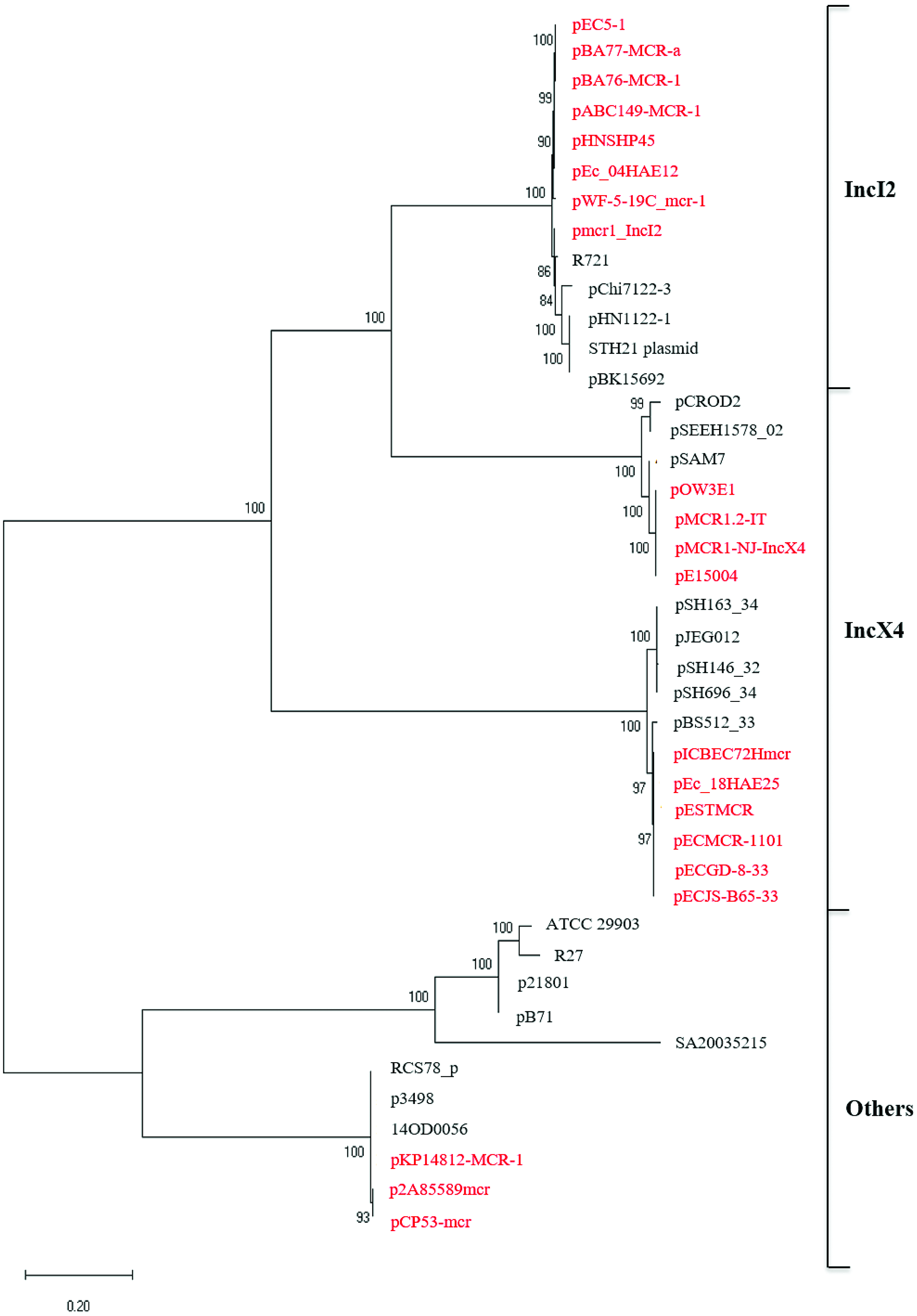
Phylogenetic tree based on nucleotide sequences of plasmid containing mcr-1 gene and without mcr-1. A phylogenetic analysis was constructed by MEGA X using best-fit substitution model (T92+G) based on the maximum-likelihood method with 1,000 bootstrap replicates. The bootstrap values are indicated as percentages at each branch. Those carrying mcr-1 are indicated in red and those without mcr are represented in black. Color images are available online.
This Whole Genome Shotgun project has been deposited at DDBJ/ENA/GenBank under the accession RBKP00000000. The version described in this article is version RBKP01000000.
Discussion
The identification and characterization of colistin-resistance gene attracted attention from the scientific community globally and extensively. mcr-1 resists to polymyxins, the last resort of therapeutic against Gram-negative pathogens with multiple drug resistances. To the best of our knowledge, this is the first report of the mcr-1-possitive E. coli with multiple gene resistances isolated from the migratory bird in Thailand. Recently, the detection of the mcr-1 gene has been isolated from European herring gull (L. argentatus), 20 Kelp gulls (L. dominicanus) in South America, 21 and wild migratory waterfowl species (F. atra) in Asia. 22 We reported an E. coli mcr-1-positive isolate-coproducing blaTEM-1B, mcr-1, mef(A), mef(B), QnrS1, sul3, tet(A), and tet(B) genes. The MLST results showed that E. coli isolate belonged to ST101 related to the previous reports that E. coli harboring mcr-1 isolated from wild birds were assigned to ST101, ST744, and ST357.21,22 The MIC of colistin from E. coli 2A85589 was measured to be 4 μg/mL. An IncHI1A plasmid was also identified using PlasmidFinder with high coverage. From plasmid types carrying mcr-1 genes, >90% of plasmid types belonged to either IncI2, IncX4, or IncHI2. Almost 75% of the isolates carrying an IncHI2 plasmid originated from Europe, whereas 65.8% of all IncI2 plasmids originated from Asia. 27 ISApl1 was detected in the plasmid harboring mcr-1, which is considered to be the main driver of horizontal gene transfer of the mcr-1 gene. The findings in this study suggest that the rapid spread of colistin resistance among different hosts might be involved in the wild migratory birds because the long range migration of them can lead to international dissemination of mcr-1-carrying bacteria. Therefore, studies related to environmental contamination are urgently needed to investigate and control the dissemination dynamics of mcr genes in the community.
Footnotes
Acknowledgments
This study was supported by Naresuan University (R2560B026), Faculty of Agriculture, Nature Resources and Environment, Naresuan University. We wish to express our gratitude for the sample from Wildlife Conservation Office, Department of National Park, Wildlife and Plant Conservation, Chatuchak, Bangkok, Thailand. Finally, we thank Dr. Apinya Lusakul for her strong support.
Disclosure Statement
No competing financial interests exist.

References
Supplementary Material
Please find the following supplemental material available below.
For Open Access articles published under a Creative Commons License, all supplemental material carries the same license as the article it is associated with.
For non-Open Access articles published, all supplemental material carries a non-exclusive license, and permission requests for re-use of supplemental material or any part of supplemental material shall be sent directly to the copyright owner as specified in the copyright notice associated with the article.
