




Abstract
Salmonella spp. is a foodborne pathogen present in the pork production chain, leading to potential contamination of end products and causing salmonellosis cases and outbreaks worldwide. The emergence of multidrug-resistant (MDR) Salmonella spp., especially isolates obtained from animal origin food, is a global concern. This study aimed to isolate Salmonella from swine mesenteric lymph nodes (MLN) and to characterize the virulence and antibiotic resistance profiles. MLN samples were obtained from a swine slaughterhouse and subjected to Salmonella spp. isolation. Ten MLN samples were positive and 29 isolates were identified based on PCR (invA and ompC) and serotyping: Derby, Cerro, and Give. Pulsed-field gel electrophoresis allowed to group the isolates based on their serotypes, resulting in three major clusters. All isolates presented the virulence-related genes pefA, sipA, sopB, spaN, and pagC. Relatively high numbers of Salmonella spp. were resistant to neomycin, polymyxin B, ciprofloxacin, tetracycline, and nalidixic acid. Furthermore, 25 isolates presented simultaneous resistance to three or more antibiotic classes, being characterized as MDR. The obtained results confirmed the relevance of swine as reservoirs of Salmonella spp. in the pork production chain and demonstrated the MDR profiles of isolates. Proper control and surveillance are required to avoid the contamination of end products.
Introduction
S
Lymphatic tissues are the main sites for Salmonella spp. colonization, allowing their multiplication and determining swine as natural reservoirs of this pathogen, and during slaughtering, cuts in lymphatic tissues can lead to Salmonella spp. contamination to swine carcasses. 4 Consequently, proper control and sanitary measures are mandatory in swine slaughtering to avoid Salmonella spp. spread to end products. Checking its presence in lymphatic tissues, such as the mesenteric lymph nodes (MLN), is a usual monitoring procedure adopted by official fiscalization agencies and industries.5,6
Once present in pork products, Salmonella spp. can infect humans through consumption and even cross-contamination from raw foods during food preparation at home. 7 Salmonella infections are influenced by the host, host's age, environment, and virulence factors. 8 These virulence factors provide to Salmonella an important role attributed in the infection caused by the invasion, enterotoxin production, and pathogenesis, enhancing the induction of gastroenteritis. 9 Antibiotic therapy is required in several cases, but Salmonella spp. is becoming increasingly resistant to these substances, resulting in inefficient medical treatment. 10 Hur et al. 11 described an increasing trend of Salmonella spp. isolates from human, food, and animal sources exhibiting multidrug-resistant (MDR) phenotypes. Studies have described the MDR of Salmonella spp. obtained from different steps of pork production.12,13
In this sense, monitoring and identification of resistance in key pathogens in different food production chains are important procedures for understanding how the antibiotic resistance can be spread and how humans can be affected by resistant pathogens. Considering that Salmonella is a key pathogen in the pork production chain, this study aimed to characterize the virulence and antibiotic resistance profiles of isolates obtained from swine MLN.
Materials and Methods
Sampling
A swine slaughterhouse, located in Minas Gerais State, Brazil, was visited five times for sampling of MLN from 100 finished pigs during slaughtering. Pigs were bred in different farms, located in different cities (Guaraciaba, Jequeri, Piranga, Ponte Nova, Urucânia, and Raul Soares). The samples were collected after the evisceration and before the gut inspection by using sterile knives, then placed in sterile bags and kept under refrigeration during transport and until microbiological analysis.
Salmonella spp. detection and characterization
Salmonella detection was based on a previous report. 14 MLN samples were cleaned with alcohol 70°GL and sliced to obtain 10 g portions. Then, the portions were added to 90 mL of buffered peptone water (1% w/v; Oxoid Ltd., Basingstoke, United Kingdom), homogenized, and incubated overnight at 37°C for 18 h. Aliquots of the pre-enrichment were transferred to novobiocin–tetrathionate (Oxoid) and Rappaport Vassiliadis (Oxoid) broths, and incubated at 37°C/24 h and 42°C/24 h, respectively. The obtained cultures were streaked onto plates containing mannitol–lysine–crystal violet–brilliant green agar (Oxoid) and xylose lysine agar (Oxoid), and incubated at 37°C overnight. Suspect Salmonella colonies (red with black center or black center) were transferred to lysine iron agar and triple-sugar agar, and incubated at 37°C overnight. Cultures that presented Salmonella characteristics were subjected to PCR assays targeting invA and ompC, an important and specifically virulence factors of this pathogen, and used for species identification15,16 after DNA extraction by the boiling technique. 17 Confirmed Salmonella isolates were serotyped by using somatic and flagellar antisera, according to the White–Kauffmann protocol (Adolf Lutz Institute).
DNA from Salmonella spp. isolates was also subjected to PCR assays targeting virulence-related genes (pefA, spvC, sipA, sopB, sefA, spaN, pagC, rpoS, spvB). All primers and PCR conditions are described in Table 1. Briefly, PCR mixes were composed of GoTaq® Green Master Mix (Promega, Madison, WI), 400 nM of each primer (Table 1), 1 μL of DNA, and nuclease-free water (Promega) to complete a final volume of 25 μL. PCR products were electrophoresed in agarose 1.5% (w/v; Promega), stained with UniSafe (Uniscience, Osasco, Brazil), and visualized using L-PIX-HE (Loccus Biotecnologia, Cotia, Brazil).
Functions of Genes, Sequences, and Characteristics of the PCRs Used to Identify Salmonella spp
Salmonella spp. isolates were subjected to XbaI macrorestriction and pulsed-field gel electrophoresis (PFGE), as described by Ribot et al. 18 Isolates were grown in brain/heart infusion broth (BHI; Oxoid) at 37°C overnight, diluted to 0.8–1.2 absorbance at 610 nm, and transferred to low-melting agar (Bio-Rad, Hercules, CA). The obtained plugs were treated with proteinase K (20 mg/mL; Sigma–Aldrich, St. Louis, MO) for DNA extraction and subjected to macrorestriction with XbaI (50 U; Promega). Then, the obtained products were subjected to PFGE using CHEF-DR III (Bio-Rad): initial switch time of 2.2 sec, final switch time of 63.8 sec, and running time of 18 h. Salmonella Braenderup (ATCC BAA-664) was subjected to the described procedures and considered the reference standard pattern. PFGE profiles were analyzed by the unweighted pair group method with arithmetic mean, with a Dice coefficient of 1.5% tolerance, 5% optimization, and 94.5% similarity cutoff (BioNumerics 6.6, Applied Maths, Sint-Martens-Latem, Belgium).
Antibiotic resistance
Salmonella isolates were characterized by their resistance profiles against 21 antibiotics from 10 classes (Table 2, Clinical Laboratory and Standards Institute 19 ), using the disk diffusion assay, as described by Bauer et al. 20 Isolates were grown in BHI (Oxoid) at 37°C overnight, diluted to 0.5 McFarland standard, and surface-plated onto Mueller–Hinton agar (Oxoid). Then, antibiotic-impregnated disks were equidistantly placed, and the plates were incubated at 37°C for 24 h. After incubation, the inhibition zones were measured, compared in the Clinical Laboratory Standard Institute—CLSI, M100 (2018), and the isolates were characterized as resistant or susceptible to each tested antibiotic by the table disposable by CLSI. 19
Classes, Subclasses, and Concentrations of Antibiotic Disks Considered to Assess the Resistance of Salmonella spp. Isolates Obtained from Swine Mesenteric Lymph Nodes
Classes and subclasses defined according to the Clinical Laboratory and Standards Institute. 19
β-lactam antibiotics.
First-generation cephalosporins.
Third-generation cephalosporins.
Fifth-generation cephalosporins.
In addition, the isolates were characterized by their resistance to extended-spectrum β-lactamases (ESBL) by a double-disk diffusion assay, as described by Jarlier et al. 21 BHI (Oxoid) growth cultures (obtained as described above) were surface-plated onto Mueller–Hinton agar (Oxoid) in which five antibiotic disks were added (aztreonam, 30 μg; cefotaxime, 30 μg; cefepime, 30 μg; ceftazidime, 30 μg; and amoxicillin–clavulanic acid, 30 μg). The plates were incubated at 37°C for 24 h, and the isolates were characterized as resistant or susceptible to ESBL, as described by Leclercq et al. 22
Statistical analysis
Frequencies of antibiotic resistance among the Salmonella isolates were compared by the chi-square or Fisher's exact test (0 = sensitive and 1 = resistant) using R software, and p < 0.05 as the level of significance. 23
Results
Salmonella spp. was detected in 10 MLN samples, from pigs bred in farms located in Piranga (n = 5), Urucânia (n = 3), Jequeri (n = 1), and Raul Soares (n = 1). Based on PCR amplification for invA and ompC, 29 isolates were confirmed as Salmonella spp. and serotyped as S. Derby (n = 17), S. Cerro (n = 8), and S. Give (n = 4). All Salmonella spp. isolates presented PCR amplification products for pefA, sipA, sopB, spaN, and pagC.
The genetic profiles of Salmonella spp. isolates obtained by PFGE are presented in Fig. 1. Only four (SUI 42, SUI 46, SUI 47, and SUI 48) of the 29 isolates did not present XbaI macrorestriction. Isolates were grouped into three major clusters, with a minimum of 94.5% similarity. The largest cluster was composed of Salmonella Derby only, with isolates from three different cities: Piranga, Urucânia, and Jequeri. Two isolates identified as Salmonella Derby did not group into any cluster and presented the lowest similarity to other isolates (81.2%). Isolates identified as Salmonella Give grouped in a cluster with 96.8% similarity, and all were obtained from pigs bred in Urucânia. Salmonella Cerro isolates (n = 4) were also obtained from pigs bred in a single city (Raul Soares), and only two of them grouped in a cluster with 96.8% similarity.
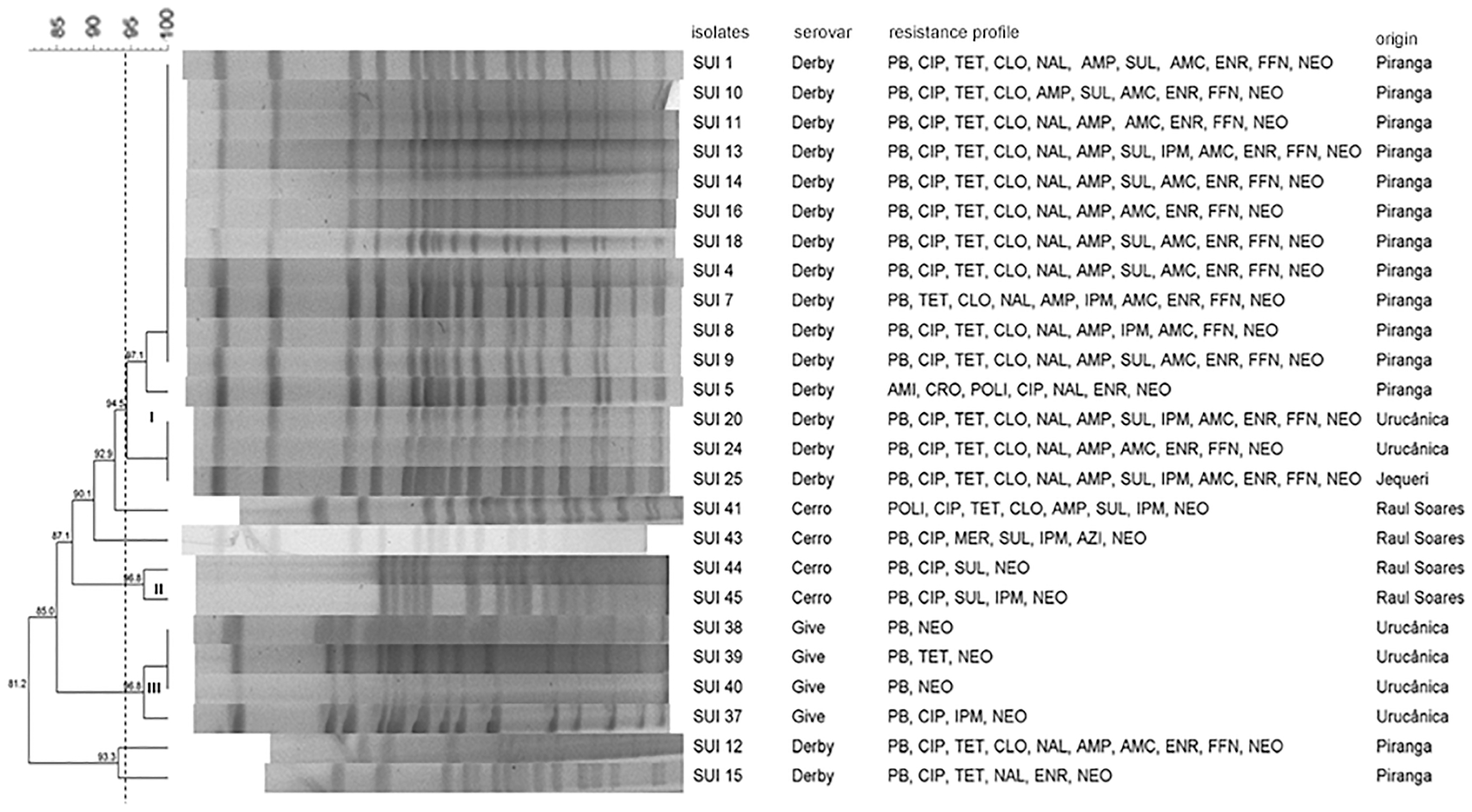
PFGE results and cluster profile (I, II, III) from Salmonella Derby, Salmonella Cerro, and Salmonella Give isolates from pig lymph nodes, the resistance profile, and from the cities collected. AMC, amoxicillin; AMI, amikacin; AMP, ampicillin; AZI, azithromycin; CIP, ciprofloxacin; CLO, chloramphenicol; CRO, ceftriaxone; ENR, enrofloxacin; FFN, florfenicol; IPM, imipenem; MER, meropenem; NAL, nalidixic acid; NEO, neomycin; PB, polymyxin b; PFGE, pulsed-field gel electrophoresis; SUL, sulfonamide; TET, tetracycline.
All Salmonella spp. isolates were resistant to at least one antibiotic: neomycin (n = 29), polymyxin B (n = 28), ciprofloxacin (n = 23), tetracycline (n = 18), nalidixic acid (n = 16), chloramphenicol (n = 16), ampicillin (n = 16), sulfonamide (n = 15), amoxicillin (n = 15), florfenicol (n = 15), imipenem (n = 10), amikacin (n = 2), azithromycin (n = 2), ceftriaxone (n = 1), and meropenem (n = 1). All isolates were susceptible to trimethoprim, gentamicin, cefalotin, and cefepime. However, no ESBL-producers were recorded. Fifteen antibiotic resistance profiles were recorded (Table 3), and 25 isolates were characterized as MDR, considering the simultaneous resistance to antibiotics as belonging to at least three different classes. 24 Figure 1 also shows the antibiotic resistance profiles of the Salmonella spp. isolates that presented XbaI macrorestriction. The isolates identified as Salmonella Cerro and Salmonella Give presented resistance to a lower number of antibiotics when compared with isolates identified as Salmonella Derby.
Antibiotic Resistance Profiles of Salmonella spp. Isolates Obtained from Swine Mesenteric Lymph Nodes
AMI, amikacin; AMP, ampicillin; AMX, amoxicillin; AZI, azithromycin; CHL, chloramphenicol; CIP, ciprofloxacin; CRO, ceftriaxone; ENR, enrofloxacin; FFN, florfenicol; IPM, imipenem; MP, meropenem; NAL, nalidixic acid; NEO, neomycin; PB, polymyxin b; SUL, sulfonamide; TET, tetracycline.
Discussion
Salmonella spp. was identified in the MLN from 10 of the 100 studied pig carcasses. These results are similar to the epidemiological data presented by the European Union. 25 However, similar studies show different levels of colonization by Salmonella spp. in swine MLN, with frequencies varying from 7% to 80%.26–29 These variations are due to the influence of several factors associated with the pork production chain, such as the quality control procedures, the prevention systems used in industries, the analytical unit of each method, the season, the sampling methods, and the conditions of farming as well. 30
Nowadays, Minas Gerais State is characterized as an important pole of pork production chain in Brazil. In this state, the swine production occurs in a full cycle system, where all steps of swine production occur in the production farm. 31 This Brazilian state produced about 4,6 million of pigs and 416.000 ton of pork in 2016, being 21% from the Zona da Mata region, where this study was developed. 32 This production system is the one of many food chains that can disseminate the microorganism until the final product and cause the outbreaks. Based on Brazilian official reports from the Ministry of Health between 2009 and 2018, ∼47 outbreaks were described as related to pork or by-products, 33 and efforts were applied to improve the quality and safety of pork production.
Considering all factors, the intervention in the slaughter steps seems to be the best strategy to reduce Salmonella from carcasses and end products.34,35 Ferrer Savall et al. showed that cross-contamination could be increased in the slaughterhouse due to stress conditions during transport associated with poor hygienic procedures, especially at the beginning of the slaughtering, leading to defecation and skin contamination. 36 Therefore, proper hygienic procedures that start at the first steps of slaughtering are relevant to decrease Salmonella spp. release and spread among animals and pig carcasses. 5 In Brazil, the Good Manufacture practices and Hazard Analysis Critical Control Point have become mandatory in the slaughterhouses. 37 In addition, swine is an important reservoir of different Salmonella serovars, and considering that this pathogen can be expected in some specific portions and organs of the pigs, understanding the role of reservoirs in the pork production chain is crucial to establishing proper procedures and monitoring plans aimed at controlling Salmonella contamination and spread. 38
Salmonella Derby was the serovar most identified in this study. This serovar is usually associated with swine, as observed in recent studies.39,40 According to the European Union, Salmonella Derby is ranked as the sixth-most frequent serovar associated with salmonellosis cases in humans. 41 Despite being identified at relatively lower frequencies, Salmonella Cerro and Salmonella Give are also relevant as pathogens associated with animal production. Salmonella Cerro is commonly isolated from chickens and cows,42,43 and is usually associated with animal diseases. 44 Salmonella Give has become an important serovar in recent years, especially in European countries. In 2010, this serovar was responsible for 684 salmonellosis cases across Europe. 45
Based on the PFGE results (Fig. 1), Salmonella Give and Salmonella Cerro were isolated from specific locations, indicating a limited geographical distribution with local circulation among the studied animals and the same source disposable. This characteristic is confirmed by their genetic profiles, which were highly similar to each other. In contrast, Salmonella Derby presented multiple genetic profiles and was isolated from animals bred in different cities. The major PFGE cluster (I, Fig. 1) was formed by the majority of isolates that were obtained from Piranga, Urucânia, and Jequeri, demonstrating its distribution in the region of the study. The circulation of this clone can be a result of cross-contamination caused by rodents, birds, and wild animals.13,46 Another hypothesis is the feed supplier as an important source of contamination with Salmonella because the animal feed distributed to different farms is derived from a single producer. 47
Another important point in this work was that the same virulence gene profile was obtained for all the isolates (pefA, sipA, sopB, spaN, invA, and pagC), even from different serotypes. In general, these genes have an important activity in the enteric cells because of their relevance in the initial steps of infection in the host. pefA is reported to be enrolled in a mechanism related to adhesion. 48 sipA, sopB, invA, and span are responsible for host cell invasion, helping the bacterium machinery to enter into the host cells and replicate.49–51 pagC is enrolled in targeting the complement system of the immune response. 52 The presence of these virulence genes can be enrolled as salmonellosis infections. Studies developed by Wannaprasat et al. identified 131 Salmonella isolates from human cases and swine in Thailand harboring sipA, spaN, pagC, and sopB. 53 In China and Iran, the majority of the characterized Salmonella isolates involved in outbreaks harbor pefA, sopB, and sipA.54–56
Besides the virulence gene profile, other important data are the identification of a high number of Salmonella spp. isolates resistant to antibiotics and the characterization of a predominant MDR profile (Table 3). Calayag et al. and Li et al. described Salmonella strains isolated from food industry environments as resistant to a range of antibiotics.57,58 The occurrence of Salmonella spp. with high frequencies of antibiotic resistance is also reported in several studies related to swine in Brazil, and the MDR feature is a common finding.2,59
In recent years, the concern about MDR Salmonella has been increasing. Several isolates in the present work (n = 25/29) were characterized as MDR. Other studies report similar results, especially regarding isolates obtained from the pork production chain.57,58 MDR is a worldwide concern, and animal origin foods are often associated with the spread of MDR pathogens to humans. As a result, the World Health Organization proposed official programs for the surveillance of Salmonella antimicrobial resistance from outbreaks, and to question the origins of this feature. 60
The development of resistance-related bacteria that evolve from livestock systems, such as Salmonella spp. from swine, can be linked to the use of antibiotics as growth promoters and their indiscriminate use in therapeutics. 61 The use of antimicrobials in the swine production is apparently common in Brazil. Unofficial records indicate that different classes of antibiotics, such as β-lactam, colistin, tetracycline, phenicol, quinolones, macrolides, and fosfomycin, are used as prophylactics and therapeutics in the region where the experiment was conducted. Other studies reported the use of antimicrobials in the pork production chain as prophylactic or therapeutic actions,62,63 and this practice can cause an onset of MDR bacteria as indicated by our results. In this context, the World Health Organization has raised alerts about the inappropriate animal management in many food production chains and highlighted the improper use of quinolones, cephalosporins, glycopeptides, polymyxins, aminoglycosides, penicillins, macrolides, and chloramphenicol used in animal production and human treatment. 60
In Brazil, an official program was established in 2018 by the Ministry of Health (Plano de Ação Nacional de Prevenção e Controle da Resistência Antimicrobiana no Âmbito da Saúde Única—National Action Plan for Prevention and Control of Antimicrobial Resistance in Public Health). This plan aims to improve and promote strategies for the control of antibiotic resistance spread, and also set up a national surveillance system to implement actions for preventing cases up to 2022. 64 As a complementary action, the Ministry of Agriculture also launched an official program in 2018 (Plano de Ação Nacional de Prevenção e Controle da Resistência Antimicrobiana no Âmbito da Agropecuária—National Action Plan for the Prevention and Control of Antimicrobial Resistance in the Field of Agriculture). It outlines strategies for the rational use and knowledge of the risks of the consequences of antibiotic resistance in production animals. 65 Ideally, both programs must be complementary to provide the proper characterization of the current scenario in Brazil related to antibiotic resistance. Moreover, a new program must be developed to combine all information about MDR and the food production chain.
Overall, the results confirmed pigs as a reservoir of Salmonella with a virulence potential and MDR phenotypes. The isolates presented multiple clonal clusters based on PFGE and different serovars with the same virulence and antibiotic resistance profile. Furthermore, the presence of Salmonella seems to be related to the livestock system typically found in the pork production chain. In this context, adequate surveillance and control of resistant pathogenic bacteria remain the best approach to control this global problem.
Footnotes
Disclosure Statement
No competing financial interests exist.
Funding Information
Coordenação de Aperfeiçoamento de Pessoal de Nível Superior (CAPES, Brasília, DF, Brazil, Financial Code 001), Conselho Nacional de Desenvolvimento Científico e Tecnológico (CNPq, Brasília, DF, Brazil) and Fundação de Amparo à Pesquisa do Estado de Minas Gerais (FAPEMIG, Belo Horizonte, MG, Brazil).