




Abstract
Background:
Growth arrest-specific 6 (Gas6) is a vitamin K-dependent protein secreted by immune cells, endothelial cells, vascular smooth muscle cells, and adipocytes. Recent studies indicate that Gas6 and receptors of the TAM (Tyro3, Axl, and Mer) family may be involved in the pathogenesis of obesity, systemic inflammation, and insulin resistance. The aim of this study was to investigate the association between plasma Gas6 protein and the c.843 + 7G>A Gas6 polymorphism in metabolic syndrome (MetS).
Methods:
Two hundred five adults (88 men and 117 women) were recruited in this study. Plasma Gas6 concentration, general, and biochemical data were measured. All subjects were genotyped for the c.843 + 7G>A Gas6 polymorphism.
Results:
Plasma Gas6 concentrations decreased in parallel with various MetS components in all groups (P = 0.017 for trend). Patients in the second and third tertiles of Gas6 level had higher high-density lipoprotein cholesterol (HDL-C) levels than those in the first tertile overall and in the female group. Plasma Gas6 levels were significantly positively correlated with HDL-C level and negatively with fasting glucose level in the female patients. The A allele and genotype AA in single nucleotide polymorphism c.843 + 7G>A were less frequent in the subjects with MetS compared to those without MetS.
Conclusions:
Our results demonstrated a positive correlation between Gas6 protein values and HDL-C and reinforce the association with fasting glucose. In addition, the presence of c.843 + 7G>A Gas6 polymorphisms, especially the AA genotype, had an association with MetS. The potential role of the Gas6/TAM system in MetS deserves further investigation.
Introduction
Metabolic syndrome (MetS) is a common metabolic disorder encompassing a cluster of risk factors, including dyslipidemia, obesity, raised blood pressure, and insulin resistance. 1 MetS has become a major public health concern worldwide because of its systemic effects on the development of several chronic diseases such as diabetes, coronary heart disease, and cancer. 2 MetS is a state of chronic low-grade inflammation as a consequence of complex interplay between genetic and environmental factors. The early detection of groups at high risk of MetS can allow for early interventions, which can then reduce the risk of adverse consequences. 3 In recent years, a number of MetS studies have increased understanding of the genetic and biological backgrounds of the pathogenesis of MetS and enabled the identification of high-risk patients with MetS using biomarkers and genetic variations. 4
Growth arrest-specific 6 (Gas6) is a vitamin-K dependent protein which is partly bound by TAM (Tyro3, Axl, and Mer) receptors with different affinities, particularly Axl. 5 Recent studies have demonstrated that the Gas6/TAM system is involved in the regulation of cell survival, progression of inflammation, platelet aggregation, endothelial dysfunction, development of obesity, and the pathogenesis of insulin resistance. We previously elucidated that plasma Gas6 levels are associated with glucose intolerance, markers of inflammation, and endothelial dysfunction, and other studies have also reported similar findings. 6 –10 This supports the potential role of Gas6 levels in the pathogenesis of obesity, insulin resistance, and related complications. 9 Furthermore, previous studies have explored the associations between genetic variants of Gas6 and various disease states, including stroke, acute coronary syndrome, type 2 diabetes, and obesity. 11 –15 However, little is known about the role of Gas6 in the association of MetS, especially with regards to the genetic background and MetS components. Therefore, we conducted this cross-sectional study to investigate whether plasma Gas6 concentrations and Gas6 genetic variants are associated with the occurrence of MetS.
Methods
Two hundred five adults (88 men and 117 women) were recruited from the outpatient clinics of Tri-Service General Hospital, Taipei, Taiwan. The criteria for inclusion into this trial were as follows: an age from 20 to 75 years, body mass index <35 kg/m2, and absence of infection within the previous 3 weeks. The exclusion criteria were pregnant or breastfeeding women, a serum creatinine level 132.6 μmol/L, an abnormal serum aspartate aminotransferase or alanine aminotransferase (2.5 times above the upper reference range) level, acute or chronic pancreatitis, a history of cerebrovascular accidents, myocardial infarction, heart failure, malignancy, consumption of oral anticoagulants or existing antidiabetic therapy, autoimmune disorders or psychiatric diseases, including mood disorders and alcoholism, and taking concomitant drugs such as beta-blockers, diuretics, cholestyramine, or systemic steroids. A 75 g oral glucose tolerance test (OGTT) was performed in all patients after they had fasted for at least 10 hr. The institutional review board of Tri-Service General Hospital approved the protocol, and all subjects gave written informed consent.
Biomarker assays
Following a 10-hr fast, blood samples were obtained during the OGTT. General biochemical tests were performed in addition to measurements of serum total cholesterol, triglyceride, and low-density lipoprotein-cholesterol (LDL-C) using the enzymatic colorimetric method in a Roche Cobas C501 Chemistry Analyzer (Diamond Diagnostics). The intra- and interassay coefficients of variation (CVs) for LDL and total cholesterol were 0.70% and 1.22% and 0.82% and 1.74%, respectively. Serum levels of high-density lipoprotein cholesterol (HDL-C) were determined using an enzymatic colorimetric assay method after dextran sulfate precipitation. The intra- and interassay CVs for HDL-C were 0.96% and 1.82%, respectively. In addition, fasting levels of plasma glucose were measured during the OGTT using the hexokinase method (UV test) on a Roche Cobas C501 Chemistry Analyzer (Diamond Diagnostics). The intra-assay and interassay CVs for glucose were 0.98% and 1.81%, respectively.
Measurement of Gas6
Plasma levels of the Gas6 protein were assayed in duplicate using sandwich enzyme-linked immunosorbent assay (ELISA). This method has been validated according to the Food and Drug Administration (FDA) guidelines in a previous study (inter- and intra-assay CVs were within 10%; mean recovery in 10 patients, 97%; and lower limit of quantification, 0.24 ng/mL). Briefly, a 96-well microtiter plate was coated with 4 μg/mL of polyclonal mouse anti-human Gas6 antibody (R&D Systems, Lille, France) and incubated overnight at room temperature. The following day, the plates were washed (thrice) with 0.05% Tween 20 in phosphate-buffered saline (PBS), and the wells were blocked with 1% bovine serum albumin in PBS and further incubated for 1 hr at room temperature. Three additional washes were then performed, and 100 μL of plasma or standards (recombinant human Gas6; R&D Systems, Lille, France) were added to the wells which were then incubated for 2 hr at room temperature. Washes were repeated with 0.05% Tween 20 in PBS, followed by the addition of 100 ng/mL of biotinylated monoclonal goat anti-human Gas6 antibody (R&D Systems, Lille, France). The plates were then incubated for 2 hr at room temperature. Detection was performed using peroxidase-conjugated streptavidin. All measurements were repeated thrice.
DNA extraction and genotype analysis
DNA was isolated from blood samples using a QIAamp DNA Blood Kit following the manufacturer's instructions (Qiagen). The quality of isolated genomic DNA was checked using agarose gel electrophoresis, and the quantity was determined using spectrophotometry. The single nucleotide polymorphism (SNP) selection and primers using intron 8 c.834 + 7G>A Gas6 were as described in a previous study. 14 Genotyping was performed using commercial TaqMan Genotyping Assays (Applied Biosystems, Inc.). TaqMan PCR was performed according to the manufacturer's standard protocol as follows: 5 ng of genomic DNA was mixed with 2 × TaqMan Universal PCR Master Mix and 20 × TaqMan Assay Mix to a final volume of 5 mL, which was then dispensed into a 384-well plate. Each sample underwent 40 amplification cycles on a GeneAmp PCR System 9700 (ABI). Fluorescent signals of the two probes, corresponding to two different alleles, were analyzed using a PRISM 7900HT Sequence Detection System (ABI). Genotypes were determined automatically by Sequence Detection Software (ABI).
Statistical methods
Descriptive results of continuous variables were expressed as mean ± standard deviation of the mean, and P < 0.05 was considered to be statistically significant. The distribution and homogeneity of the variables were evaluated using Levene's test, and logarithmic transformation was carried out for variables that showed skewed distribution. Triglycerides and Gas6 were analyzed and tested for significance on a log scale. We used the unpaired t test and analysis of variance (ANOVA) for comparisons of quantitative variables. One-way ANOVA using the Bonferroni test as a post hoc test was also applied to compare differences among different tertiles of each group. Relationships between Gas6 and other variables (both anthropometric and biochemical) were analyzed using Spearman rank-order correlations and partial correlation analysis after adjusting for age. The chi-squared test was used to determine the genotype distributions for Hardy–Weinberg equilibrium and to compare the observed allele and genotype frequencies in the patients and control subjects. Nominal significance was considered to be P < 0.05. Logistic regression analysis was performed using SPSS version 20.0 (Chicago, IL) under the assumption of a codominant inheritance model. Odds ratios and 95% confidence intervals were calculated for each variant genotype compared to the homozygous wild-type genotype. A recessive model was then chosen in which the homozygotes for the variant allele were compared to the wild-type homozygotes combined with the heterozygotes. All statistical analyses were performed using SPSS version 20.0 (Chicago, IL).
Results
Gender-specific comparisons of the anthropometric variables and biomarker data are shown in Table 1. The proportion of patients with diabetes, waist circumference, waist-to-hip ratio, diastolic blood pressure, and fasting glucose were significantly lower in the women than in the men. In contrast, HDL-C was significantly higher in the women (Table 1). Although plasma Gas6 concentrations were higher in the women than in the men, the difference was not statistically significant.
Baseline Anthropometric Data And Metabolic Components of the Study Population
P < 0.05 when female compared with male. Data shown as mean ± SD.
The logarithms of these variables were used for the analysis.
BMI, body mass index; DBP, diastolic blood pressure; DM, diabetes mellitus; FPG, fasting plasma glucose; Gas6, growth arrest-specific 6; HDL-C, high-density lipoprotein cholesterol; LDL-C, low-density lipoprotein cholesterol; SBP, systolic blood pressure; SD, standard deviation; W/H, waist/hip.
There was a significant stepwise decrease in plasma Gas6 levels in parallel to the number of MetS components present, and subjects with four or five components had the lowest Gas6 concentration (P for trend = 0.017) (Fig. 1). Table 2 shows the MetS components among three tertiles of Gas6 levels in the patients overall and in male and female groups. The patients in the second and third tertile of Gas6 levels had a higher HDL-C level than those in the first tertile (P < 0.05) overall and in the female group. There were no significant differences in the other components in each group. No statistical significance was found in comparisons of all components in the male group.
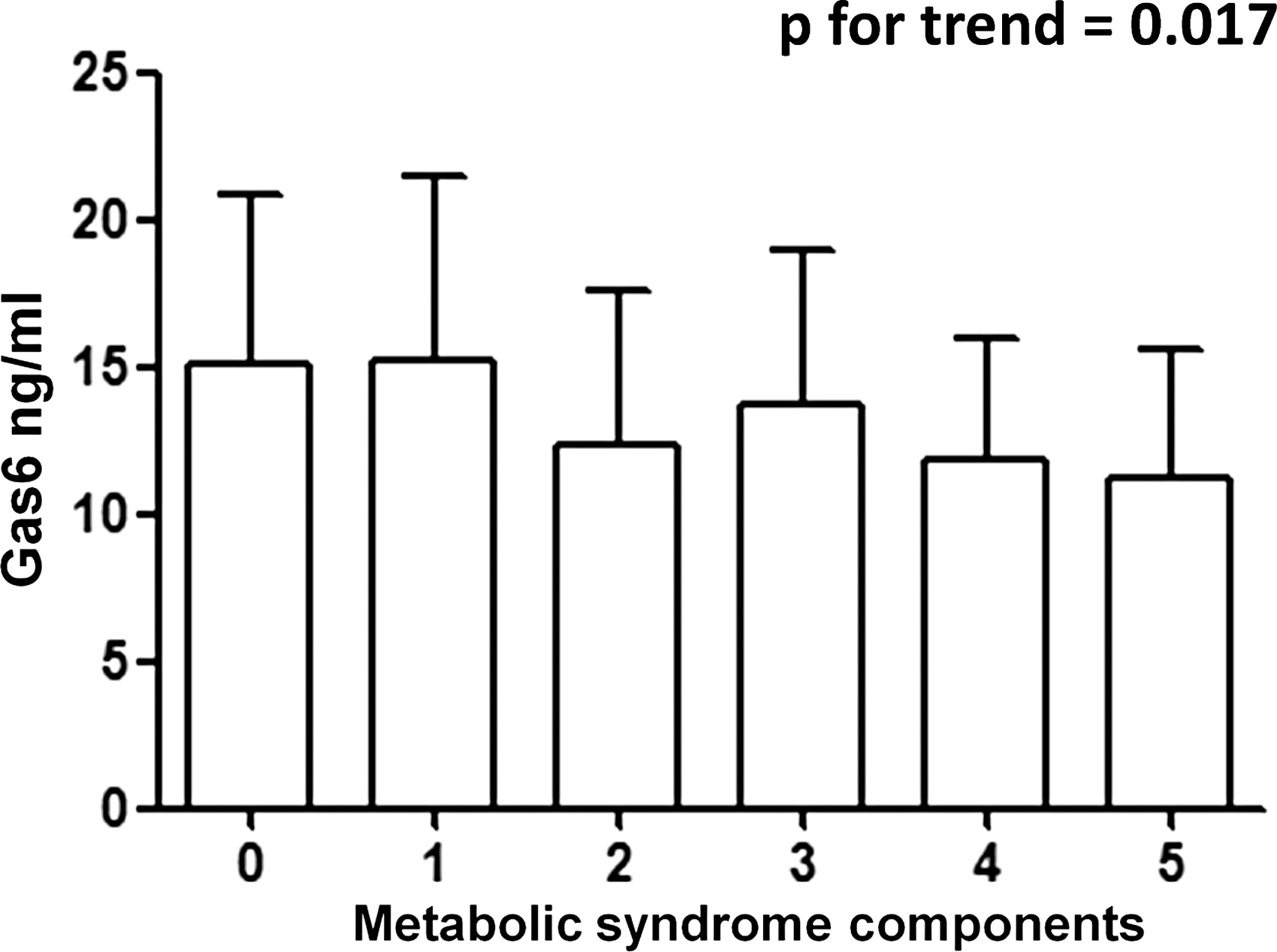
Relationship between Gas6 levels and the number of criteria for a diagnosis of metabolic syndrome in all 205 subjects. Lower plasma levels of Gas6 tended to be associated with more components of the metabolic syndrome (P for trend = 0.017). Gas6, growth arrest-specific 6.
Metabolic Syndrome According to Growth Arrest-Specific 6 (Mean [Standard Deviation])
Overall P < 0.05.
Gas6 (1) vs. Gas6 (2), P < 0.05.
Gas6 (1) vs. Gas6 (3), P < 0.05.
The results of correlation between Gas6 and MetS components among males and females after adjusting for age showed that Gas6 was positively correlated with HDL-C (r = 0.283, P < 0.001) and negatively correlated with fasting glucose (r = −0.383, P = 0.03) in the females (Fig. 2) but not in the males. There were no significant correlations with systolic blood pressure, diastolic blood pressure, triglyceride, or LDL-C in either sex.
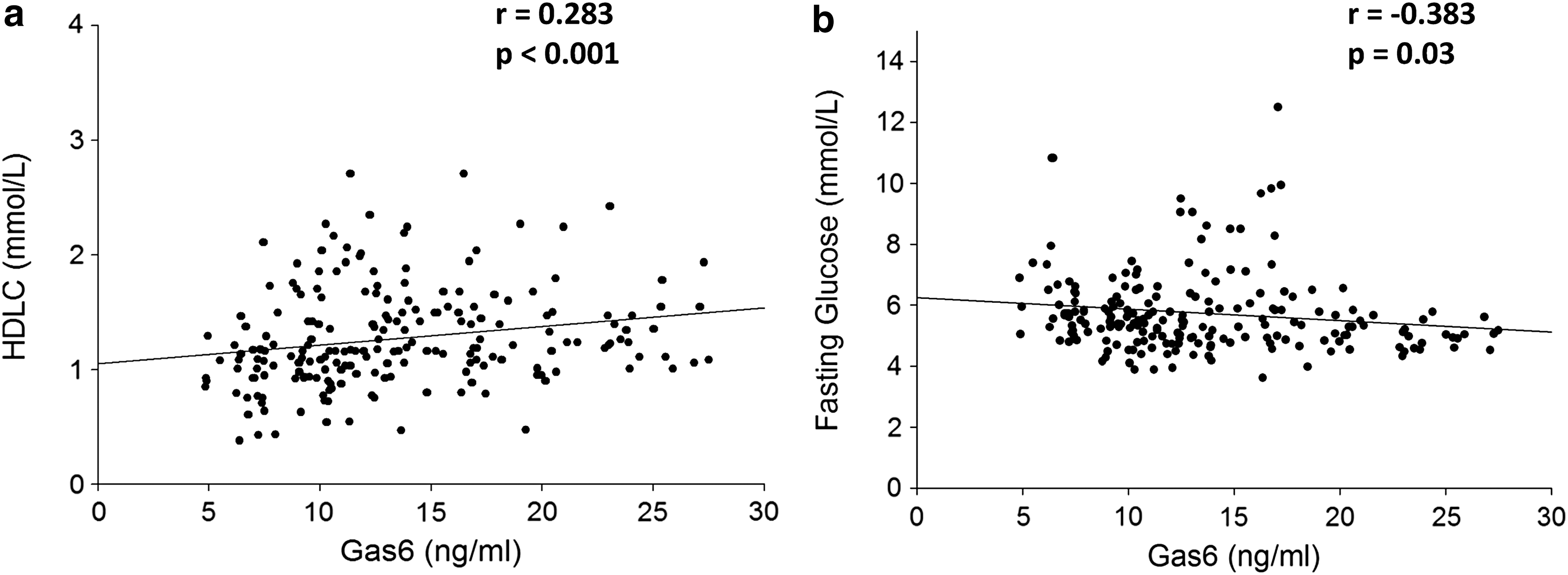
The association of
The subjects were further divided into groups according to c.843 + 7G>A Gas6 genotype. The genotype frequencies of c.843 + 7G>A Gas6 polymorphism are presented in Table 3. All genotype frequencies were found to be within the Hardy–Weinberg equilibrium. Comparisons of the frequencies of the c.834 + 7G>A genotype in the patients with and without MetS showed that the AA genotype was less frequent in the MetS group than in the non-MetS group (P = 0.01) (Table 3).
Genotype Frequencies in Metabolic Syndrome and Nonmetabolic Syndrome Patients
P value of the chi-squared test of observed patients' genotypes compared to genotypes expected from non-MetS frequencies.
MetS, metabolic syndrome.
In unadjusted logistic regression analysis (Table 4), the AA genotype appeared to be a protective factor for MetS under codominant and recessive models (MetS vs. non-MetS, AA vs. GG, 0.241 [0.083–0.817], AA vs. GG/GA, 0.344 [0.152–0.938]). Moreover, the association became slightly stronger after adjusting for age, sex, family history of diabetes, smoking, and alcohol consumption (MetS vs. non-MetS, AA vs. GG, 0.216 [0.070–0.782], AA vs. GG/GA, 0.303 [0.102–0.892]).
Odds Ratios and Confidence Intervals for Genotypes and Frequencies in Metabolic Syndrome and Nonmetabolic Syndrome Patients
Logistic regression model comparing patients and non-MetSs in a recessive model.
Logistic regression model adjusted for age, sex, diabetes family history, smoking, and alcohol consumption.
Data are OR (95% CI).
CI, confidence interval; OR, odds ratio.
Discussion
The results of the present study suggested that the Gas6/TAM system had an association with MetS. The concentration of plasma Gas6 was inversely correlated with the severity of MetS. Among the five components of MetS, HDL and fasting glucose were statistically different in the female group. As to the distribution of the Gas6 c.834 + 7G>A polymorphism, we found that the frequencies of both the A allele and homozygous AA genotype were significantly lower in the patients with MetS. Moreover, the presence of the AA genotype significantly lowered the risk of MetS.
In the current study, we first found that, in patients with MetS, the plasma Gas6 level was positively correlated with HDL-C level in female group not in male group. Several possible explanations of this novel finding are including gender, estrogen, insulin resistance, and cardiovascular diseases. First, HDL-C level varies with ethnicity and gender. In general, women have a higher level than men. Gender difference in HDL-C is partly explained by estrogen. 16 In addition, our previous report revealed that plasma Gas6 levels were positively correlated with estradiol (E2) levels in women. 17 Second, there has been considerable interest in the relationship between HDL-C and insulin resistance. 18 In the presence of insulin resistance, HDL-C levels often are reduced. Meanwhile, our previous study also showed a negative correlation between Gas6 level and insulin resistance, especially in women but not in men. 19 Third, the reduced levels of HDL-C in the MetS are believed to play a role in the predisposition to atherosclerosis, since HDL-C normally has antiatherosclerotic properties. 20 In clinical analysis, an increase in HDL-C level by 6% reduces the incidence of cardiovascular disease by 22%–24%. 21 HDL-C is considered protective in development of cardiovascular diseases. We previously showed that the expressions of both Gas6 and Axl molecules were higher in the left internal mammary artery in patients undergoing coronary artery bypass compared to the aorta and that this was associated with a lower incidence of atherosclerosis and superior long-term patency rate. 22 Another study reported that the median plasma Gas6 level was higher in healthy subjects than in patients with acute coronary syndrome. 11 However, further studies are needed to elucidate the association between HDL-C and Gas6 levels especially in women.
We also found that plasma Gas6 levels were significantly associated with fasting blood glucose levels in the female group but not in the male group. This, in part, could be explained by earlier studies, which reported the presence of a functional estrogen-responsive element in the Gas6 promoter 23 and the regulation of plasma Gas6 concentration by sex hormones. 24 Our previous study had showed that significantly lower Gas6 levels in the postmenopausal compared to the premenopausal women and plasma Gas6 levels were positively correlated with E2 levels in the pre- and postmenopausal women. 17 In addition, we had revealed a negative correlation between Gas6 level and fasting glucose, insulin resistance, especially in women but not in men, in another of our previous study. 19 In this study, we reinforce the findings of our previous data in which plasma Gas6 levels were inversely correlated with fasting glucose. 9,19 Furthermore, the results of our previous in vitro study demonstrated that exposure to increasing concentrations of glucose leads to decreased endothelial Gas6 expression and altered endothelial cell viability, angiogenesis, and adhesion functions through Gas6/Axl/Akt signaling. 8
SNPs, the most common DNA sequence variation, can cause a particular disease in certain populations or people. In recent decades, several SNPs in different genes have been associated with MetS. Many of these SNPs are located in genes involved in weight regulation, lipid metabolism, inflammation, insulin resistance, and glucose/carbohydrate metabolism, 12,25 –27 which are common pathogenic mechanisms involved in MetS. In addition, many other SNPs located in genes involved in diseases other than MetS have been associated with MetS. For example, the SNPs rs11066001 and rs3782886 in the gene of breast cancer suppressor protein-associated protein have been associated with a decreased risk of MetS. 28 Previous studies have shown that Gas6 SNPs, and especially c.843 + 7G>A in intron 8, are associated with stroke, 13 acute coronary syndrome, 11 and type 2 diabetes. 14 Furthermore, the AA genotype of the c.843 + 7G>A Gas6 polymorphism has been shown to have a protective role against acute coronary syndrome 11 and type 2 diabetes. 14 Hsieh et al. suggested that Gas6 gene variants were associated with insulin resistance, although the effects on subsequent progression to type 2 diabetes were minimal in their study. 12 Kazakova et al. 29 found that the Gas6 SNP rs8191974 T allelic gene was also a protective factor against type 2 diabetes, consistent with our previous study. 14 In the present study, we demonstrated that the subjects with MetS had significant lower frequencies of both the A allele and the homozygous AA genotype of the c.843 + 7G>A Gas6 polymorphism than those without MetS. As such, the AA genotype of Gas6 c.843 + 7G>A SNP decreased the risk of MetS and appeared to have a protective effect against MetS. We hypothesize that different Gas6 polymorphisms can result in different plasma Gas6 levels, which then provide different levels of protection against the development of MetS and that the Gas6 gene rs8191974 is likely to affect the risk factors for MetS, including obesity, fasting glucose, and lipid metabolism. Further studies are needed to test this hypothesis.
There is one limitation to this study. Numerous studies have demonstrated that Gas6 plays roles in both glucose metabolism and lipid metabolism and also cardiovascular diseases 11 and obesity. 6,12 However, our results showed that, among the five components of MetS, only levels of HDL and fasting glucose were statistically significantly correlated with plasma Gas6 levels. This may be partially due to an insufficient sample size, and future studies with a larger sample are needed to confirm our results.
In conclusion, we demonstrated that Gas6 level was correlated with the components of MetS. We also provided evidence that the A allele of SNP c.843 + 7G>A in the Gas6 gene was protective against MetS and that the AA genotype significantly decreased the risk of MetS. These findings may encourage further studies on the role of the Gas6/TAM pathway in the development of MetS, which may lead to the development of screening tools and new therapies.
Footnotes
Acknowledgments
This work was supported by research grants from the Ministry of Science and Technology (MOST 104-2314-B-016-026, MOST 104-2314-B-016-053, MOST 105-2314-B-016-040-MY3) and Tri-Service General Hospital (TSGH-C104–199, TSGH-C105-005-S03, TSGH-C105-005-S04, TSGH-C105–120, TSGHC105–185, TSGH-C106-006-S01, TSGH-C106-006-S02, TSGH-C106-007-S01, TSGH-C107-005-007-S05, TSGH-C106–161, MAB-105-084) in Taiwan. The authors declare that all authors listed have actively participated in the study and met the requirements for authorship. Y.-H.L. wrote the article and researched data. C.-H.L., F.-H.L., S.-C.S., J.-S.L., C.-H.H., Y.-J.H., and Y.-S.S. contributed to the discussion and statistical analyses and reviewed/edited the article. C.-H.L. supervised the project and reviewed/edited the article. All authors have read and approved the final version of the article.
Author Disclosure Statement
No competing financial interests exist.