




Abstract
Advances in antisense oligonucleotide (ASO) chemistry and screening have enabled the design and selection of molecules that are optimized for a particular therapeutic application in terms of both potency and tolerability. The most-well studied of the chemically modified ASOs are single-stranded antisense inhibitors with phosphorothioate backbones and 2′-O-methoxyethyl modifications (2′-MOE ASO). The 2′-MOE chemical modification in the design of the ASO has conferred increased hybridization affinity, increased stability, and/or enhanced tissue residence time, resulting in better potency and pharmacokinetics. Compound screening and selection are also important in optimizing the tolerability of intended therapeutic antisense inhibitors. In this study, we report the chronic toxicity of multiple 2′-MOE ASOs in mice for several representative compounds that have progressed to later phases of clinical development. The results show that these 2′-MOE ASOs selected for development have consistent behavior between sequences, have tolerability profiles suitable for chronic administration, and exhibit a relative lack of progression of findings observed in subchronic studies in mice.
Introduction
A
Chemical modifications have helped improve the drug properties, but the nucleotide sequence can also greatly affect the tolerability profile of a particular ASO. Thus, careful design of sequences, together with improved screening, has enabled researchers to select better and safer sequences for therapeutic development [8]. There are certain sequence elements, such as the CpG dinucleotide motifs, flanked by two purines on the 5′ end of the oligonucleotide and two pyrimidines on the 3′ end, known to greatly influence the proinflammatory activity and can be avoided in the design of an oligonucleotide [11,12]. However, there are unknown sequence motifs that require empirical screening of a large library of sequences to optimize tolerability [8]. Even well-designed sequences can still be associated with inflammatory or hepatic effects that can potentially affect tolerability at higher doses. Since one of the primary nonspecific class effects of 2′-MOE ASOs has been proinflammatory properties, potential drug candidates are primarily screened to reduce these inflammatory effects as much as possible in mice or in human cell culture systems. Thus, a combination of screening and design is needed to optimize tolerability.
The toxicologic profile of both PS ODNs and 2′-MOE ASOs in rodents treated for 4 to 13 weeks has been published for several sequences by a number of different laboratories, but there is little information published on the toxicity of ASOs after longer durations of exposure [2,6]. This article focuses on the 6-month toxicology studies completed for several representative 2′-MOE ASOs. These compounds are the product of more intense compound screening and selection implemented for ASOs intended for human therapeutic development [8]. As such, they should be regarded as benchmarks for the well-tolerated compounds in this class rather than reflecting the full range of potential chronic mouse toxicities. This publication presents the toxicology findings of 6-month testing in mice, compares findings to those seen in the shorter term studies, and assesses the potential for progression of effects over time.
Materials and Methods
Oligonucleotides
Single-stranded ASOs designed against specific human mRNA transcripts were discovered and synthesized by Ionis Pharmaceuticals (Carlsbad, CA) and formulated in phosphate-buffered saline (pH 7–7.4). The 2′-MOE ASOs were of 17–20 nucleotides in length and contained chemical modifications (phosphorothioate in place of a phosphodiester in the DNA backbone and 2-O-methoxyethyl [2′-MOE] on the sugar of the outermost nucleotides at the 3′ and 5′ ends) for improved mRNA binding affinity and pharmacokinetic properties (Table 1) [7–9].
Boldface type represents 2′-MOE nucleotides, italicized type represents DNA nucleotides.
Weekly doses in 26-week toxicity studies in CD-1 mice (mg/kg/week).
2′-MOE, 2′-O-methoxyethyl; ASO, antisense oligonucleotide; PS ODN, phosphorothioate oligodeoxynucleotide.
Animal studies
All animal procedures were performed in full compliance with AAALAC guidelines at AAALAC-accredited contract research laboratories and were approved by the local institutional animal care and use committee (IACUC). All procedures and laboratory measurements were conducted in compliance with Good Laboratory Practice (GLP) regulations.
Studies varied slightly in specific design elements but generally consisted of four treatment groups of the indicated ASO and a concurrent control group. Treatment was for 26 weeks, with a 13-week recovery phase to assess the reversibility of any treatment-related effects (see Table 1 for details). In some cases, a 3-month interim necropsy was also included. In general, 18 mice/sex/group were utilized with 12 mice/sex/group sacrificed after 26 weeks of treatment and 6 mice/sex/group utilized for the recovery phase. If an interim sacrifice at 3 months was included in the study design, an additional 6 mice/sex/group were utilized. The CD-1 mouse strain was used in all studies, and animals were purchased from established professional breeders. Following an ∼2-week acclimation period, the animals were stratified by body weight and randomized into treatment groups. Animals were ∼8 weeks of age (20–30 g body weight) at initiation of dosing. The animals were housed individually in suspended wire mesh cages equipped with automatic watering, and were maintained in an environmentally controlled room (72°F, 50% relative humidity, 12-h light/dark cycle). Food (certified rodent diet) and water were available ad libitum. Animals were identified by either an electronic microchip implant or by tail tattoo.
Animals received subcutaneous injections of ASO or vehicle (saline) on alternating days during week 1, followed by weekly injections through 26 weeks. Dose levels were generally in the range of 3 to 80 mg/kg/dose at a dose volume of 10 mL/kg. Dosing was rotated among four dose sites on the back of the animal. During the treatment period, all animals were observed twice daily for viability and clinical observations. Body weights and food consumption were measured weekly throughout all phases of the studies, while ophthalmic examinations were performed on all animals before the first dose and before scheduled necropsy.
Necropsies were performed on designated animals at scheduled intervals. Euthanasia was generally performed by either carbon dioxide or isoflurane inhalation, followed by exsanguination on nonfasted animals. Before necropsy, blood samples for the evaluation of hematology and clinical chemistry parameters and cytokine/chemokine and serum immunoglobulin (IgG and IgM) measurements were collected either by cardiac puncture or via the vena cava. Hematology parameters included both total and differential leukocyte counts; erythrocyte counts; hemoglobin concentration; hematocrit; mean corpuscular volume, mean corpuscular hemoglobin, and mean corpuscular hemoglobin concentration; and platelet and reticulocyte counts. Clinical chemistry parameters included aspartate aminotransferase, alanine aminotransferase (ALT), alkaline phosphatase, creatine kinase, total bilirubin, albumin, globulin, total protein, blood urea nitrogen, creatinine, cholesterol, triglycerides, electrolytes (sodium, potassium, chloride), inorganic phosphorus, calcium, and glucose.
At necropsy, a complete examination of all body cavities was conducted and selected organs (generally adrenals, brain, heart, kidneys, liver, lung, spleen, and testes/ovaries) were excised, trimmed of fat and connective tissue, and weighed. Approximately, 70 standard organs/tissues were collected from each animal (including all gross lesions), fixed in 10% neutral buffered formalin, sectioned, and stained with hematoxylin and eosin for histopathologic evaluation.
Statistics
All essential numerical data were analyzed for statistically significant differences between treated and control groups. These analyses generally followed standard acceptable statistical techniques using a one-way analysis of variance to assess significance, followed by Dunnett's test to determine which treatment groups differed from the control group if significance was determined from the analysis of variance. Statistical significance was considered when P < 0.05.
Results
There were no treatment-related deaths with any of the 2′-MOE ASOs evaluated, nor were there any adverse effects in body weight or food consumption. Clinical findings noted were consistent with those commonly observed in mice of the age and strain utilized, with no clear relationship to ASO treatment.
Liver effects: ALT
Treatment with 404173 or 420915 produced dose-dependent increases in ALT in both male and female mice (Fig. 1). The enzyme increases for these representative 2′-MOE ASOs occurred at doses ≥40 mg/kg/week. The magnitude of the effect was similar for both sequences with approximately a two- to fourfold increase in males and females, and corresponded with negligible histologic changes, consisting of basophilic granules in Kupffer cells, Kupffer cell hypertrophy, inflammatory cell infiltrates, and/or single-cell necrosis of hepatocytes. The data for these sequences were consistent with the increases in ALT values observed at similar dose levels for the four additional 2′-MOE ASOs (Table 2). The magnitude of ALT increase varied by sequence but there was little to no progression between 3 and 6 months of treatment, and these increases were generally reversible when treatment was discontinued in the recovery phase.

Dose/response for ALT following 26-week treatment with ISIS 404173 or 420915.
ALT, alanine aminotransferase.
Spleen weight effects
Treatment of mice with 404173 and 420915 produced dose-dependent increases in spleen weight (Fig. 2). The magnitude of spleen weight increase was greater with 404173, with increases of two- to threefold that were statistically significant at doses ≥40 mg/kg/week. By comparison, the increased spleen weight in mice treated with 420915 was less than twofold and only significant in male mice at 80 mg/kg/week. This increase in spleen weight for 420915 was representative of the magnitude of spleen weight increase observed with the four additional 2′-MOE ASOs (Table 3). Increases in spleen weight generally corresponded with overall increased cellularity and/or increases in germinal center cellularity. There was no obvious progression between 3 and 6 months of treatment, although the spleen weight increase was often present at a lower dose after the longer duration of treatment. These weight increases were reversible when treatment was discontinued in the recovery phase.
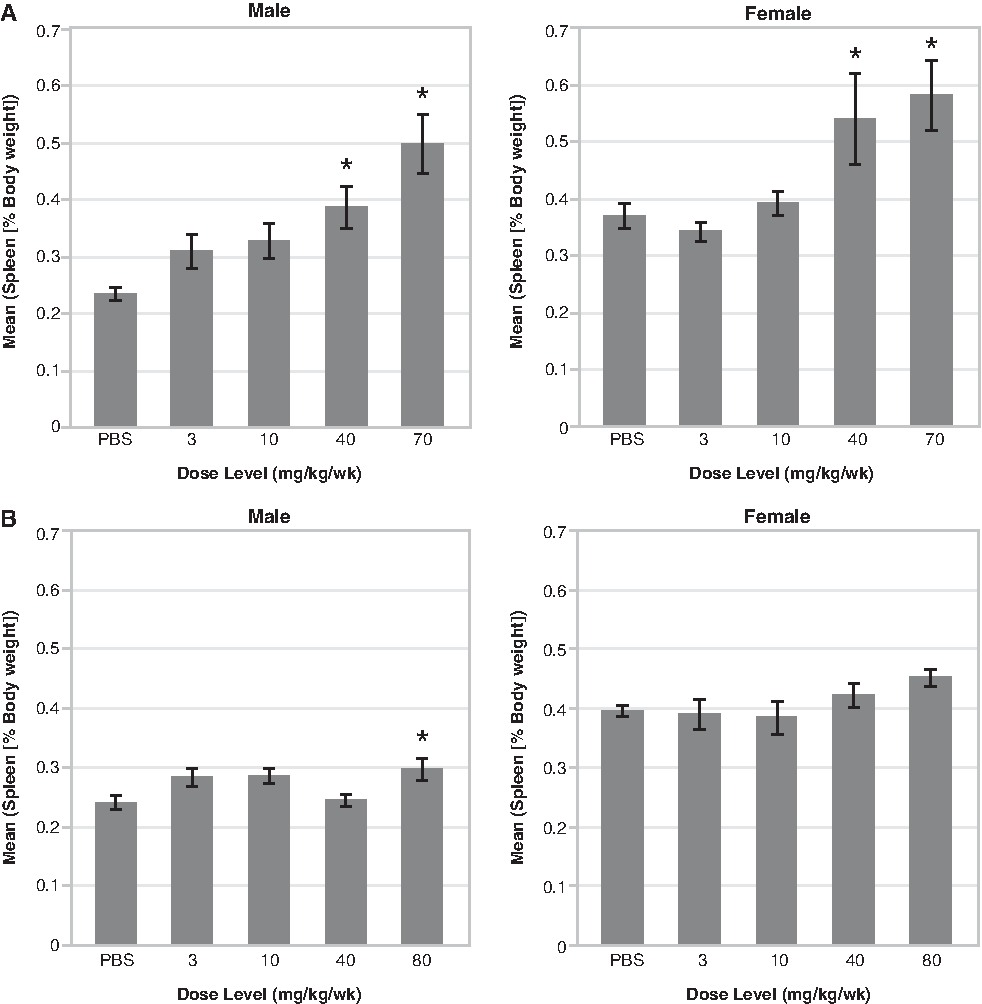
Dose/response for spleen weight following 26-week treatment with ISIS 404173 or 420915.
Inflammatory effects
Dose-related histopathologic changes associated with the proinflammatory properties in mice were noted with all of the 2′-MOE ASOs evaluated microscopically after 6 months of treatment. Findings consisted of mixed inflammatory cell infiltrates in multiple tissues, with the severity of the findings being minimal to mild in most cases, and were observed at doses ≥35 mg/kg/week (Table 4). By comparison, after treatment of mice for 6 months with PS ODNs, the severity scores for cell infiltrates can range up to the marked level for some tissues. A representative PS ODN is also included in Table 4. Although histopathology assessment was conducted across multiple laboratories and pathologists, the assessment utilized common diagnostic criteria and descriptive terminology established for ASOs and was in general agreement across the studies. For the six 2′-MOE ASOs evaluated, inflammatory cell infiltrates were observed in 10–12 tissues, most commonly involving the liver, spleen, lymph nodes, and heart. For the most part, there was little progression of this finding, both in the incidence and severity, between 3 and 6 months of treatment, but there was only partial recovery following the 13-week recovery period. In studies designed with a 3-month interim sacrifice, an increase in the severity of these findings was generally noted after 6 months of treatment when compared after 3 months.
Based on the severity score for cell infiltrates and number of tissues effected (+ = minimal, ++ = mild, +++ = moderate, ++++ = marked).
Platelet effects
Treatment of mice with 404173 and 420915 produced dose-dependent decreases in platelet (PLT) count that was significant in males at ≥40 mg/kg/week (Fig. 3). The decreases were in the range of ∼20% to 30% for these representative sequences, and the effect was consistent across the mid- and high-dose group animals. The magnitude of the change in PLT count was representative of the magnitude of effect for the four other 2′-MOE ASOs, and there was little to no progression of platelet decreases between 3 and 6 months (Table 5).

Dose/response for platelet count following 26-week treatment with ISIS 404173 or 420915.
PLT clumping noted in the raw data.
PLT, platelet.
Discussion
In the work summarized here, subcutaneous administration of representative 2′-MOE ASOs to mice for 6 months at the various dose levels tested was well tolerated, with dose-related toxicity generally occurring at doses of ≥35 mg/kg/week. There was no treatment-related mortality and no adverse effects on clinical findings, body weight, or food consumption with any of the sequences.
In general, the observations for 2′-MOE ASOs were similar to those reported for PS ODNs, but of lesser severity and incidence [13,14]. The most common finding in these 6-month studies was multiorgan inflammatory cell infiltration and increased spleen weights in mice treated at doses ≥35 mg/kg/week. In general, the severity of these findings for 2′MOE compounds was lesser and affected fewer tissues than the earlier PS ODNs [10,14]. For comparison, some of the PS ODNs or CpG-containing immunostimulatory oligonucleotides could produce at least three- to fivefold increases in spleen weight at doses of 35 to 40 mg/kg [15–17]. Also, with the PS ODNs, the number of tissues observed with inflammatory cell infiltrates was typically >25, with severity ranging from minimal to marked, while the 2′-MOE ASOs discussed here generally only affected 10–12 tissues, with severity ranging from minimal to mild. In addition, these effects were observed at lower doses (≥10 mg/kg/week) with the PS ODNs compared with the 2′-MOE ASOs (≥35 mg/kg/week) [2].
While there was an increased severity of inflammatory effects with longer duration of treatment reported for some of the early PS ODNs, there was little progression observed in mice treated with the 2′-MOE ASOs when going from a subchronic to a chronic duration of treatment. In the studies reported here, only modest increases in severity were observed, with no additional inflammatory effects and no occurrence of necrosis or fibrosis.
The increased ALT levels correlated with the magnitude of inflammatory cell infiltrates and single hepatocyte necrosis observed microscopically in the liver. This was an expected finding since the liver has been shown to typically have one of the highest concentrations of ASO in tissues [13,18].
The other common histologic observation was the presence of basophilic granules, primarily in the cytoplasm of the renal proximal tubular epithelium. The kidney is the tissue that generally contains the highest concentration of ASO, but has not been considered a significant target organ of toxicity in mice [13]. The absence of adverse histologic changes in mouse kidney is attributed to the saturation of uptake and increased clearance rate compared with other species tested, leading to less drug accumulation [6,13,19]. The reason for this is that while the mouse kidney still poses a relatively high concentration of oligonucleotide, the absolute concentration accumulated in the kidney cortex is low relative to the monkey and other higher species because of saturable uptake and faster clearance (Table 6) [9]. While mild to moderate numbers of treatment-related basophilic granules were noted microscopically, none of the morphologic changes in the kidney was considered adverse, and there was no evidence of renal dysfunction in mice treated for up to 6 months with the 2′-MOE ASOs studied here (Fig. 4). Of notable exception are the reported findings of glomerulopathy and subsequent papillary necrosis that have been reported for 2′-O-methyl ASOs [20]. These differences most likely reflect the differences in either the sequence or chemistry of the different classes of ASOs, or possibly a combination of both. This papillary necrosis in chronically treated mice at this point is the only reported case and thus is interpreted as an individual property of the particular compound rather than representative of the class.

Dose/response for blood urea nitrogen following 26-week treatment with ISIS 404173 or 420915.
Mean concentration ± standard deviation; n = 12 for mouse studies and n = 6 for monkey studies (combined genders).
Treatment duration for mouse studies = 6 months and for monkey studies = 3 months.
The investigation reported here is considered representative of the chronic mouse tolerability for 2′-MOE ASO sequences that avoid known inflammatory sequence motifs and have been selected for optimal tolerability through screening in in vitro and in vivo assays. It is well recognized that antisense inhibitors intended for human therapeutic development need to be optimized for potency and tolerability, as is the case for other drug modalities. At this point in time, optimization of both ASO potency and tolerability is an empirical process [8]. Thus, it is important to know that the 2′-MOE ASOs presented in this article are representative of those that have been screened from a library of hundreds of potential inhibitors and ultimately selected for clinical development.
It is also well known that many of the hepatic and inflammatory class effects of oligonucleotide drugs are dependent on the sequence and chemical modifications [13]. The therapeutic 2′-MOE gapmer ASOs summarized here are members of the most well-studied class of oligonucleotides, as of the date of publishing this article. Because of the sequence-dependent nature of tolerability effects, the data presented here are considered to be a guide as to what one may expect, but are not perfectly representative of all sequences. It is also acknowledged that, even for highly selected sequences, there is a potential for unexpected behavior. Thus, the value of the presented work is to provide a basis for comparison of data from mouse toxicology studies for new 2′-MOE ASO compounds and to provide some reference to judge the potential human tolerability.
One must also be aware that, while it is considered reasonable to compare data between sequences within a chemical class, great caution should be taken in comparing data between chemical classes. This is not always intuitive, since seemingly subtle differences in chemistry can have a significant influence on the tolerability properties. Such is the case with the impact of the 2′-MOE modification on the inflammatory properties of a single-strand phosphorothioate oligonucleotide [10]. The various 2′-backbone modifications all have a specific purpose and can broadly influence properties of the oligonucleotide, including the relative hydrophobic or hydrophilic binding properties [21]. As oligonucleotide chemistry continues to become more diverse, even the amount of 2′-alkyl modifications or the phosphorothioate content can influence tolerability profiles.
The results presented in this publication clearly show that longer duration of treatment of mice (up to 6 months) via subcutaneous administration with six different 2′-MOE ASOs did not cause any additional toxicity or any significant increase in the severity of toxicity from what was observed in subchronic studies. Since some 2′-MOE ASOs currently undergoing clinical testing may require long-term administration in humans, it was important to evaluate the toxic potential from long-term dosing in mice to establish the safety of these compounds before starting clinical testing.
Footnotes
Author Disclosure Statement
T.A.Z., T-W.K., L.S., and S.P.H. are employees of Ionis Pharmaceuticals. No competing financial interests for D.S., C.P., S-Y.P., and Y.K.