




Abstract
Abstract
Vaccinomics is the convergence of vaccinology and population-based omics sciences. The success of knowledge-based innovations such as vaccinomics is not only contingent on access to new biotechnologies. It also requires new ways of governance of science, knowledge production, and management. This article presents a conceptual analysis of the anticipatory and adaptive approaches that are crucial for the responsible design and sustainable transition of vaccinomics to public health practice. Anticipatory governance is a new approach to manage the uncertainties embedded on an innovation trajectory with participatory foresight, in order to devise governance instruments for collective “steering” of science and technology. As a contrast to hitherto narrowly framed “downstream impact assessments” for emerging technologies, anticipatory governance adopts a broader and interventionist approach that recognizes the social construction of technology design and innovation. It includes in its process explicit mechanisms to understand the factors upstream to the innovation trajectory such as deliberation and cocultivation of the aims, motives, funding, design, and direction of science and technology, both by experts and publics. This upstream shift from a consumer “product uptake” focus to “participatory technology design” on the innovation trajectory is an appropriately radical and necessary departure in the field of technology assessment, especially given that considerable public funds are dedicated to innovations. Recent examples of demands by research funding agencies to anticipate the broad impacts of proposed research—at a very upstream stage at the time of research funding application—suggest that anticipatory governance with foresight may be one way how postgenomics scientific practice might transform in the future toward responsible innovation. Moreover, the present context of knowledge production in vaccinomics is such that policy making for vaccines of the 21st century is occurring in the face of uncertainties where the “facts are uncertain, values in dispute, stakes high and decisions urgent and where no single one of these dimensions can be managed in isolation from the rest.” This article concludes, however, that uncertainty is not an accident of the scientific method, but its very substance. Anticipatory governance with participatory foresight offers a mechanism to respond to such inherent sociotechnical uncertainties in the emerging field of vaccinomics by making the coproduction of scientific knowledge by technology and the social systems explicit. Ultimately, this serves to integrate scientific and social knowledge thereby steering innovations to coproduce results and outputs that are socially robust and context sensitive.
Introduction
Due to large heterogeneity in immune responses to vaccines, the new generation of vaccines in the 21st century will likely be more customized/personalized for individuals and subpopulations, and thus, markedly different than the “one-size-fits-all” vaccines of the 20th century (Adamczyk-Poplawska et al., 2011; Poland et al. 2009). “Vaccinomics,” a term coined by Poland and colleagues in 2007 (Poland, 2007; Poland et al., 2007), refers to integrated use of data intensive multiomics approaches to understand the mechanisms responsible for heterogeneity in humoral, cell-mediated, and innate immune responses to vaccines at both the individual and population level. Similar to other data-intensive omics technology applications (Kolker, 2011), vaccinomics can be conceptualized as the “science of understanding biological heterogeneity” (Ozdemir et al., 2009).
Vaccinomics proposes a conceptual framework that broadens the scope of vaccine applications in healthcare to include both prevention and treatment (Giri et al., 2010; O'Meara and Disis, 2011). Indeed, vaccines enabled by gen(omics) discovery tools are emerging as a standard treatment for some types of cancers. The United States National Institutes of Health Clinical Trials registry Website identifies over 20 clinical trials at the Phase III stage with the aim of developing therapeutic vaccines for numerous types of cancer (O'Meara and Disis, 2011). The first therapeutic cancer vaccine for castration-resistant prostate cancer was approved by the U.S. Food and Drug Administration. The U.S. National Comprehensive Cancer Network (NCCN) recognized this agent as a category 1 (highest recommendation) in 2010 (for discussion, see O'Meara and Disis, 2011). As a new instrument in the global health toolbox, vaccinomics will therefore impact broad segments of the society in developed and developing countries, including both healthy and patient populations.
Vaccinomics Future(s): How to Steer New Technology and Innovation?
In the wake of past highly polarized public and stakeholder responses toward both vaccines and genetics/genomics research (i.e., a double jeopardy situation), the future is yet undecided for vaccinomics. Transformative crosscutting biotechnologies such as vaccinomics are often accompanied by potential consequences for society in contexts that can be both negative and positive. Yet, the rapid pace of technology development does not afford the luxury to wait for societal and policy engagement until the science has “matured.” Nor are the uncertainties entirely technical in nature. Increasingly, policymakers and society have to act when “facts are uncertain, values in dispute, stakes high and decisions urgent” (Ravetz, 1987; Turnpenny et al., 2009). What type of transformation in governance of science do we need so that vaccinomics delivers sustainable solutions to the pressing global health priorities affecting all citizens of the world?
At this early phase of vaccinomics, there is ample room for social science engagement to steer the vaccinomics technology design and innovation trajectory in a manner that is closely attuned to social values. Indeed, the success of knowledge-based innovations such as vaccinomics is not only contingent on access to new biotechnologies. It also requires new ways of governance of science, knowledge production, and management (Bell and Hindmoor, 2009; Carlile, 2004; Cook and Brown, 1999; Faraj and Yan, 2009; Huzair et al., 2011; Ozdemir et al., 2010, 2011a). It demands an understanding of the ways in which science–technology–society are interwoven in coproduction of knowledge on a day-to-day basis (Bijker et al., 1987; Faraj et al., 2004; Jasanoff, 2006; Ozdemir et al., 2011b; Ravetz, 1971; Yearley, 2005).
This article presents a conceptual framework on anticipatory and adaptive approaches that are crucial not only for the responsible design of emerging postgenomics technologies such as vaccinomics but also for their effective transition to public health practice. Specifically, we underscore anticipatory governance (AG) as a new approach to manage the uncertainties embedded on an innovation trajectory with foresight, in order to devise governance instruments for collective “steering” of science and technology. As a contrast to hitherto narrowly framed “downstream impact assessments” for emerging technologies, AG adopts a broader and interventionist approach that recognizes the social shaping of innovation and technology design. The present analysis is therefore developed against a background from the field of “technology assessment” for the OMICS readership, as an inquiry with origins in the business community and management sciences, and increasingly informed by notions of social shaping of technology.
Four Decades of Technology Assessment: Then And Now
The technology assessment (TA) approach developed in the 1960s in reaction to broad failures in predicting the consequences of technology developments on the environment and society. These efforts have focused on ways to keep a given technology controllable. The approach was first institutionalized and extensively used in the United States, where significant social opposition materialized toward the environmental and social costs of developments such as supersonic transport, nuclear power, the pollution cost of fossil fuels. At the same time, the need emerged for longer term evaluation of developments in areas such as genetics and renewable energy. The aim was to bring together the public and private sectors in order to identify both intended and unintended societal, economic, and environmental effects of scientific and technological opportunities (Brooks and Bowers, 1970) and map alternative development courses (Livingston, 1970).
During its early stages, TA was considered a form of policy research that analyzed the social consequences of the technology application. The goal was to provide policy makers with information on policy alternatives (Goodman, 2004). For example, to ensure the emergence of the best knowledge for congressional action, U.S. Congress authorized the formation of the congressional Office of Technology Assessment (OTA) in 1972. Innovative for its time, the OTA framework relied on multidisciplinary teams representing a variety of stakeholders and diverse viewpoints. The reports generated were framed broadly, included a variety of policy options, and were written in accessible language. The general view was that the world is interdependent and only with continual foresight could one manage the second-order consequences that may emerge.
The OTA was formed as an advisory agency for the U.S. Congress. It was governed by a bipartisan panel for political impartiality. Ad hoc assessment panels made up of interdisciplinary “experts” researched and summarized issues, particularly those that were controversial, and provided policy alternatives rather than a specific recommendation. This work was criticized by the Congress at that time, which came to believe that forecasts of novel technologies in dynamic markets were not useful (Bimber, 1996). Although the U.S. Congress closed the OTA in 1995, a dozen European parliaments have been effectively establishing OTA-like programs over the past decades that appear to be thriving successfully with an emphasis on broad public participation (Sclove, 2010).
In a democracy, the need for actionable analysis and knowledge on complex developments at the science–society nexus is crucial. In the United States, the OTA shut down in 1995 has led to the migration of the TA function to boundary organizations such as the National Academies of Science (NAS). It has been suggested by scholars, politicians, and institutions that Congress reestablish its technology assessment capability (e.g., Epstein, 2009; Healy & Dean, 2007; Holt, 2009). Although this has yet to happen, technology assessment has survived.
The lesson of four decades of technology assessment may be of the growing importance to build an open space where issues related to the governance of science and technology are discussed and analyzed. The traditional belief that scientific trajectory is linear has been replaced with an understanding that innovations emerge from a series of strategic decisions made over time by people with a vision of the future(s). As we will discuss in subsequent sections of this article, TA is now transforming from a focus that has dealt with “impacts” or consequences of technology and innovation products, to moving (albeit slowly) to influence the design of technology. This upstream shift from consumer and end-user “product uptake” focus to “technology design” on the innovation trajectory is an appropriately radical and responsible move, especially given that considerable public funds are dedicated to innovations by governments.
Controlling Emerging Technologies: The Collingridge Dilemma
Emerging technologies and transformative innovations present a two-pronged control conundrum known as the Collingridge Dilemma:
The social consequences of a technology cannot be predicted early in the life of the technology. By the time undesirable consequences are discovered, however, the technology is often so much part of the whole economics and social fabric that its control is extremely difficult. This is the dilemma of control. When change is easy, the need for it cannot be foreseen; when the need for change is apparent, change has become expensive, difficult and time consuming (Collingridge, 1980, p. 11).
The first part of the Collingridge Dilemma is concerned with the notorious resistance of technologies to changing their trajectories in later stages. A reactive approach to governance or waiting to adopt a technology until its future trajectory is “locked” into a certain path may result in greater knowledge on the attendant social impacts. But attempts to modify the technology at this later stage become difficult as it is then “entrenched” (a terminology used by Collingridge) in a complex nexus of sociotechnical, economic, and political dependencies. That is, negotiation of technology future(s) is more feasible at early phases of innovations when ideas are just that—ideas, and not beliefs that are difficult to reframe in light of new sociotechnical insights.
Collingridge has borrowed in part from the classic (and often contested) linear model of innovations (Godin, 2006; Ogburn 1922), but his observations on technology entrenchment remain pertinent today (Marris and Rose, 2010). Even the staunchest critiques of the linear model of innovations would agree that already cemented firm beliefs and pathway dependencies pose rigid constraints on shaping an entrenched technology. Such social systems do not permit flexibility in stakeholder values for effective negotiation of science and technology policy.
The predicament of an entrenched technology is also consistent with an observation made by Sir Michael Marmot: “Scientific findings do not fall on blank minds that get made up as a result. Science engages with busy minds that have strong views about how things are and ought to be” (Marmot, 2004, p. 906).
Considering the problem of technology entrenchment, a “wait-and-see” approach is therefore not tenable in a context of responsible innovation with emerging technologies (Owen and Goldberg, 2010). An alternative is to engage with science and technology from the outset so as to predict their long term social impacts. This is “the customary response” to the Dilemma (Collingridge, 1980, p. 11). In the past, this has taken the form of decision analytic frameworks and quantitative predictive algorithms. Such a “predict-and-control” approach is not, however, without its problems. Many of the emerging transformative technologies such as vaccinomics impact diverse environmental, ecological, and social systems with complex intertwined effects that cannot be predicted a priori.
Such uncertainty about the future is not simply due to shortcomings from scientific descriptions of the natural world. Social factors such as human values and ways of knowing—what we choose to know and how we know it—expressly impact what gets to be produced as scientific knowledge. The choice and framing of scientific hypotheses, experimental methodology and interpretation of data can all be influenced by experts' and their institutions' value systems that often remain implicit in scientific decision making (Ozdemir et al., 2009). In other words, it is impossible to separate the “knowledge” and the “knower” (Lehoux, 2011; Macfarlane, 2003; Ozdemir et al., 2009).
Anticipatory Governance: A Response to the Dilemma
Expertise and lay knowledge: contested and fluid boundaries
Thirty years on, the dilemma of technology control astutely described by Collingridge (1980) is still situated in a narrow technocratic vision guided primarily by quantitative risk assessment, cost-effectiveness analysis, or regulatory measures (e.g., precautionary principle) developed to address the “risk society” framework (Beck, 1992) that has prevailed particularly in Europe. As a response to the Dilemma, expert opinions continue to be sought to forecast the innovation and technology trajectory. However, there is a host of limitations associated with specialized expert knowledge (Taleb, 2010; Wynne 1992a, 1996). We list some of these below and note that these can coexist at the same time, without necessarily a hierarchical organization in the uncertainties they represent:
1. Risk refers to a situation where the system parameters and their associated probabilities are known in relation to a hazard or cognate outcome. 2. Uncertainty is when we know the system parameters but not their probability in relation to a hazard. 3. Ignorance is when we do not know the system parameters nor their odds in relation to a hazard, that is, “unknown unknowns.” 4. Indeterminacy is the case of an entirely open system that includes a social or human agent with an entirely unchecked social behavior that acts on technological predictions. Hazards can occur in such open systems despite assurance of expert opinion in favor of safety. 5. Black Swans are rare and outlier events that cannot be predicted a priori (often they have no precedence), and thus, fall outside our usual cognitive imaginative capacity and expectations, but with massive impacts on society.
Recalling how technologies can “lock in” or become “entrenched,” experts, by virtue of their disciplinary brackets, have an inherent tendency to develop professional blind spots or “trained incapacity” (Veblen, 1914). Events such as Black Swans, ignorance, or indeterminacy fall outside the extant dominant technology discourse or the innovation “master narrative.” Thus, “a scientific expert is someone who knows more and more about less and less, until finally knowing (almost) everything about (almost) nothing” (Choi et al., 2005, p. 632). Or, “an expert is best seen as a committed advocate, matching his opinions with other experts who take a different view of the data available to them in a critical battle” (Collingridge, 1980, p. 12).
Reliance solely on expert knowledge in governance is problematic because expertise is a highly contested and fluid construct, nor are the experts necessarily value-neutral, disinterested, and objective (Marris and Rose, 2010). Indeed, the importance of local knowledge and context in the validation or rejection of expert knowledge has been empirically documented in studies of: the radioactive contamination in the wake of the Chernobyl fall-out (Wynne, 1992b), the governance of the health effects of hazardous agricultural sprays (Irwin, 1989), and the case of the BSE scare (Jasanoff, 1997; Yearley, 1992). Additionally, public(s) may be “much more interested in issues of distribution, power relations, and a generic sense of fairness” (Yearley, 2000, p. 118).
Efforts to broaden and complement expert knowledge are based on the idea of “shared governance” and coevolution of science and society. Traditional governance questions such as “Do we adopt/reject a technology, given that it is now well developed and mature?” are being replaced with “How can a new technology and its applications be co-designed and governed collaboratively early on, together with innovators and anticipated end-users?” (Ozdemir et al., 2010). This signals an upstream shift for shared (and anticipatory) governance at the stage of technology design before its applications enter society.
For democratization of expert knowledge and shared governance, engaging a broad set of stakeholders with different ways of knowing creates “epistemic cultures” (Knorr-Cetina, 1999), necessary for a rich discourse on innovations. As we will discuss in the next section, broadly constructed epistemic cultures contribute to a foundation for robust and negotiated “anticipatory knowledge” (Selin, 2008, p. 1880) concerning the plausible innovation trajectories.
From forecast to foresight
Individuals, groups, and communities, whether faced by an emerging technology, healthcare innovation, climate change, or by an environmental and economic crisis, need to develop a broad capacity early on to prepare for the future impacts of such transformative events. Responses to these ever present societal challenges have tended to focus on “prediction” or alternatively, creation of policies that “forecast” a deterministic future. Yet, social events with long-lasting impacts such as emerging health technologies, environmental change, or military conflicts are unpredictable by their very nature. Oftentimes, there are multiple possible future(s) for a given innovation trajectory. The traditional “predict-and-control” framework by the regulatory state or governments is inadequate for complex social change and transformative innovations (Miles, 2010; Quay, 2010).
Put another way, what do we do when we do not exactly know what the future holds? How can we best prepare against unanticipated impacts of new technologies (including the cases of ignorance and indeterminacy) so that not only can we characterize them in real time but also intervene on the innovation trajectory with the new information on emerging impacts of technology in society? Governance mechanisms that recognize the ever-present uncertainty in our knowledge systems as well as its social and technical dimensions are necessary (Jasanoff, 2007).
Collingridge (1980) has noted that “since the future is extremely uncertain, options which allow the decision maker to respond to whatever the future brings are to be favoured.” This sentiment articulated 30 years ago still resonates well in the second decade of the 21st century in the postgenomics era. If prediction of the future is not feasible, then, the next best alternative is to closely “follow the actors” of an innovation system wherever they go, from the outset of a technology or scientific discovery (Irwin, 2008; Latour, 1987).
Because innovation future(s) are ostensibly uncertain in “sociotechnical systems” that coproduce scientific knowledge (Jasanoff, 2006), decision makers ideally should continually monitor a technology in real-time as it coevolves with society, in order to understand the ways in which science–technology–society are interwoven in the course of an innovation (Ozdemir et al., 2009, 2011b). This provides the stakeholders with the flexibility and resilience to better adapt and promptly respond to whatever consequences might emerge on innovation trajectories.
Foresight is a human cognitive capability that has existed since time immemorial (Miles, 2010). Yet this fundamental aspect of cognitive creativity has not been hitherto utilized in the governance of science and technology or knowledge based innovations. Etymological origins of “foresight” date to 17th century Renaissance England in the Restoration Period. English playwright and poet William Congreve used it in his comedy Love for Love (1694), where Mr. Foresight was a person engaged with the alleged signs and symbols of the future (Miles, 2010). From a management science angle, Robert Chia defines foresight as:
A refined sensitivity for detecting and disclosing invisible, inarticulate or unconscious societal motives, aspirations, and preferences and of articulating them in such a way as to create novel opportunities hitherto unthought and hence unavailable to a society or organization (Chia, 2004, p. 22).
In a discussion on foresight on nanotechnology and sociology of the future as an emerging field of study, Selin (2008) has commented:
Foresight is a means to analyze the explicit and implicit stories embraced and circulated to cope with futures known and unknown. By “stories,” I highlight from a postmodernist perspective, the difficulties about talking about a world of forces “out there.” Instead, tacitly understood interpretative frameworks are organized into stories that characterize experience and perceptions. Foresight practices bring these stories out into the open for examination. Such stories of the future are potent sources of legitimization, inspiration, and construction in an emerging technoscience like nanotechnology” (Selin, 2008, p. 1880).
Indeed, foresight in part depends on broadening and integrating expert knowledge with other ways of knowing, including locally situated and tacit knowledge, together with enhanced reflexivity, that is, a broad cognizance and acknowledgement of how our own values, beliefs, and political commitments as well as choice of research questions and methodologies collectively contribute to construction of meanings from science and technology. Foresight is essential to contextualize emerging technologies and scientific discoveries over time, extending well beyond the immediate future, for example, over a course of 10 years or several decades (Giles, 2011).
Anticipatory governance with foresight
AG with foresight has emerged in the above broader context on policy-relevant decision making under uncertainty. AG is well suited for managing the uncertainties posed by the future(s) of innovations and the prospective understanding of transformative social changes in rapidly moving and dynamic fields such as vaccinomics. With its origins in an eclectic blend of literature from the fields of future(s) studies (Bell, 1997; Miles, 2000), constructive (Douma et al., 2007; Rip et al. 1995), and real-time technology assessment (Guston and Sarewitz, 2002), sociology of expectations, management sciences and strategic planning (Ratcliffe, 2002; Schoemaker and van der Heijden, 1992; van der Heijden 1996), and social studies of science and technology (Barben et al., 2008), AG has recently attracted attention in diverse fields such as nanotechnology, public administration, climate change, military adaptive capacity, personalized medicine, and social risks attendant to clinical trials in marginalized populations (Barben et al., 2008; Chi, 2008; Ozdemir, 2009; Ozdemir et al., 2009; Quay, 2010).
One of the key concepts underpinning AG is that the best way to definitively predict the future of a complex system is to “run it” (see also the section on the caveats of the AG). Provided that a complex system with embedded technical and social uncertainties is allowed to run carefully in increments, and under conditions of “open access connectivity” where multistakeholder values (both expert and lay), knowledge as well as modes of knowing are characterized transparently, deliberated, and discursively fed back to the stakeholders of an innovation ecosystem, a mutual learning experience can materialize.
Participatory foresight, a key ingredient of AG enabled by multistakeholder engagement as described above, frames innovations as a shared collective learning exercise under complex contingent conditions, where stakeholders have mutual interdependencies. It builds on the principle of incremental recursive learning and explores the representations of multiple possible “futures-in-the-present” as perceived by a diverse set of stakeholders, both expert and lay. As such, it signals a shift in favor of “looking at” rather than the prediction-oriented “looking into” the future(s) (McGrail, 2010).
Instead of generating predictive “what if” or “if—then” statements on the future, AG aims to understand how the future(s) are being constructed in the present (e.g., which values are shaping the imaginations of the future in the present?), and how the intersection and interaction of such values/imaginations might influence innovation trajectories or result in societal transformation (e.g., social consensus or conflict). This allows the values embedded in future vision(s) to be explicit and deliberated before a social change introduced by a technology, environmental, or other crisis locks into a deterministic path. It also contributes to a foundation for what Selin calls anticipatory knowledge (Selin, 2008, p. 1880).
The goal of AG is not to predict or forecast a singular future but to develop participatory foresight on multiple possible future(s). Guston (2007) describes AG as “the ability of a variety of stakeholders, including the lay-public, to prepare for the issues that [nano-scale science and engineering] may present before those issues are manifest or reified in particular technologies.” As observed by Quay (2010) in the case of climate change, “rather than trying to tame or ignore uncertainty, this approach explores uncertainty and its implications for current and future decision making.”
AG underscores shared governance, the coproduction of knowledge by science and society and the inseparable nature of “facts” and “values” where both of these elements need to be made explicit and deliberated to achieve innovation in governance. Beyond the traditional expert knowledge, AG responds to uncertainty by mobilizing through an extended peer community of “epistemic cultures,” local and tacit knowledge and ways of knowing to enable a more robust and enriched framing of science and technology. This broader approach to “knowledge” (including but beyond expert opinions) allows an examination of the value and power systems that shape visions of the sociotechnical future(s) (Table 1).
Figure 1 presents a schema for anticipatory governance of vaccinomics with participatory foresight. In particular, a broad engagement concerning the stakeholder attitudes towards “evidence” is timely for complex 21st century innovations. For example, there will likely be a diverse set of expectations and attitudes toward the appropriateness of the extant evidentiary frameworks and regulatory review mechanisms vis-à-vis vaccinomics. In such cases, foresight exercises can help induce a multistakeholder collaborative transformation to negotiate, and when possible, to codesign the future(s) of innovations (e.g., among innovators and end users of innovations) (Fig. 1). This cultivates a broad capacity for scientists, funding agencies, governments, and citizens to understand how the decisions they make today might impact the future, and thus allows decision making on innovations that are more likely to survive the future uncertainties.
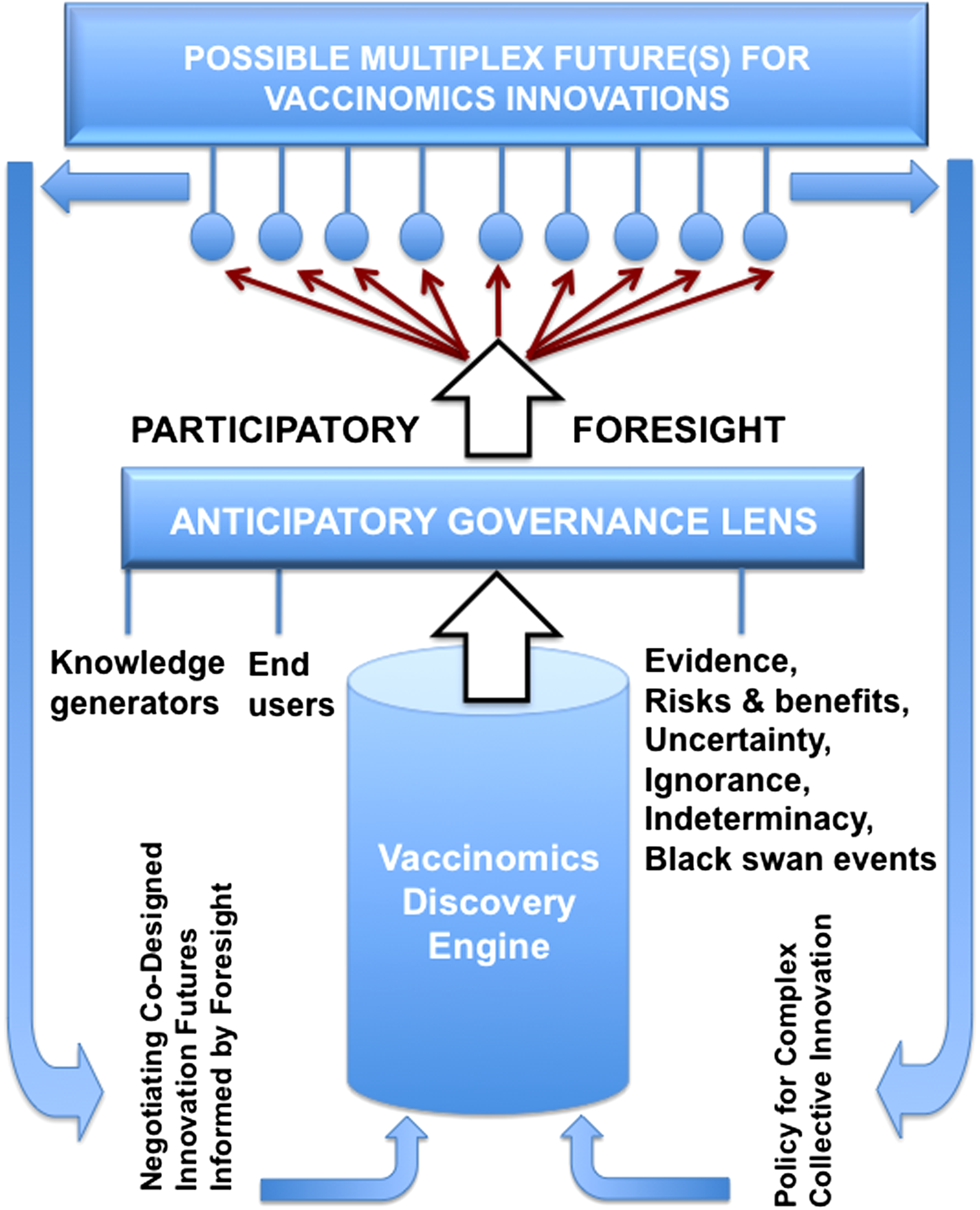
A conceptual and practical application framework for anticipatory governance of vaccinomics with participatory foresight. In the course of multistakeholder engagement, for example, between knowledge generator and end-users, several themes can be explored including the type and extent of evidence perceived to be adequate to transition a vaccinomics biomarker to public health practice, risks and benefits of vaccinomics, as well as the perceptions toward different configurations of uncertainty. This cultivates a broad capacity for scientists, funding agencies, governments, and citizens to understand how the decisions they make today might impact the future, and thus allows decision making on innovations that are more likely to survive the future uncertainties.
Engagement exercises using the scenario method can help form a shared mental model of the innovation trajectories among the stakeholders (Ratcliffe, 2002), and where disagreements exist, create a platform to negotiate and calibrate conflicting expectations toward the future(s) among the constituents of an innovation ecosystem. The scenario method is also valuable for broadening the imaginations regarding the future(s) of an emerging technology. Such enhancement of the collective cognitive visions in an innovation ecosystem for multiple possible (multiplex) future(s) and their putative configurations is noteworthy (Fig. 1). This can serve as an “insurance” mechanism against the technologies' notorious tendency to be “entrenched” or locked in a rigid course that can stall their adaptability and steering towards socially desirable outcomes. Hence, the scenario methods expand the “cognitive armamentarium” to respond to the challenges of innovations and emerging technologies in a versatile manner.
Deployment of social science methods such as Delphi surveys, focus groups, and citizens' juries—from the outset of a technology—can provide iterative ongoing feedback to the stakeholders so that a real-time broad discussion of the innovation future(s) can be initiated and sustained over time and societal contexts.
In contrast to the precautionary principle that focuses on risks, AG aims to develop capacity for understanding and responding to both the adverse and beneficial effects of technology and innovations. AG emphasizes the coproduction of knowledge by science and society (i.e., science is not an autonomous enterprise); it also works toward enabling coproduction through social learning that becomes possible by upstream engagement between science and society from the outset of an innovation, before “cognitive lock-in” develops among the stakeholders.
Future Promises and Caveats
AG should not be viewed as a panacea for the challenges of innovations and emerging technologies. There will also likely be successive generations of AG frames. A wholesale application of AG may not be realistic or desirable. Adjustments will be necessary depending on the specific context (e.g., the type of technology and its present degree of entrenchment, range of stakeholders involved, how versatile the future technology applications might be, etc.). Still, developing a broad capacity to respond to the uncertainties of innovation future(s) by AG warrants attention, particularly in the case of postnormal science (PNS).
In contrast to the “normal science” (Kuhn, 1962), PNS aims to address knowledge production and scientific inquiry where “facts are uncertain, values in dispute, stakes high and decisions urgent and where no single one of these dimensions can be managed in isolation from the rest” (Ravetz, 1987, p. 99; see also Turnpenny et al., 2009, 2010). Funtowicz and Ravetz (1991) have termed these characteristics as PNS. Others have named the similar forms of complex knowledge production processes as “Mode 2” (Gibbons et al., 1994). Indeed, vaccinomics is a timely example of PNS; convergence of long-standing tensions in genomics, vaccines, and public health collectively create the qualities of a PNS.
Some recent examples of demands by research funding agencies for sociotechnical integration of PNS through anticipation of the broad impacts of proposed research—that is, at a very upstream stage at the time of research funding application—suggest that AG may be one way how scientific practice might transform in the future toward responsible innovation (Ommer et al., 2011; Owen and Goldberg, 2010). Despite these promises, the following caveats of AG should be born in mind; they also constitute potential focus areas for innovation in governance of science and technology in the current postgenomics era:
1. Although there might be some resemblance between the efforts to study public understanding of science and AG, the latter has a proactive interventionist (normative) goal to feed the complex linkages between social change and technology back to the stakeholders for real-time sociotechnical integration. 2. AG cannot be a “one time” singular effort; instead, it should be considered as an incremental, iterative, and continuous effort to build capacity among a complex range of stakeholders while the innovation system is evolving (see also Huzair et al., 2011, for the vaccinomics innovation systems). 3. Steering an innovation trajectory in a sustainable manner warrants mechanisms for both acceleration and deceleration, in much the same way a complex aerodynamic system like airplane requires these qualities to take off and navigate under turbulence. Anticipatory governance findings may, at times, suggest that momentary deceleration of a gen(omics) discovery engine may be prudent for long-term acceleration and multistakeholder sustainability. How might stakeholders with existing political and economic commitments view such recommendations as deceleration and acceleration of technology applications? 4. The goal of public engagement for AG should not be about pacifying public “resistance” or making the public(s) “accept” an emerging technology (Lehoux, 2011). By framing public responses to science and innovation as “resistance” or “acceptance,” the scientific enterprise in the 20th century has been quick to (incorrectly) bring to the fore the “public knowledge deficit thesis,” an idea that has been contested and rejected for a long time in the social studies of science and technology field. Instead, beyond a simplistic dichotomy of public acceptance or resistance to emerging technologies, the scientific enterprise should reflect “upstream” on ways in which scientific priorities and questions are framed by experts without citizen participation, and how this one-sided practice might lead to “framing errors” thereby vastly undermining the future sustainability of innovations. 5. It is interesting to note that the social sciences have been reluctant in taking on the task of studying the future. How can an empirical discipline such as sociology study a construct such as the “future,” which has not yet materialized? One can, however, empirically examine how future(s) are being constructed in the present using valid social science methods, and symmetries and asymmetries in these cognitive imaginations among stakeholders to build a broad capacity to anticipate the future. Will social sciences be willing to take on the task of being a social architect by studying the future(s)-in-the-present? 6. Foresight studies, instead of presenting a prediction of the future, aim to understand the sociotechnical forces shaping both the supply and demand of scientific knowledge and technology. But in a traditional policy environment that often demands “if–then” predictions of the future, will there be adequate funding and interest for such anticipatory knowledge that can build broad capacity for responsible innovation?
Concluding Remarks: Where Now for Technology Governance?
Despite substantial evidence from social and political science literatures supporting a close and interactive coexistence and relationship between society and science (Nowotny et al., 2001), the views in the scientific community continue to maintain a sharp demarcation “line” to separate them (Ingram and McDonald, 2002; Ingram et al., 2004). Technological determinism expressed as a one-way linear and deterministic flow of scientific knowledge from “lab-to-clinic” still represents the dominant conceptual framing of the postgenomics innovations (Knoppers, 2009). In contrast, little attention has been given to the ways society and politics of scientific knowledge influence science and technology development. This predicament in our current approach to study of 21st century innovations is not new. Since the origins of modern thought over 300 years ago, the image of science as an invariably beneficial, objective, value-free, and intrinsically ethical activity has endured. This view was immortalized by Michael Polanyi's “Republic of Science” (1962) and the works of Robert Merton (1968) throughout the 20th century (see Guston, 1992; Ozdemir et al. 2009, 2011a; Tallachini, 2005). The need for a more intense, reflexive, and open dialogue between science and society from the outset of innovations at an upstream stage, and the integration of this dialogue to actively shape the technology and innovation trajectories rest at the core of the AG.
AG makes the human values that affect science transparent and explicit thereby creating an opportunity for their deliberation through an extended community of peers including experts and citizens. This reflects a general shift from “government” to “governance” in which a range of actors, not only governmental but also nongovernmental, play a more significant role in knowledge production than in the past. This does not mean, however, deregulation of science and technology or a “hollowed-out government” but moving beyond a neat (and false) separation of fact/value and science/policy so that social control and shaping of technology design and knowledge coproduction can be achieved.
Saltelli and Funtowicz (2004) have aptly noted that uncertainty is not an accident of the scientific method, but its very substance. AG offers a mechanism to respond to this uncertainty by making the coproduction of knowledge by both the natural world and the social systems transparent. Openness and transparency are needed not only in understanding of uncertainty in the scientific output but also in the upstream elements such as how and why a research question is framed in a certain direction. This should not be seen as a threat to science as already social systems greatly impact the entire scientific process, thereby coproducing knowledge (Nowotny et al., 2001; Jasanoff, 2007; Wynne, 2010). Science and its governance would be well served by a genuine acknowledgement of this inseparable interaction between science and the social. Conversely, scientism—that scientific evidence is the only (autonomous) authority that can justify policy action—is one factor that limits the impact of science in policy and good governance (Wynne, 2010) (Table 1).
Although the AG examines the multiple possible future(s) of science and technology, its own future as an innovation in governance is also in the making. Omics data intensive science will become a stronger partner for innovative governance of vaccinomics if it moves beyond solely supplying “facts” to expressing the coproduction of knowledge and normative assumptions (e.g., values, beliefs, political commitments) that collectively define both the uncertainties and the solutions to public policy issues. Such recognition is necessary to steer innovations and emerging technologies in a manner that is closely attuned to social values (Einsiedel, 2011; Gaskell et al., 2005; Lehoux, 2011). Ultimately, this serves to integrate scientific and social knowledge thereby steering innovations to coproduce results and outputs that are socially robust and context sensitive (Ozdemir et al., 2010, 2011b).
Footnotes
Acknowledgments
Supported by a career investigator salary for science-in-society research in personalized medicine from the Fonds de la recherche en santé du Québec (FRSQ), an operating research grant from the Social Sciences and Humanities Research Council (231644) (VO), the Canada Research Chair in Law and Medicine (BMK) and the Canada Research Chair in Technology, Management & Healthcare (SAF). The views expressed in this article are entirely the personal opinions of the authors and do not necessarily reflect the positions of the affiliated institutions.
Author Disclosure Statement
The authors declare that no conflicting financial interests exist.