




Abstract

I
On the other hand, it has been demonstrated that SIRT1 activates various oncogenes such as c-MYC and RAS oncoproteins. SIRT1 has also been shown to contribute to the tumorigenesis process by inducing inhibition and epigenetic silencing of tumor suppressor genes such as p53 and members of the FoxO family. Hence, SIRT1 can exert tumor promoter properties as well. Therefore, depending on its regulation of a multitude of substrates, SIRT1 may play different roles in different types of cancer.
Regulated by various different genes, the pathogenesis of colorectal cancer (CRC) is a multifactorial process that involves the deacetylation capability of SIRT1. Numerous studies have revealed the clinical relevance of SIRT1 expression and its role in the tumor formation, prognosis, and overall survival (OS) of CRC. However, there is a wide discrepancy between these studies concerning SIRT1 expression rate and subsequently its exact role in the disease. The inconsistency between these studies comes from the fact that SIRT1 may play opposing roles in colorectal carcinogenesis.
Consistent with the hypothesis that SIRT1 can act as a tumor suppressor, some studies have shown a reduced SIRT1 expression in human colorectal adenocarcinoma in comparison with normal colorectal tissues. These studies also evaluated the association between SIRT1 expression and clinicopathological parameters of CRC patients, they concluded that decreased SIRT1 expression was associated with colorectal tumor progression and frequent regional lymph node metastasis. Accordingly, SIRT1 expression was associated with better prognosis and OS of CRC patients.
Sun et al. (2017) gave a likely explanation for the decreased SIRT1 expression in CRC patients with advanced stages. They reported that SIRT1 activation by a selective SIRT1 activator SRT1720 reduced the invasiveness of CRC cells in vitro. Although the inhibition of SIRT1 by a selective SIRT1 inhibitor Ex-527 promoted their migration, they postulated that SIRT1 suppresses the invasion and migration of CRC cells. The authors also focused on the impact of SIRT1 on CRC metastasis. They uncovered a functional role of the SIRT1/miR-15b-5p/ACOX1 axis in suppressing CRC metastasis in vitro, using human CRC continuous cell lines, as well as in vivo using BALB/c nude mice.
They stated that SIRT1 negatively regulates miR-15b-5p transcription through deacetylation of AP-1, a transcriptional activator, and consequently impairing its ability to bind to the miR-15b-5p promoter (Fig. 1A). MicroRNAs are small noncoding RNAs that can modulate protein expression. It has been shown that miR-15b-5p regulation of certain targets in tumorigenesis leads to an increased proliferation and migration of cancer cells. In their study, the authors highlighted that miR-15b-5p can directly target and downregulate ACOX1 expression in CRC, an enzyme of the fatty acid oxidation pathway. The authors showed that ACOX1-impaired expression by miR-15b-5p promotes CRC metastasis. The authors also revealed that SIRT1 overexpression in CRC cells significantly suppressed miR-15b-5p expression and increased ACOX1 expression. When tested in vivo, CRC cells with stable SIRT1 expression inhibited the expression of miR-15b-5p and enhanced ACOX1 expression, resulting in reduced CRC metastasis. Hence, the authors provide evidence of a suppressive role of SIRT1/miR-15b-5p/ACOX1 axis in CRC metastasis (Sun et al., 2017).
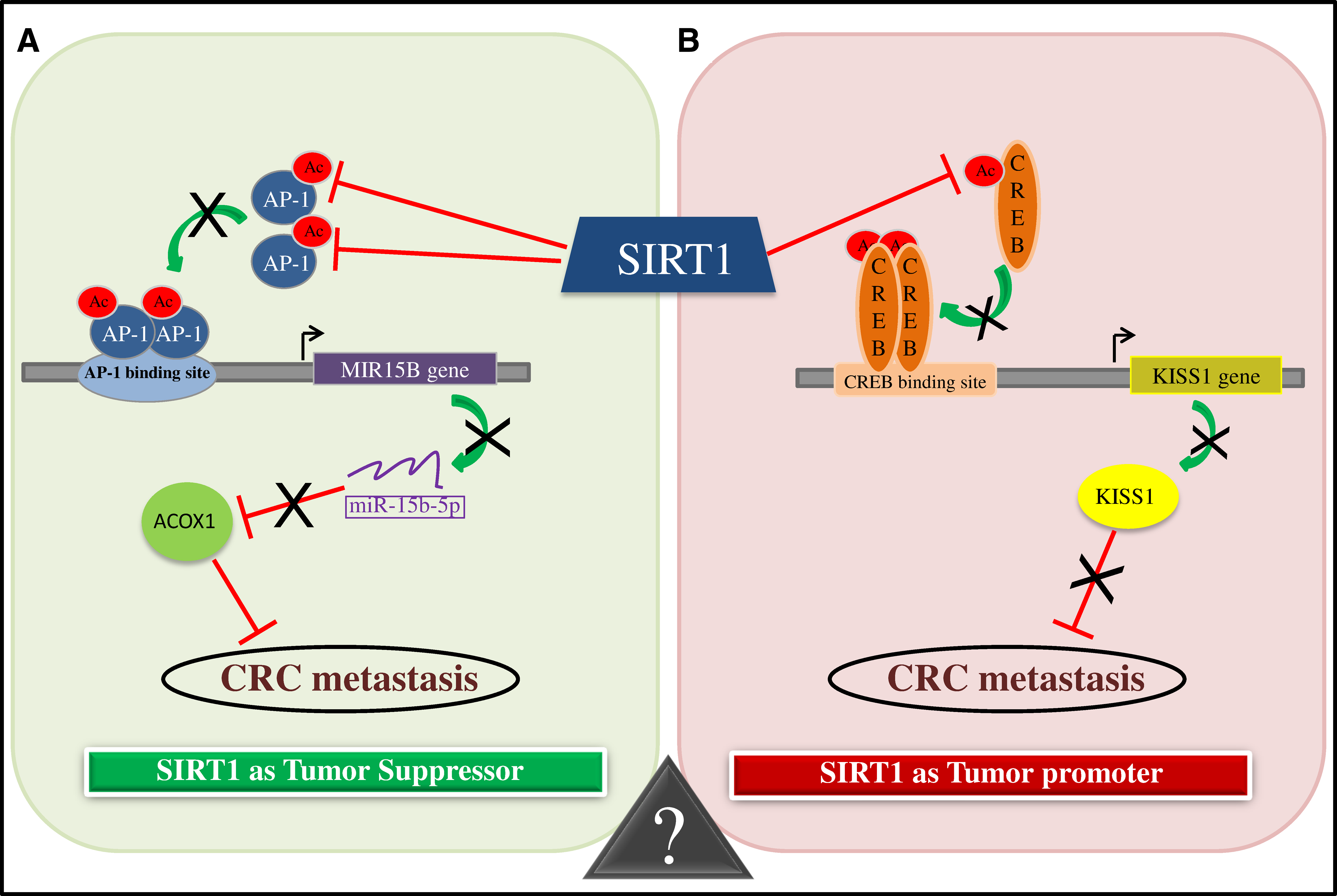
Contradictory functions of SIRT1 in human colorectal tumorigenesis process.
In contrast, many studies asserted an oncogenic role of SIRT1 in CRC. They have reported an abundance of SIRT1 expression in human CRC tissues, especially in advanced-stage tumors and tumors with lymph node (Lv et al., 2014). That overexpression was strongly correlated with metastasis and tumor invasion depth. It was also associated with poor prognosis, shorter OS, and disease-free survival of CRC patients. Chen et al. (2014) reported an overexpression of SIRT1 in cancer stem-like cells of CRC, cancer stem cells (CSCs) that have the ability of self-renewal and differentiation. The authors also highlighted an underlying association between SIRT1 and cancer stem-like cells. They found that SIRT1 inhibition in CRC cells led to an increased p53 expression. SIRT1 deficiency also led to a decrease in CD133+ percentage, a common stem cell marker that characterizes colorectal CSCs. Furthermore, SIRT1 inhibition led to decreased expression of several stemness-associated genes such as Oct4, Nanog, Cripto, Tert, and Lin28. Moreover, the authors observed a significant reduction in colorectal tumorigenicity by knocking down SIRT1 expression using SIRT1 small hairpin RNA in vivo. They postulated that SIRT1 plays a prosurvival role in CRC by keeping the stemness of cancer stem-like cells, as well maintaining the ability of colony and sphere formation in CRC cells (Chen et al., 2014).
Whereas Shen et al. (2016) were interested in the role of SIRT1 in distant metastasis, the authors revealed an SIRT1/CREB/KISS1 signaling pathway. They showed that SIRT1 knockdown decelerated the progress of CRC metastasis by functionally reducing the invasion and migration of CRC cells both in vivo and in vitro. SIRT1 knockdown also enhanced the chemosensitivity of CRC cells to 5-fluorouracil and oxaliplatin, two chemotherapeutic drugs used for clinical treatment of CRC. Furthermore, the authors demonstrated that SIRT1 upregulates the metastasis of CRC by downregulating KISS1 expression, a major tumor metastasis suppressor. KISS1 downregulation was realized through deacetylating and subsequently inactivating CREB transcriptional activity, a direct SIRT1 target that binds and triggers KISS1 transcription (Fig. 1B). Therefore, the authors concluded that SIRT1 actively contributes to the distant metastasis of CRC through SIRT1/CREB/KISS1 signaling pathway (Shen et al., 2016).
In conclusion, it appears that the controversy surrounding SIRT1 role in colorectal tumorigenesis has not been completely resolved. Consistent with recent findings, SIRT1 seems to have a bivalent role in the pathogenesis of breast cancer as well as CRC (Rifaï et al., 2017). Therefore, more in-depth studies are needed to be done to pin down the functional role of SIRT1 in the pathogenesis of CRC.
Footnotes
Acknowledgment
The authors thank the Hariri Foundation for a grant to Khaldoun Rifaï.
Author Disclosure Statement
The authors declare that no competing financial interests exist.