




Abstract
Health care does not always take place in a setting of peace, prosperity, and social order, a point that is often overlooked in quotidian medical practice. This has become most evident with the current COVID-19 pandemic by the new coronavirus that is wreaking havoc across the planet. Health care providers are facing unprecedented challenges to intervene on numerous nonlinear uncertainties in science and society as the pandemic evolves. In Afghanistan, health care delivery is already a major crosscutting challenge. Although efforts to rebuild the health care systems in Afghanistan have been made (Acerra et al.), both acute and chronic illnesses remain as major medical and critical governance gaps to be remedied. In addition, health care facilities and medical equipment are not adequate in the country. There is a need for medical and scientific expertise to clinically and sociologically contextualize and interpret diagnostic tests as well as drugs and vaccines that will be deployed in the coming months as part of the planetary collective response to the COVID-19 pandemic. In a time of pandemic and facing a novel infectious pathogen, health care workers are in need of planetary scale consultation and support. Even creating a small consultation network using mobile applications might offer improved health outcomes. The Internet of Things and digital health ought to be considered in concert with telemedicine as part of an effective pandemic response.
Perspective
Health care does not always take place in a setting of peace, prosperity, and social order, a point that is often overlooked in quotidian medical practice. This has become most evident with the current COVID-19 pandemic by the new coronavirus that is wreaking havoc across the planet. Health care providers are facing unprecedented challenges to intervene on numerous nonlinear uncertainties in science and society as the pandemic evolves.
The experience with the pandemic so far shows that the health care systems and science governance frameworks in which we live do not lend them to find cures that are robust and immediately actionable. Before we can discover real-life solutions to the pandemic, we need to check our entrenched long-standing assumptions in planetary health and society. In particular, we need a new understanding of health services and medical education, much broader than the present theories on health are able to inform, so as to take into account the social, political, and ecological determinants of COVID-19 pandemic response, and integrate them with scholarship in medicine.
A case in point is Afghanistan, a country located in central Asia with >34 million population, life expectancy of 61 and 64 years in men and women, respectively (World Health Organization, 2016) (Fig. 1). Since the 1970s, social conflict and civil war have led to unstable political governance, poor economy, and public health indicators. With the COVID-19, such intertwined predicaments are being amplified and put on steroids. These social and political determinants of planetary health now wait for immediate action that will otherwise be major roadblocks to an effective pandemic response in Afghanistan, not to mention in other resource-limited countries and those that are currently in a state of war and social conflict such as in Syria.
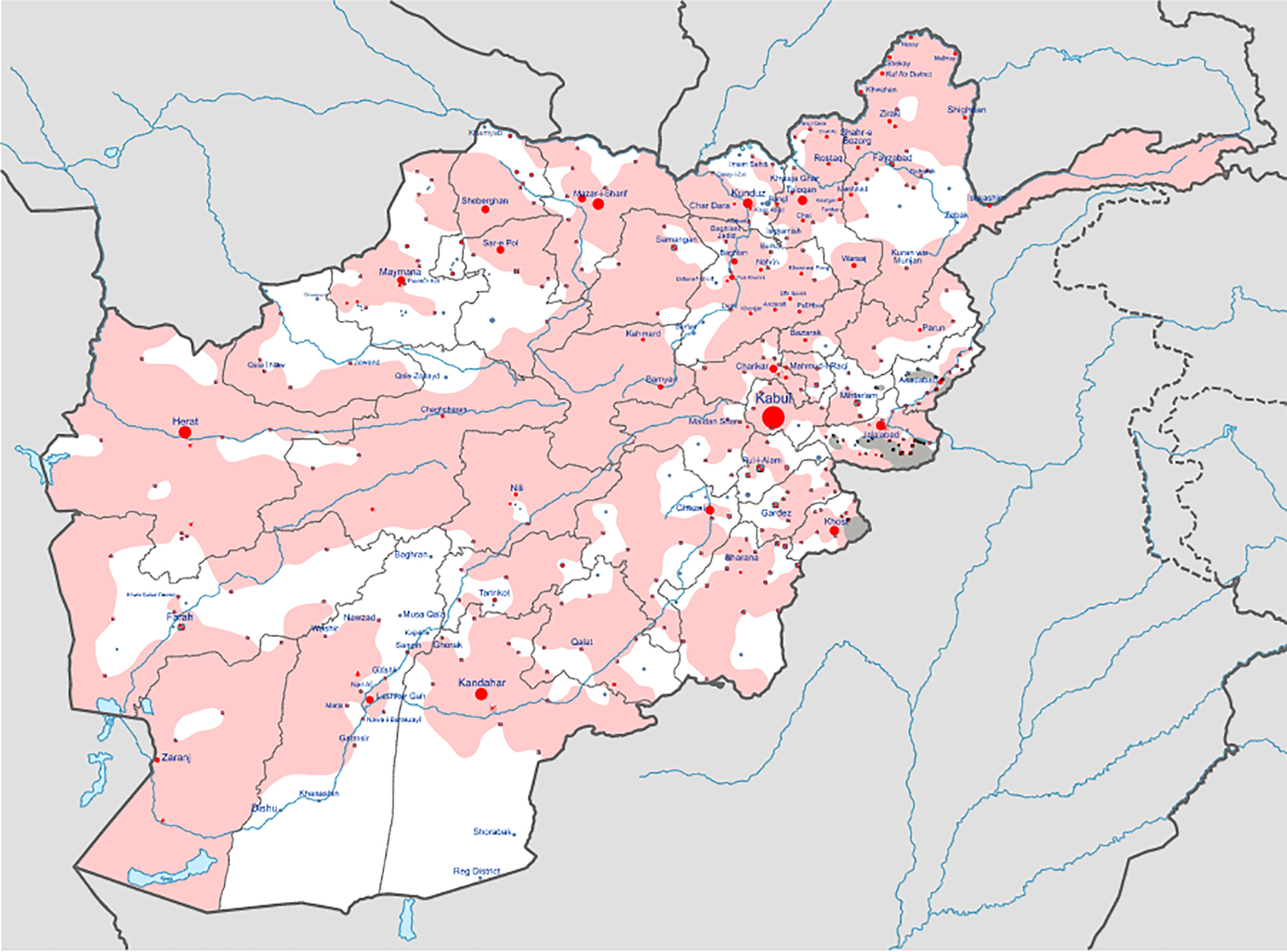
Afghanistan, the country geographical context.
In Afghanistan, health care delivery is already a major crosscutting challenge. Although efforts to rebuild the health care systems in Afghanistan have been made (Acerra et al., 2009), both acute and chronic illnesses remain as major medical and critical governance gaps to be remedied. In addition, health care facilities and medical equipment are not adequate in the country. There is a need for medical and scientific expertise to clinically and sociologically contextualize and interpret diagnostic tests as well as drugs and vaccines that will be deployed in the coming months as part of the planetary collective response to the COVID-19 pandemic.
We should not forget Afghanistan and geographies laden with social conflict or war in the collective pandemic response. No doubt, if we are to succeed in stemming the current pandemic, there is a need for concerted action in Afghanistan as well as the rest of the world. In a pandemic situation, no country is an island; what happens in one geography affects others, and vice versa.
Developing countries are in need of independent and critically informed science journalism, particularly for building public trust in pandemic governance. Afghanistan, for instance, has reportedly 270 confirmed COVID-19 cases as of April 4 (World Health Organization, 2020). In the absence of widespread COVID-19 testing, inadequate resources for independent journalism and given that many cases can be asymptomatic, the true scale of the pandemic is likely much larger than the confirmed cases. Also, it is uncertain how the country's intensive care unit (ICU) beds and ventilators will be able to meet the growing health care demands. Even if there were sufficient ventilators, appropriate use and deployment of interventions that employ ventilators are of concern because of the insufficient numbers of physicians and health care workers specialized in ICU care in the face of the pandemic.
Time is of essence. We propose that the expertise in telemedicine and emerging technologies in digital health offer veritable solutions to strengthen health care systems in developing countries.
Telemedicine has been debated extensively as one of the possible approaches for clinical service delivery to rural communities, home health care, or in the case of countries that lack adequate health and personnel infrastructure. Telemedicine is particularly relevant in times of COVID-19 (Calton et al., 2020; Reichert, 2019) and especially in Afghanistan and other countries as we practice social distancing as part of the pandemic response. Diagnostic medicine and radiology expertise are crucial, for example, to document the lung abnormalities on chest computed tomography after the initial onset of symptoms (Pan et al., 2020).
Telemedicine would allow access to radiology and diagnostic medicine consultations within Afghanistan as well as with other countries in times of a pandemic. Telemedicine could also prevent unnecessary visits to the emergency departments of hospitals.
The Internet of Things (IoT) has been recently discussed in the literature in a context of medical services and health research. However, we suggest that the IoT that builds on ubiquitous planetary scale digital connectivity, Big Data, and real-time data analysis tools such as artificial intelligence (AI) can be usefully deployed in a context of a pandemic response as well. Although certain technologies such as AI are not available worldwide, the IoT approach and digital connectivity could help analyze the emerging pandemic data in institutions and countries that have such advanced technologies while data continue to stream in worldwide, from both developed and developing countries, urban and rural geographies.
In a time of pandemic and facing a novel infectious pathogen, health care workers are in need of planetary scale consultation and support. Even creating a small consultation network using mobile applications might offer improved health outcomes. The IoT and digital health ought to be considered in concert with telemedicine as part of an effective pandemic response.
Finally, we cannot emphasize sufficiently that the world needs to address the pandemic in countries with civil war and social conflict, precisely because such geographies are also the places where the current COVID-19 might establish a strong hold due to social and political determinants of planetary health in times of both war and pandemics. The IoT and telemedicine could help delivery of not only clinical services but also curation of much needed data on pandemic spread inclusively and the testing of medicines and vaccines that are currently being developed around the world (Peeri et al., 2020).
We are in this pandemic together as planetary society. Afghanistan and the health care scholars in developing countries are poised to play an important leadership role. They can usefully engage with the IoT and telemedicine, provided they are also well informed on critical governance of technologies (Özdemir, 2019; Sarewitz, 2016; Sclove, 2020; Thunberg, 2019) in planetary health, and thus help achieve the much needed capacity and speed to strengthen health systems and respond to the pandemic on a planetary scale.
Footnotes
Disclaimer
The views expressed are the personal opinions of the authors only.
Author Disclosure Statement
The authors declare they have no conflicting financial interests.
Funding Information
No funding was received for this article.