




Abstract
Since the introduction of the first monoclonal antibody, biopharmaceuticals and biotherapeutic products manufactured in cellular factories are on the rise in modern medicine and therapeutics. Dynamic and real-time innovation strategies for operational implementation of biotherapeutic production are rapidly emerging. The advances in related fields such as genome editing technology, systems biology, and machine learning/artificial intelligence are expected to introduce innovative solutions in every aspect of the mammalian cell culture-based biotherapeutic production. This conceptual review offers a synthesis of the prospects and challenges of integration of multiomics technologies, and an integrative biology vision to cellular factories and biotherapeutic innovation.
Introduction
Since the introduction of the first monoclonal antibody, various types of protein biopharmaceuticals have been continuously introduced over time (Fekete et al., 2016; Nelson et al., 2010). Especially, antibody–drug conjugates (ADCs) have received much attention for improving the management of lethal diseases due to its ability to provide synergistic effects between specific monoclonal antibodies and conventional chemicals. Among others, nanobody (antibody fragments) and polyclonal antibody, are revolutionized formats of biotherapeutics (Beck et al., 2017).
The absorption, distribution, metabolism, and excretion (ADME) information is of paramount importance for biotherapeutics and drug development. However, the ADME information is usually imprecise due to complexity of the biotherapeutics and the lack of proper research tools, particularly in analytical characterization (Lee, 2013; Tibbitts et al., 2016). For example, post-translational modifications (PTMs) are frequently associated with protein production, secretion, efficacy, stability, solubility, viscosity, half-life, and immunogenicity. Therefore, PTMs are an essential component of the biological regulatory processes. In particular, glycosylation, one of the critical quality attributes (CQAs) of therapeutic monoclonal antibodies, are known to be primarily related to the therapeutic efficacy and potentially severe adverse events (Lill, 2017).
Thus, glycosylation is closely monitored in each phase of therapeutic development (Szigeti et al., 2018). Last but not least, the heterogeneity of the biotherapeutics is derived from two other commonly detected PTMs: the conversion of N-terminal glutamate or glutamine to pyroglutamate and the troublesome C-terminal lysine variants (Dick et al., 2008; Liu et al., 2011). Collectively, the advancement of the analytical platforms is needed for adequate characterization of biotherapeutic products.
Over the past years, the sensitivity and robustness of hyphenated mass spectrometry (MS) techniques are significantly improved to the level that compartment-specific and even single-cell proteomics and metabolomics are now practically achievable (Chappell et al., 2018).
Compared with others, liquid chromatography–MS (LC–MS) and its variety are currently the cutting-edge methods for proteomics and metabolomics. As a potential orthogonal method to LC–MS-based approaches, capillary electrophoresis-MS (CE–MS)-based and metabolomics have gained much interest (Kok et al., 2014; Zhang et al., 2017). CE–MS is a versatile platform that is suitable for many aspects of the production and quality control of biotherapeutics (Lechner et al., 2019; Le-Minh et al., 2019). Indeed, a comprehensive review highlights a variety of applications of CE-based methods, including CE–MS, in the characterization of monoclonal antibodies and related products (Gahoual et al., 2016).
In addition to the biotherapeutic characterization to guarantee the quality, efficacy, and safety of therapeutic products, optimizing the biosynthesizing platforms is a critical aspect. The optimization of culturing strategy, nutritious carbon source, and cell engineering, together with random mutagenesis, has been the typical approach to improve therapeutic protein production in the field of biotherapeutics (Lim et al., 2010; Richelle and Lewis, 2017). Nevertheless, available techniques are yet optimal since there are no well-defined and universal quantitative indicators and optimization strategies. Various omics technologies, such as genomics, transcriptomics, proteomics, and metabolomics, as well as genome editing technologies, have emerged and achieved adequate maturity in recent years. These technologies are transforming host cell engineering to facilitate the high production and quality of therapeutic biological products (Lewis et al., 2016).
Regarding the metabolomics, it is capable of monitoring most, if not all, core biochemical processes of a cell culture system. Thus, metabolomics is an essential tool to indicate the metabolic status of the cell in different phases of growth, suggest the molecular signature that is associated with a more productive phenotype, and provide biomarkers for detecting the variation of the mammalian cultured cell clones (Dickson, 2014). The developments and applications of CE–MS-based metabolomics in the period of 2000–2018 were extensively reviewed (Ramautar et al., 2009, 2015, 2017, 2019). The review series strongly demonstrated that CE–MS had established a dominant position in the integrative omics area.
In the current expert review, the emerging role of CE–MS in integrative protein biopharmaceutics and omics science are discussed. We also examine the key aspects of metabolic engineering, which essentially decide the success of the development and application of biotherapeutics with an emphasis on protein biopharmaceuticals. We do not aim at giving an exhaustive summarization toward the development of the field; instead, the role of integrative omics and data science in the bioprocess are emphasized. Finally, we provide new insights that aim to extend the potential of omics sciences in the improvement of protein biopharmaceutical production and quality control.
CE–MS for Production and Quality Control of Protein Biopharmaceutics
The bioequivalence and physicochemical characteristics from small-molecule drugs are not readily applied for biotherapeutics. Thus, the concept of “similar biological product” has been put as the center of regulation and standardized protocols (Knezevic and Griffiths, 2017; WHO, 2013). There are many properties of a biopharmaceutic product to be determined. Primary structure, C-terminal and N-terminal heterogeneity, oligosaccharide transformation, amino acid modification, fragmentation of hinge regions, and disulfide bond interactions, to name a few. All belong to the CQAs and strongly influence the safety, quality, and efficacy of biotherapeutics (Jiang et al., 2017). During the development of a new protein biotherapeutic species, mass characterization is essential to examine the sequence integrity and the consequent effects of the PTMs.
Furthermore, biosimilars are assessed and compared with the original drug to ensure they are remarkably similar and possess no clinically meaningful differences in terms of physicochemical quality, clinical efficacy, and safety (Beck et al., 2013; Sandra et al., 2014). To confirm the sequence integrity of the recombinant monoclonal antibody therapeutics, the intact mass analysis of reduced IgG, Ide S enzyme digested IgG subunits, or papain antibody fragments, is frequently utilized.
This kind of analysis has been primarily conducted using LC–MS, while CE–MS has recently appeared to be a comparable approach (Han et al., 2016; Shukla and Gupta, 2020). Capillary electrophoresis separation is armed with exceptional resolving power, high efficiency, and adaptable settings (Wang et al., 2013). It also requires a minimal injection volume with a limited amount of running buffer, and importantly an electrospray ionization (ESI)-MS comparable.
Notably, CE offers several advantages when coupled with an ESI-MS due to the low flow rate, which includes but not limited to reduced ion suppression, good separation, broad metabolite coverage, suitable for noncovalent complex characterization, and fewer artifacts (Lew et al., 2015; Naz et al., 2014). An interlaboratory investigation has confirmed that CE–MS is a robust platform for peptide mapping (Wenz et al., 2015). As CE–MS appears a profound capacity of characterizing PTMs, the employment of CE–MS for complex samples, including glycan—the highly variant structures after the PTMs, has been significantly increased in recent years (Lechner et al., 2019; Mariño et al., 2010; Voeten et al., 2018; Zhao et al., 2012).
Multiple glycoforms, as well as accompanied degradation products and oxidation and/or acetylation modifications of monoclonal antibody (Trastuzumab), recombinant human interferon-β, and recombinant human erythropoietin, have been successfully characterized using CE–MS (Haselberg et al., 2013, 2018). Sialylation, a glycosylation feature occurring at the nonreducing end of a glycan moiety, was successfully characterized by using CE–MS (Kammeijer et al., 2017).
The performance of the CE–MS platform has outperformed the LC–MS platform in the pharmacokinetic analysis and drug metabolism of biotherapeutic molecules in complex biological fluids (Xia, 2016). It is of importance to mention that CE–MS could be employed readily for determining the purity and stability of antibodies. This technique allows us to examine the existence of contaminants and CQAs such as the deamidated and sequence variants, clipped and truncated forms, just to name a few, of the antibody under investigation (François et al., 2016; Haselberg et al., 2018; Zhu et al., 2016). Finally, different conformational states, including native and unfolded monomers and dimers, and charged variants of the therapeutic monoclonal antibody, were seamlessly characterized using CE–MS (Fekete et al., 2016; Le-Minh et al., 2019).
Regarding the characterization of biotherapeutics, the roles of modified or hybrid techniques of CE–MS has also been emerging. For instance, the microfluidic CE–MS platform was reported to successfully characterize the variants of the intact ADCs at a higher speed (Redman et al., 2016). Significantly, gathering the protein stereostructure information and efficient charge in solution is possible with mobility CE–MS (Zhang et al., 2019a, 2019b). Importantly, a variety of preconcentration techniques to increase the sensitivity of CE-based analysis has been actively developed (Kim et al., 2019).
Ultimately, CE–MS-related methods hold considerable potential in improving the analysis of biotherapeutics. Together with the particular characteristics of the electrophoretic separation of CE, accelerating innovation in the coupling interface of CE and MS has significantly improved the sensitivity and robustness of the platform (Fig. 1). Nonetheless, the CE–MS approach is yet to be mature, and there are rooms for improvements to adequately address the need for the development and quality control of complex biotherapeutic molecules (Gahoual et al., 2019).
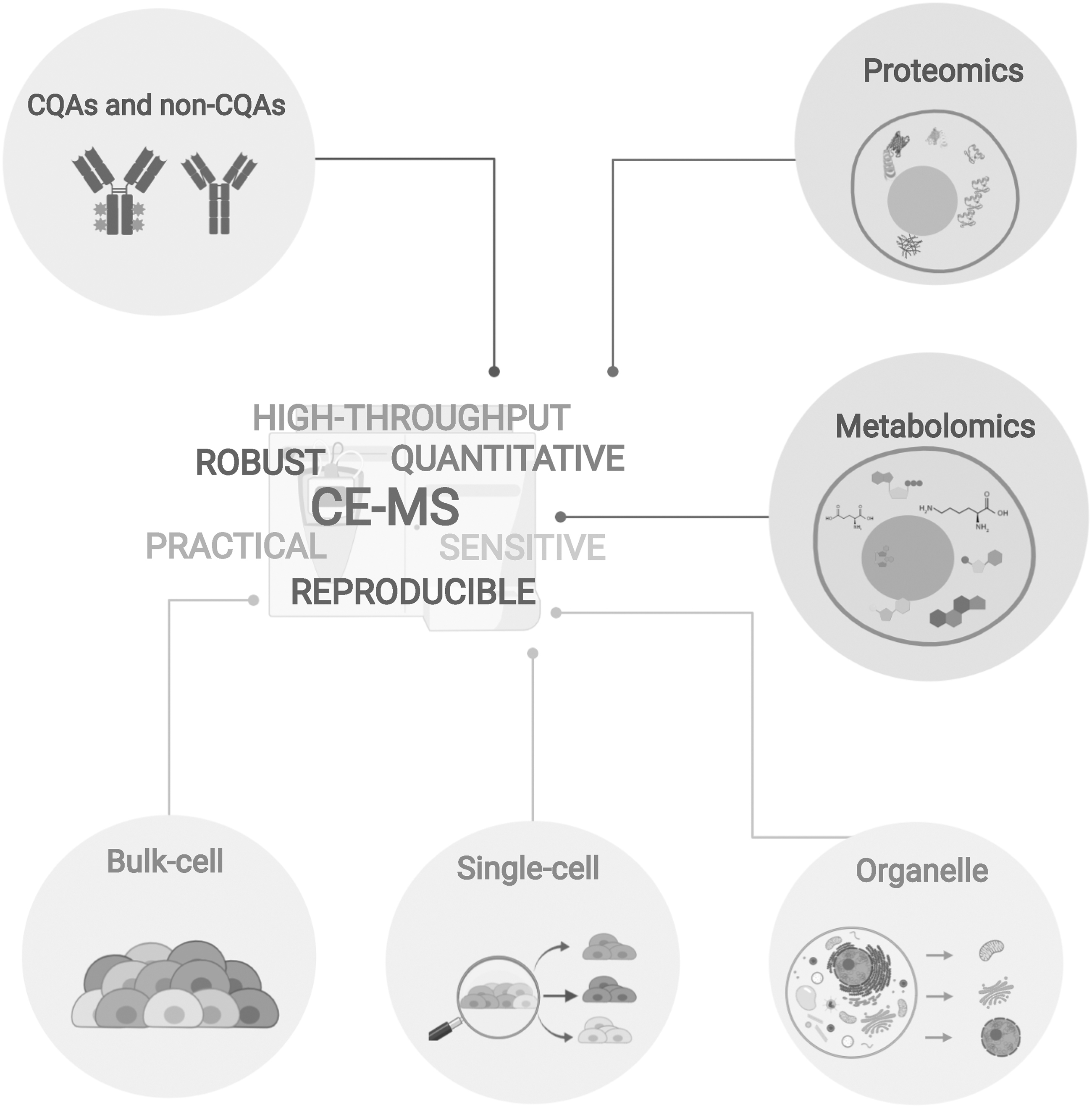
Capillary electrophoresis–mass spectrometry for the characterization of biotherapeutics and omics science.
Metabolomics for the Optimization of Mammalian Cell Bioprocess
The analysis of biomolecules that particularizes into small molecules (generally <1500 Da) belongs to a family of a research field called metabolomics (Miggiels et al., 2018; Monge et al., 2019; Ramautar et al., 2013). Under the umbrella term metabolomics, there are several subfields, such as lipidomics—selectively focus on the analysis of lipids, and steroidomics—selectively focus on the study of steroids (Long et al., 2020; Yang and Han, 2016).
Regardless of the platforms used, there are generally three main metabolomic approaches: untargeted metabolomics, semitargeted metabolomics, and targeted metabolomics. Untargeted metabolomics is particularly useful for unbiased and exhaustive exploratory research or hypothesis-generating studies. This approach gives the most extensive coverage and most comprehensive information of the biosamples under investigation. However, quantitative data are not readily achievable. On the contrary, targeted metabolomics provide more precise properties and quantitative measurements of the known list of metabolites. It is, however, biased by the hypothesis testing design that only a few metabolites will be characterized (Broadhurst et al., 2018; Srivastava et al., 2016).
A combination between the untargeted approach and targeted approach or metabolic flux analysis is of paramount importance to have a piece of comprehensive and in-depth knowledge about the biological system (Baker, 2011; Cabaton et al., 2018). Semitargeted metabolomics, also known as large-scale targeted metabolomics, may be the right approach when there is some prior knowledge of the research model of interest (Yuan et al., 2012). For example, semitargeted metabolomics could target several major biochemical pathways of mammalian cells. Due to accumulated understanding of biochemistry, we know beforehand the metabolites that exist, although a precise understanding of which metabolites are more critical remains to be unknown. Importantly, quantitative analysis is possible for semitargeted metabolomics, and thus, it is a very powerful and generally applied method in practice.
The summarization of the advantages and disadvantages of each metabolomics approach is shown in Figure 2. Importantly, various bioinformatics approaches are developed for the computational, visualization, and contextualization of metabolomics data (Barupal et al., 2018).

Advantages and disadvantages of different metabolomics approaches.
Metabolomics is a standalone platform that provides significantly useful information on the phenotypes of the engineered mammalian cells in the processing of biotherapeutics. The integration of metabolomics and other omics platforms, such as proteomics, transcriptomics, and the family of omics under genomics could extend our knowledge even more. It is of importance to mention that transcriptomics, coupled with genome engineering, has an excellent track record in cell culture processes for biopharmaceuticals (Vishwanathan et al., 2014). Valuable omics data are accessible and can be soon transformed into concrete starting points of the process optimization.
A prototype of this potential approach has been demonstrated in an in-depth characterization of the metabolic clone performance. The authors suggested an essential role of the regulation of amino acids, such as a high rate of glutamine synthesis or the low degradation rate of branched-chain amino acids, which is associated with the high-producer Chinese hamster ovary (CHO) cell clones (Popp et al., 2016).
CHO cells were first established in 1957 (Kumar et al., 2007). CHO cells are capable of generating human-like proteins with comparable PTMs. Importantly, the cells can be genetically manipulated into different clones, expressing the genes of interest, which will result in an increased level of related protein products (Fischer et al., 2015). Furthermore, the genome of CHO cells is available, which will facilitate the utilization of integrative omics technologies in improving the genotypes and phenotypes optimal for the production of recombinant therapeutic proteins (Hefzi et al., 2016; Kaas et al., 2015; Kimura and Omasa, 2018; Xu et al., 2011). Besides, a list of commonly reported metabolic indicators and their functions is introduced (Dickson, 2014).
Importantly, a list of biologically consistent annotation of metabolomics data on CHO cells' combined information from the database and in silico analysis is available (Alden et al., 2017). These make a reliable starting point for developing a targeted and quantitative analysis to improve the overall quality and productivity.
Capillary separation techniques are advantageous compared with liquid separation in several aspects, as discussed earlier. CE–MS was found capable of reliable profiling of the plasma metabolites in a large-scale study consisting of more than 8000 samples (Harada et al., 2018). Furthermore, CE–MS is the de facto method that is widely applied in untargeted metabolomics as well as proteomics (Ramautar et al., 2019; Voeten et al., 2018). Also, CE separation is favorable for highly polar endogenous metabolites, including charged sugars (Zamboni et al., 2015). CE is a miniaturized system that is suitable for the analysis of single-cell experiments (Neumann et al., 2019). The quantitative analysis targeting endogenous nucleotides at the single-cell level showed a good agreement with the bulk cell regarding the calculated energy balance of the cell (Liu et al., 2014).
This method may be applied for the characterization of energy balance for the host cells in bioprocessing. The long separation time of CE can be solved by a serial injection of several samples, which could reduce the total analytic time of each sample down to 2–3 min. This strategy was utilized to characterize amino acid profiles of biological matrices (Shanmuganathan and Britz-McKibbin, 2019). When employed adequately with a suitable batch-adjusted method, it can significantly improve the throughput of the analytical analysis.
The data generated from a metabolomics analysis are essentially high dimensional, which makes it naturally hard to be analyzed using conventional statistical tools. To this angle, a sophisticated analysis strategy using machine learning (ML) algorithms appears to be a more suitable solution. ML can capture small changes in the attributes and provide an accurate prediction, which allows a quick application.
Very recently, Liu et al. developed a software incorporating ML to CE–MS-generated data for feature selection and optimization for the extraction of trace-level signals and successfully applied to a single-cell metabolomics study on Xenopus laevis embryo (Liu et al., 2019). Although its application to the biopharmaceutical bioprocess is not readily ascertained, it may be employed to access the heterogeneity of the engineered CHO cell culture. In Figure 3, we present a diagram showing how ML models derived from different sources of data can be implemented during the bioprocess. On this basic theme, we will discuss how the integrative omics can be employed to improve the biotherapeutic production and quality control.
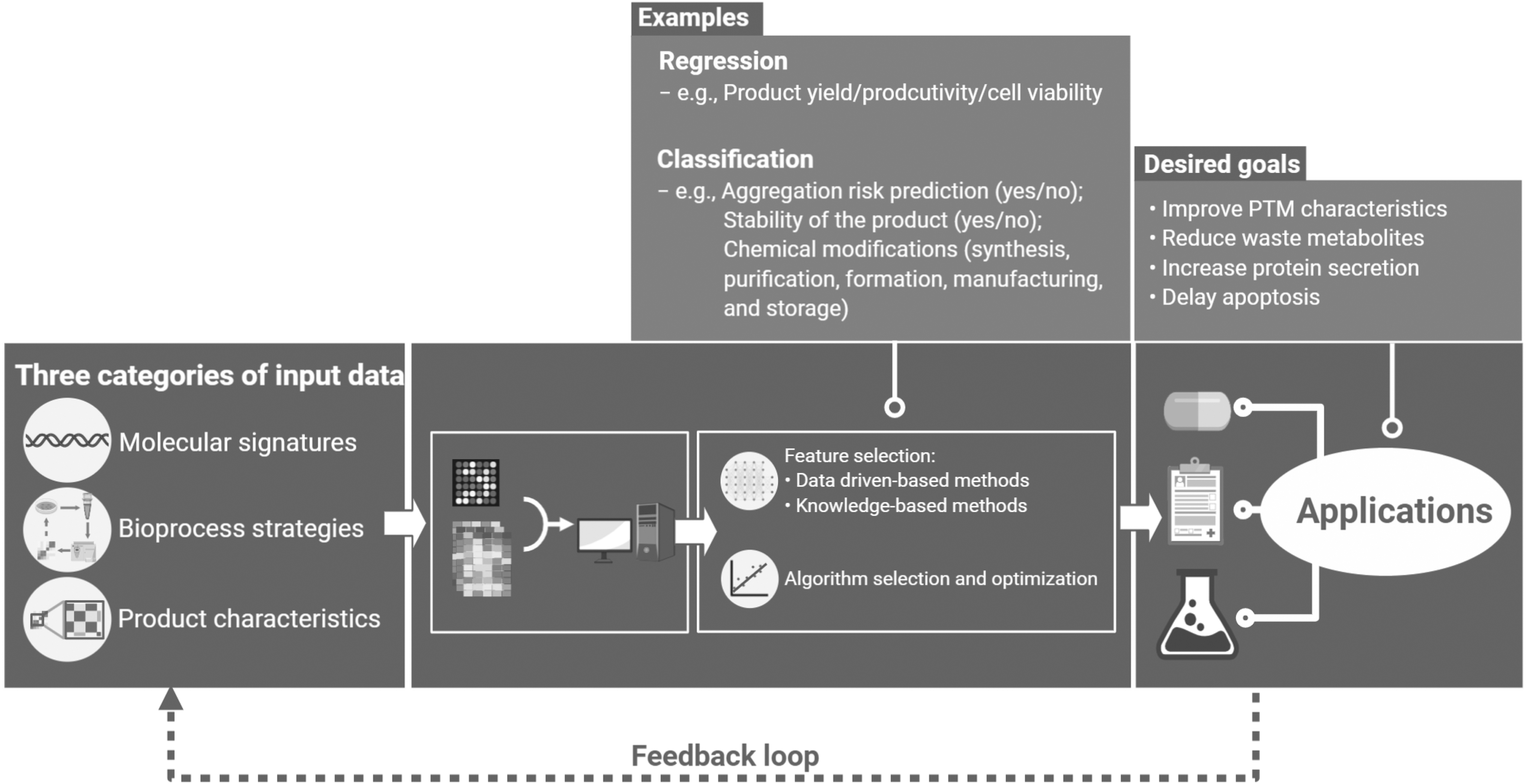
Machine learning for the optimization of cellular engineering and bioprocess.
Biotherapeutic Production and Quality Control
Mammalian culturing cell system is an essential platform for the production of biotherapeutic products (Walsh, 2014, 2018). Several types of cells have been utilized so far, and CHO cells have been the most frequently used host cells for the industrial production of biotherapeutic proteins (Kim et al., 2012; Ritacco et al., 2018). A considerable number of CHO lineages have been introduced (Wurm, 2013). Despite the sensitivity to environmental factors of the genome, CHO cell lines are capable of providing correctly folded and human-compatible PTMs of the therapeutic recombinant proteins with high and stable productivity. CHO genome could undergo unexpected alterations, for example, genome rearrangement, during culture.
Genome instability strongly influences the quality of biotherapeutic products. Besides, genome alterations properly result in a profound change in the downstream omics (Dahodwala and Lee, 2019). Thus, there is a need to develop a cost-efficient and delicate process to predict these kinds of event during the cell line engineering and development and to contribute to the quality control process of the bioproduction (Stolfa et al., 2018).
Metabolic profiles are made up of the natural metabolic systems of the cultured cells, and the actual growth media used (Galbraith et al., 2018). Metabolic regulators, besides cell cycle and apoptosis modulators, are generally the targets of host cell engineering (Wurm, 2013). Identifying the physiologically biochemical states by targeting metabolic hubs of the mammalian cell culture is one of the crucial aspects of the bioprocess (Ahn and Antoniewicz, 2011; Ben Yahia et al., 2017; Dean and Reddy, 2013). As an example, better insights into the nucleotide sugar metabolism that involve in the N-glycosylation of the CHO cells have helped the effective determination and predict protein glycosylation of the biotherapeutic proteins (Naik et al., 2018).
High-throughput metabolic profiles analyzed by a multivariate method revealed a clear difference regarding the metabolite characteristics of four growth stages of the CHO cells (Vodopivec et al., 2019). Nevertheless, more sophisticated approaches that can capture the time-dependent information on the host cells are of paramount importance. Hsu et al. recently introduced such a method. They successfully developed a high-throughput multiomics approach to obtain time-dependent intracellular and extracellular metabolic profiles of the CHO cultured cells (Hsu et al., 2017). This approach has a considerable number of applications. For example, it extends out capacity in assessing the effects of additional factors into the culture system at a high resolution.
Media formulation, although less critical compared with genetic engineering, is an essential aspect. Thus, analyzing the metabolic profiles of the cultured cells depending on the media for the biotherapeutic products is of high interest. Recent metabolomics coupled with a multivariate analysis approach reveals deep insights into this aspect by examining the cell health and the production of insulin-like growth factor-1 using different growth media with an awareness of the growth stages of the cells (Mohmad-Saberi et al., 2013). The authors once again demonstrated that the metabolic profiles of cultured cells are different and associated with the growth phase. Also, culturing media affect the production capacity of the cells. Some potential biomarkers to monitor and improve the bioprocessing were introduced (Mohmad-Saberi et al., 2013).
Another strategy to optimize the production of therapeutic proteins is to reduce the byproducts of cellular metabolism. For a stable and high-profile host cell culture for biotherapeutics, it is of importance to design a scalable and flexible strategy for growth media preparation and modification (Ritacco et al., 2018). Commonly generated byproducts of large-scale CHO cultivation include lactate and ammonia. These molecules cause negative effects on the metabolism of the cells as well as biochemical properties, such as pH and osmolality, of the culturing system. Altogether, they interactively introduce adverse effects on cell survival, cell growth, and the credibility of targeted biotherapeutic products of glycosylation (Galleguillos et al., 2017; Li et al., 2010).
Current strategies are mainly aimed at reducing the accumulation of byproducts by targeting regulators of the central metabolism, and very often, a particular phenotype of interest is monitored (Richelle and Lewis, 2017). Recent proteomics and integrative metabolomics analysis over the time course of the CHO bioprocess revealed that the deletion of cysteine of the feeding system increases the oxidative stress of the cultured cells that eventually cause various deleterious cellular responses. This work demonstrated that the multiomics approach allows an in-depth analysis of the cellular biochemical processes of the CHO cells during the bioproduction. It emphasized the importance of the redox balance and the health status of the cells (Ali et al., 2019b).
More profound insights into the nucleotide sugar metabolism that involves in the N-glycosylation of the CHO cells have helped the effective determination and predict protein glycosylation of the biotherapeutic proteins (Naik et al., 2018). Nonetheless, every metabolic enzyme belongs to the metabolic network of the cell; changing a metabolic node may trigger unexpected and unfavorable events of the metabolic cascade. This emphasizes the need to monitor the holistic effect of applied metabolic engineering strategies as well as to find the potential benefits of other biomedical pathways toward the improvement in the production of biotherapeutic proteins. In this regard, omics big data coupled with mathematical modeling and machine learning/artificial intelligence (ML/AI) may provide a probable solution.
Collectively, these demonstrate that more advancing and standardized maneuvers of multiomics and data science, as discussed below, are needed to capture the optimal biochemical states of the cell for the production and regulation of the biotherapeutic products. What is more, simplex or sophisticated strategies targeting the protein production-associated targets of CHO cells that provide significant improvement for the overall production remains to be explored.
Standardized Omics-Based System for Biotherapeutics
Accumulating evidence and lessons from pitfalls for decades in treating and engineering mammalian cells in bioprocessing stands as an invaluable resource for the optimization of the cell culture characteristics, such as protein synthesis capacity, metabolic network, cell culture density, and cell longevity (Buchsteiner et al., 2018; Kastelic et al., 2019; Lim et al., 2010). During the bioproduction, different omics platforms are most suitable for one step than the others.
For instance, genomics and epigenomics are generally used for cell line development rather than monitoring media development, process development, and manufacturing. However, proteomics and metabolomics, two omics platforms that are closer to the phenotypes of the cells, are arguably more useful for the media formulation and feed process development (Stolfa et al., 2018). Presumably, when a predefined panel of crucial metabolic performance indicators, a quantitative targeted metabolomics approach can be used for an immediate intervention of the production of biopharmaceuticals.
In addition, the genome of CHO cells has been mapped, which establishes a base for in-depth cellular engineering to maximize its potential on the production of biotherapeutic proteins. A consensus genome-scale reconstruction at the scale of 1766 genes and 6663 reactions for CHO cellular metabolism using multiomics data and experimental evidence was recently introduced (Hefzi et al., 2016). The authors emphasized that targeting cell engineering is a more efficient resource allocation than bioprocess.
Moreover, developing a multiomics-based strategy to monitor the dynamic changes in the cellular components and phenotypes of engineered cell lines is practical (Farrell et al., 2014). Multiomics profiles could help elucidating the genotypic and phenotypic differences among CHO cell lines, including regulatory and metabolic signatures (Yusufi et al., 2017). This allows the researchers to monitor and verify the characteristics of their desired mammalian cell lines globally. Also, the cost efficiency on the technical advancement and actual benefits, especially on process transfer and production, should be carefully considered (Kelley et al., 2018).
The preparation for the probable occurrence of the biological endurance, for example, mutations and metabolic shift, of the parental and engineered cell lines during the bioproduction is also of importance (Fischer et al., 2015; Golabgir et al., 2016). Besides, cost-efficient and near real-time approaches for the measurements of the essential predictive features to the outcome of interest, such as fingerprint and footprint metabolic profiles that are strongly associated with the cell viability and therapeutic protein production, are of paramount importance.
Semitargeted or untargeted metabolomics, coupled with a targeted quantitative analysis appears to be an excellent option in this matter. This approach is relatively easy and fast to conduct while still providing adequate quantitative information to the predictive features. For instance, the information on the important precursors for glycolysis and citric acid cycle or the byproducts that started to be exceedingly accumulated after several days of cell cultures will allow an on-time intervention (Dickson, 2014; Evie et al., 2017; Pereira et al., 2018). The advantages and disadvantages of using omics-based methods for studying biotherapeutics are summarized in Table 1.
Advantages and Limitations of Conventional Versus Integrative Omics Systems for Studying Biotherapeutics
The combination of high-throughput multiomics and standard biological techniques (e.g., western blots and polymerase chain reaction) can provide a more robust prediction on the protein production of the cell culture-based method. It is due to the fact that omics data are prone to giving false-positive results, which may need to be validated in a more robust way when the related biochemical processes are determined (Robasky et al., 2013; Schrimpe-Rutledge et al., 2016; Storey and Tibshirani, 2003). This idea was demonstrated through a very sophisticated multiomics and time-course analysis that revealed the metabolic adaptation during the production of erythropoietin using CHO cells (Ley et al., 2015).
Besides, a large-scale and dynamic workflow that provides quantitative information on anabolism and catabolism of the cells will also give great insights for improving the credibility of biopharmaceuticals. As an example, Templeton et al. utilized 13C metabolic flux analysis and found that enhanced catabolic rate of the branched-chain amino acids is associated with the increased cell death and more importantly, a negligible net growth rate of the cell is not necessarily associated with a negligible gross growth rate (Templeton et al., 2017).
Ultimately, where each aspect of the bioproduction has achieved considerable success, there comes a demand for a model predictive control of the culture system for bioprocessing. Indeed, adaptive, dynamic, and online process models appear to be essential for quality control of the mammalian cell culture bioprocesses (Justice et al., 2011; Pais et al., 2014; Sommeregger et al., 2017). Fortunately, MS-based high-throughput analytical workflows can be automated. For instance, the information on the precursors for glycolysis and citric acid cycle or the byproducts that started to be exceedingly accumulated after several days of cell cultures will allow an on-time intervention (Dickson, 2014; Evie et al., 2017; Pereira et al., 2018).
Similarly, dynamic and real-time monitoring strategies, for example, real-time release testing, of biopharmaceutical operational implementation can be improved (Jiang et al., 2017). A quantitative multiattribute method was developed for monitoring an extensive array of product quality attributes of the biotherapeutic molecules. It is, hopefully, capable of replacing conventional applied methods shortly (Rogers et al., 2015). It is worth mentioning that a framework for real-time monitoring of glycosylation, a significant indicator of the CQAs, which characterized the entire time course of a fed-batch culture was introduced (Tharmalingam et al., 2015). A semiautomated approach is relatively easy and fast to conduct while still providing adequate quantitative information to the predictive features. Figure 4 is a simplified illustration of cell engineering and bioprocess and the possible role of omics methods.
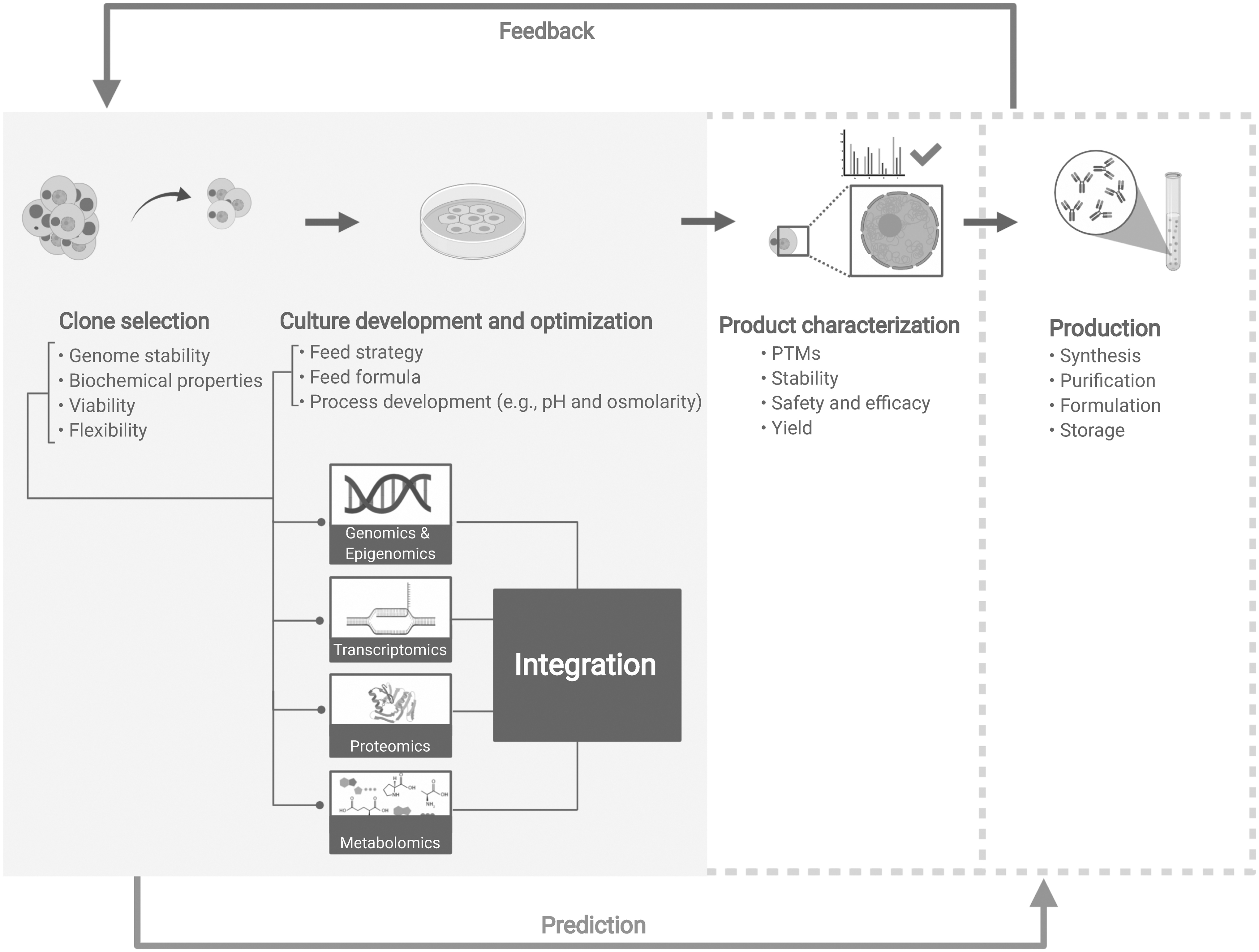
Potentials and emerging roles of integrative omics in biotherapeutics.
Future Perspectives
The employment of individual omics undoubtedly provides comprehensive information to the host cells that can be used to modulate the bioproduction of therapeutic proteins (Lalonde and Durocher, 2017). Even though omics data are inherently sophisticated and detailed, each omics platform still gives fragmented evidence about the bioprocess. As different layers of omics data and systems biology strategies for their integration are readily available, the multiomics integration is expected, and it will give deep insights into the CHO cells (Farrell et al., 2014; Stolfa et al., 2018). In recent years, accumulating omics data for CHO cell lines have opened new opportunities for a more comprehensive understanding of the metabolic network and allow accurate interventions to be practical.
During the research and development phase, the multiomics analysis may also be integrated with in silico mathematical modeling to fully accelerate the engineering, biological mechanism, and metabolic network of the host cell in a targeted manner (Sertbas and Ulgen, 2018; Yaşar Yildiz et al., 2019; Yusufi et al., 2017). Nevertheless, for real-time systemic measurement in-process validation and in-process control, especially in the commercial phase, where it is somewhat resource and time restricted, metabolomics should be considered to be a preferred approach. Besides, it has been known that viral and microbial contamination can alter the metabolism of the host cells (Eisenreich et al., 2019; Prusinkiewicz and Mymryk, 2019). We speculate that metabolomics can also be used to examine these unwanted events during the biopharmaceutical manufacture.
Along with the comprehensiveness of the analytical platforms, the depth of the analysis should also be considered to get high-performance cell lines and bioprocesses. Bulk-cell studies inherently provide the “average” information that came from the method of sampling. It contains several inherent shortcomings.
First, data from the heterogeneity of culturing systems within or between batches is hardly obtained. To this aim, single-cell metabolomics can become a proper method, especially when the CE–MS platform is now mature enough for capturing the metabolic profile at the single-cell level (Neumann et al., 2019). Single-cell metabolomics provides an accurate estimation of the phenotype that can answer the question of “what is going on in the culture batch,” particularly the cell-to-cell variations (Ali et al., 2019a). Single-cell metabolomics can also be used for a more sophisticated investigation of pharmacokinetics and pharmacodynamics of developed drug molecules (Ali et al., 2019a; Vinegoni et al., 2015). Eventually, it gives us a window of the decision to maximize the safety, quality, efficacy, and quantity of the biotherapeutic proteins.
Second, bulk cell analyses do not provide adequate resolutions on the metabolic pathways, which happens in the cytoplasm as well as various organelles. For instance, the tricarboxylic acid (TCA) cycle and electron transport chain occur primarily inside the mitochondrion. The subcellular metabolomics will also allow the examination regarding the variations and interactions among organelles, in which any disruptions of the balance in the metabolic network will be accurately detected.
Third, metabolomics is still suffering from relatively low coverage, high variability, inaccurate quantification, and troublesome quality control that can hamper the potential of metabolomics. Metabolomics is conceivably the most difficult omics profile to be measured among genomics, transcriptomics, proteomics, and metabolomics (Zenobi, 2013). The standardization of the utilized methodologies and the reporting strategies in metabolomics has yet been established (Kilk, 2019). Above all else, the collaboration of scientists from various backgrounds is needed to not only standardize the analytical and computational analyses for specific needs but also to accelerate the development of innovative technologies to expand further frontiers of the field.
Finally, the mathematical modeling of the metabolic fluxes specialized for CHO cells remains to be further manufactured (Galleguillos et al., 2017; Huang et al., 2017).
Computational approaches for the characterization, design, and optimization of therapeutic antibodies have achieved considerable success (Kroll et al., 2017; Sifniotis et al., 2019). ML/AI technologies have proven records on revolutionizing various fields of science, including biotechnology and biomedicine. Because of the availability of data regarding the molecular profiles of the host cell for biotherapeutic molecules, it is expected that ML models will be soon constructed to accelerate the molecular engineering of new cell lines, design efficient media, optimize feeding strategies, and eventually improve the process optimization for the production of biopharmaceuticals (Huang et al., 2017).
As an example, several ML algorithms were applied for the aggregation risk prediction of antibodies (Obrezanova et al., 2015). This study introduced a prototype of how ML can be used complementary with current strategies for the developability assessment. Also, when adequate data can be available in developing an ML-based prediction model on the stability, efficacy, and safety of a therapeutic product, it may help improve future planning of drug discovery by, for example, suggesting suitable characteristics that a biotherapeutics should have.
However, ML/AI is essentially black box, which introduces uncertainty to some degree and may hamper the action. The transition from mechanistic-driven to a data-driven and systems biology approach will take a considerable amount of time and require a community-driven repository for collecting enough data and detecting all potential problems (Kuo et al., 2018). Finally, an innovative platform for the curation and mapping of public discussion will help improve prospective research directions (Tournay et al., 2019).
Concluding Remarks
Dynamic and real-time innovation strategies for operational implementation of biotherapeutic production are rapidly emerging. The advances in related fields such as genome editing technology, systems biology, and ML/AI are expected to introduce innovative solutions in every aspect of the mammalian cell culture-based biotherapeutic production. This expert review offers a synthesis of the prospects and challenges of integration of multiomics technologies, and an integrative biology vision to cellular factories and biotherapeutic innovation.
The employment of different individual or combined instrumental platforms provides excellent resolutions into various aspects of the production of biotherapeutics. In this reign, CE–MS has proven to be a versatile platform that can afford the high demand from the in-depth characterization of the biopharmaceutic products as well as the information-rich proteomics and metabolomics. Accumulating and standardized knowledge about the host cells and its biological properties will shorten the search for optimizing the high-quality clones, culturing media, feed strategy, biotherapeutic characterization, and quality control. Finally, the development with the fast pace of other associated fields, including, but not limited to, the genome editing technology, systems biology, and ML/AI, assures that crucial breakthrough innovations of biotherapeutic production and quality control will soon be accomplished.
Footnotes
Acknowledgment
Figures in this article were created using Biorender.
Author Disclosure Statement
The authors declare they have no conflicting financial interests.
Funding Information
The authors received no specific funding for this article.