




Abstract
With coronavirus disease 19 (COVID-19), we have witnessed a shift from public health to planetary health and a growing recognition of the importance of systems science in developing effective solutions against pandemics in the 21st century. COVID-19 and the history of frequent infectious outbreaks in the last two decades suggest that COVID-19 is likely a dry run for future ecological crises. Now is the right time to plan ahead and deploy the armamentarium of systems science scholarship for planetary health. The science of epigenomics, which investigates both genetic and nongenetic traits regarding heritable phenotypic alterations, and new approaches to understanding genome regulation in humans and pathogens offer veritable prospects to boost the global scientific capacities to innovate therapeutics and diagnostics against novel and existing infectious agents. Several reversible epigenetic alterations, such as chromatin remodeling and histone methylation, control and influence gene expression. COVID-19 lethality is linked, in part, to the cytokine storm, age, and status of the immune system in a given person. Additionally, due to reduced human mobility and daily activities, effects of the pandemic on the environment have been both positive and negative. For example, reduction in environmental pollution and lesser extraction from nature have potential positive corollaries on water and air quality. Negative effects include pollution as plastics and other materials were disposed in unconventional places and spaces in the course of the pandemic. I discuss the opportunities and challenges associated with the science of epigenomics, specifically with an eye to inform and prevent future ecological crises and pandemics that are looming on the horizon in the 21st century. In particular, this article underscores that epigenetics of both viruses and the host may influence virus infectivity and severity of attendant disease.
Introduction
The World Health Organization identified the severe acute respiratory syndrome coronavirus 2 (SARS-CoV-2) coronavirus disease 19 (COVID-19) in December 2019, with a pandemic declared in March 2021. The origins and root causes of the pandemic are being actively researched by the public health community worldwide (Andrew et al., 1982; Whitworth, 2020). As of February 23, 2021, the worldwide COVID-19 statistics put the number of cases as above 111 million with above 2 million deaths (Dong et al., 2020). SARS-CoV-2 derived its name from having a genome similar to SARS-CoV when sequenced (Qing and Gallagher, 2020; Zhu et al., 2020).
Several pieces of evidence link the SARS-CoV being transmitted from animals such as bats or pangolins to humans, with investigations still continuing at the time of writing this article (Benvenuto et al., 2020; Lu et al., 2020; Lvov and Alkhovsky, 2020). Although there have been two previous epidemics associated with SARS-CoV, COVID-19 is associated with more severe cases and symptoms, including shortness of breath, fever, severe pneumonia, acute respiratory distress syndrome, and organ failure (Guan et al., 2020; Li et al., 2020). The severity of the disease appears to be linked to age and comorbidities such as hypertension, diabetes, and obesity (Apea et al., 2021; Guan et al., 2020; Li et al., 2020; Suleyman et al., 2020).
Importantly, several reports indicate that individuals above 60 years of age are disproportionately affected by COVID-19 (Lithander et al., 2020; Salimi and Hamlyn, 2020). Reports indicate that aging is associated with slow metabolism, slow immune response to infections, and changes in cell and tissue architecture, leading to alterations in the functions of many biological systems (Bajaj et al., 2020; López-Otín et al., 2013; Weyand and Goronzy, 2016). As has been noted with cancer-causing mutations, age-linked genomic instability results in many chromosomal and epigenetic aberrations and mutations, leading to malfunctioning cellular systems impacting the immune system (Berdasco and Esteller, 2012; Fraga and Esteller, 2007; Gonzalo, 2010; Issa, 2003). Reports indicate ineffective viral clearance in an aged immune system, leading to disease fatalities (Bordallo et al., 2020; Mueller et al., 2020).
In young people, the youthful immune system responds to the viral infection in a much controlled manner compared with the aged immune system in the elderly (Covino et al., 2021; Mueller et al., 2020). A slow and ineffective immune response has great consequences in the case of a viral infection (Bansal et al., 2012; Oh et al., 2019; Tregoning and Schwarze, 2010). Reports indicate that consideration of the age factor during treatment of COVID-19 patients is reducing mortality in many countries (Cascella et al., 2020; Colaneri et al., 2020; Liu et al., 2020b; Vijayvargiya et al., 2020; Zhou et al., 2020a).
Coronaviruses: Cell Entry and Infection
Coronaviruses are small viruses of about 60–130 nm in diameter and belong to the Coronaviridae family within the Nidovirales order (McIntosh and Peiris, 2009; Saif et al., 2019). They are made of a single RNA strand with four subgroups, namely alpha (α), beta (β), gamma (γ), and delta (δ) (Hamid et al., 2020; Madabhavi et al., 2020; Shereen et al., 2020). SARS-CoV-2, the virus that causes COVID-19, belongs to the β subgroup and has a genome of ∼30 kb length consisting of 10 open reading frames (Chen et al., 2020b; Kandeel et al., 2020).
Structurally, coronaviruses are made up of a membrane, envelope, nucleocapsid, and spike protein (Kandeel et al., 2020). To attach to host cells, the virus uses the spike protein and fuses with the cell membrane (Hulswit et al., 2016). Once the virus enters the respiratory system, it can attach to cells through the spike protein and then fuses with the cell membrane, allowing infection to occur (Fig. 1) (Qing and Gallagher, 2020; Tortorici and Veesler, 2019; Walls et al., 2017).
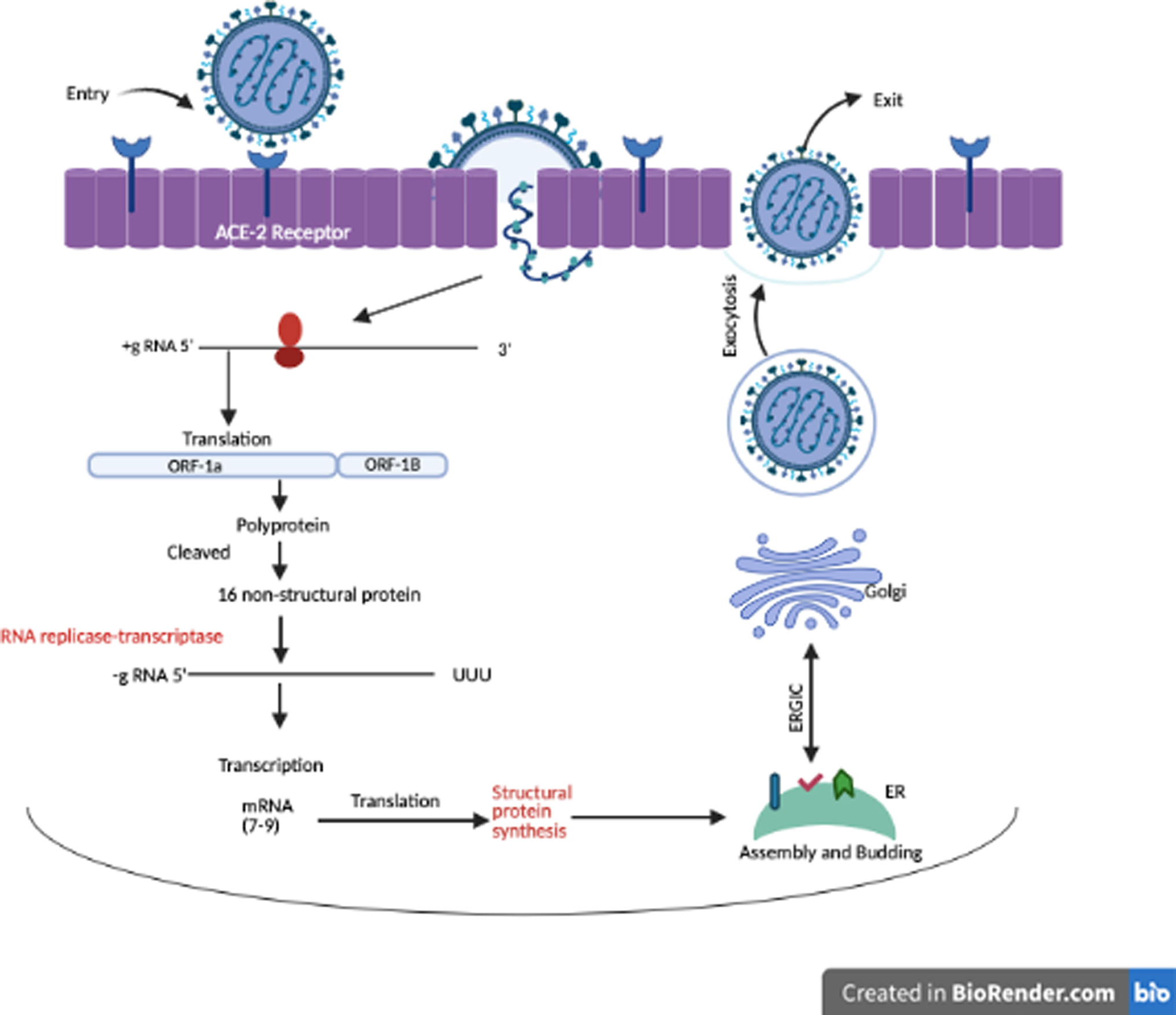
The binding and entry of the SARS-CoV-2 virus into host cells. The spike protein binds to the receptor referred to as ACE2, allowing the viral RNA to enter the cell. After translation of viral proteins, assembly occurs in the endoplasmic reticulum–Golgi intermediate compartment. Through exocytosis, virions are then released. ACE2, angiotensin-converting enzyme 2; SARS-CoV-2, severe acute respiratory syndrome coronavirus 2.
The spike protein binds to the angiotensin-converting enzyme 2 (ACE2) receptor, which is highly expressed in several cells, including lung, immune, testis, and endothelial cells (Letko et al., 2020; Wang et al., 2020b). Several host factors, including furin and other proteases, are involved in the entry of coronavirus into the cell (Hoffmann et al., 2020; Letko et al., 2020; Walls et al., 2020). Once inside the host cell, the coronavirus genome multiplies, and the host's ribosomes are involved in protein synthesis, with the virion assembled in the host's endoplasmic reticulum–Golgi intermediate complex (Hoffmann et al., 2020; Walls et al., 2020). The final virus is packaged into vesicles for cellular secretion (Li et al., 2005). Several reports indicate that SARS-CoV-2 can interact with receptors besides ACE2 and this requires further investigation (Strollo and Pozzilli, 2020; Vankadari and Wilce, 2020).
Epigenetics
The field of epigenetics covers investigations into heritable phenotypes that are stable and caused by conformational changes of the chromatin as well as activation states that do not result in changes in primary DNA nucleotide sequences (Berger et al., 2009; Dzobo, 2019). The study of genome epigenetics, also referred to as epigenomics, allows scientists to study and interpret the functions of epigenetic patterns and consequences of epigenetic alterations of the genome (D'Urso and Brickner, 2014; Falahi et al., 2015; Furukawa and Kikuchi, 2016; Jones et al., 2015; Pal and Tyler, 2016).
Recent data indicate that epigenetics plays a huge part in the initiation and progression of many diseases, including cancer and infectious diseases (Dzobo, 2019; Falahi et al., 2015; Fraga and Esteller, 2007; Furukawa and Kikuchi, 2016; Gonzalo, 2010; Jin and Liu, 2018). In addition, epigenetic marks made during early developmental stages influence gene expression as well as susceptibility to certain pathological conditions later in life (Gibney and Nolan, 2010; Nafee et al., 2008; Schäfer and Baric, 2017).
Unlike mutations, epigenetic alterations only affect chromatin conformation without changing the DNA, allowing epigenetic changes to be reversed and fast-acting in response to insults and microenvironmental changes (Goldberg et al., 2007; Jenuwein and Allis, 2001; Kouzarides, 2007). New data demonstrate real associations between epigenetics and cellular processes, including metabolism (Dimmeler et al., 2015; Keating and El-Osta, 2015; Keating et al., 2016; Miao et al., 2014). Methylation of DNA as well as modifications of histones results in chromatin changes that act in tandem with noncoding RNA, allowing proteins that regulate transcription to have access to the chromatin (Jaenisch and Bird, 2003; Wu and Zhang, 2014). By influencing transcription, epigenetic alterations impact protein synthesis (Ilango et al., 2020; Nöthling et al., 2020; Zhao et al., 2010). At any given time, activation states of chromatin influence a cell epigenome (The ENCODE Project Consortium, 2012).
Several enzymes are involved in epigenetic regulation and these include histone deacetylases (HDACs), histone methyltransferases, histone kinases, and histone acetyltransferases (Lin and Dent, 2006; Marmorstein and Trievel, 2009; Seto and Yoshida, 2014). Histone-modifying enzymes establish patterns that cause various proteins linked to the chromatin to have different affinities for each other and therefore contrasting and synergistic interactions (Biel et al., 2005; Eberharter and Becker, 2002; Keppler and Archer, 2008). These interactions determine whether the chromatin is in an active or silent state (Bannister and Kouzarides, 2011; Kouzarides, 2007; Strahl and Allis, 2000). Noncoding RNAs, lacking protein coding ability, have the ability to silence and activate gene expression through mimicking binding sites of transcription factors (Beermann et al., 2016; Boon et al., 2016; De Majo and Calore, 2018).
Viral Infection and Epigenetic Alterations
Identifying epigenetic alterations that cause and present in pathophysiological conditions allows scientists to develop new treatment strategies for different diseases. This can be achieved through combination therapies or by simply strengthening the immune system to fight off bacterial and viral infections (Bennett et al., 2020; Smale et al., 2014). Reports indicate that some viruses may not be able to integrate into the host DNA, but rather use the host's cellular machinery, including epigenetic mechanisms, to multiply and spread (Kennedy et al., 2015; Lieberman, 2016; Singh and Tscharke, 2020). The H3N2 influenza virus was shown to suppress the activation of the host's innate immune system by influencing epigenetic regulation of gene expression (Marazzi and Garcia-Sastre, 2015).
Other viruses such as hepatitis C virus as well as adenoviruses interfere with the host's epigenetic machinery and influence immune function (Ferrari et al., 2014; Seo et al., 2015). An association has been noted between influenza A virus and Middle East respiratory syndrome coronavirus (MERS-CoV) virus infection-mediated repressive histone modification with reduced expression of genes stimulated by interferon (IFN) despite activation by several transcription factors (Menachery et al., 2014). DNA methylation also results in reduced levels of antigen presentation molecules following MERS-CoV infection (Menachery et al., 2018). Through the use of latest sequencing techniques, it is possible to investigate the epigenetics of the whole genome. Reports indicate that viruses counteract the immune system through various epigenetic mechanisms.
Viruses such as SARS-CoV have the ability to switch off recognition by the immune system through encoding unique proteins (Liang et al., 2009; Schäfer and Baric, 2017). IFNs, necessary for antivirus response, have been shown to be regulated by epigenetic marks and the development of host response memory is linked to the epigenetic machinery (Fang et al., 2012; García-Sastre and Biron, 2006). Several reports have shown epigenetic regulation of innate immune response induction (Kaikkonen et al., 2011). In addition, increased H3K27me3 levels at promoter regions of IFN-stimulated genes have been associated with MERS-CoV infection, implying that viruses can target the innate immune response triggered by IFN (Menachery et al., 2014).
RNA modifications have also been linked to viruses such as SARS-CoV. Modifications of N6-methyladenosine play critical roles during viral replication (Kennedy et al., 2016; Lichinchi et al., 2016). In addition, methylation of RNAs of viruses may be directed at specific sequences only (Aevermann et al., 2014; Kaikkonen et al., 2011). Overall, viral infection, including SARS-CoV-2 infection, alters the epigenetic make-up of the host and, in turn, these epigenetic changes either promote or suppress viral replication and spread.
SARS-CoV-2 Infection and Epigenetics
New technologies have allowed the field of epigenetics to change within a short period of time, with novel data revealing how epigenetic marks play a huge role in memory and behavior and during development. It is obvious today that epigenetics is important in many facets of human life as well as in diseases (Obata et al., 2015; Portela and Esteller, 2010). In most cases, new data revealed that viruses can develop properties and functions that interfere with the host's epigenome and the genome to create an environment conducive for virus survival (Busslinger and Tarakhovsky, 2014; Vavougios, 2020).
In addition, recent reports indicate that mutations and chromatin changes during the process of aging alter the immune landscape in an individual, impacting the ability to respond to viral infections (López-Otín et al., 2013; Mueller et al., 2020). Already viruses related to SARS-CoV-2 have been shown to cause epigenetic changes by interfering with the host's activation of IFN response genes as well as influencing the host's antigen presentation (Islam et al., 2021; Liang et al., 2009). Studies on the methylation states of immune cells during and after infection are shedding new light on how virus infection impacts the host epigenetic landscape, and vice versa (Chen et al., 2020a; Domovitz and Gal-Tanamy, 2021).
The reason why SARS-CoV-2 infection can be severe in adults has to do with many factors, including the aged epigenome. Recent success in the development of vaccines against SARS-CoV-2 has raised hopes that the effects of the pandemic on day-to-day lives of people can soon be minimized. Most vaccines developed so far appear to work on various strains available and thus are able to elicit broadly neutralizing antibodies in vaccinated individuals (Brouwer et al., 2020; Erasmus et al., 2020; Rogers et al., 2020). The vaccines may also elicit T cell responses (Erasmus et al., 2020; Grifoni et al., 2020). Beside vaccines, several drugs are under investigation for their effectiveness against SARS-CoV-2 (Table 1).
Antiviral Drugs Under Investigation for Their Effectiveness Against Severe Acute Respiratory Syndrome Coronavirus 2
Combination therapy with antiviral drugs and epigenetic-targeted drugs is gaining ground in the search for successful treatment of SARS-CoV-2. These strategies may inhibit viral entry and replication as well as boost the host's immune response (El Baba and Herbein, 2020; Sang et al., 2021). Currently, several drugs targeting the epigenome have been shown to be useful in reducing the severity of COVID-19 and some have been approved by the Food and Drug Administration (FDA) (Atlante et al., 2020; Dandara et al., 2020; Dzobo et al., 2021; Zhou et al., 2020b). Therapies that specifically target the SARS-CoV-2 virus can do so through inhibiting viral replication and virus–receptor binding. Several enzymes necessary for viral replication, including proteases, can be inhibited by drugs such as galidesivir and darunavir.
Other broad-acting drugs can also suppress virus infection. Valproic acid has been shown to have antiviral activity (Gordon et al., 2020). Trichostatin A together with rapamycin and other antiviral agents has been shown to downregulate proinflammatory mediator production (Adhikari et al., 2020). Panobinostat and belinostat are HDAC inhibitors shown to affect several signaling pathways necessary for viral replication and survival, including the transforming growth factor-β cascade (Dejligbjerg et al., 2008; Patnaik and Anupriya, 2019).
Properties of antiviral agents such as pharmacokinetics are impacted by epigenetic regulation, placing epigenetics at the center of drug discovery and treatment of SARS-CoV-2 (Barnabas et al., 2020; Paniri et al., 2020). Several epigenetic mechanisms and networks involved in SARS-CoV-2 infection have been revealed and these are under investigation (El Baba and Herbein, 2020; Sang et al., 2021). HDACs have been shown to regulate several proteins involved in viral multiplication and maturation (Nehme et al., 2019). As a result, many drugs and compounds that can abrogate the effects of HDACs have shown effectiveness at slowing infection and preventing severe cases of COVID-19 (Cole et al., 2016; Pascual, 2020; Wang et al., 2020a).
In addition, the expression of ACE2, the receptor through which SARS-CoV-2 attaches to cells, has been shown to be controlled partly by DNA methylation and modifications of histones, meaning enzymes such as HDACs and acetyltransferases are targets to modulate the host's immune response to viral infection (Chai et al., 2020; Chlamydas et al., 2020). Investigations are therefore underway to evaluate the effectiveness of valproic acid and azacitidine against SARS-CoV-2 infection (Chlamydas et al., 2020). Azacitidine can be used against SARS-CoV-2 and act through viral mimicry (Li and De Clercq, 2020). Several inhibitors of bromodomain and extra-terminal (BET) proteins, including CPI-0610 and ABBV-744, act by boosting the immune response to viral infection as well as blocking viral attachment to human cells (Zhang and Kuchroo, 2019).
Furthermore, epigenetic drugs currently in use for cancer are being investigated for their effectiveness in the treatment of COVID-19. This is partly because most epigenetic drugs regulate cellular processes such as inflammation and the immune system (Pruimboom, 2020; van Dam et al., 2020). Investigations reveal that the cytokine storm is linked to severe cases of COVID-19, linking production of cytokines with adverse outcomes (Dzobo et al., 2021; Hamid et al., 2020; Hoffmann et al., 2020). Therapeutic agents that inhibit inflammation are therefore appealing in the treatment of COVID-19.
Several studies have shown that immune cells can maintain a memory of past infection events through epigenetic mechanisms (Kerboua, 2020; Netea et al., 2020). This so-called trained immunity appears to be useful in reducing the severity of COVID-19 and can be broad-based immunity against variants of the virus (Netea et al., 2020). Exposure to an insult leads to many changes, including epigenetic reprogramming, resulting in some memory, which can lead to an increased immune response in case the exposure occurs again (Geller and Yan, 2020).
Furthermore, natural products have been suggested to act in reprogramming the epigenome and ultimately improve the immune response to infections (Fang et al., 2020; Singh, 2020; Thomford et al., 2018; Vyas et al., 2020). Importantly, reports indicate that vitamin D can reduce the severity of COVID-19 potentially through suppressing inflammation and the cytokine storm (Allegra et al., 2020; Ferder et al., 2020; Pruimboom, 2020; Singh, 2020).
Advances in technologies and the deposition of data within publicly available databases have allowed scientists to work much faster in terms of coming up with solutions for prevailing diseases. Currently, it is possible to obtain epigenomic data of individuals very fast and interpretation can be aided through the use of artificial intelligence (Dzobo, 2019; Dzobo et al., 2019). By combining both genomic and epigenomic data, scientists are able to diagnose the disease and apply personalized and targeted treatment at times (Rabouw et al., 2016; Thomford et al., 2019; Thornbrough et al., 2016).
COVID-19 Pandemic Effects on the Environment
With climate change and other socioecological events taking place on earth, the stability of systems on earth is put to the test. Science must help the earth survive through coming up with early prediction systems and ways to respond to natural disasters, for example. In March of 2020, the World Health Organization declared COVID-19 a pandemic and the disease provided great challenges for humanity by incapacitating health care systems (Cucinotta and Vanelli, 2020; Ferretti et al., 2020). Huge advances have been made in monitoring of disease spread, communication and transmission of data, biomedical sciences, and artificial intelligence and these have resulted in increased quality of life (Cornwall, 2020; Vokó and Pitter, 2020). Threats still exist in the form of nuclear proliferation, sliding backward democracies, and terrorist activities, making our disaster preparedness not up to standard.
The main reason that epidemic diseases start and spread is the interaction between humans and animals, from domesticated animals to wild animals (Cleaveland et al., 2001; Taylor et al., 2001; Woolhouse and Gowtage-Sequeria, 2005). Eating wild animal meat as well as living within close proximity of animals ultimately causes animal pathogens to be passed on to humans. The COVID-19 pandemic is widespread and has a range of impacts on the environment.
There has been a lot of interest on the spread of COVID-19 as well as its effects on socioecological systems, which include soil, climate, and water. The general conditions of the environment can help spread or inhibit the spread of the virus (Liu et al., 2020a; Xie and Zhu, 2020). For example, while it is not a treatment strategy, exposure of the virus to ultraviolet light results in its inactivation (Lytle and Sagripanti, 2005; Sagripanti and Lytle, 2007, 2020). However, warm temperature cannot stop the spread of the virus.
The COVID-19 pandemic caused many countries to shut down their economies or limit economic activity, thus impacting the environment. Reduced economic activities might result in increased poverty as well as reduced efforts to invest in long-term goals. On an individual level, many people had to adjust their lifestyles as well as interpersonal affairs (Balanzá-Martínez et al., 2020; Di Renzo et al., 2020). While outdoor crime decreased due to lockdowns, reports of increased domestic violence have been prevalent as people were kept in close proximity to each other (Das et al., 2020; Perez-Vincent et al., 2020; Roesch et al., 2020).
It is important that the old and fragile people in society are looked after with access to good health care facilities. It is obvious that the COVID-19 pandemic caused negative effects on the economy and society at large, but some of the consequences of the pandemic have seen the environment improve in terms of lack of pollution and improvement in water and air quality, for example. As an effect on the environment, pandemics can trigger migration from high-risk areas to low-risk or lockdown-free areas in the country or across countries (Chen et al., 2020c; Rothan and Byrareddy, 2020).
Many reports documented the improved air quality as the pandemic progressed (Czuba, 2020; Tollefson, 2020). Reduced air travel meant that greenhouse emissions were also reduced (Harrison et al., 2015; Kivits et al., 2010). Noise pollution was also decreased (Arora et al., 2020; Basu et al., 2021). On the negative side, reduced export of several products, including agricultural and fish products, meant that large amounts of organic waste were generated. In addition, it became difficult to monitor changes in the natural ecosystems (Barouki et al., 2021; Cooke et al., 2021).
For urban populations, focus was placed on the effect of the COVID-19 pandemic on mental health of individuals. This is partly due to the compact nature of cities, with people living in close proximity to each other. The rural populations tend to have more space between individuals. Recent reports show that SARS-CoV-2 can be detected in sewage, but there is no need for panic as the virus easily dies in water and can be inactivated by the warm water of sewage conditions (Ahmed et al., 2020; Gundy et al., 2009; Medema et al., 2020). The presence of SARS-CoV on surfaces will be one of the key factors to finally control its spread. Reports indicate that the virus remains on surfaces for many days (Nag et al., 2020; Van Doremalen et al., 2020). New and better methods of purifying water and air are required.
Overall, the impact of the COVID-19 pandemic has been enormous. Table 2 highlights important points relating to the intersection of epigenetics and pandemic prevention or response. From impacting people's movement to economic slowdown, the COVID-19 pandemic has both short- and long-term effects. In addition, the COVID-19 pandemic demonstrates the interconnectedness of human health and planetary well-being. Once the pandemic spread to all corners of the globe, lockdowns became an everyday thing, with consequences felt locally and globally.
Intersection of Epigenetics and Coronavirus Disease 19 Pandemic Prevention or Response
SARS-CoV-2, severe acute respiratory syndrome coronavirus 2.
Conclusions
The COVID-19 disease was identified as a pandemic by the World Health Organization and has devastated many lives and economies worldwide. Given the challenges associated with a highly infectious disease, development of vaccines was accelerated and we now have several vaccines approved by the FDA and other regulatory agencies in various countries. Severe cases of COVID-19 are associated with a cytokine storm characterized by increased inflammation and release of large amounts of cytokines, including interleukin (IL)-6 and IL-18. This can easily lead to multiple organ damage and death. SARS-CoV-2 infection has been observed to be associated with various epigenetic alterations of the host's epigenome. Current studies are investigating epigenetic alterations and inhibitors with the hope of innovation for therapeutic agents or repurposing already existing drugs.
The science of epigenomics is poised to inform and prevent future ecological crises and pandemics that are looming on the horizon in the 21st century. In particular, epigenetics of both viruses and the host may influence virus infectivity and severity of attendant disease.
Footnotes
Author Disclosure Statement
The author declares there are no conflicting financial interests.
Funding Information
No funding was received in support of this study.