




Abstract
Governments and publics in Europe and around the world have turned to innovation in response to the manifold economic, environmental, and societal challenges we are facing. However, innovations often end up in what is popularly termed as the “valley of death” between upstream creation and downstream product development and implementation. Consequently, the benefits of innovation do not always reach the citizens. In addition, critically informed governance of innovations matter because it allows steering of innovations in response to the values and end points desired by society. With the COVID-19 pandemic, we have witnessed the rise of digital health and new information and communications technologies (ICTs). The pandemic underscored the need for innovation governance between global North and the global South. We report and discuss, in this study, the development of the innXchange innovation wheel to improve innovation creation and management, using a case study of cooperation between Europe and Africa. The innovation wheel offers best practice guidance and framework to build capacity for innovation dimensions such as partnership mobilization, evaluation, and monitoring, not to mention innovation literacy. The framework emphasizes active engagement of all key stakeholders from the very beginning, also referred to as “systematic early dialog.” We propose the incorporation of systematic early dialog as the best practice guidance in global South and global North cooperation for health care and ICT innovation. The framework is a novel instrument to help overcome the current barriers in planetary health innovation management and consequently, bring breakthrough discoveries in ICTs and innovative ideas to the people.
Introduction
Governments and publics around the world have turned to innovation in response to the many economic, environmental, and societal challenges we are currently facing. The COVID-19 pandemic has showed us how fragile our systems and ways of working are and that we are not prepared to adequately address the challenges we are facing. Especially with regard to health care, the pandemic showed us the tragic truth that health systems and governments are not prepared to deal with such tragic events and has exposed gaps in our systems on all levels.
However, despite the major challenges and tragic losses we experienced last year, it is important to highlight the impressive breakthrough developments and innovations that have been achieved in curbing the spread, including the development of vaccines within less than a year compared to the normal average development phase of 15–20 years (Alaran et al., 2021; Black et al., 2020). Those achievements clearly show the potential and importance of innovations to close those gaps and address the challenges. Therefore, it is not surprising that innovation, specifically responsible innovation (RI) (Von Schomberg and Hankins, 2019), is high on the agendas of policymakers, academics, and industry, and is continuously receiving more attention by citizens (OECD, 2015).
With the COVID-19 pandemic, we have witnessed a digital revolution around the world across all industries and on all levels. We have seen developments in information and communications technologies before the pandemic, which have catalyzed the emergence of digital economy. However, the pandemic accelerated the use of digital solutions as well as the development of digital innovations at an unprecedented pace around the world (Hantrais et al., 2021). Processes and procedures that were done before in person, on paper, or at specific locations are now digitalized, creating a momentum and unforeseen opportunities (Hantrais et al., 2021). Especially, in health care, we have witnessed the power of data and digital solutions in protecting and improving health and preventing illness (Tanwar et al., 2021).
In most western countries, innovation mainly appears in highly regulated, research and development (R&D)-intensive, predefined, and market-driven settings. Top-down approaches are often applied, which leave the vast majority of the society out (United Nations Conference on Trade Development, 2018). There is growing emphasis that many market innovations are not desirable from a societal standpoint and that economic interest exceeds the added value for societies. Therefore, it is not surprising that many mature markets, which have been ranked as top innovators over decades, are facing challenges to remain on top of the leaderboard due to the changing landscape of innovation. Europe is currently struggling to keep up with the innovation capacity of emerging countries and does no longer enjoy the old monopolies in fields of science and technology (Madelin and Ringrose, 2016).
Recently, new emerging innovation approaches such as frugal innovation and grassroot innovation, which focus on inclusiveness, have been increasingly disrupting the current innovation processes of mature markets (Pansera, 2013). Those innovations are designed to address specific daily problems at low cost and thus are affordable and accessible also for the lower socioeconomic groups. The emergence of new bottom-up, low-cost innovations highlights that innovation can appear without high R&D expenditures and in less predefined settings (Pansera, 2013). Thus, being a top investor in R&D does not guarantee to be a top innovator anymore. Moreover, frugal innovations have the potential to address the many societal and environmental challenges we are currently facing (Agarwal and Brem, 2017).
Evidence has indicated that many innovations, especially in health care, are failing during the developing process and are often ending in the popularly termed “Death Valley of Innovations” (Hudson and Khazragui, 2013). It is important to understand that there is no “one-size fits all” innovation approach and that an innovation approach that works in one setting might fail in another.
It is widely believed that there is a mismatch between the space new products are entering the market and the added societal value those products have. Specifically, in health care, innovations do not deliver on societal expectations as innovation priorities of large pharmaceutical companies are purely based on the infinite economic and finical growth imperative (Ağirbaşli, 2021; Von Schomberg, 2019). New emerging approaches such as critically informed governance of innovations will be crucial as those approaches will allow to steer innovation in response to values and end points desired by society.
A change in mindsets will be needed to move away from market-driven innovations based on economic rationale toward RI that are aligned with shared public values and expectations (Von Schomberg, 2019). The COVID-19 pandemic showed that market mechanism does not invariably work well for planetary public good (PPGs) such as planetary health care, vaccines, essential medicine, and personal protective equipment as there are tremendous disparities in access to those PPGs in rich and poor countries (Von Schomberg and Özdemir, 2020). PPGs should be available to the entire society around the world in a sustainable and enduring manner. Current market and economic models to not acknowledge the importance of PPGs to address the many challenges we are facing, mainly because of the lacking financial incentive. Consequently, we live in a society with haves and have-nots (Von Schomberg and Özdemir, 2020).
As highlighted by Von Schomberg and Özdemir, “a new modus operandi,” paradigm shift and new approaches are required to not fall pack to pre-COVID market mechanisms and to create an innovation process in which innovations are not created and developed purely on financial incentives, but that innovations will be responsible and shaped in accordance with societal values and expectations (Ağirbaşli, 2021; Von Schomberg, 2019; Von Schomberg and Özdemir, 2020).
The pandemic underscored the need for innovation governance between the global north and the global south as well as the need for innovation frameworks and informed governance of innovations. We believe that the findings of the interdisciplinary EU FP7 ERA-net ERAfrica project “innXchange—increasing innovation potential by European—African cooperation” contribute to the current discussion and calls for novel innovation governance frameworks.
The project aimed at providing systematic guidance on the essential steps of the innovation process and building capacity for the creation and management of innovation through global South and global North cooperation between African (Kenya and South Africa) and European partners (The Netherlands and Germany). The participating countries are members of the ERA-net ERAfrica scheme and shared the same enthusiasm and interest to allocate funding to develop best practice guidance and a framework to steer the creation and management of RI in health care and information and communications technologies (ICT).
These fields were chosen due to their immense innovation potentials and the importance of PPGs. The aim of the framework and guidance is to overcome the current barriers in planetary health innovation creation and management, mainly moving away from existing market mechanisms that lead to innovations with no desirable value for citizens, and consequently to bring innovations to people addressing the needs and values.
Materials and Methods
To develop the best practice guidance, a manifold methodological approach was applied, which has been described by the authors in the first publication summarizing the project results (Schee Genannt Halfmann et al., 2019).
As first step, a narrative literature review was conducted to determine the status quo with regard to innovation in health care and ICT in the four participating countries from the ERA-net ERAfrica. Based on the information derived from the literature search, the project partners designed semistructured interviews in the format of a strengths, weaknesses, opportunities, and threats (SWOT) analysis. Furthermore, a complementary survey was developed, consisting of 22 open and closed questions addressing innovation creation and innovation management with regard to health care and ICT.
The SWOT analysis was conducted to retrieve insights about factors facilitating or hindering the innovation process. The survey and interviews were adjusted after detailed input from the members of the scientific advisory board of the project. In total, 40 experts from the four participating project countries, representing different stakeholders, such as policy makers, industry, academia, civil society, and nongovernmental organizations, were invited to participate in the interview and survey in person or through phone. This study was conducted under the research ethics oversight of Maastricht University, the host institution. Each participant was informed that data will be anonymized and treated confidential before the interview. Participants gave consent at the beginning of the interview that the data can be used for further analysis.
For the second part of the guidance development process, the consortium organized “innovation camps” in each of the four countries. High-level representatives and key opinion leaders of the different stakeholder groups were invited to participate in the innovation camps. Between 15 and 20 experts participated in the 2-day events. During the innovation camps, experts were asked to discuss case studies, which were developed during the course of the project based on the outcomes of the literature search. The four case studies addressed the two different parts of the innovation process, the creation and the management part.
During the last part of the project, the partners organized together with the scientific advisory board of the project an “innovation creator.” During the innovation creator, all data collected during the different research activities and from the various sources (literature research, innovation camps, interviews, and survey) were brought together, clustered, and analyzed. Based on those findings of the analysis, a general framework for an optimized innovation process, the “innXchange innovation wheel,” was developed. The framework emphasizes that innovation thinking, and the creation of marketable ideas or concepts can be enforced by active engagement of all key stakeholders from the very beginning, also referred to as “systematic early dialog.”
Summarizing the results of the project in an innovation wheel was inspired by the “public health wheel” created by the Institute of Medicine, 1988 (25). The public health wheel (also called “public health trias”) was used to derive the “European Best Practice Guidelines for Quality Assurance, Provision and Use of Genome-based Information and Technologies,” which had been endorsed by the EU Member States in 2012 (PHGEN II, coordinator: Maastricht University, The Netherlands) (26) (Figure 1).
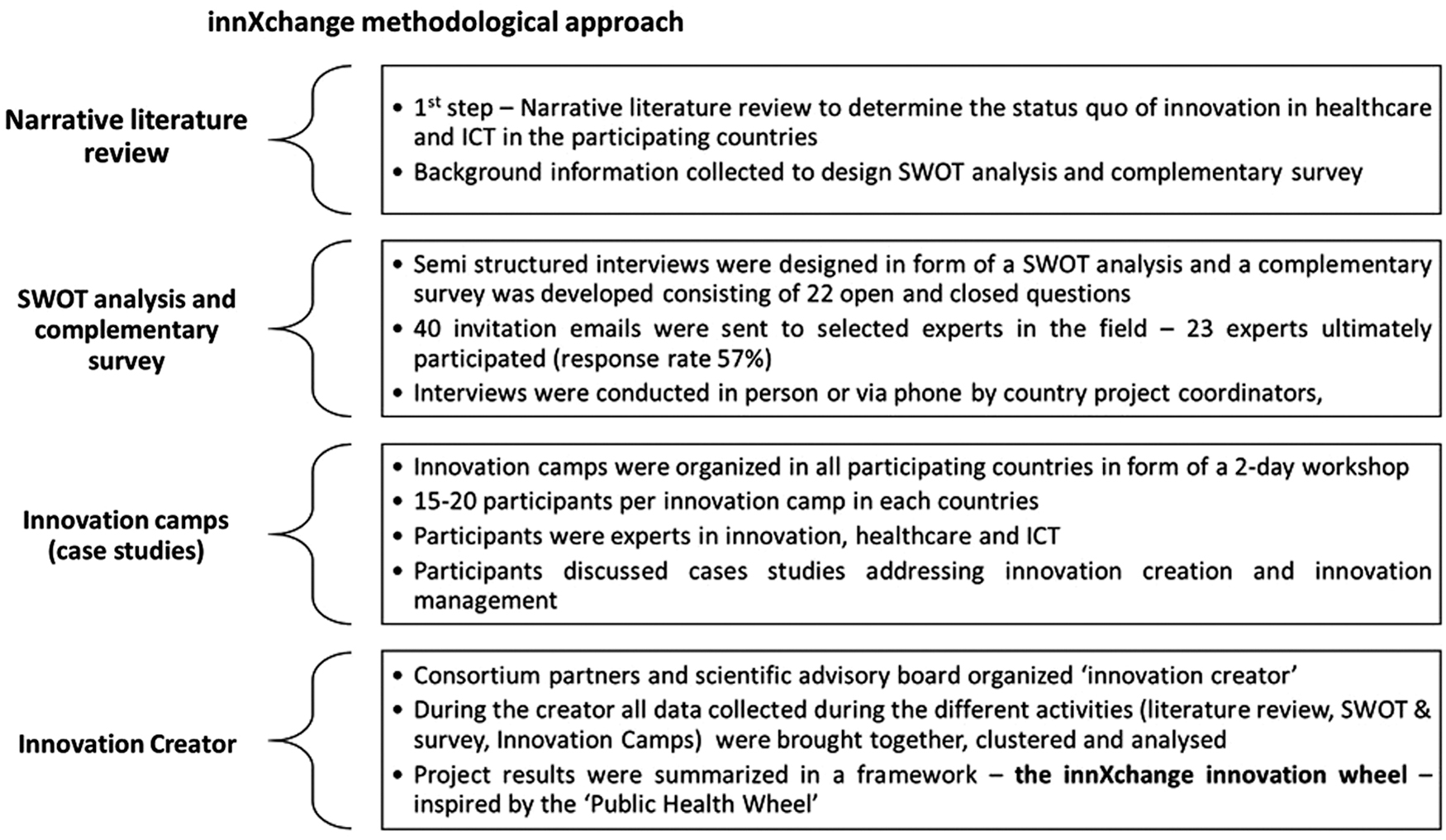
Overview of manifold methodological approach applied to develop the innXchange innovation wheel.
Results
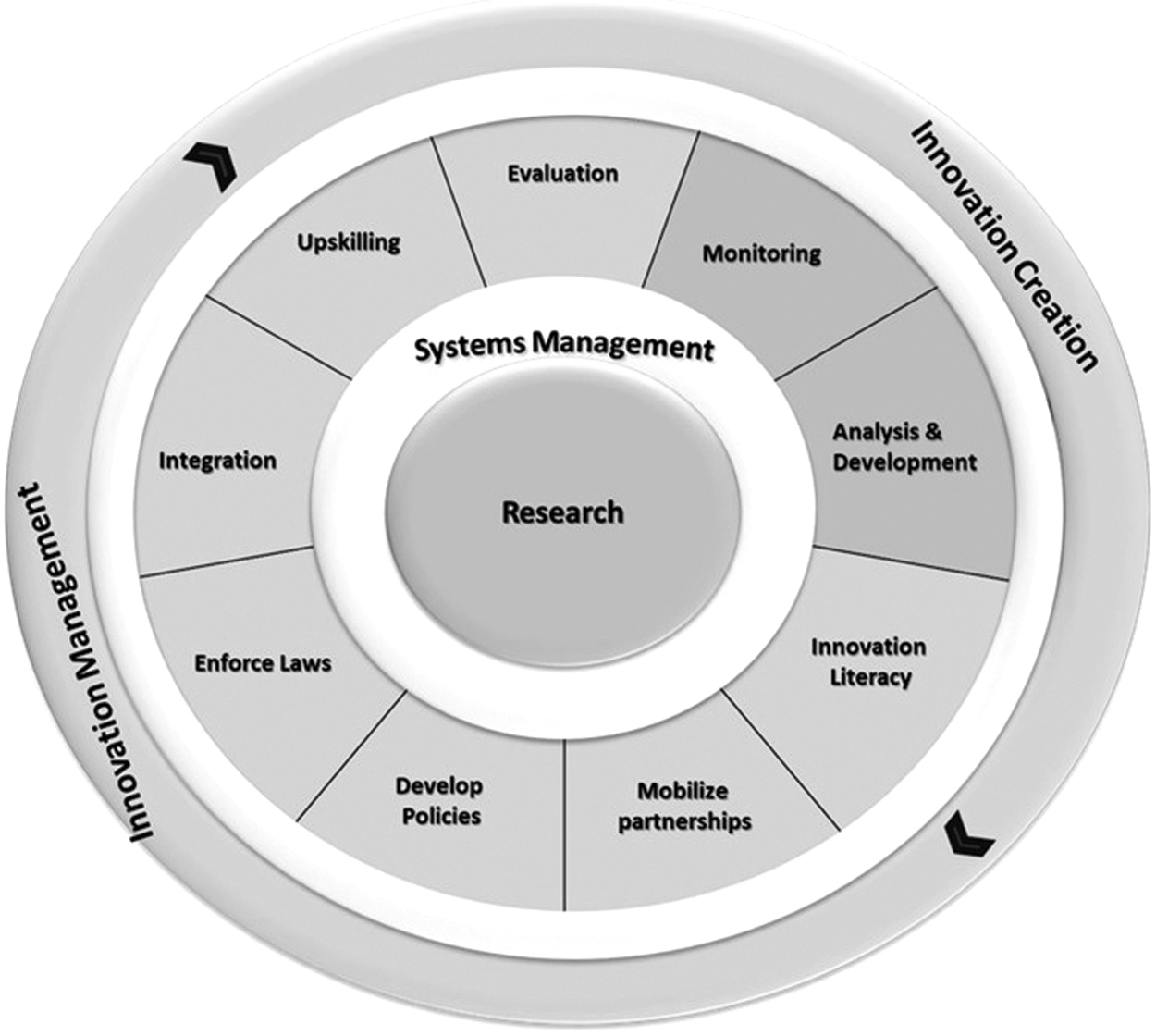
The “innXchange innovation wheel” is depicted in Figure 2. The wheel consists of 11 tasks, which together address the whole complexity of the innovation process. The wheel tasks “Monitoring and Analysis & Development” are addressing the innovation creation process. The other tasks are focusing on innovation management. Research and systems management are underlying and cross-cutting tasks, which apply to the whole innovation process. For each wheel task, specific guidance and recommendations were formulated to improve the innovation process and to strengthen “systematic early dialog” (Table 1).
innXchange Guidelines and Recommendations to Strengthen Systematic Early Dialog
ICTs, information and communications technologies.
Discussion
This case study was conducted to provide systematic guidance on the essential steps of the innovation process and develop a framework to build capacity for the creation and management of innovation in health care and ICT through global North and global South partnerships. The COVID-19 pandemic has clearly underscored the need for innovation governance between the global North and the global South.
The ongoing COVID-19 pandemic has showed us how fragile our health systems and especially our health care systems are and that we are less prepared to cope with such events and challenges than we think. However, the pandemic has also taught us how important innovations are to quickly respond to such disasters and that innovations will play an important role for governments and the public to respond to the many economic, environmental, and societal challenges we are facing besides the COVID-19 pandemic.
Scientific literature, published over the last two decades, emphasized the importance to understand the changing landscape of innovation (Pansera, 2013) and that most market innovations do not automatically deliver societal desirable outcomes (Von Schomberg and Hankins, 2019).
According to Madelin and Ringrose (2016), “(…). Traditionally, innovation has taken place in centralized, closed and inward-looking elite circles” (Madelin and Ringrose, 2016). In the past, R&D investments have been seen as the main driver for innovation (Bhatti and Ventresca, 2013). However, in times of resource constraints, the demand for low-cost solutions is drastically increasing throughout Europe and around the world.
Based on the demand for affordable solutions, innovation approaches, such as frugal innovation and grassroot innovation, have emerged and are currently challenging the traditional innovation approaches in mature markets (Hossain et al., 2016; Pansera, 2013). Mainly those new innovation approaches emerge in developing economies and are stemmed from the urgent need to find immediate, cheap solutions to address local needs and to improve the economic opportunities of the poor segments of the society (Rosca et al., 2018).
Frugal innovation, according to Hossain et al. (2016), “comprises innovative mixtures of available knowledge and technologies to solve urgent local needs” (Hossain et al., 2016). The emergence of frugal innovations underlines that market innovations do not automatically deliver societal desirable outcomes and that market efficiency mechanisms have created a world with haves and have nots. Frugal mindsets and ideas of individuals are the main drivers for those innovations that appear in less predefined settings and without immense R&D investments. Frugal innovations address urgent needs at low costs compared to market innovations that are based on economic rationales without added value for the society. During the last years, the new innovation concepts such as frugal innovations have changed the lives of millions of people (mostly of the poorest in the society) around the world (Leliveld and Knorringa, 2018).
There is a clear need for a paradigm shift and new ways of working are required to ensure that innovations are not purely developed because of financial incentives, but are shaped in accordance with societal values and expectations (Ağirbaşli, 2021; Von Schomberg and Hankins, 2019; Von Schomberg and Özdemir, 2020). This is particularly true for health care. Innovation in health care does not often deliver on societal expectations as innovation priorities are mainly based on the infinite economic and financial growth imperative (Ağirbaşli, 2021). The COVID pandemic showed us that the market mechanisms do not work for PPGs such as vaccines or planetary health care as we are experiencing large disparities in access to PPGs between developed and developing or rich and poor countries.
Even though PPGs should be available to the entire population, many market mechanisms do not consider or address this. There is a clear need for a paradigm shift and new forms of innovation governance and capacity building to ensure that innovations have societally desirable outcomes. Furthermore, a paradigm shift is needed to put PPGs into practice to ensure that health care services and health care are accessible to everyone (Ağirbaşli, 2021; Von Schomberg and Özdemir, 2020).
The growing emphasis that market innovations do not automatically deliver societal desirable outcomes highlights the need for new approaches such as critically informed governance of innovation to steer innovation in health care and public health in response to values and end points desired by the society and away from assumptions of infinite economic growth. Frugal innovation is a great example for innovations that are developed to address urgent needs at low costs with added desirable value for the society without a pure economic rational.
According to Rosca (2018) “frugal innovations in healthcare involve simple, affordable, robust, and easy-to-use technologies that doctors or patients themselves can use in resource-constraint environments to avoid, identify, or treat health issues” (Rosca et al., 2018). Not only have frugal innovation the potential to improve the quality of life of millions of people but they also improve economic productivity through decreasing mortality and a consequently healthier more productive workforce (Crisp, 2014; Rosca et al., 2018).
Notwithstanding the great potential frugal innovations might have to address the many health care challenges around the world, it will be important to ensure that they comply with international safety standards. This will be a key challenge that needs to be addressed in the years ahead to offer solutions that are accessible and affordable for everyone and are proven to be safe for the users, and that safety is not sacrificed to lower the costs (Rosca et al., 2018).
It is widely discussed among scholars that frugal innovations bear a great opportunity to address the many challenges the world is currently facing (Leliveld and Knorringa, 2018; Rosca et al., 2018). Not only do those innovations have great impact on developing countries, frugal innovation can also play an important role for developed markets (Bhatti and Ventresca, 2013; Pansera, 2013). However, to make full use of this potential, changes in mindsets of innovators in developed countries are needed.
It is important to understand that market innovations do not often have added societal value, especially in health care and public health, and to address the challenges we are facing, innovators need to understand first needs of the society before innovating. To keep up with emerging markets and to ensure to remain top innovators, western mature markets need to increase their willingness to learn from developing markets and to shift their mindsets away from believing that they can teach the rest of the world (Crisp, 2014; Pansera, 2013).
As highlighted by Crisp (2014), mutual learning will be a crucial part in the future to make full use of the potentials new innovation approaches bear (Crisp, 2014). To ensure that novel innovation approaches such as frugal innovation do not fall into old pre-covid market mechanisms, approaches such as innovation governance between the global north and the global south and frameworks for informed governance of innovations will be needed.
Furthermore, norms and values of the society, trust in institutions, mindsets, and openness toward innovation are also important pillars of the innovation ecosystems (Zhu et al., 2018). Creativity and changes in mindsets will be important to keep up with emerging economies.
Furthermore, governments need to act in a more transparent way to gain the trust of the society. Governments are often criticized to be not transparent, to think and act in silos, and to support their own interests and not the interest and rights of the society. It will be of great importance for governments to be more transparent and responsive (Madelin and Ringrose, 2016; Zhu et al., 2018). As highlighted by Zhu et al. (2018), “innovation is incubated as long as people show a constant trust in institutions” (Zhu et al., 2018). Especially in health care and ICT, trust is an important pillar that needs to be adequately addressed. Data misuse and data protection in times of “omics technologies” and big data are major concerns of the society, which greatly impact the diffusion and adaption of new technologies.
In addition, to increase trust among citizens, innovation needs to have desirable societal value. Governments need to provide regulatory frameworks that ensure the protection of the citizens and patients and on the other hand support science and research and not restrict them.
Another important pillar that determines the success of the innovation process is the innovation ecosystem. The ecosystem is a complex construct that is built on many different pillars. To create proinnovation environments, governments play a crucial role in providing the fundamental perquisites such as education, legislation and regulation, innovation funding schemes, and integrating innovation throughout the whole policy landscape (Madelin and Ringrose, 2016; OECD, 2015; United Nations Conference on Trade Development, 2018).
However, our findings highlighted that the given infrastructure often hampers innovation instead of supporting it. Regulations and legislations are often outdated and do not address emerging technologies in health care and ICT adequately. In some cases, the regulatory framework is even too restrictive for emerging technologies to evolve and diffuse. This is in line with scientific literature (Negrouk et al., 2015). To facilitate innovation and not hindering it, legislations and regulations need to adapt faster to emerging technologies such as “omics technologies” and the use of big data in health care and that the digitalization will become a main pillar of regulatory frameworks. Digitalization is not only a key enabler for innovation in health care but also its impact reaches out to other areas such as agriculture (Michel et al., 2019), banking (Meagher, 2018), and education (Quaglio et al., 2016).
Furthermore, the political landscape of health and health care is changing as the pandemic has showed us health is becoming more global and more politicized (Kickbusch, 2016). There is a need to move away from technocracy in innovation governance and management, including health innovation. Politicization of health care and innovations in health care are required on all levels of governance and required collaboration with all stakeholders, including national governments, global institutions, and private economy, as well as the society. This underlines the importance of systematic early dialog in innovation governance and that innovation governance should not only be done my elite politicians but rather also by all stakeholders involved.
The past has shown that “the delegation of the political to politicians and of knowledge production to the scientists no longer holds in modern societies (…)” (Kickbusch, 2016). To work toward a common purpose in innovation governance, we need to move away from technocracy and need to work closer together with citizens, politicians, and researchers (Kickbusch, 2016). Citizens will be and have always been important in advancing health care and public health and they will be even more important for innovation governance as many market innovations do not have added value for the citizens (Kickbusch, 2015).
We believe that the proposed framework and the underlying concept of “systematic early dialog” will be crucial to improve the innovation creation and management process in planetary health care and ICT. The framework will help to assess whether we are doing the right things in the innovation process and innovations in health care are desirable from a societal standpoint.
The framework is not only providing guidance for innovators but is also emphasizing the inclusion of all stakeholders involved in the innovation process. Stressing the importance of dialog and collaboration between all stakeholders from the early beginning reduces the risk of innovation to end in the death valley of innovation. Since the framework emphasizes the inclusion of all parts of the society, it will enable more openness toward innovation and current skepticism will be shifted toward optimism and inclusiveness. Furthermore, systematic early dialog is important to move away from technocracy in innovation management and governance to ensure that innovations have clear added and desirable value for citizens, and that citizens' voices are heard.
The proposed framework and recommendations that cover the different parts of the innovation process address the whole complexity of innovation and the many different aspects that influence the innovation creation and management process. Following the 11 different steps outlined in the innovation wheel will help to address the crucial parts of the innovation process to ensure a successful innovation process.
The framework is designed to help innovators to analyze the innovation creation and innovation management process in more detail. This will allow innovators to identify as well as overcome common barriers and hurdles at the different stages of the innovation process. This will allow them to build capacities to bring improvements and breakthrough ideas and technologies to the citizens/patients/health systems and thus improve the lives of millions of people. In addition, the framework will support new innovations to diffuse and to bring breakthrough discoveries to the market by emphasizing the importance of the innovation ecosystem, the emergence of novel innovative approaches, and systematic early dialog.
Furthermore, it is important to mention that there are no “one-size fits” all innovations and that the innovation process might vary between different sectors and on local, national, and especially, international levels. Therefore, we developed the generic framework that can be applied to all different levels. In addition, we believe that the innXchange innovation wheel can also be applied to other sectors than health care and ICT.
Limitations
The innXchange innovation wheel is currently a theoretical framework that was developed based on small case studies in Europe and Africa. The authors acknowledge that additional testing and validation studies of the framework will be required to ensure large-scale application of the best practice guidance. The framework is currently applied in a national R&D project “food4future” funded by the German Federal Ministry of Education, to validate and test the theoretical framework in real-world settings.
Conclusions
Innovations that are governed in ways that are critically informed, managed, and aligned with societal values offer veritable potentials to respond to the manifold challenges that we currently face in planetary health. Especially, innovations are seen as drivers for sustainable growth. The potential innovations are widely discussed among scholars; however, to make full use of this potential, several barriers have been discussed in this article that need to be addressed to successfully innovate.
To improve the innovation process, the right infrastructures and a well-functioning innovation ecosystem need to be in place. Governments can play a crucial role in this by providing the right policy frameworks, which are supportive for innovation and address the whole complexity of innovation.
In addition, western countries need to be open to learn from developing countries to adequately address the need for affordable solutions in health care and ICT and to ensure that all parts of the society can participate in the innovation process. To ensure that the aforementioned issues are addressed, we emphasize the importance of systematic early dialog. Following the essential steps outlined in our generic framework and best practice guidance, and incorporating systematic dialog as key concept in the innovation process can help to overcome the current barriers and consequently bring breakthrough discoveries and innovative ideas, with desirable added value, to the people.
Footnotes
Acknowledgments
The authors thank the members of the Scientific Advisory Board: Karen Böhme (PTJ, Germany), Erica Hackenitz (NWO, The Netherlands), and Paula Kotze (University of Pretoria, South Africa). We also thank the members of the Project Consortium: Riana Steyn (University of Pretoria, South Africa), Komla Pillay (University of Pretoria, South Africa), Ines Huelsmann (Furtwangen University, Germany), Babette Regierer (SB Science Management, Germany), and Bernard Chiira (Strathmore University, Kenya) for their valuable contributions to the project.
Author Disclosure Statement
The authors declare they have no conflicting financial interests.
Funding Information
The ERA-net ERAfrica project innXchange has received funding from the European Union's Seventh Framework Programme for Research and Technological Development under grant agreement No. 266603. This work was supported by the Netherlands Organisation for Scientific Research (The Netherlands), The Department of Science and Technology (South Africa), The Ministry of Education, Science and Technology (Kenya), and the German Federal Ministry for Education and Research (Germany).