




Abstract

We live in truly exciting and challenging times for drug and vaccine development. A case in point is the COVID-19 pandemic. There remain wide global disparities in access to vaccines across countries and communities. At the same time, new oral antivirals such as molnupiravir and nirmatrelvir–ritonavir to fight COVID-19, both as a pandemic and endemic disease, are emerging. In these debates, we notice that attention to theranostics, the diagnostics that can help forecast health intervention outcomes, has lagged behind.
Theranostics relates to the fusion of therapeutics with diagnostic medicine. In this context, it is noteworthy that an ounce of prevention (e.g., of drug side effects or treatment resistance by theranostic tests) is worth a pound of cure. Theranostic tests can inform the entire continuum of drug and vaccine discovery, clinical trials, and public health practices.
Within the field of theranostics, glycomics warrant further attention as new vaccine and oral antiviral drug developments are underway and beginning to bear fruits. The information represented in glycans, and their conjugated forms of glycoproteins and glycolipids, is collectively referred to “sugar code” or the third alphabet of life, the first and second alphabets being the genomic and protein codes (Wang, 2022).
There is evidence to suggest that glycomics, the sugar code and the theranostics that build on them, can usefully inform new vaccines and drug discoveries for COVID-19. In patients with COVID-19, afucosylation within immunoglobulin G (IgG) Fc domain can activate the antibody-dependent cell-mediated cytotoxicity through ligating to Fc domain γ receptor IIIa on natural killer cells, neutrophils, and macrophages, and then upregulates the release of proinflammatory factors (e.g., interleukin-1β, interleukin-6, C-reactive protein, tumor necrosis factor α, and interferon-γ).
For those COVID-19 patients who have severe symptoms, the agalactosylation and asialylation of the IgG Fc region can amplify the lectin-initiated complement pathway, suggesting the intricate clinical phenotypes in severe acute respiratory syndrome coronavirus 2 (SARS-CoV-2) infection (Fig. 1). Mannose-binding lectin can bind to sites on the SARS-CoV-2 spike protein (Wang et al., 2021), such an ancient form of immunity protects many against COVID-19 infection (Hou et al., 2021). In addition, mucins (a diverse and heterogeneous family of glycoproteins that comprise the bulk of mucus and the epithelial glycocalix) inhibit SARS-CoV-2 in a glycan-dependent manner. Mucin molecular structure plays a complex and important role in host defense (Wardzala et al., 2022).
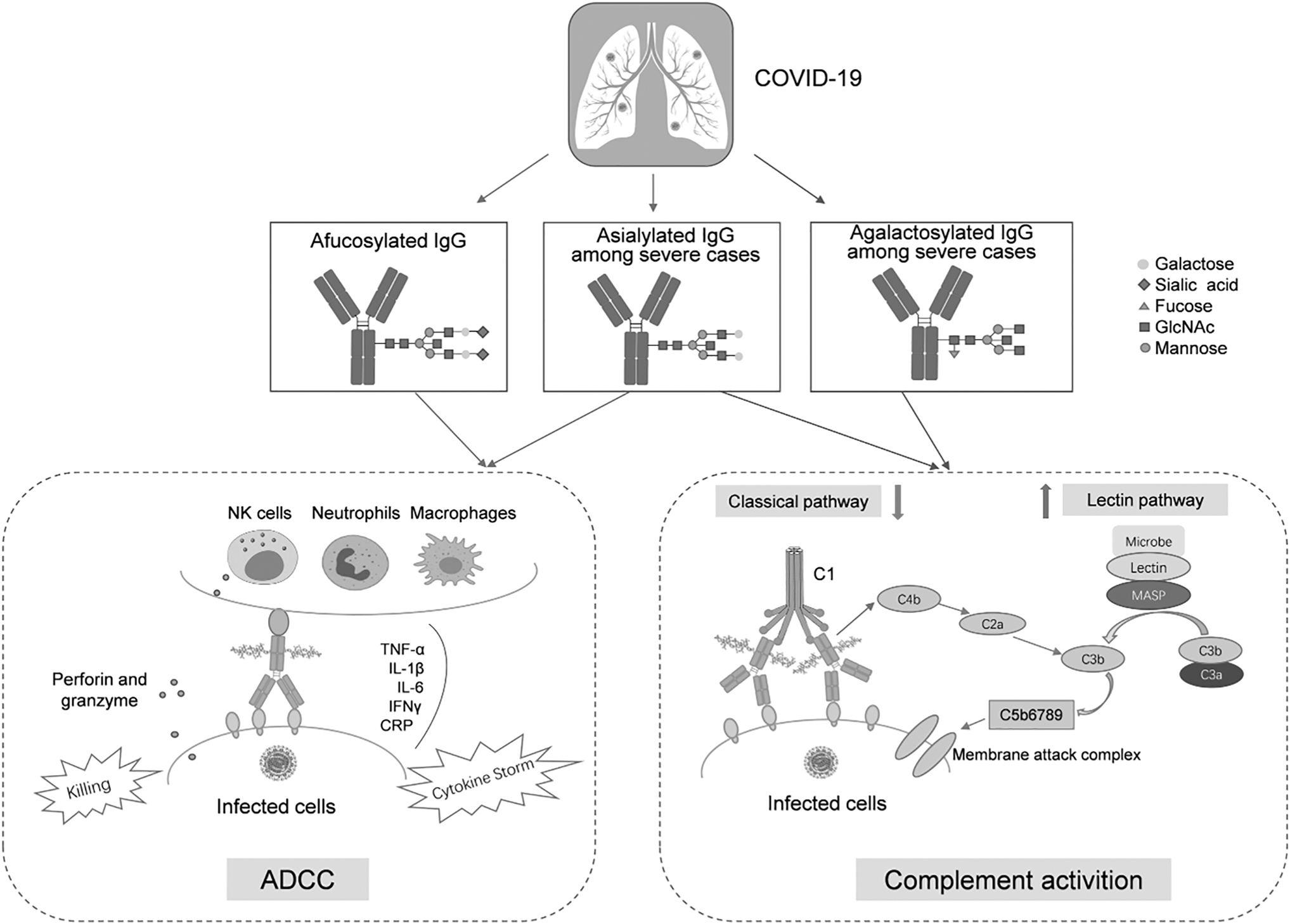
The hypothesized roles of IgG N-glycosylation in COVID-19 immunopathology. Hou et al. (2021); reproduced with permission. ADCC, antibody-dependent cell-mediated cytotoxicity; CRP, C-reactive protein; GlcNAc, N-acetylglucosamine; IFN-γ, interferon γ; IgG, immunoglobulin G; IL-1β, interleukin 1β; IL-6, interleukin 6; MASP, mannose-binding lectin-associated serine protease; NK, natural killer; TNF-α, tumor necrosis factor α.
As already mentioned, in the field of glycobiology, COVID-19–related therapeutic strategies and drugs involving glycan-binding proteins, antiglycan antibodies, glycan antigens, lectin inhibitors, and glycosidase inhibitors are needed to be considered. In addition, the corresponding proposals of those candidate drugs need relevant medical review and approval (Lardone et al., 2021).
Overall, it follows naturally that what we have learned on the interaction between viruses and hosts will guide the clinical diagnosis, treatment, and development of host-targeting antivirals: glycomics holds the key in this endeavor (Wang, 2022).