




Abstract
Tuberculosis (TB) among patients with human immunodeficiency virus (HIV) is a major global health burden and contributes to a high mortality rate due to HIV-mediated immunosuppression and subsequent susceptibility to TB. It is imperative to understand the pathogenesis of the association between HIV and TB for therapeutic innovation and preventive medicine. In the present study, we employed transcriptomic and bioinformatic analyses of differential gene expression data obtained from Gene Expression Omnibus (GEO) of the National Center for Biotechnology Information. The expression data of Mycobacterium tuberculosis-infected macrophages and blood samples from TB patients (GSE54992, GSE52819, and GSE19435) and blood samples from HIV patients (GSE30310) were accessed for identification of differentially expressed genes (DEGs). Data from 20 healthy subjects and 19 patients with TB and 16 healthy subjects and 16 patients with HIV were analyzed. We report here the DEGs shared by HIV and TB infection. Moreover, HIV and TB host–pathogen interaction data were collected from BIOGRID, v 4.4.210, for identifying significantly modulated genes' targets and their interactions with the host. Host targets, including PLSCR1 (phospholipid scramblase 1), STAT1 (signal transducer and activator of transcription-1 alpha/beta), FBXO6 (F-box only protein 6), ITGAL (integrin alpha-L), and APP (amyloid beta precursor protein), are commonly modulated in both diseases. The function of these targets was screened from and reconciled with the literature to understand their role in the pathogenesis of HIV and TB. Overall, the study results suggest that these targets may potentially be important contributors to the pathogenesis of this comorbidity. Further experimental work is needed for evaluating these new observations, with a view to future therapeutic innovation for patients with HIV and TB.
Introduction
Human immunodeficiency virus (HIV) is one of the major global health burdens, which affects the host immune system and weakens a person's ability to defend against various infections (Waymack and Sundareshan, 2022). This viral infection leads to immunodeficiency and subsequent susceptibility to various opportunistic infections such as tuberculosis (TB) (Bruchfeld et al, 2015), coccidioidomycosis (Fish et al, 1990), Pneumocystis jirovecii pneumonia (Selwyn et al, 1998), and candidiasis (Jindal et al, 2009).
The recent fact sheet of the Joint United Nations Programme on HIV/AIDS (UNAIDS) regarding global HIV and AIDS cases estimated that in 2021, there were 38.4 million people living with HIV, whereas 650,000 died due to AIDS-related illness, and around 1.5 million people were newly infected with HIV (UNAIDS, 2022a).
Development of severe opportunistic infections is a major problem in the course of HIV, reducing the life expectancy of HIV patients. Mycobacterium tuberculosis (Mtb) infection is one of the most common HIV-associated opportunistic infections (Bruchfeld et al, 2015), which predominantly affects the lungs and spreads from one individual to another through nasal droplets of an infected person.
A World Health Organization (WHO) estimate points out that TB is the second leading infectious killer and the 13th leading cause of death, accounting for nearly 1.6 million individuals who died from TB as per 2021 report (WHO, 2021).
Moreover, the co-occurrence of HIV-TB is 18 times more frequent than development of TB among individuals without HIV/AIDS, leading to almost 214,000 deaths worldwide (UNAIDS, 2022b). It is noteworthy that a total of 30 high-TB burden countries identified by WHO were responsible for 87% of new TB patients in 2020, including India, China, Indonesia, the Philippines, Pakistan, Nigeria, Bangladesh, and the Democratic Republic of Congo, accounting for more than two-thirds of the global TB burden (WHO, 2022).
Several factors that augment the TB risk among patients with HIV have been identified. Deprived immunity due to HIV infection is considered to be a major factor favoring this association (Bell and Noursadeghi, 2018). It is noteworthy that global efforts to support HIV treatment and prevention have significantly reduced HIV incidence. For instance, since 2000, new HIV infections per year have reduced by 60% in 2018 (Mosha et al, 2022).
Advancement in antiretroviral therapy has converted HIV into a potentially manageable disease (Oguntibeju, 2012). On the other hand, opportunistic infections such as TB are still a major cause of morbidity and mortality in patients.
In addition, drug resistance is an additional challenge in TB elimination involving multidrug-resistant TB (MDR-TB) and the extensively drug-resistant TB (XDR-TB) phenotype, where Mtb shows resistance to first-line isoniazid and rifampicin (MDR) or resistance to fluoroquinolones and at least one second-line drug (XDR) (Seung et al, 2015). It is not surprising that HIV infections with XDR/MDR-TB further complicate the patient's condition, leading to high mortality rates (Singh et al, 2020).
There is an urgent need to identify the precise pathogenic mechanisms of HIV-associated TB, which would be useful for managing this coinfection. The development of integrated therapies is crucial for management of HIV/TB coinfection and to address morbidity and mortality due to HIV-TB (Gupta et al, 2004).
In the present study, we employed transcriptomic and host–pathogen interaction (HPI) analyses and report the differentially expressed genes (DEGs) shared by HIV and TB infection.
Materials and Methods
Data collection
The gene expression profiles of TB and HIV were downloaded from Gene Expression Omnibus (GEO), a publicly available and comprehensive database for gene expression profiles (Edgar et al, 2002). The gene expression profiles for TB (GSE54992, GSE52819, and GSE19435) and HIV (GSE30310) were accessed for identification of DEGs (access date April 27, 2022).
The transcriptomic data from 20 healthy subjects and 19 patients with TB and 16 healthy subjects and 16 patients with HIV+ no ART were analyzed for exploring the differential gene expression that is common in HIV and Mtb infections.
Informed consent and research ethics
The study involved a bioinformatic analysis using a publicly available database, and consent was not applicable.
Screening of DEGs
GEO2R (www.ncbi.nlm.nih.gov/geo/geo2r) was used to screen DEGs between the two expression profiles (Barrett et al, 2013). DEGs for TB samples and healthy samples as well as patients with HIV infection and healthy samples were obtained and the values for statistical significance were adjusted as |fold change| ≥ 1 and adjusted p-value ≤0.05. DEGs (downregulated and upregulated) were identified based on the Log2FC value.
Extraction of HPIs associated with HIV/TB
BioGrid (https://thebiogrid.org), version 4.4.210, was used to obtain known HPIs (Oughtred et al, 2021). The database was filtered to screen HIV and Mtb human-specific HPIs in addition to human–human interactions and used for further analyses.
HPI map construction and screening of common HIV/TB targets
The HPI data extracted from BIOGRID were used to construct the HIV-1/HIV-2 and Mtb HPI network using Cytoscape, version 3.8.0. Cytoscape is freely available software for construction and visualization of interaction networks (Shannon et al, 2003). This interaction network was mapped using differential gene expression data to identify DEGs under these infections and their potential involvement in HPIs to identify HIV/TB targets modulating associated host factors.
Functional identification of important host targets
DEGs common in HIV and Mtb infections and those involved in the HPI network were screened and their biological role in HIV and Mtb infections was screened from literature.
Results
Detection of DEGs in HIV and Mtb infections
The gene expression dataset for TB (GSE54992, GSE52819, and GSE19435) and HIV (GSE30310) was analyzed with the GEO2R tool and a total of 198 differentially expressed genes, including 138 downregulated and 60 upregulated genes, were identified in HIV samples. Removal of duplicate entries from this dataset gave us 196 DEGs for HIV, including 137 downregulated and 59 upregulated genes. Likewise, a total of 616 DEGs were identified in TB samples among 3 datasets, including 372 downregulated and 244 upregulated genes.
Removal of duplicate entries and probe sets gave 590 DEGs in the TB patient sample, including 368 downregulated and 222 upregulated genes. During the screening of common genes involved in both conditions, a total of 20 genes were identified as downregulated in both HIV and TB samples and 2 genes were upregulated in both conditions (Supplementary Tables S2 and S3). These genes are further mapped with the HPI network to find common nodes.
HPI data associated with TB and HIV-1 and HIV-2 from BIOGRID, version 4.4.210
The BIOGRID database, version 4.4.210, contains ∼2.3 million interactions involving several organisms. In this study, a total of 980,764 HPIs with relevant literature and evidence were used for the analysis. These HPIs include HIV-1, HIV-2, and TB-related HPIs with human hosts. Details of HPIs with studied pathogens are presented in Table 1.
Summary of Host–Pathogen Interactions of Relevance in the Present Study, from BIOGRID, Version 4.4.210
HIV, human immunodeficiency virus; HPI, host–pathogen interaction; Mtb, Mycobacterium tuberculosis.
Identification of common human targets associated with studied pathogens
Figure 1a indicates a number of host targets involved in the studied HPIs. It was found that only one host target is common among all three studied HPI networks, while for HIV and TB, a total of six common host targets, including the earlier mentioned target, were found. Table 2 presents details of these common targets and their role in HIV and Mtb infections as per literature.

Functions of the Human Targets Commonly Involved in HIV and Tuberculosis Host–Pathogen Interactions
MAPK, mitogen-activated protein kinase; TB, tuberculosis; TLR, Toll-like receptor; TNF, tumor necrosis factor.
Screening of common DEGs in HIV and Mtb infections
The gene expression study of HIV and TB identified 20 target genes that are commonly downregulated and 2 that are commonly upregulated in both diseases (Fig. 1b, c). These differentially expressed common gene targets along with their HPI with any studied pathogen may influence the pathogenesis of other infectious agent (Fig. 2).
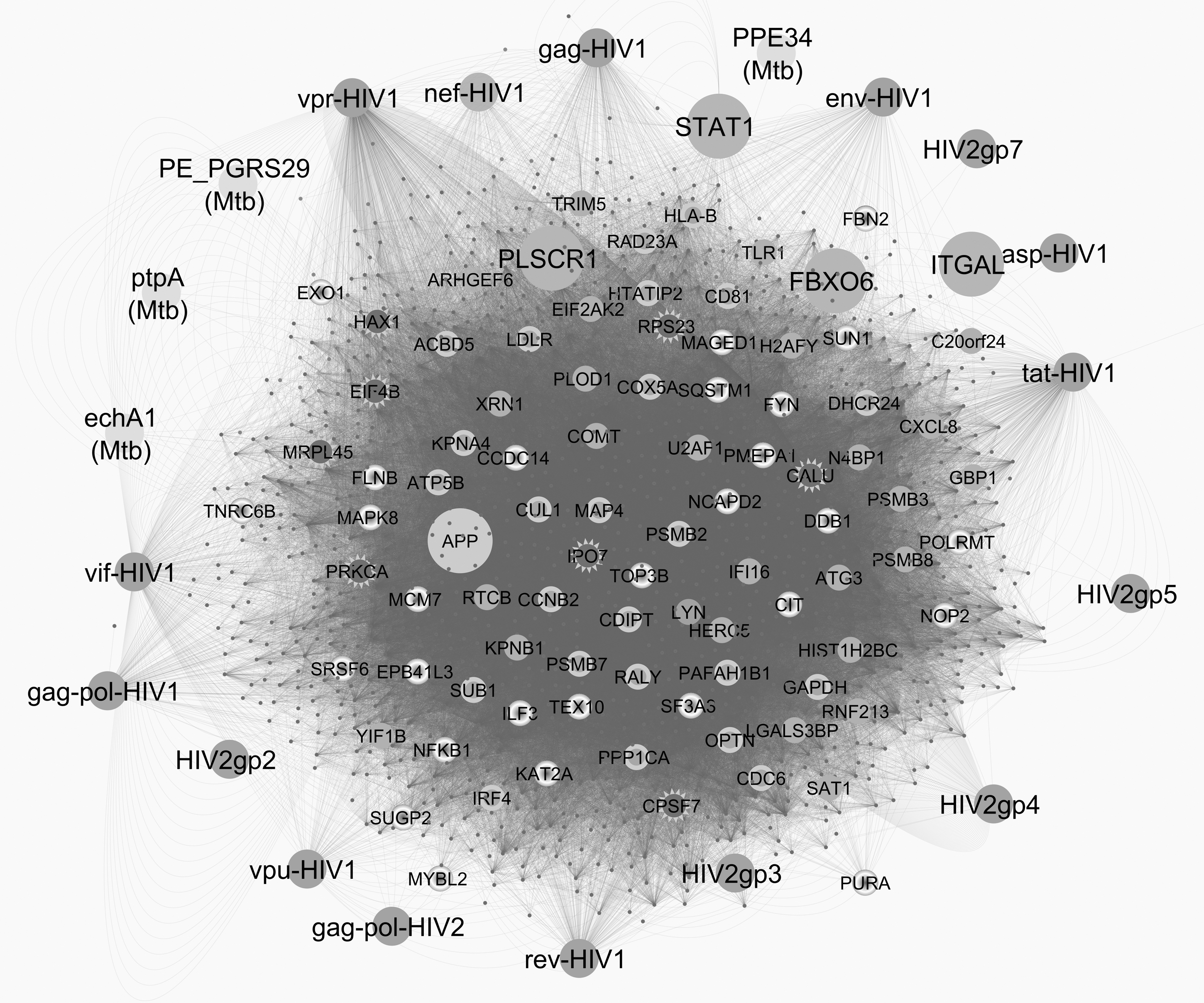
Host-pathogen interaction (HPI) map of HIV and TB and upregulated and downregulated targets as per differential gene expression analysis. The Mtb, HIV1 and 2 nodes are shown with different colors along with the name of concerned organism. The upregulated human targets involved with HIV are shown with red-color nodes with serrated border, while downregulated human targets are shown with orange-color nodes with smooth border. Similarly, downregulated human targets involved in Mtb are shown with sky blue nodes without border, and upregulated human targets are shown with blue-white gradient. The PLSCR1, STAT1, FBXO6, and ITGAL are commonly downregulated, while the APP was upregulated in HIV while downregulated in TB, therefore shown with large-size node. These human nodes indicate only differentially expressed targets involved in HPI with any studied pathogens. APP, amyloid beta precursor protein; FBXO6, F-box only protein 6; PLSCR1, phospholipid scramblase 1; STAT1, signal transducer and activator of transcription-1 alpha/beta; TLR, Toll-like receptor.
The details of human targets showing differential expression and interacting with any studied pathogens are presented in Table 3. The complete details of human targets interacting with HIV and/or Mtb and showing differential gene expression are presented in Supplementary Table S1.
Role of Commonly Found Differentially Expressed Genes of Tuberculosis/HIV Associated with Host–Pathogen Interactions with Either HIV or Mycobacterium tuberculosis
ISGs, interferon-stimulated genes.
Discussion
TB is one of the most prevalent opportunistic infections associated with HIV patients and contributes to high mortality. While introduction of antiretroviral therapy has helped to significantly reduce HIV prevalence and transform it into a chronic manageable condition (Oguntibeju, 2012), the development of opportunistic infections continues to be a major burden for clinical management of HIV comorbidity.
In the present study, transcriptome data from patients with HIV or TB infection were analyzed to screen for differentially expressed host genes involved in TB and HIV using GEO2R (Barrett et al, 2013). The possible HPIs of these targets with studied pathogens were also analyzed as per available biological interaction data. The DEGs in HIV and TB infections were categorized as upregulated/downregulated based on their Log2FC values under two different experimental conditions.
A positive Log2FC value represents upregulation, while negative value represents downregulation, compared with the control. Nonspecific probe sets and entries that occur more than twice were eliminated from the data before analysis. These expression data were further used to screen commonly downregulated or upregulated genes in both diseases to identify the synergy among these infections. The results indicate that there are 2 commonly upregulated and 20 commonly downregulated genes in both diseases (Fig. 1b, c, and Supplementary Tables S2 and S3).
These expression data are further used for understanding the interactions of these targets with pathogens, as per available HPI data, and their effects on disease pathogenesis (Supplementary Table S1). Subsequently, common host targets involved in HPIs with both pathogens were also identified (Fig. 1a). HPI data were downloaded from BIOGRID, version 4.4.210, which is a well-known repository of protein, genetic, and chemical interactions (Oughtred et al, 2021).
In this study, HIV-1, HIV-2, and Mtb-associated HPIs along with human-specific interactions were screened from the whole dataset. These filtered data were used to construct a combined HPI map of the above pathogens and the gene expression data were mapped to these targets to identify HPIs with differentially expressed host targets during HIV and Mtb infections.
The HPI data of HIV-1, HIV-2, and Mtb screened from BIOGRID, version 4.4.210, revealed five host targets that are commonly involved in interactions with HIV-1 and Mtb, and only one common target, that is, ubiquitin C (UBC), was found in all studied pathogens, including HIV-1, HIV-2, and Mtb. UBC codes for ubiquitin C involved in ubiquitination during protein degradation, cell cycle regulation, and DNA repair system. HIV replication is significantly assisted by proteins such as rev, tat, and gag (Bres et al, 2003; Gottwein and Krausslich, 2005), and the research demonstrates that UBC promotes HIV replication by ubiquitination of these proteins.
Moreover, ubiquitin also binds to the Mtb surface protein, which helps the bacterium to invade cells internally, limits the host's inflammatory reactions, and enhances host xenophagy (Chai et al, 2019). Due to the common role of UBC in the pathogenesis of both HIV and TB, it may serve as an important therapeutic target for both infections and must be explored separately. The role of these common host targets involved in HPI with HIV and Mtb indicates that these targets must be explored for their involvement in this disease combination (Table 2).
The HPI data were further mapped with differential gene expression data of Mtb and HIV and their HPIs with studied pathogens. The study identified a total of four downregulated host targets, that is, FBXO6 (F-box only protein 6), PLSCR1 (phospholipid scramblase 1), STAT1 (signal transducer and activator of transcription-1 alpha/beta), and ITGAL (integrin alpha-L), interacting with any of the studied pathogens. Moreover, APP (amyloid beta precursor protein) was upregulated in HIV and downregulated in TB and involved in screened HPI (Table 3).
STAT1 causes inflammation and is involved in the immune response to HIV-1 infection and its suppression prevents the induction of antiviral ISGs (interferon-stimulated genes) (Gargan et al, 2018). Moreover, STAT1 also has a role in immunological protection against TB (Yi et al, 2020). During HIV infection, interferon (IFN) signaling is inhibited by downregulation of STAT1, resulting in its influence on HIV replication (Nguyen et al, 2018).
Due to the common role of STAT-1 signaling in HIV and TB infections and its role in protection from both infections, it should be studied further to understand its potential in management of HIV-associated Mtb infection. PLSCR1 is also involved in the IFN-mediated antiviral function. It interacts with the HIV-1 Tat protein and its overexpression downregulates the activation of HIV-1 long terminal repeat, leading to repressed translocation of Tat (Kusano and Eizuru, 2013). This factor also mediates the immune response to Mtb and acts as a hub gene in TB infection (Sambarey et al, 2017).
FBXO6 can activate IFN-I signaling activity, which contributes to antiviral immunity during HIV infection (Du et al, 2019). The previous study showed that FBXO6 is also involved in the host immune response to Mtb infection (Sambarey et al, 2017). ITGAL is primarily involved in providing antibacterial immunity during TB infection (Ghosh et al, 2006), although our literature survey could not find its role in HIV infection. The common role of abovementioned commonly expressed host targets involved in HPI with HIV or TB needs further study to assess their therapeutic potential in managing the problem of HIV-associated TB.
As mentioned earlier, APP is overexpressed in HIV and underexpressed in Mtb infection. The amyloid beta protein acts as an antimicrobial peptide during infections and provides innate immune defense against several pathogens (Gosztyla et al, 2018). During the HIV infection, APP interacts with HIV-1 Gag proteins, which block HIV virion generation and spread. It has also been found that HIV leads to degradation of APP and in response, the host upregulates the expression of this target (Chai et al, 2017).
In contrast, Mtb infection was found to be associated with downregulation of APP as per the differential gene expression data. As the APP has the potential to modulate certain macrophage phenotypes (Puig et al, 2017) and macrophages are important contributors to the spread of the mycobacterial infection (Shastri et al, 2018), it is plausible that downregulation of APP may support Mtb infection (Chai et al, 2017). It can be speculated that downregulation of APP may contribute to the pathogenesis of both HIV and Mtb infections.
It is noteworthy that screened targets are mainly involved in IFN signaling and provide antiviral and antibacterial immunity in HIV/TB infection. In addition, commonly interacting HPI targets screened in the study, such as UBC, must be investigated experimentally.
Conclusions
The protein–protein interaction network of HPIs and DEGs identifies the commonly expressed genes and their involvement in interaction with pathogens. The functional analysis of screened targets revealed that the commonly downregulated genes in HIV/TB infection, that is, FBXO6, PLSCR1, STAT1, and ITGAL, provide antiviral and antibacterial immunity during infection, while APP, which is overexpressed during HIV infection and underexpressed in TB, may benefit the HIV/TB infection.
On the other hand, computational studies have certain limitations. It is noteworthy that the analysis was performed on separate HIV or TB patients' data and additional details of data obtained from HIV/TB coinfected patients may add further insights in the future. Therefore, the future addition of data with a larger sample to current knowledge would be useful in unraveling comprehensive information about targets in this disease combination.
Furthermore, the actual coverage of HPI data in databases such as BIOGRID is continually evolving and none of these databases provide complete coverage of HPIs between certain organisms. For instance, the BIOGRID database lists interaction of only env with APP; in contrast, recent literature has highlighted the interaction of APP with HIV-1 gag (Chai et al, 2017). Therefore, this must be considered while evaluating these findings at an experimental level.
Nevertheless, current findings hold their importance based on transcriptome and interactome data, while the screened targets have the ability to reduce time and cost in future research and bioinformatic analysis. Further experimental work is needed for evaluating these new observations, with a view to future therapeutic innovation for patients with HIV and TB.
Footnotes
Authors' Contributions
P.W. was involved in conceptualization, data collection, analyses, experimental approach, transcriptome data analysis, and manuscript writing and editing; K.M. was involved in data analysis and manuscript writing and editing; and A.A.K. was involved in conceptualization, data collection, analyses, experimental approach, interactome data analysis, manuscript writing and editing, and overall supervision.
Author Disclosure Statement
The authors declare they have no conflicting financial interests.
Funding Information
The authors express their thanks to the Science and Engineering Research Board, Department of Science and Technology, Government of India, for supporting this work through a grant, SRG/2021/000330.

Abbreviations Used
References
Supplementary Material
Please find the following supplemental material available below.
For Open Access articles published under a Creative Commons License, all supplemental material carries the same license as the article it is associated with.
For non-Open Access articles published, all supplemental material carries a non-exclusive license, and permission requests for re-use of supplemental material or any part of supplemental material shall be sent directly to the copyright owner as specified in the copyright notice associated with the article.
