




Abstract

Dear Editor,
Lately it has been reported that low-level laser therapy (LLLT) might be beneficial in patients with burning mouth syndrome (BMS). BMS is characterized by burning symptoms and is distressing for the patient and clinician as well. Despite numerous studies, etiology is poorly understood and therapy is often unbeneficial.
Yang and Huang 1 reported that LLLT might be an effective treatment for BMS, and Kato et al. 2 reported that LLLT provided a significant and lasting reduction in symptoms. Cekic-Arambašin et al. 3 also reported a significant decrease in burning symptoms in patients with BMS. However, Hansen and Thoroe 4 were unable to confirm these findings in their double-blind crossover study, and the same authors concluded that the therapeutic benefit seen in patients with BMS was caused by placebo effects.
Forty female participants were included in this study. All had BMS and their average age was 68 years (range 57–85 years). Participants were randomly allocated. In 20 BMS patients, red diode laser with emission of 685 nm was applied five times a week during 2 weeks. The device had the following characteristics: irradiation dose 2 J/cm2, frequency 4.56 Hz, output 30 mW. Another 20 patients with BMS served as a control group and were treated by the same laser, which was switched off. This investigation was single-blinded placebo- controlled. Burning intensity was recorded by use of visual analogue scale (VAS) every day during 10 days of therapy.
Statistical analysis was performed by use of Friedman ANOVA and post-hoc Wilcoxon test for dependant data for comparison between daily burning intensity within each group, whereas Mann–Whitney test was used for the daily comparison between groups.
The decrease in average pain scores during 10 days of therapy measured by VAS is seen in Fig. 1.
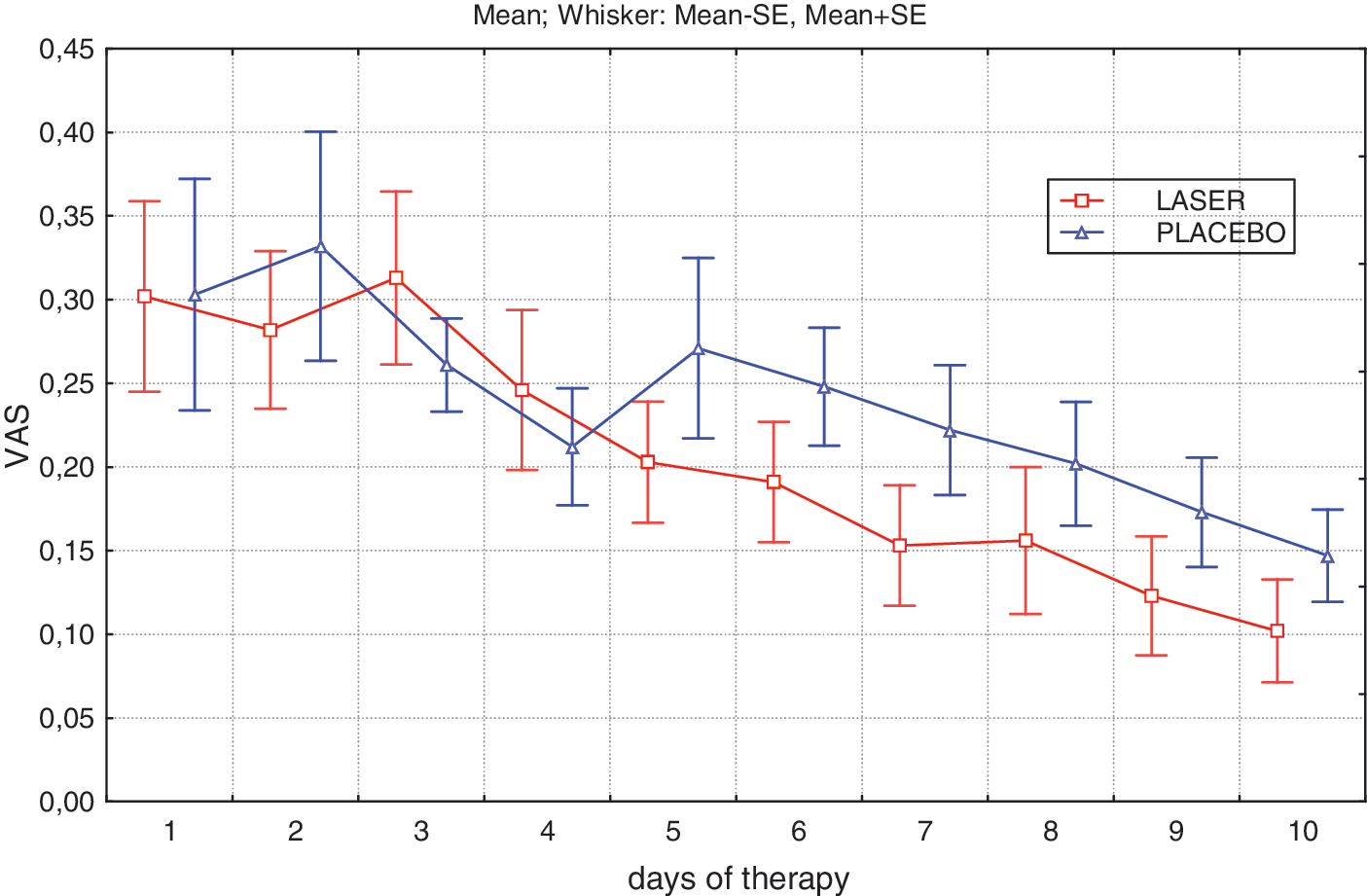
VAS on every day of the therapy in the study and control (placebo) group.
Indeed, LLLT decreased symptom intensity in BMS patients as seen by VAS, but also the symptom intensity decreased in the same manner in the placebo group as well, where device was switched off.
The results of this study show that effect of LLLT is based on the placebo effect as a decrease in symptoms was also seen in patients who were treated with LLLT in which the device was switched off, the result being in corcondance with study of Hansen and Thoroe. 4