




Abstract
Introduction
Melanin functions as a natural choromophore that sufficiently absorbs light at 810 nm, and the hair shaft in the follicle acts as the primary absorber of the applied laser. 4 Melanin is found not only in hair shaft and follicle but also in the epidermis. 3 Unfortunately, because of inevitable absorption of laser energy by melanin in the epidermis, it is not possible to heat hair follicle without heating the epidermis, which must be preserved to avoid side effects. 5
The considerable amount of melanin in epidermis according to skin type causes a decrease in the optical penetration depth of laser beam in skin tissue. This may lead to inefficient treatment process. In other words, a larger amount of melanin in the epidermis causes an increase in superficial absorption of laser beam in the epidermis, leading to epidermal thermal damage. 6
To optimize the hair removal process, it is necessary to understand the basic underlying principles of tissue optics; light delivery into tissue; and resultant heat production, heat distribution, and thermal damage. 7 Optimal laser treatment parameters have been proposed based on mathematical analysis of light propagation in human skin using thermal and optical properties of the follicle and its adjacent structures. 1 Hence, recently mathematical and simulation studies have received much attention, providing better understanding about how laser light interacts with living tissue. 8,9 One of the most commonly used mathematical models for describing the photon transport is Monte Carlo based modeling. In addition, some bioheat equations can be added to this simulation method for heat and thermal damage modeling inside biological tissues. 1
Because different skin types have different fractions of melanin in the epidermis, and cooling devices alone are not successful in protecting the dark-skinned epidermis, 5 it is necessary to investigate the role of various skin types on the thermal damage pattern of skin-hair tissues because of various laser parameters such as fluence and pulse duration.
In addition, an important issue about the efficacy of laser-assisted hair removal may be raised when hair color changes during the repeated sessions of laser therapy. When we deal with lighter hairs that contain a lower amount of melanin, this should be especially considered as another parameter affecting heat distribution and thermal damage patterns. 10 On the other hand, hair-removal devices generally differ in their choice of wavelength, fluence, pulse duration, and spot size. These characteristics are all important and play a crucial role in both the safety and the efficacy of the treatment procedure. 2 In our previous project, we simulated the heat distribution and thermal damage patterns of diode hair-removal lasers for different spot sizes, pulse durations, and fluences as a guide for optimization according to only single hair follicle, one skin type (III) and one hair color. 11
The goal of present study was to simulate the effects of thermal damage of 810 nm diode hair-removal lasers caused by various skin types, hair colors, and hair densities, using laser-induced-temperature-calculation-in-tissue (LITCIT), a Monte Carlo based software, hoping to find the parameters for diode laser photoepilation systems that lead to achieve optimal treatment results.
Materials and Methods
To simulate the patterns of skin thermal damage during laser irradiation, a previously applied model of skin was used. 10 –12 Human skin geometry was modeled as semi-infinite two layer geometry composed of a top 100 μm thick epidermis overlying a semi-infinite 3.9 mm thick dermis. 13 –16
Hair target also modeled as two quaxial cylinders: a heavily pigmented cylinder of diameter 100 μm as a hair shaft and a surrounding cylinder of diameter 200 μm as a hair follicle. 11,17 LITCIT simulation software version 1.31 (Laser in Medizin Technologie, Berlin, Germany) has been used for this study. It has already been validated against standard mathematical methods. 18 Optical properties such as absorption coefficient μa(mm−1), scattering coefficient μs(mm−1), and anisotropy factor g and refractive index n, and thermal properties such as density ρ(g/cm3), heat capacity Cp (J/gK), and heat conductivity κ(W/cmK) are input parameters of various structures of tissue model. 11,19 –21
Absorption coefficients of the epidermis for different skin types were calculated according to the Jacques' equation.
In this study, we assumed four different skin types II, III, IV, and V. Their fractions of melanin in epidermis fmel were assumed 5%, 10%, 15%, and 20%, respectively.
The total absorption coefficient of epidermis (μaepi
) combines the baseline skin absorption and the melanin absorption, which is calculated using the following equations:
19,20
That
That λ is the wavelength of laser in nanometer.
The optical properties of various components for different skin types are listed in Table 1. Additionally, the thermal properties of tissue were estimated depending on the water content of the tissue (w) according to the literature. 6,13,16 We assumed that w=0.50 for the epidermis and hair and w=0.75 for the dermis. 11,13 Calculating thermal coefficients κ(W/cmK), ρ(g/cm3 ), CP (J/gK) resulted in 0.0048, 1.075, and 3.488 for dermis, respectively. For epidermis and hair components, these thermal coefficients were 0.0034, 1.1497, and 2.789, respectively.
In this study, a semiconductor diode laser hair-removal system at 810 nm wavelength was used for simulations (10 mm spot size, fluences of 0.1–100 J/cm2, and pulse durations of 50–1200 ms). 22
In addition, the laser beam was modeled in the form of short and long pulses (100–400 ms) and various fluences (20–60 J/cm2).
Results
Effect of skin type
In this section, the results of simulated thermal damage patterns of different skin types caused by various laser parameters at the end of laser pulse irradiation are presented. To illustrate various parameters such as different fluences or pulse durations consecutively, we reconstructed the patterns, and some central parts of central slice were selected and combined as one pattern. It should be noted that the x-axis dimension is mm.
Thermal damage pattern of various skin types caused by different fluences are described as follows: 1. Keeping pulse duration constant, we gave different fluences and different melanin content of skin as inputs in order to calculate thermal damage patterns (Fig. 1). There is an increased amount of thermal damage both to the hair follicle and to the adjacent epidermis, for increased fluences. This considerable thermal damage is caused by the greater amount of total energy that is delivered to the tissue volume while using higher fluences in all skin types. 2. The effect of pulse duration on thermal damage pattern of different skin types was determined by the following: keeping fluence constant, we gave different pulse durations and different melanin content of skin as inputs in order to calculate thermal damage patterns (Fig. 2). While applying high fluences on any skin type
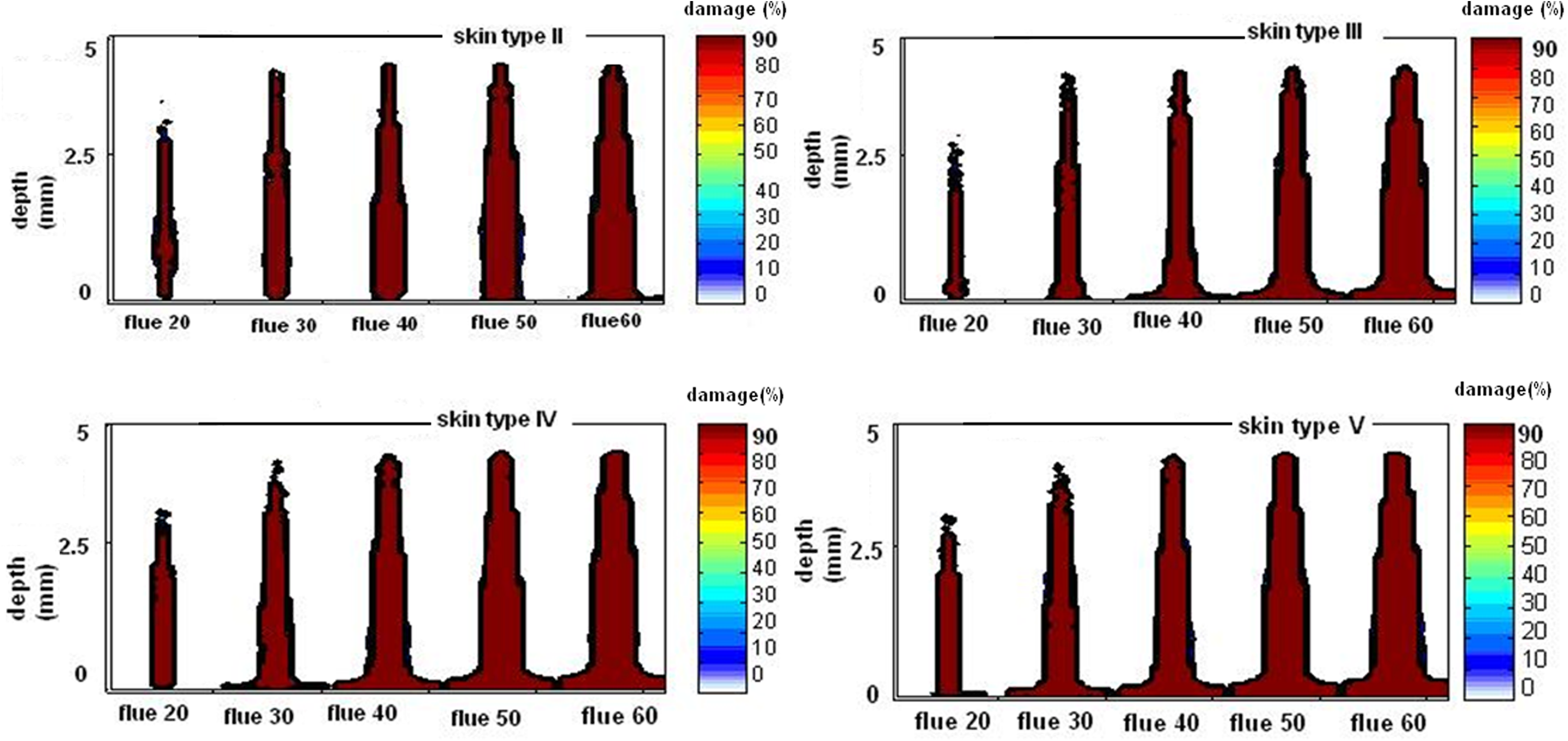
Thermal damage pattern at the end of 810 nm laser pulse irradiation with spot size 10 mm and 200 ms pulse duration for different fluences and skin types.
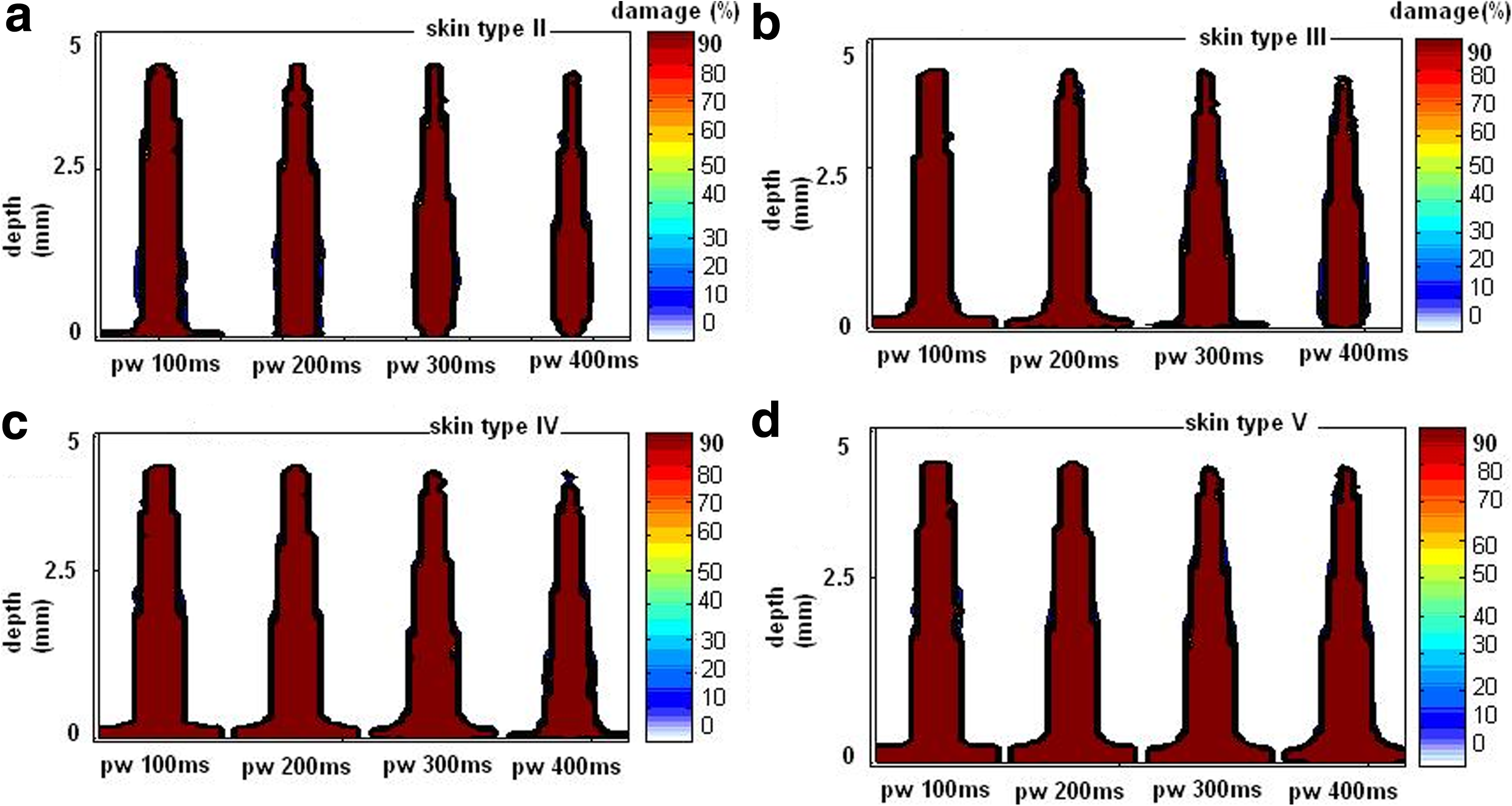
Thermal damage pattern at the end of 810 nm laser pulse irradiation with spot size 10 mm, fluence 50 J/cm2, and different pulse durations and skin types.
Effect of hair color
One of the issues that may occur in laser therapy of unwanted hairs is that the amount of melanin in the hair shaft may decrease in successive sessions of therapy as they grow thinner and lighter. Keeping the melanin content of the epidermis constant (skin type III); in this section, different melanin content of a single hair shaft (lighter: μa =1.5 mm−1 Vs darker: μa =3.5 mm−1) was given as inputs in order to calculate thermal damage patterns of two different pulse durations, 200 and 400 ms, while using different fluences (Fig. 3).
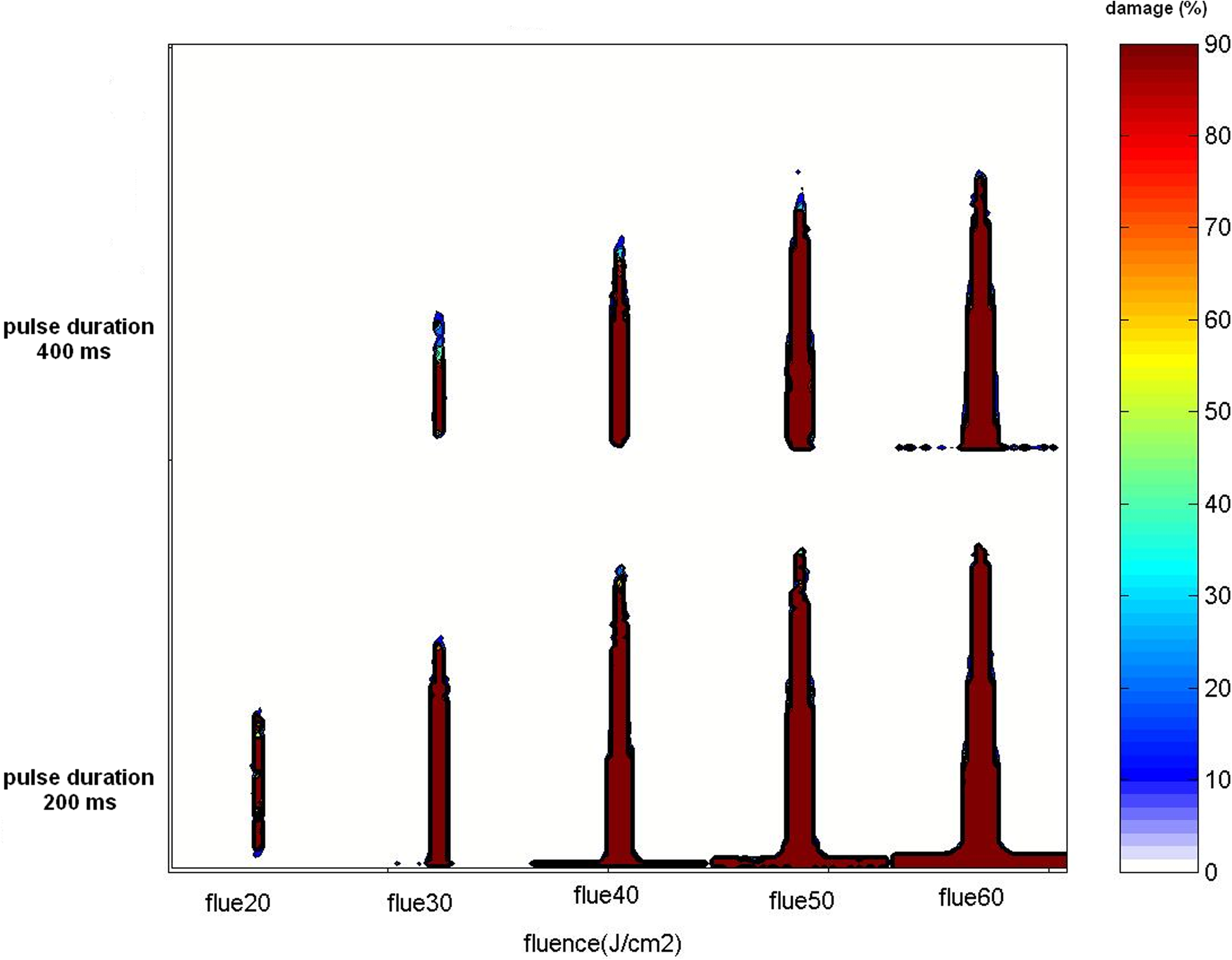
Thermal damage pattern of skin type III containing a light hair at the end of 810 nm laser pulse irradiation with 10 mm spot size and different pulses (200, 400 ms) for different fluences 20–60 J/cm2.
As expected, a lighter hair shaft has fewer melanin choromophores to absorb laser light. Effective thermal damage to the hair follicle in this setting was achieved by using higher fluences which at the same time caused unwanted damage to the adjacent epidermis. In lighter hairs, while using longer pulse durations, higher fluences are needed in order to obtain the same level of thermal damage in the hair follicle as shorter pulse widths (Fig. 3).
Effect of hair density
In this section, assuming skin type (III) and fluence constant, we gave two different pulse durations (200 and 400 ms), and two different hair densities (interfollicular space 0.5 and 1 mm) as inputs in order to calculate the thermal damage patterns (Figs. 4 and 5).
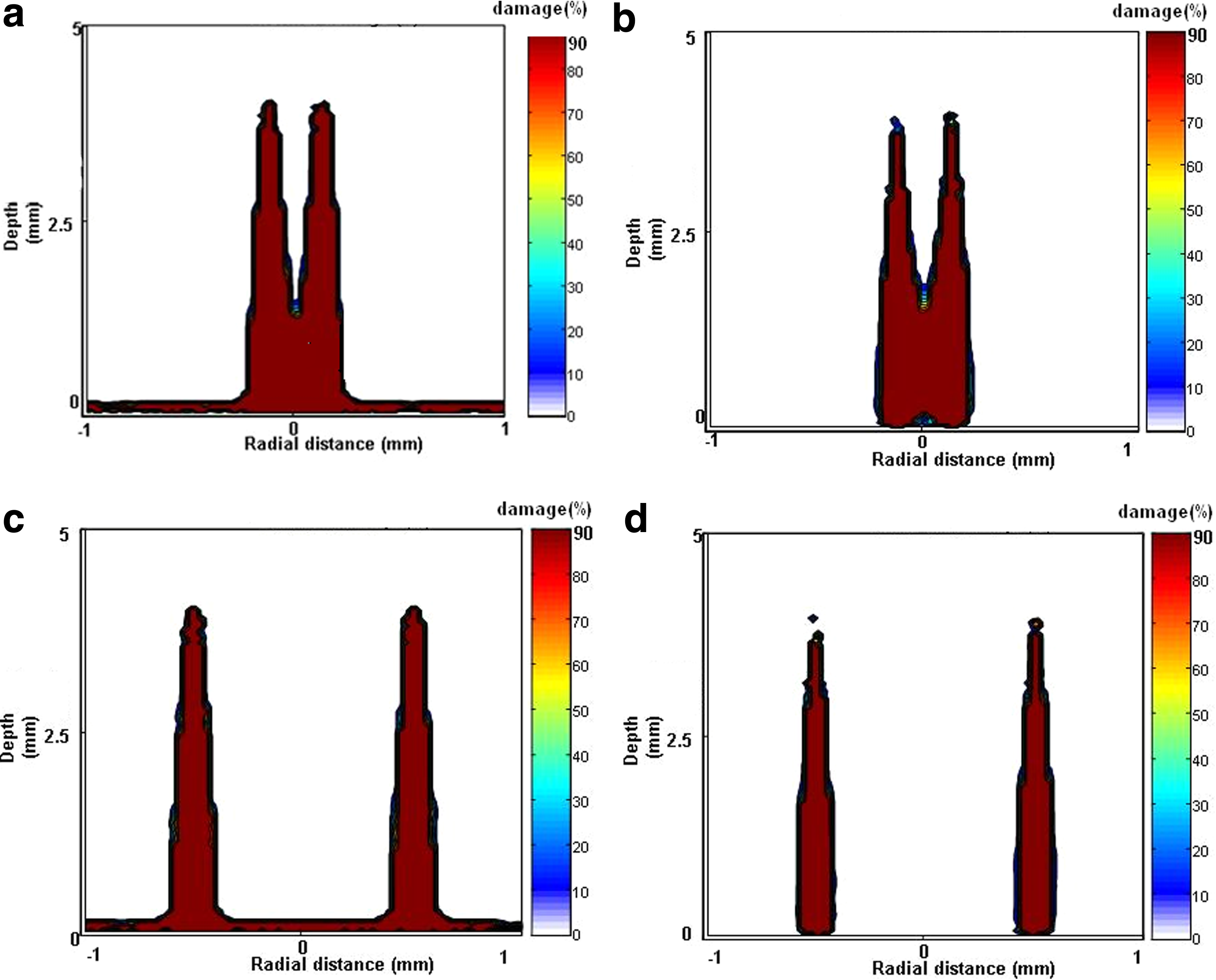
Thermal damage pattern of skin type III at the end of 810 nm laser pulse irradiation with 10 mm spot size, fluence 50 J/cm2
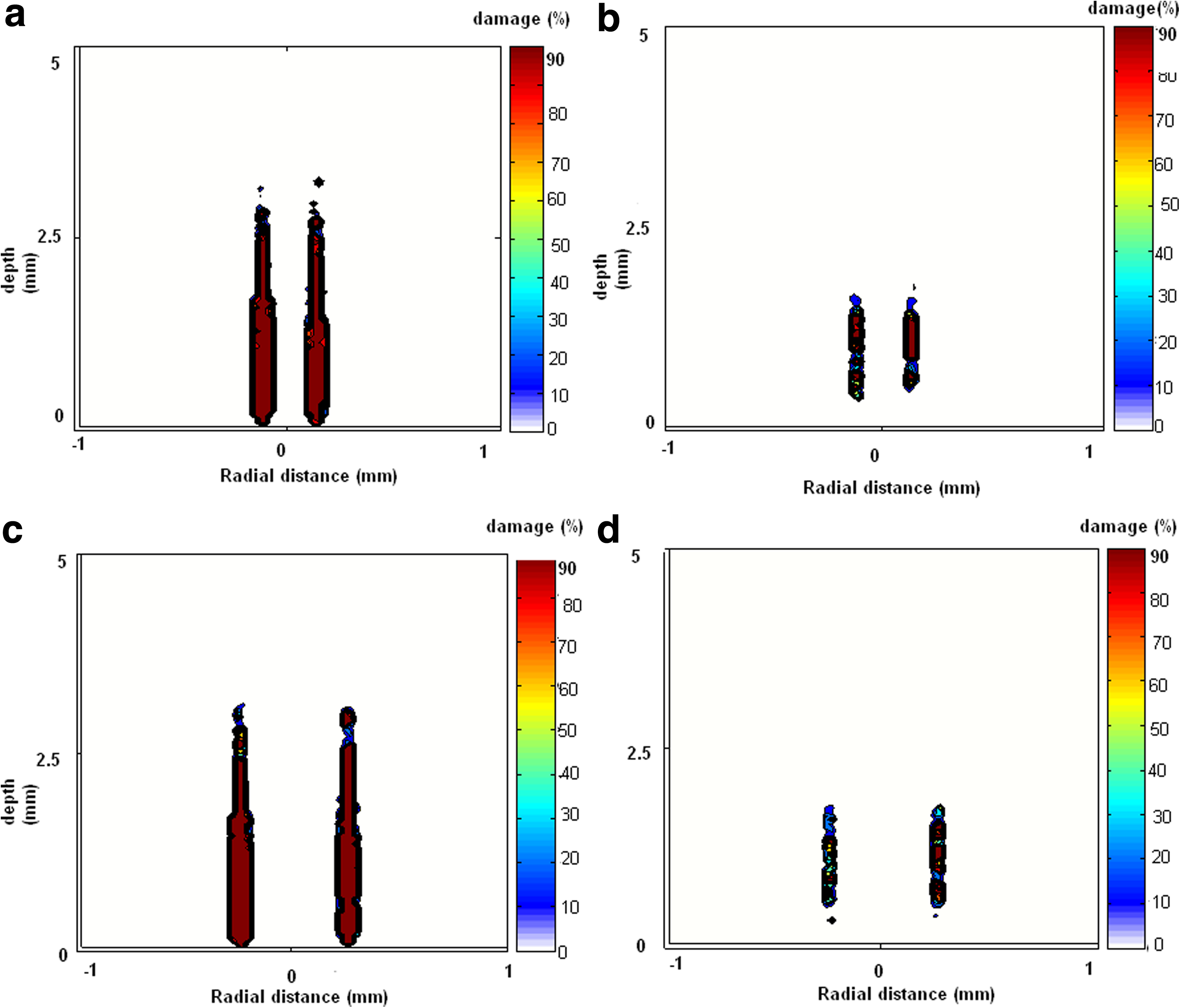
Thermal damage pattern of skin type III at the end of 810 nm laser pulse irradiation with 10 mm spot size, fluence 20 J/cm2
Regardless of pulse duration, when the distance between hair follicles is ≤0.5 mm, there is significant increase in thermal damage to interfollicular epidermis with high fluences compared with lower hair densities when the distance between hair follicles is ≥1 mm (Fig. 4 a and b). Therefore, lower fluences seem to be more appropriate to apply to prevent unwanted thermal damage to the interfollicular epidermis when diode hair-removal lasers for an anatomical site with high hair densities are used (Fig. 5 a and b). On the other hand, lengthening the pulse duration will protect the interfollicular epidermis from unwanted damage when the distance between follicles is>1 mm (Figs. 4c and d, and 5c and d).
Discussion
Laser-assisted hair removal is based on selective photothermolysis theory. The main choromophore in this process is melanin. It is found in both hair and epidermis. Therefore, during laser irradiation of hair, the absorption of laser energy by the melanin in the epidermis is inevitable. As there are various fractions of melanin in the epidermis or hair shaft according to different skin types or hair colors, simulating the pattern of thermal damage considering different skin and hair conditions caused by hair-removal lasers can be helpful for optimizing the treatment parameters. On the other hand, recent studies based on the extended theory of selective photothermolysis have shown that pulse durations longer than thermal relaxation time (TRT), are more appropriate for laser hair removal. 11,17 In this survey, as expected, we observed that different amounts of melanin content in epidermis and hair affected simulated thermal damage patterns significantly. Likewise, a similar effect was observed with different hair densities.
These simulation results showed that increasing the fluence causes a relevant increase in thermal damage both to the epidermis and the hair follicle in all skin types. Likewise, it was indicated that the amount of thermal damage to epidermis was greater in darker skin types by using higher fluences This considerable thermal damage was caused by the greater amount of total energy that is delivered to the tissue volume. Therefore, increasing the fluence to achieve better clinical outcomes, which is a common policy in daily practice of dermatologists, will definitely cause irreversible unwanted thermal damage to the epidermis, and as a result more side effects, especially in darker skin types (Fig. 1). In other words, by using higher fluences, the efficacy increases at the expense of increasing side effects. 13,23 –27
Using longer pulse durations was accompanied by effective thermal damage to the hair follicle, while preserving the epidermis in skin types II and III. These results agree with those of previous clinical trials. 7,24,25,27 –32].
However, in very dark skin, lengthening the pulse duration may not prevent thermal damage to the epidermis caused by high fluences (Fig. 2), and as there is limitation in selecting higher fluence in darker skin types, it could be suggested to use low to moderate fluences and at the same time longer pulse durations in order to prevent unwanted thermal damage, and at the same time compensate for the lost efficacy caused by lowering the fluence. These results are in agreement with the results of some clinical studies in which side effects such as erythma and edema were observed to be greater in darker skin types. 23 –26
As expected, lighter hair shafts have fewer melanin choromophores for absorption of laser light. Therefore using higher fluences (higher photon densities) will lead to more efficient thermal damage of hair follicle. On the other hand, while using longer pulse durations, higher fluences are needed in order to obtain the same level of thermal damage in hair follicles with low melanin contents as can be obtained with shorter pulse widths (Fig. 4). This agrees with what happens in clinical studies. 7,27,32
As is shown in Fig. 4a and b, regardless of pulse duration, when the distance between hair follicles is ≤0.5 mm, there is significant increase in thermal damage to interfollicular epidermis with high fluences compared with lower hair densities (interfollicular space≥1 mm). Therefore, lower fluences seem to be more appropriate when diode hair-removal lasers are going to be used for anatomical sites with high hair densities, in order to prevent unwanted thermal damage to the interfollicular epidermis (Fig. 5a and b). On the other hand, lengthening the pulse duration will protect interfollicular epidermis from unwanted damage when the distance of follicles is >1 mm (Figs. 4c and d, and 5c and d).
Our study has some limitations. For example, our target modeling is not ideal. Furthermore, we are putting the calculated parameters into an ex-vivo trial by skin samples for determining absorption coefficients of various skin types instead of calculating based on reference skin optics formulas; however, all of the data are not yet available. Therefore, these results show a rough estimation of what may happen during hair removal using diode laser (810 nm).
Conclusions
During hair removal in lighter skin types
Footnotes
Acknowledgments
The authors appreciate the financial support provided by Research Center of Science and Technology in Medicine, Tehran University of Medical Sciences.
Author Disclosure Statement
No conflicting financial interests exist.