




Abstract
Introduction
S
In the present study, we hypothesized that the sterile hydrogel dressing NeoHeal would facilitate cooling during laser-assisted oral surgery in a manner similar to what has been documented for dermatological surgery. 13,14 Also in laser-assisted oral surgery, thermal injures are a constant in the tissues treated by lasers. This is because of the photothermic effect of laser devices on soft tissues. At the point of incidence, the laser beam increases the temperature to >100°C, with vaporization of the tissue. Around this region, the thermal increase exceeds 50°C, creating an area of coagulative necrosis. In the most peripheral surrounding areas, the thermal damage is reversible, because the thermal increase is <50°C. 15 Therefore, the high water content of the NeoHeal matrix underlies its ability to absorb heat generated in situ during laser-assisted interventions of soft tissues. The aim of this study was to evaluate the possible beneficial effect of NeoHeal during laser-assisted oral surgery.
Methods
The study was approved by the University of L'Aquila Ethics Committee, after which patient recruitment began. Our study included 30 patients, with an age range from 26 to 40 years, and a mean age 32, each of whom provided a self-control, resulting in the evaluation of 60 samples: 30 test sites and 30 control sites (details are presented in the next paragraph). The study included only ambulatory patients who underwent removal of some overlying gum via a laser blade in both of the arches for prosthetic-implant purposes. The exclusion criteria were: (1) no need for laser surgery, (2) diagnosis of a mental illness, (3) being <18 years of age, and (4) lacking in general good health, referring to American Society of Anesthesiologists (ASA) Physical Classification System. For each patient, the decision of whether to use the left or right side of the oral cavity as the test site (i.e., NeoHeal used) or the site of oral surgery was selected according to a balanced randomized protocol, described as follows. If the right-side upper jaw was not treated with NeoHeal, then the left-side lower jaw served as the test site.
Surgical procedure
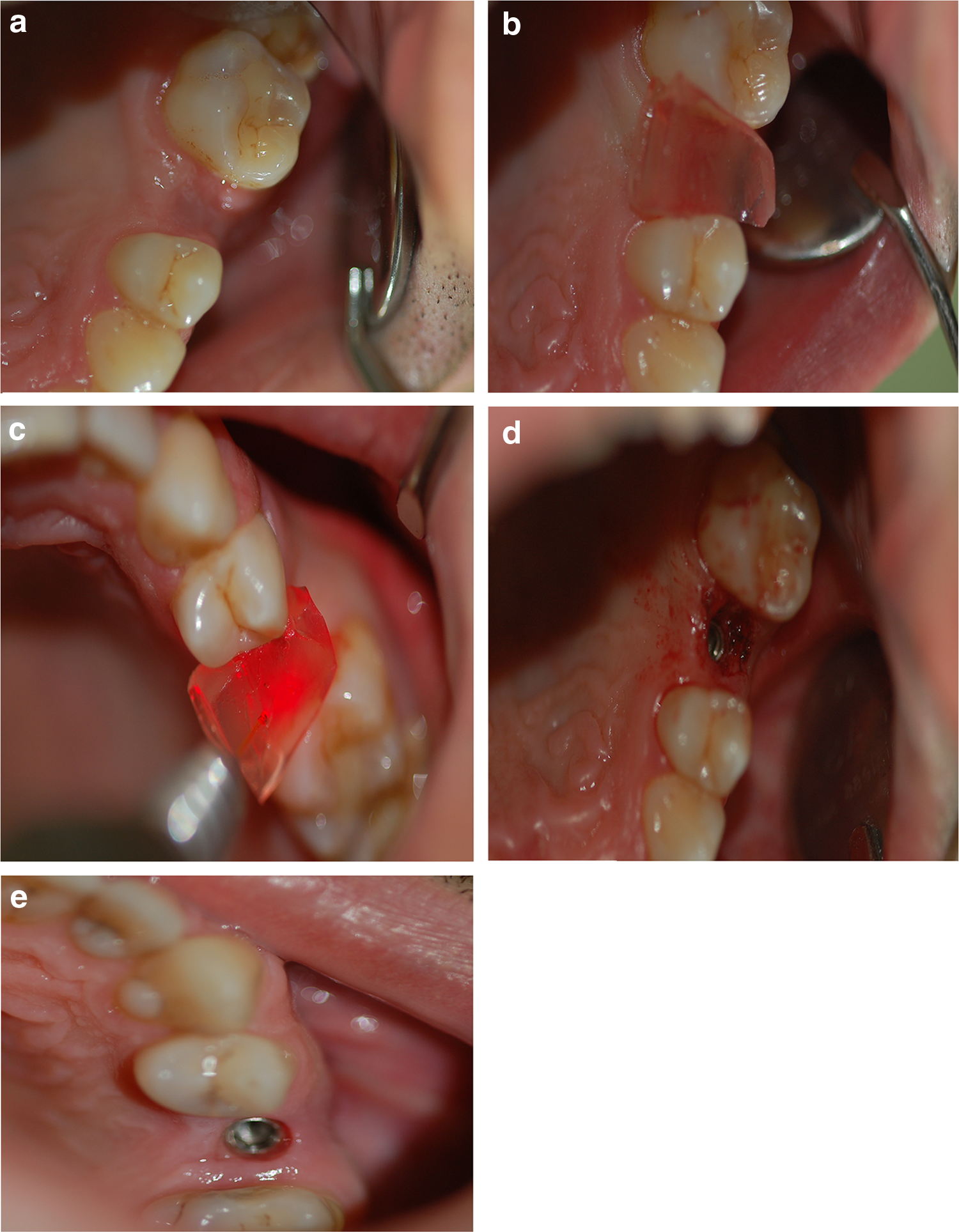
NeoHeal was obtained from Kikgel (Poland). A diode laser (SIROLaser, wavelength 970 nm) was used with the following settings: power, 3 W; mode, continuous wave; optical fiber dimensions, 320 μm. These parameters were the ones pre-installed in the machines for gingival surgery. Local anesthesia (Ubistesin 40mg/mL, with adrenalin 1:100.000 [3M ESPE]) was applied both in the test and control sites prior to the interventions. The laser cutting was performed through the hydrogel pad: the hydrogel pad was taken from its box with sterile clamps, cut with sterile scissors according to the needing, and held on the mucosa for the duration of the intervention (Fig. 1a–c). Soon after the surgical procedure, in both the test and control sites, the hydrogel pad was removed (Fig. 1d). In both of groups, the intervention lasted 15 min. The following two questions, in English translation, were asked of each patient immediately after surgery. (1) “Score your pain level felt during the intervention, on a scale from 0 to 5,” with 0 denoting no pain and 5 indicating intense pain. (2) “Would you judge your intervention comfortable or not comfortable?” The following two questions were asked at the 7 day follow-up. (1) “Score your pain level felt during the healing period, on a scale from 0 to 5.” (2) “Would you judge your intervention healing period as very good, good, or not very good?” The primary end-point was the answer to the first question immediately after the intervention, and the final end-point was the answer to the first question at the 7-day follow-up. The results were evaluated by descriptive statistical analysis (frequency of any given answer) and validated with a nonparametric test (Wilcoxon). The software XLSTAT version 2014.3.07 was used for statistical analysis.
Results
Considering the 30 test sites (i.e., NeoHeal used) and 30 control sites (NeoHeal not used), at the primary end-point, 20% of patients indicated they did not feel any pain when surgery was performed on their test site (i.e., NeoHeal used), whereas 100% of patients indicated that they felt pain during surgery on the control site (NeoHeal not used), even if the pain was not too intense. Regarding the pain score revealed, on the test site, 33.3% of patients responded that they experienced a pain level of 1 (minimal pain) after the intervention, 23.3% responded that they experienced a level of 2, 13.33% responded that they experienced a level of 3, and 10% responded that they experienced a level of 5. On the control site, 23.3% of patients responded that they experienced a pain level of 1, 10% responded that they experienced a level of 2, 20% responded that they experienced a level of 3, 10% responded that they experienced a level of 4, and 36.667% responded that they experienced a level of 5. For the final end-point, for the test site, 23.3% of patients responded that they did not experience any discomfort during the healing period. Concerning the control site, all patients experienced discomfort during the healing period (Table 1). All these data were subjected to statistical evaluation using the Wilcoxon test, and resulted in a statistically significant difference with a p value <0.05.
Results from the questionnaire, comparing the outcomes from the site tests and the control sites.
Wilcoxon test.
Discussion
Laser ablative and nonablative therapies involve the use of heat to remove a lesion. To date, clinicians (especially dermatologists) have sought cooling strategies to prevent damage to adjacent tissues. In this regard, synthetic-polymer hydrogels constitute a group of materials used in numerous biomedical disciplines. A hydrogel is made from a water-insoluble polymer that can absorb a large amount of water; that is, it is a water-swollen polymer network. 16 Hydrogels have been used in ophthalmology as contact lenses, in surgery as absorbable sutures, and in many other areas of clinical practice to treat illness such as diabetes, osteoporosis, asthma, heart disease, and neoplasms. 16
The hydrogel NeoHeal was used in our present study. NeoHeal is a type of dressing hydrogel made of natural and synthetic polymers and having >90% aqueous composition. The polymers used to make NeoHeal are polyvinylpyrrolidone, polyethylene glycol, agar, and purified water crosslinked and sterilized by gamma irradiation. NeoHeal is transparent, flexible, and mechanically strong enough even at a thickness of 3–4 mm. The flexibility and mechanic properties of NeoHeal are particularly useful for treating areas such as the face and zones around joints. Because NeoHeal is sterile and can actually bond to a wound, it serves as an efficient barrier against bacteria. These qualities make NeoHeal a good dressing for epithelial wounds in moist areas such as the oral cavity. Furthermore, considering that cells such as fibroblasts and/or neutrophils require a moist environment, this kind of hydrogel dressing may be a good solution for patients experiencing local inflammation or pain. Fibroblasts and the other cells can grow quickly so as to accelerate the process of granulation in the wound. In addition, NeoHeal has been reported to absorb wound secretions. 17 –21
Very few studies have been published concerning the use of hydrogels in clinical treatment and dermatology, and no such study has been published concerning laser-assisted dental surgery, in which diode lasers are the most widely used. In 2005, a multicenter study on the use of hydrogel pads in 330 patients reported that >80% of patients rated the hydrogel pad positively. 22
Interestingly, in the study by Meier and Dummer 22 , patients' satisfaction was reported to be greater for treatment of vascular lesions than for pigmented lesions. Intraoperative temperature gradients may explain this. In 2007, in their reply, Wright et al. 23 stated that, in these types of procedures, hydrogel pads reduce the transmission of incident laser light by ∼30%. This energy drop may be accounted for by reflection of laser light from either surface of the hydrogel pad as well as by absorption and scattering within it. In 2008, Bodendorf et al. 14 reported how their patients were very satisfied with the use of a hydrogel pad during laser treatment. In fact, 92.9% of assessments reported that patients stated being “very satisfied” or “satisfied” with treatment or finding it “acceptable.” Of the 37 patients who underwent multiple treatments, 10 rated hydrogel cooling as superior to cold-air cooling. Of the total of 97 treatments, one or more of the following events occurred a total of five times: a report of “some discomfort” or being “worse than cold-air cooling” or no desire to use a hydrogel pad in subsequent treatment.
In 2009, Cassuto et al. 24 reported how patients with dermocosmetic lesions who had undergone nonablative laser therapy were benefited by the use of the hydrogel pad, LaserAid, compared with a fluid gel. All patients experienced less local pain with LaserAid than with the fluid gel, and reported that the cooling effect of LaserAid was superior to that of the fluid gel. In 2013, Zeka et al. 13 reported use of NeoHeal in a case of successful lesion removal at the navel, a very difficult zone in which to perform surgery. In our study reported here, NeoHeal benefited patients undergoing laser-assisted oral surgery. They experienced little or no pain compared with the traditional technique, without the use of cooling aids. In addition, use of NeoHeal improved oral comfort immediately after the intervention and during the healing period.
Strength and limitations
The strength of this study is the novelty of the protocol used. There has been no report of a clinical study that utilized a hydrogel pad during laser-assisted oral surgery. Limitations include the small size of the patient group and the lack of histological assessment, to demonstrate that use of NeoHeal resulted in a lower level of damage to oral tissue.
Conclusions
Cooling aids are necessary to prevent collateral damage from heat generated during laser-assisted therapy. The hydrogel NeoHeal is a proven cooling device and is very useful for this purpose. Even though histological studies are needed to confirm the thermal shield properties of Neoheal on tissues, we may conclude that its hydrogel properties and high water content make it a very useful cooling aid for dental laser surgery. It clearly could be included in such protocols for better care of patients.
Footnotes
Acknowledgment
We thank the BiomEditor Service for reviewing the English article.
Author Disclosure Statement
No competing financial interests exist.