




Abstract
Introduction
F
Mineral trioxide aggregate (MTA) has been widely used as a repair material for furcal perforations and has shown successful results in several case studies with long-term follow-up. 7,8 MTA possesses numerous favorable properties that not only support its clinical use but also have some major disadvantages such as long setting time and tooth discoloration potential. 9 To overcome such drawbacks, Biodentine, a silicate-based cement, has been showing a number of favorable properties such as short setting time, high mechanical strength, and superior handling characteristics. 10,11 Therefore, Biodentine has been advocated for use in all endodontic indications for MTA, including the repair of endodontic perforations. 11
After perforation repair, different irrigation solutions can be used to disinfect the root canal system. 4 It has been shown that the inevitable contact of irrigation solutions with endodontic biomaterials might jeopardize the integrity and adhesion of set materials to dentin. 12 Therefore, it can be hypothesized that these adverse effects may inclusively be more pronounced following the use of device-assisted irrigation techniques that enhance the effect of irrigation solutions.
The use of laser-activated irrigation (LAI) produces transient cavitation effects in aqueous solutions through optical breakdown by strong absorption of laser energy. 13,14 Cavitation is the formation of vapor-containing bubbles inside a fluid. This process results in the induction of liquid agitation and shock waves in the irrigant might result in an in-depth cleaning and disinfection, 15 which renders it more effective than hand irrigation or passive ultrasonic irrigation in removing dentine debris from the apical part of the root canal. 16 Recent studies of LAI using an erbium, chromium: yttrium–scandium–gallium–garnet (Er,Cr:YSGG) laser at a wavelength of 2780 nm reported that this technique is able to remove the smear layer effectively 17 and enhances root canal disinfection 18 without causing damage to surrounding tissues. 19,20
Several studies investigated the adhesion of calcium silicate-based cements after exposure to endodontic irrigants, 4,21 but the effects of LAI on bond strength of such materials remain to be elucidated. Thus, the objective of the present study was to assess the push-out bond strength of ProRoot MTA and Biodentine after LAI. The null hypothesis tested was that LAI does not affect the push-out bond strength of ProRoot MTA and Biodentine, and there is no difference in the push-out bond strength of ProRoot MTA and Biodentine.
Materials and Methods
Specimen preparation
One hundred freshly extracted, sound, human mandibular molars with nonfused diverging roots were used. Root canal patency was confirmed with radiographs, and the teeth were decoronated 5 mm above the pulpal floor. Following endodontic access, the working length of each root canal was determined with 10 K-files by subtracting 1 mm from the canal length. The distal and mesial canals were enlarged up to ProTaper Next file size X3 (0.30 mm tip; Dentsply Maillefer, Ballaigues, Switzerland) and ProTaper Next X2 (0.25 mm tip), respectively. Then, the teeth were mounted in acrylic molds, leaving a 3-mm space beneath the root bifurcation for the placement of a gelatin sponge (Spongostan; Johnson & Johnson Medical Limited, United Kingdom) that would act as a matrix to pack the tested repair materials against. 22
Cylindrical perforation defects were prepared in the center of the pulp chamber floor by using a high-speed, water-cooled, size 3 round diamond bur. The defects were instrumented with Gates Glidden burs (Dentsply Maillefer) #2 to #5 so as to reach a standardized diameter of 1.3 mm. The height of defects was adjusted to 2 mm using a wheel-shaped diamond bur (Dentsply Maillefer). The chamber and perforations were flushed with distilled water and dried. The specimens were randomly divided into two groups of 40 teeth each according to the repair cement: (1) ProRoot MTA or (2) Biodentine. The cements were mixed according to the manufacturer's recommendations, carried into the perforation defects using an MTA gun (Dentsply Maillefer), and compacted with a hand plugger (Dentsply Maillefer).
The specimens were stored at 37°C and 100% humidity for 1 week. Thereafter, the specimens were further subgrouped according to the irrigation regimens applied (n = 10/subgroup): (a) 5 mL of distilled water per root canal using needle irrigation with a 30-gauge NaviTip FX (Ultradent Products, Inc., South Jordan, UT) needle. The needle tip was placed ∼1 mm from the apex; (b) 5 mL of 5.25% NaOCl per root canal, utilizing needle irrigation as in group 1, and (c) needle irrigation with distilled water as in group 1 for 15 sec, followed by LAI for 15 sec using Er,Cr:YSGG laser (Waterlase; Biolase Technology, Irvine, CA) with a wavelength of 2780 nm, a pulse energy of 25 mJ, 140-μs pulse duration, and 20 Hz repetition rate with no air or water. The laser tip, RFT 3 (calibration factor of 0.85, diameter 415 lm, length 17 mm) (Endolase; Biolase Technology), was positioned 5 mm apically from the orifice.
To ensure standardized and stable power outputs, a power meter (FieldMaster, Coherent, Inc., Au-burn, CA) was used to calibrate the output powers before each irradiation. The water was not aspirated from the canal, thus laser irradiation was always performed within an irrigant-filled canal. The cycle (distilled water for 15 sec, followed by LAI for 15 sec) was repeated four times. The total volume of irrigant was 5 mL, and the total treatment was 2 min; 23 (d) LAI was performed using 5.25% NaOCl as in subgroup (c) and (e) control group (no irrigation).
Push-out test
Loading was applied on test materials by using a universal testing machine (Instron, Model 1334; Instron Corp., Canton, MA). A cylindrical stainless steel plunger of 1 mm diameter, operating at a crosshead speed of 1 mm/min, was used to apply force on the materials (Fig. 1). The load was applied to the material from the apical to the coronal direction until bond failure occurred. The bond strength values were then converted to megapascals (MPa) by dividing the load in Newtons (N) by the area of calcium silicate cement.
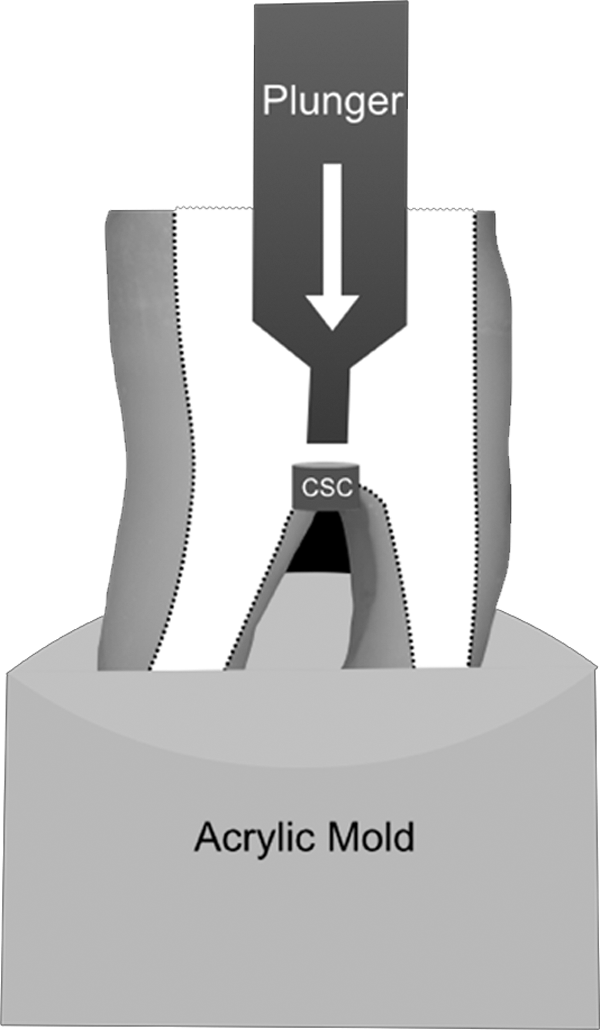
Schematic representation of the push-out test. Arrow indicates direction of stainless steel plunger. CSC, calcium silicate-based cement.
Statistical evaluation
Bond strength values were analyzed using SPSS v11.5 software (SPSS, Inc., Chicago, IL). Multi-variate analysis of variance (ANOVA) was used to determine the effect of different factors: irrigation solutions (NaOCl and saline), calcium silicate cements (ProRoot MTA and Biodentine), and irrigation techniques (needle irrigation and LAI). One-way ANOVA and Tukey's post hoc tests were applied for multiple comparisons (p < 0.05).
Results
The push-out bond strength (MPa) values of the test and control groups are presented in Table 1. Irrespective of the irrigation solutions and protocols, Biodentine yielded significantly higher push-out bond strength than ProRoot MTA (p < 0.05). Compared with control (no irrigation), exposure of the cements to NaOCl and distilled water solutions did not significantly affect the push-out bond strength values (p > 0.05). Likewise, laser activation of NaOCl and distilled water had no significant effect on the dislocation resistance of Biodentine and MTA (p > 0.05).
The values are as mean ± SD. Different superscript letters indicate significant differences.
LAI, laser-activated irrigation; MTA, mineral trioxide aggregate; SD, standard deviation.
Discussion
An ideal furcal perforation repair material should adhere to the dentin walls and resist dislodging forces such as tooth flexion during function and mechanical forces of condensation of restorative materials over the repair site. 24 To assess the adhesion of dental materials in vitro, the push-out bond strength test has been shown to be efficient and reliable as the test conditions can be comparable with clinical situations. 25,26 In the present study, the bond strength of ProRoot MTA and Biodentine to the furcal tooth structure was tested using the push-out bond strength test. NaOCl was used for laser activation because it is the most widely used irrigation solution. However, it should be cautioned that solutions such as EDTA also merit further investigation due to their potential interactions with inorganic materials. 27
The present results reject the second null hypothesis as Biodentine showed better dislocation resistance than ProRoot MTA in control groups and in both LAI and manual irrigation protocols. This result is similar to previous studies showing that Biodentine, in the absence of the present irrigation challenge, had higher bond strength than ProRoot MTA. 21,28,29 The higher bond strength values of Biodentine may result from its smaller particle size, which could enhance penetration of the cement into dentinal tubules, leading to improved bond strength. 21 Such micromechanical retention could be further reinforced through crystal growth within the dentinal tubules. 30 Finally, the higher content of calcium-releasing products in Biodentine may contribute to increased biomineralization rates and consequently bond strength. 21,31 Compared with the results from previous studies, 21,32 both Biodentine and MTA showed higher push-out bond strength values in the present study. A recent study indicated that thicker specimens had higher resistance to dislodgement. 33 Our study is in agreement with such results as the cement layer thicknesses are considerably greater (2 mm) than that of a regular push-out specimen (i.e., 0.5–1 mm) owing to the applied test design.
The Er,Cr:YSGG Laser has demonstrated to be effective regarding smear layer removal and disinfection. 17,18,34 In previous studies, LAI was performed before obturation, which resulted in higher bond strength values associated with the cleaning efficacy of LAI on root canal walls. 35 –37 Such cleaning efficacy is based on producing transient cavitation in liquids by laser activation at subablative levels, which results in formation of vapor bubbles that expand and implode with secondary cavitation effects. 38 In contrast to those studies, 35 –37 the effect of LAI on repair endodontic materials has not been tested. From this point of view, the present study was designed to investigate the effect of LAI on set calcium silicate-based cements. According to the present results, the first null hypothesis should be accepted because LAI did not alter the push-out bond strength values of the tested cements.
In this study, the bond strength values of both the LAI and control groups (manual irrigation) corroborate with those of a previous study, which reported that the push-out bond strength of ProRoot MTA and Biodentine was not significantly different when immersed in NaOCl and saline solutions. 21 It is well known that the prolonged time of exposure to the irrigants and the number of contact surfaces of the material with irrigants may cause alterations in the chemical composition of dentin, 39,40 and this may affect the bond strength. The present results can be explained by the relatively short irrigation time (2 min) and less contact surface of the material (coronal surface of perforation) with the irrigation solutions. In a study by Christo et al., 23 the antibacterial effect of low concentrations of sodium hypochlorite (i.e., 1%) was considered ineffective against Enterococcus faecalis biofilms with a total LAI time of 2 min, while for higher concentrations (4%), the duration of 2 min was significantly more effective, which justifies the present utilization of a 2-min treatment time. Undoubtedly, future studies should test different protocols.
Conclusions
Within the experimental conditions of the present study, the following conclusions can be drawn: (1) in furcation defects, Biodentine yielded greater dislodgement resistance than ProRoot MTA and (2) laser-assisted irrigation has no adverse effect on the push-out dentin bond strength of Biodentine and ProRoot MTA, independently of the irrigation solutions. The potential effects of other irrigation solutions as well as their effect on sealing properties of repaired furcal perforations remain to be investigated.
Footnotes
Author Disclosure Statement
No competing financial interests exist.