




Abstract
Objective:
To compare the effects of photobiomodulation therapy (PBMT) and extracorporeal shock wave therapy (ESWT) on lateral epicondylitis (LE).
Background:
Although several authors have investigated the effects of PBMT and ESWT on LE, only one study to date has compared ESWT with PBMT. Ours is also the first study assessing patient satisfaction levels and quality of life in addition to comparing the two methods.
Methods:
Forty-three patients were randomly divided into two groups: 23 (mean age: 48.2 ± 9.4; 17 female, 6 male) were included in the PBMT group and 20 (mean age: 48.0 ± 9.9; 15 female, 5 male) in the ESWT group. PBMT was applied three times a week for 4 weeks, and ESWT once a week for 4 weeks. Stretching and eccentric strengthening exercises were also given to both groups as a home program. The Mayo Elbow Performance Score and disabilities of the arm, shoulder, and hand (DASH) were used for evaluating upper extremity functions. Pain intensity was evaluated using a visual analog scale (VAS), and muscle strengths were also assessed using a hand-held dynamometer. The 12-Item Short Form (SF-12) Survey Physical and Mental Component Scales were used to evaluate quality of life, and the global rating of change scale to evaluate patient satisfaction. Patients were assessed before treatment and at 12-week follow-up.
Results:
Improvements for elbow extension and shoulder flexion strength and for VAS movement were observed only in the PBMT group, whereas improvement of handgrip strength was present in both groups (p < 0.05). However, handgrip strength was superior in the PBMT group than in the ESWT group (p = 0.02).
Conclusions:
Both PBMT and ESWT are useful and can be used in the treatment of LE.
Introduction
Lateral epicondylitis (LE)
Various therapeutic methods are available for the management of LE, but there is no consensus on which is best. Many nonoperative methods have been proposed for LE, including resting, cold, physiotherapy, nonsteroidal anti-inflammatory drugs, steroid injection, exercise therapy, orthosis, platelet-rich plasma injection, prolotherapy, botulinum toxin injection, and surgical treatment. 5 –7
Extracorporeal shock wave therapy (ESWT) and laser therapy have recently become very popular. Photobiomodulation therapy (PBMT), with a range of variations, is generally used in clinical practice. 8 –14 Numerous systematic reviews have been published concerning the effectiveness of laser therapies, but inconsistent results have been reported. 5,15
ESWT exhibits direct effects on the calcification of tissues, cell activity alteration throughout cavitation, acoustic microstreaming, altered cell membrane permeability, on nociceptors throughout hyperstimulation, and blocking control of the gate mechanism. 15 Both methods have been widely used for many musculoskeletal conditions. However, ESWT is more expensive and less commonly used than PBMT. The purpose of this study was to compare ESWT with PBMT in terms of pain, function, quality of life, and muscle strength, and to investigate patient satisfaction in terms of the treatment of LE.
Materials and Methods
Subjects
Patients presenting to the Istanbul University Department of Orthopedics with LE-related pain between September 2012 and September 2013 were included in the study. Two orthopedic surgeons confirmed the diagnosis.
Inclusion criteria were (1) patients' age (between 18 and 60 years), (2) tenderness at palpation of the anterior epicondyle, (3) Cozen test positivity, (4) pain with resisted wrist or middle finger extension with the elbow in extension, (5) pain persisting for at least 6 months, and (6) previous conservative treatments (at least 12 weeks since the latest conservative therapy). Exclusion criteria were (1) previous treatment with PBMT or ESWT, (2) a pain score <30 mm on the visual analog scale (VAS), (3) evidence of elbow bursitis or articular or synovial pathologies, or signs of elbow laxity or instability, (4) acute infection of the soft tissues or the bones adjacent to the area of treatment, and (5) any neurological or specific orthopedic problem in the upper extremity.
Fifty-nine consecutive patients admitted to department of orthopedics were screened for possible inclusion. After exclusion, 52 patients were randomly divided into PBMT and ESWT groups (26 patients to each group) (Fig. 1). A computer-generated randomization list was created and patients were assigned to PBMT or ESWT group by the computer. Sequentially numbered opaque sealed envelopes containing cards based on a randomization list were prepared by an independent research assistant. Priori concealed allocation was conducted by another researcher who was unaware of interventions and did not participate in the treatment process or analysis of the study.

Flow chart. ESWT, extracorporeal shock wave therapy; PBMT, photobiomodulation therapy.
Randomized patients received physiotherapy during the study period until hospital discharge according to the intervention they were allocated. The patients were unaware of the treatment program of the other group and blinded to group allocation. All subjects were informed about the content of the study before enrollment. The Institutional Review Board of the Istanbul University, Faculty of Medicine Department of Orthopedics approved the study procedures (2011-894-264).
Photobiomodulation therapy
The hypothesized effect mechanism of PBMT involves altering cellular function without significant temperature changes exceeding ±0.5°C inside cells and bacteria after irradiation at particular wavelengths. A 3B laser of M 1000 was used in this study (Level of Laser Co., Moglano Veneto in Milano, Italy) (Fig. 2). Ga-As was the medium activation of the laser. The continuous wavelength mode was set at 904 nm, the frequency level at 50 Hz, the power intensity on the skin at 40 mW, the spot size at 0.5 cm2, 50% was the cycle of the duty, and the energy density at 2.4 J/cm2. 1 The probe resting time on the lateral epicondyle was 1 min, and six areas were irradiated over the facet. 10 The irradiation area size was set at 3 cm2.
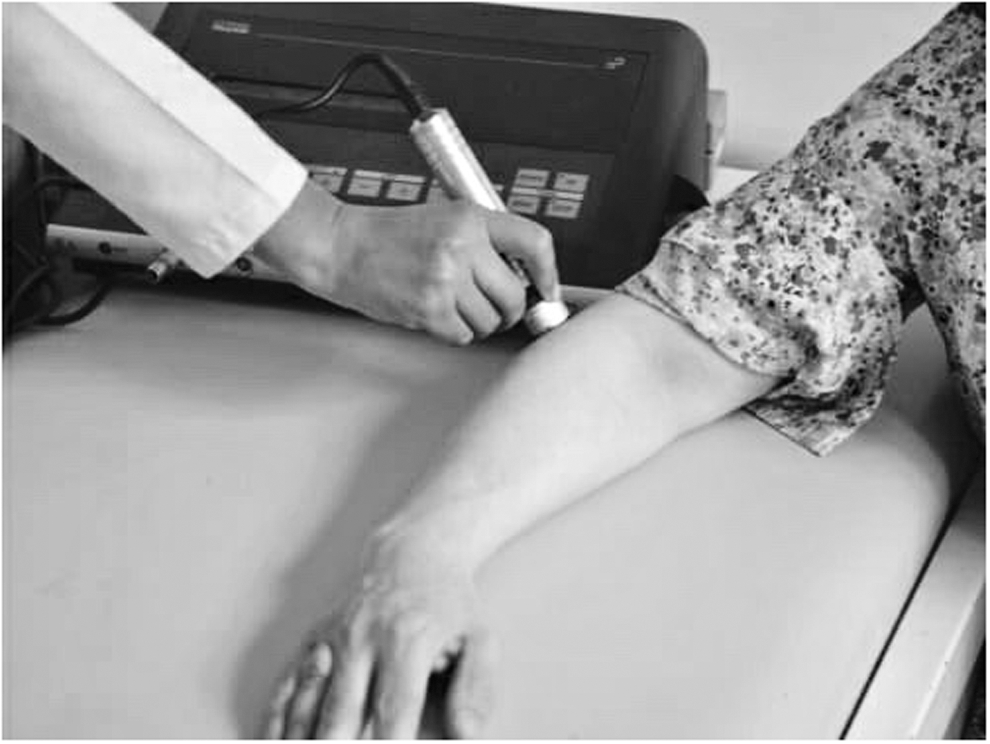
The application of PBMT. PBMT, photobiomodulation therapy.
During the procedure, the patient was in a relaxed seated position with the elbow resting on a bed or a table. The area of application was cleansed with alcohol before the PBMT procedure.
Extracorporeal shock wave therapy
In this study, low-dose focused ESWT was performed by an experienced physiotherapist using a cylindrical coil electromagnetic generator with a lithotripter (Epos Ultra-Dornier). All patients were positioned with the elbow at a flexing level of 90° in the supine position. The shockwave applicator was positioned vertically to the lateral epicondyle. The treatment area was determined based on the locus of maximum pressure pain. Two thousand pulses with energy of 0.09 mJ/mm2 were applied based on toleration of pain for each patient and therapy at the maximum level.
Eccentric exercises
Both groups performed eccentric exercises for the wrist extensor muscles. The patients performed eccentric exercises lying on a bed with the elbow fully extended, the wrist supported on the bed, and the forearm in the pronation position. While in this position, before returning to the start position, patients would be flexing the wrist slowly until achieving full flexion, and were encouraged to maintain this even in the event of mild pain. Three sets of repetitions of 10–15 exercises were performed at each treatment session, with a rest interval of at least 1 min between each set. In the event of mild pain occurring during the eccentric exercise, the weight was reduced.
Stretching exercises
With the elbow in extension, the forearm in pronation, the wrist in flexion, and with ulnar deviation of the wrist, the extensor carpi radialis brevis tendon was stretched three times for 30 sec before and after the eccentric exercises, during each treatment session with a 30- to 40-sec rest interval.
Outcome measurements
Pain
The VAS score was used to indicate pain severity. Patients were asked to indicate the most severe pain during resting and movement along a 10-cm line, with “0” indicating no pain and “10” indicating the worst pain. 16
Function
Upper extremity function was evaluated using the disabilities of the arm, shoulder, and hand (DASH) questionnaire and the Mayo Elbow Performance Score (MEPS). 17,18 DASH questionnaire is a 30 item-scale of disability symptoms pertaining to the upper extremity used for assessing the health status of a patient. Scores of all items were added to produce a score ranging from 0, indicating no disability, to 100, indicating the most severe disability. The MEPS is a tool for measuring the patient's ability to perform functional tasks, stability, pain, and range of motion. Total possible MEPSs range between 0 and 100, with higher scores indicating better function.
Short Form-12
12-Item Short Form (SF-12) is a shortened from of the SF-36 Health Survey and consists of 12 questions intended to measure health status and well-being from the patient's point of view. The SF-12 embedded and used 12 questions from the SF-36 to determine patients' Physical Component Score (PCS) and Mental Component Score (MCS). 19
Patient satisfaction
The global rating of change (GRC) scale quantifies a patient's improvement or deterioration over time, and identifies the effect of an intervention or charts the clinical course of a condition. The patient selects between “much worse,” “slightly worse,” “stayed the same,” “slightly better,” and “much better.” 20
Muscle strength
A hand-held dynamometer (HHD; kg/N; '“Nicholas Manual Muscle Tester” model 01160; Lafayette Instrument Company, Lafayette, IN) was used to measure the strength of the wrist, elbow, and shoulder muscles. Patients were allowed one practice session to become familiarized with the test procedure. Before asking patients to contract their muscles, a resistive force was applied using the HHD in the opposite direction of the intended movement. 21 The maximum isometric muscle strength was recorded as kg/N. Each muscle was assessed three times, and the mean value of these was calculated.
Wrist extension and flexion strength
The device was placed lengthwise on a reference line between the acromion and the lateral epicondyle of the humerus. The HHD was placed with a force pad 2 cm proximally to the wrist with the arm fully extended.
Elbow extension and flexion strength
The tested arm was positioned beside the trunk, with the elbow flexed at 90°, the forearm in neutral supination, and the wrist in neutral flexion, and with the patient in a supine position. To assess the elbow flexor muscles, the HHD was placed on the radial surface of the wrist joint, while to assess the elbow extensor muscles, the device was placed on the ulnar surface of the wrist joint.
Shoulder flexion strength
The shoulder was positioned in 90° forward flexion with the patient in a seated position, and resistance was applied from just above the elbow. The patient was asked to resist the force applied with the HHD.
Gross grip strength
Handgrip strength was assessed using a Jamar HHD, with the subject sitting on a straight-back armless chair with both feet flat on the floor. The participant's forearm was placed in 90° of flexion. For standardization purposes, the device was set at the second handle position for all subjects. When the dynamometer was brought into line for the correct position, subjects were asked to squeeze the handle as hard as they could. Patients performed three trials for each hand. At least 30 sec were allowed to pass between each. Scores were recorded to the nearest kilogram, and the mean score of the three trials was recorded. 22
Sample size
A minimum requirement of 26 subjects per group was identified based on power analysis using standard deviation of 2.5 cm for VAS, a difference in pain intensity between groups of 2 cm on VAS, an alpha level of 0.05, and power set at 80%. 23
Procedure
All outcome measurements were completed before, end of treatment period (4 weeks), and after 12 weeks of treatment. Patients who were prescribed a nonsteroidal anti-inflammatory drug (NSAID) before enrollment in the study were instructed not to take the medication. PBMT was applied three times a week for 4 weeks, and ESWT once a week for 4 weeks. Eccentric exercises were performed as three sets of 10 repetitions at each treatment session, with a minimum 1 min rest interval between each set, once a day. To control the activity level, all subjects were issued a limited-duty physical profile that excused them from performing wrist activity. Subjects were instructed to perform a home exercise program including extensor carpi radial stretching exercises and range of motion exercises for the shoulder and elbow.
Data analysis
Statistical Package for the Social Sciences 20.0 for Windows was used to evaluate the data and analyze descriptive statistics such as mean, standard deviation, and frequency. Distribution of data was assessed using the Shapiro Wilk test. The study data were found to be normally distributed, and a parametric test was, therefore, used for statistical analysis. Chi-square analysis for categorical variables was used for demographic comparisons between the two groups. The independent t-test was used to analyze continuous variables. Mean outcomes and 95% confidence intervals were calculated for continuous variables at baseline and follow-up.
Intragroup comparison was analyzed by pairwise comparison. Repeated measure analysis of variance (ANOVA) was conducted to compare for the dependent variables (each of outcome measures) between treatment groups (ESWT and PBMT groups), with the between-subject factor of time (preintervention, postintervention, and 12 weeks follow-up) as the repeated factor. The alpha level was set at 0.05 for all between-group comparisons. An intention-to-treat analysis was held with multiple imputations for each missing value.
Results
The median duration of symptoms was 8.2 months (range, 6–10). No difference was determined in the baseline characteristics of age, gender, dominant side, and the side involved between the groups (p > 0.05) (Table 1). The pairwise comparison pre- and postintervention results revealed improvements in elbow extension (p = 0.01), and shoulder flexion strength (p = 0.04) and VAS movement (p = 0.01) in the PBMT group only. The post-intervention for 12 weeks follow-up results showed that handgrip strength was significantly improved in both groups (Table 2).
Demographic Data of the Patients
Values expressed as mean ± SD or n.
t-Test for between-group comparison
Chi-square test for between-group comparison.
ESWT, extracorporeal shock wave therapy; L, left; PBMT, photobiomodulation therapy; R, right; SD, standard deviation.
Intragroup Comparison in Both Groups
Pairwise comparison between preintervention and end of treatment.
Pairwise comparison between end of treatment and 12-week follow-up.
p < 0.05.
DASH, disabilities of the arm, shoulder, and hand; ESWT, extracorporeal shock wave therapy; MEPS, Mayo Elbow Performance Score; PBMT, photobiomodulation therapy; SF-12 MCS, Short Form 12 Questionnaire Mental Component Score; SF-12 PCS, Short Form 12 Questionnaire Physical Component Score; VAS, visual analog scale.
A 2 × 3 repeated measure ANOVA has revealed that patients receiving ESWT demonstrated a greater increase in handgrip strength (F = 4.95, p = 0.02) (Table 3). According to GRC, all patients in the PBMT group reported feeling better or much better. Five patients in the ESWT group reported no change, and 18 patients reported improvement compared with pretreatment status (p = 0.29).
Outcome Measurements at Pre-Intervention, End of Treatment, and 12-Week Follow-Up
Repeated measure analysis of variance, p < 0.05.
DASH, disabilities of the arm, shoulder, and hand; ESWT, extracorporeal shock wave therapy; MEPS, Mayo Elbow Performance Score; PBMT, photobiomodulation therapy; SF-12 MCS, Short Form 12 Questionnaire Mental Component Score; SF-12 PCS, Short Form 12 Questionnaire Physical Component Score; VAS, visual analog scale.
Discussion
The aim of this study was to compare the effectiveness of ESWT and PBMT on pain at rest, pain at movement, grip strength, wrist, elbow and shoulder strength, health status, patient satisfaction, and upper extremity function during a 12-week follow-up period. The only significant difference between the two groups was observed in the form of better handgrip strength in the ESWT group.
PBMT has been available for nearly three decades, and various positive results have been countered by negative trial findings. 24 Bjordal et al. reported that combining PBMT and exercise is an effective alternative to corticosteroid injections and NSAID use. 24 In this review, they suggested that PBMT in the same wavelength (904 nm) as implemented during our study was safe and effective for the treatment of LE.
Chung et al. 25 reported that PBMT is more effective than traditional Chinese medicine in the treatment of LE. Ultrasound and PBMT have also been described as potentially effective in LE. 26 One recent systematic review reported that the effectiveness of PBMT in the treatment of LE is inconclusive. 27 This result is due to the inclusion of the studies with small sample size and high risks of bias and the outcomes of studies based on quantitative pooling of heterogeneous interventions tested in heterogeneous populations.
We assumed that these risks have been minimized in our study as much as possible, because of being a randomized controlled study with sufficient number of samples. Also, we attribute these conflicting results to variations in laser parameters such as wavelength, energy density, and intensity used in different studies. 28
The effect of PBMT has been compared with placebo PBMT, other electrophysiological agents, or exercises in a number of studies. 1,10,12,29,30 Okuni et al. and Morimoto et al. evaluated only the effectiveness of PBMT without comparison with a placebo group or other therapeutic options. Both studies concluded that PBMT was effective in treating pain. 29,30
Exercise program is the most common treatment approach for LE. 31 The benefits of stretching and strengthening exercises of wrist extensors and eccentric exercises for the prevention and rehabilitation in LE have been shown. 32 Isometric, isotonic, and static stretching exercises of extensor carpi radialis brevis were recommended by Stasinopulos. 32 The addition of supinator strengthening was proposed. 33 Sterigioulas et al. suggested that a combination of PBMT and plyometric exercises was more effective than placebo PBMT. 1
We included strength training in both our study groups, because LE affects not only handgrip strength but also wrist, elbow, and shoulder muscle strengths. Similarly, it has been reported in a recent study that rotator cuff and scapular muscles strengthening is also needed. 34 In addition, stretching exercises help to reorganize the collagen fibers of the extensor carpi radialis brevis tendon. 32 However, the strengthening and stretching exercises may have prevented us from observing the individual effectiveness of PBMT or ESWT.
Several systematic reviews have been conducted to document the effectiveness of ESWT on LE. 5,15,26,35,36 Buchbinder et al. concluded that ESWT may not be more effective than placebo in improving pain and function, and may be less effective than injected corticosteroids in LE. 5 Seven of the studies reported negative and 10 studies positive results of ESWT on LE in a systematic review by Thiele et al. 35 The authors concluded that there are significant differences in terms of interventions and patient groups among these studies. 37 Some of the studies included patients with acute epicondylitis receiving short-term follow-up, whereas others included chronic epicondylitis, but also used local anesthesia. Nevertheless, the authors still concluded that there is still a significant indication for ESWT despite these conflicting data. 5,15,35 –37
More recently, Weber et al. reported that ESWT is not more effective than placebo. 36 Dingemanse et al.'s 26 findings were similar to those of Weber et al., again indicating conflicting evidence for the effectiveness of ESWT versus placebo at short-, mid-, and long-term follow-up. Yalvaç et al. compared the efficacy of ESWT and therapeutic ultrasound in the treatment of LE. They found that ESWT was as effective as ultrasound in terms of improving pain level, grip strength, functional status, and quality of life, but is not superior to ultrasound. 38 Most of the studies included in these reviews compared ESWT with placebo ESWT, local injections or physical therapy.
In this study, 2000 pulses were administered with an energy level of 0.09 mJ/mm2, which is well tolerated by patients. ESWT successfully improved only three parameters: handgrip, pain, and DASH. In addition, handgrip improved significantly more than in the PBMT group. Only one previous study compared PBMT with ESWT in a manner similar to our study. The PBMT parameters in that research were 850 nm wavelength, 500 Hz frequency, 3.6 J intensity, and 40 sec in each session, which differed from those in our study. However, both studies used a very similar ESWT application, with 2000 pulses once a week.
In agreement with our study, Devrimsel et al. 37 concluded that ESWT and PBMT are effective and safe treatment options for LE. Our principal finding was that ESWT is superior to PBMT for handgrip, but that the magnitude of benefit of ESWT compared with PBMT was not particularly high.
Our study has a number of strengths. First, we think that LE affects not only the elbow muscles but also all the arm muscles that are not efficiently used by the patient because of pain. We, therefore, included wrist and shoulder muscle strengths in our study. Second, pain prevents the affected arm being used effectively in daily activities, and this, in turn, affects patients' quality of life. The assessment of quality of life is, therefore, important in evaluating the effectiveness of the treatment. Ours is also the first study to assess quality of life in addition to comparing the two methods. Third, the evaluation of patients' satisfaction levels has today become an issue of particular importance. Ours is the first study to evaluate LE patient satisfaction with different therapies. If both treatments achieve cures, then it is important which treatment satisfies the patient more.
There are also some limitations of our study. In particular, there was no control group because we did not aim to compare the superiority of methods to control subjects. The purpose of this study was to compare the most frequently used two modalities. Including a control group could help to determine how natural course of the disease might have affected similar levels of improvements in both groups. Future studies including a control group without any intervention or a placebo group to increase the strength and the level of evidence of the study should be designed.
The results of this study are also limited to subjects with chronic LE. In addition, due to the relatively short follow-up period, we were unable to assess the long-term effectiveness of the two treatment methods. Clinical trials including control groups, larger sample sizes, and long-term follow-up are now needed to compare the efficacy of ESWT and PBMT in patients with LE.
Conclusions
Subjects with LE and a clinical diagnosis of pain, weakness, and disability demonstrated a short-term improvement in handgrip strength after ESWT. No other significant differences were observed between the treatment groups. Both therapeutic options can be used in the treatment of LE. However, PBMT is a more cost-effective procedure than ESWT. Clinicians may, therefore, consider using PBMT to assist in short-term treatment of LE.
Footnotes
Author Disclosure Statement
No competing financial interests exist.