




Abstract
Objective:
The purpose of this study is to investigate the effect of various presintering and sintered surface treatments and thermocycling on the bond strength between zirconia and veneer ceramics.
Background data:
Bond stability between zirconia and veneer ceramic is a major concern, and only limited evidence about its longevity is currently available. Moreover, no study has yet evaluated the influence of thermocycling on the bond strength of veneer ceramic to zirconia after Er,Cr:YSGG laser irradiation at different pulse durations and sandblasting.
Materials and methods:
In this study, 220 nonsintered zirconia specimens were prepared with CAD/CAM and randomly divided into 2 groups; half of the specimens in each group were stored in water for 1 week, and the other half were thermocycled (5000 cycles) between baths of 5°C and 55°C. Specimens were then divided into five subgroups based on the following surface treatments: control (untreated surface), sandblasting (120 μm Al2O3), and Er,Cr: YSGG laser irradiations (3 W–8 Hz, 3 W–15 Hz, and 3 W–20 Hz, MGG 6 laser tip, for 20 sec, distance of 10 mm, water/airflow of 55% and 65%). Morphological assessment was done using atomic force microscopy and scanning electron microscopy, and phase transformation was assessed by X-ray diffractometry. All specimens were then veneered with veneering ceramic, and bond strength test using a universal testing device at a 1 mm/min crosshead speed. Data were evaluated by Kruskal–Wallis variance analysis and the Mann–Whitney U test.
Results:
There was no significant difference in the bonding strength values among the (p > 0.05). Thermocycling reduced the bond strength, but it was not significant (p > 0.05), except for the presintering 20 Hz group (p < 0.02).
Conclusions:
Application of thermocycling to sintered zirconia specimens may be detrimental to the shear bond strength of zirconia ceramics. Treating the zirconia surface after sintering is not recommended, due to the decrease in bond strength.
Introduction
Zirconia attracts wide use as a substructure material due to its unique structural properties, such as chemical stability, biocompatibility, high compressive strength, and thermal expansion coefficient, similar to hard dental tissues, and its superior esthetic performance. 1,2 However, as a solid polycrystalline structure that lacks a glassy phase, zirconia has an opaque appearance, which affects esthetics, so the zirconia substructure must be covered with a suitable veneer ceramic. 3
The bond between zirconia and veneer ceramic depends on several factors, including the chemical bonding, mechanical clamping, wetting behavior, thermal expansion coefficient, and the glass transition temperature differences. 4 It has been reported that the bonding between zirconia and veneer ceramics occurs mechanically rather than via chemical bonding and that the rough areas formed on the surface of zirconia are one of the most important factors in bonding. 5 Many studies have been done to examine this interface bonding mechanism. 6 –9 The fracture rates of zirconia veneering ceramics have been documented as 15% for Dental Concept Systems (DC-Zircon®)-based restorations at 2 years, 13% at 3 years, and for 56 Lava-based restorations at 31 months. 10 –12 As also noted in the clinical trials, the failure of the zirconia core/veneer bond is regarded as the most common clinical failure today.
Although there are numerous methods to increase surface roughness and to create micromechanical retention, the most commonly used method is roughening with aluminum oxide (Al2O3) particles. 1,13 –15 The bonding of the veneer ceramic can be improved by enhancing sandblasting surface roughness and creating undercut areas, besides cleaning the zirconia surface (ZS) or increasing the surface energy and wettability. 15,16 Despite these positive features, sandblasting can cause stress and tetragonal monoclinic phase transformation on the zirconia surface, 14,15 which might weaken the zirconia structure and reduce the life of the zirconia. Therefore, different roughening techniques have been researched. 17
Another recently developed strategy to increase the surface roughness utilizes lasers. The laser beams have been found to be a relatively safe and useful means of roughening the surface of the materials. Laser devices, such as Er:YAG, CO2, and Nd:YAG, have been used for roughening the surface by many researchers. 2,18 –20 The Er,Cr:YSGG is another effective laser system. 1,9,21,22 This laser type can be effectively absorbed by water and hydroxyapatite crystal in the dental tissue. The absorption of the photon energy causes vaporization, which leads to macro- and microscopic irregularities through microexplosions on the material surface. However, in zirconia specimens, no water content exists. The main effects of laser irradiation on zirconia may be the melting and rehardening of surface material, due to the ample absorption of laser energy. Such changes in zirconia surface topography will result in different surface roughness values. 20,23 While bond strength and surface roughness after various laser treatments, involving different experimental parameters, exist in the literature, there is limited knowledge about the effective laser parameter on dental ceramics, and conflicting results have been observed. 24 –28
Zirconia is a polymorphic material having three different phases, that is, monoclinic, tetragonal, and cubic. 29,30 Several external stresses, such as sandblasting, thermal aging, and temperature drop, may trigger the transformation from the tetragonal to the monoclinic phase (t → m). This transformation results in a volume increase of about 3–4%, which triggers the formation of compressive stresses in zirconia. The resulting stresses can stop the progress of fractures. However, if this phase transition is not controlled, the fractures may progress and cause cracks. 1,31,32 Since the sintered surface treatment may increase the phase transformation that damages zirconia, better roughening can be made due to the smooth texture of zirconia presintering. Therefore, applying presintering surface treatment to zirconia suggests that less monoclinic phase transformation may occur in the zirconia structure. 1,32
Dental restorations are exposed to moisture and mechanical and thermal fatigue in the oral environment, and the thermal fatigue triggers temporary deformations and internal stresses at the material interfaces. 3,33 Studies of the zirconia/veneer ceramic/resin cement bonding, with or without thermocycling before the bonding test, are well represented in literature, 3,17,34,35 whereas no prior reports have evaluated the effect of various frequencies of Er,Cr:YSGG lasers and the thermocycling application on the bonding between zirconia and ceramics.
The purpose of this study is to investigate the effect of various presintering and sintered surface treatments and the thermocycling on the bond strength between zirconia and veneer ceramic. The null hypotheses were that different surface treatments would not affect the shear bond strength between zirconia and veneer ceramic, the thermocycling application would not influence the bond strength, and the occurring phase transition would not impact the bond strength.
Materials and Methods
A total of 220 presintering zirconia specimens with a 7 mm diameter and 3 mm height were fabricated using a metal mold. The surfaces of the specimens were processed using a sander machine (Phoenix Beta Grinder/Polisher; Buehler, Germany) with 600, 800, and 1200 grit silicon carbide abrasives (English Abrasives Ltd., London, England), respectively. Finally, the specimens were finished with diamond disks at low speed under water cooling. The specimens were divided into two main groups, with or without thermocycling, and further divided into five subgroups based on the different presintering and sintered surface treatments (n = 10). The specimens in the sintered group were sintered in a ZYrcomat furnace (Vita Zahnfabrik, Bad Säckingen, Germany) at 1500°C for 8 h in accordance with the manufacturer's instructions. The following laser parameters were applied in our study with reference to the results obtained in previous studies (Table 1). 1,36,37 The five subgroups were treated as follows.
The Application Parameters of Laser Irradiation
Control: no surface treatment was applied to the specimens in this group.
Sandblasting: air abrasion was performed with 120 μm Al2O3 particles (Blastmate II; Ney, Yucaipa, CA) at 0.5 MPa pressure for 20 sec at a distance of 10 mm. Then, the specimens were dried with oil-free air.
Er,Cr;YSGG laser (3 W, 8 Hz): the zirconia surfaces were irradiated manually using an Er, Cr:YSGG laser handpiece (2780 nm wavelength; Waterlase MD, Biolase Technology, Inc., Irvine, CA) for 20 sec (MGG 6 laser tip, 8 Hz, 3 W) at a distance of 10 mm, and a pulse duration of 140 μs. The laser beam was delivered by the 600 μm diameter. Laser irradiation was performed under an air/water cooling (50–50%) system. The energy density was 132.63 J/cm2, and the power density was 1061.57 W/cm2.
Er,Cr;YSGG laser (3 W, 15 Hz): the specimens in this group were irradiated similarly to the 8 Hz group, but with a frequency of 15 Hz, and the energy density was 70.74 J/cm2.
After the presintering surface treatment, the specimens were sintered similarly. The changes in the surface of a specimen randomly taken from each group were examined by scanning electron microscopy (SEM-Leo 1430, × 2000 magnification; Carl Zeiss, Oberkochen, Germany) and atomic force microscopy (AFM, XE-100-E, 25 × 25 μm; Park System). The zirconia surface was also analyzed by X-ray diffractometry (XRD-PANalytical-Empyrean) to determine the crystal phases of the presintering and sintered surface grains and thereby to quantify the monoclinic and tetragonal phases (Figs. 1 and 2). The relative amount of the monoclinic phase (Xm) was calculated using the Garvie–Nicholson method
38
:

Results of XRD analysis on presintered and sintered zirconia surfaces treated with different techniques. Surfaces:
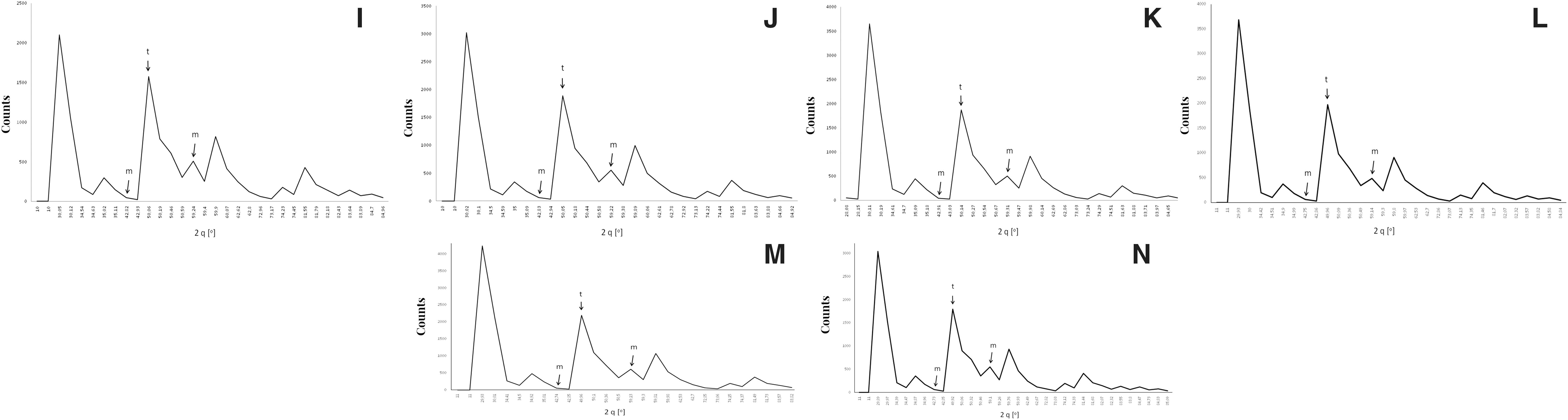
Results of XRD analysis on presintered and sintered zirconia surfaces treated with different techniques. Surfaces:
where Xm is the integrated intensity ratio of the monoclinic phase. The intensity of the monoclinic peak at Im (−111) and Im (111) is 28.2° and 31.5°, respectively, and the intensity of the tetragonal peak at It (101) is 30.2°. After the calculation of Xm, monoclinic phase volume percentage (Vm) was calculated using the following formula
39
:
Porcelain veneers were applied on the zirconia surface using a metal mold (diameter: 5 mm; height: 3 mm), and they were fired in a vacuum porcelain furnace at 760°C (Ivoclar EP600) for 45 min. Then, the specimens in the thermal cycle group were thermocycled for 5000 cycles at alternating temperatures of 5°C and 55°C (dwelling time: 20 sec, transfer time: 10 sec). Next, the shear bond strength of all specimens was tested using a universal testing machine (DCS 500; Shimadzu Corp., Kyoto, Japan), with a 1 mm/min crosshead speed until fracture. The average shear bond strength was calculated as follows:
where the load (N) is the applied shear force and the area is the bonded interface area (mm2).
Fracture surfaces were analyzed under a stereomicroscope (StemiSV 11 Apo; Carl Zeiss) and by SEM. The failure types were reported to be adhesive (failure at the interface between ceramic and zirconia), cohesive (internal failure completely within the ceramic/zirconia), and mixed (adhesive + cohesive failure).
The data were analyzed using SPSS 21 (SPSS, Inc., Chicago, IL). Suitable parametric and nonparametric techniques were used. The Mann–Whitney U test, which is the nonparametric counterpart of the Student's t-test, was used to compare the means of two groups of continuous data since there were few samples in the groups for the averages of independent two-sample groups. Kruskal–Wallis variance analysis for the nonparametric counterpart of one-way ANOVA was used to compare the measurement levels of more than two subgroups. p < 0.05 was considered statistically significant.
Results
According to the results of the statistical analysis, the surface treatment processes and sintering had no significant effect on bond strength (p > 0.05). The highest bond strength values were observed in the 20 Hz laser subgroup (9.47 ± 3.07) of the nonthermocycling group and in the sandblasting subgroup (6.73 ± 2.8) of the thermocycling group presintering. The lowest bond strength values were observed in the control subgroups of the groups presintered with and without thermocycling (5.05 ± 1.88 and 7.07 ± 4.41, respectively). The highest bond strength values in the 20 Hz laser treatment were recorded in the groups with and without thermocycling after sintering (7.63 ± 4.96 and 9.18 ± 4.43, respectively). The lowest bond strength values were obtained in the sandblasting subgroup (4.85 ± 2.73) of the group not undergoing sintered thermocycling and in the control subgroup (4.62 ± 2.14) of the group undergoing sintered thermocycling. The presintering thermocycling applied to the 20 Hz subgroup reduced the bond strength significantly (p < 0.02), while there was no significant effect in the other groups (Table 2). No cohesive failure was observed in any of the groups. The groups not undergoing presintering thermocycling showed 76% adhesive and 24% mixed failures; the groups not undergoing sintered thermocycling demonstrated 82% adhesive and 18% mixed failures. The groups undergoing presintering thermocycling and the groups undergoing sintered thermocycling presented 98% adhesive and 2% mixed failures.
Mean SBS (MPA) and Standard Deviation Values, Statistical Differences Between the Groups (N = 10)
Means with the same letters were not significantly different (p > 0.05).
SBS, shear bond strength.
indicates significant difference between 20 Hz thermal cycling (−) and 20 Hz thermal cycling (+).
Figure 3 presents the SEM and AFM images of all groups. The sandblasting specimens exhibited a rougher surface compared with the control specimens and hills of various sizes were observed on the surfaces. The specimens that underwent laser treatment displayed a rougher surface compared with the sandblasting group and various sized hills and valleys were noticed, especially in the 20 Hz specimens. Further, the sharp peaks that formed during the presintering surface treatment were smoother after sintering. The pits in the samples that underwent sintered surface treatment were shallower than the specimens having presintering surface treatment. It is possible that the applied treatment led to deeper pits since the zirconia surface before sintering is softer, or was due to carbonization caused by the laser.
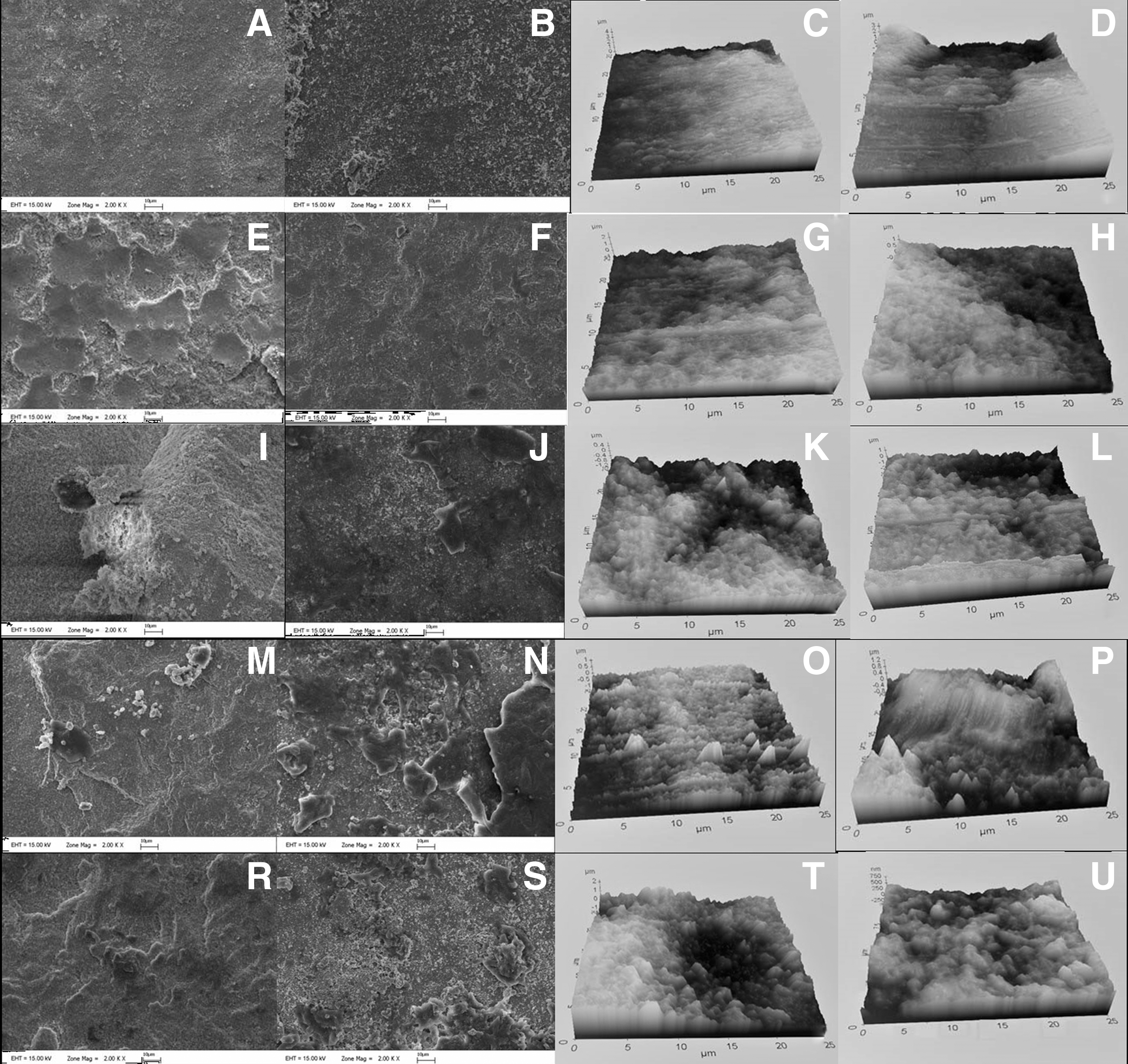
SEM and AFM images of the ZS after pretreatments.
Table 3 presents the amount of monoclinic phase (Xm) calculated at the end of the XRD analyzes for detecting the t → m phase transition in the specimens. According to the results, the increased monoclinic phase content after presintering surface treatment was decreased after the sintering of the specimens and similar values were observed in the control group. The different surface treatments applied to the specimens in the sintered group increased the t → m phase transition compared with the control group. Moreover, the amount of monoclinic phase transformation in the specimens undergoing sintered surface treatment was higher than the amount of monoclinic phase of the specimens subjected to surface treatment before sintering (Figs. 1 and 2).
Monoclinic Phase Rates of Zirconia Specimens After Different Surface Treatments
Discussion
The results obtained in this study show that the surface treatment presintering and 20 Hz Er,Cr:YSGG laser treatment had increased bond strength values and that thermocycling has reduced the bond strength compared with the untreated groups. The study hypothesis that suggests different surface treatments do not affect the bond strength between zirconia and veneer ceramic has been accepted. The hypothesis that thermocycling application does not decrease bond strength has been partially accepted. While the thermocycling application presintering significantly reduced bond strength in the 20 Hz laser subgroup, no statistically significant difference was seen in the other subgroups. The hypothesis that phase transformation does not affect bond strength values has been accepted.
The accurate measurement of the bond force at the interface between zirconia and veneer porcelain is quite complex. However, the shear bond strength test is a common method applicable to zirconia-based ceramic systems. 6 Since most of the stresses related to the fracture of the bond between the teeth and the restorations are the stresses of shearing in clinical terms, 2 and because the applied forces are perpendicular to the bond surface, the small cross-sectional area of the bond surface virtually eliminates the combination of structural defects that significantly affect the test readings. 8,15 Therefore, the shear bond strength test was used to assess the bond between zirconia and veneer ceramic in our study.
Since the sintered surface treatment can increase the phase transformation that damages zirconia, the presintering treatment has drawn considerable attention in recent studies. 9,40 –42 Literature indicates sintering zirconia after a presintering surface treatment decreases the monoclinic phase content in the zirconia structure, and the rough texture continues to be observed more frequently; 1,32,40 it has also been stated that the nonrigid, chalk-like form of zirconia before sintering facilitates getting surface roughness after surface treatment. 1,42
Controversial results have been reported in studies examining the effect of presintering and sintered sandblasting treatment on the bond between zirconia and resin cement/porcelain. 4,6,43,44 Research comparing the impact of presintering and sintered sandblasting treatment on the bond between zirconia and the resin cement has revealed that although the application of presintering surface treatment increases the rough areas, there is no significant effect on bonding. The same studies also found that the monoclinic phase ratio after XRD analysis in the presintering surface treatment groups was higher than the sintered group, and the sintering after surface treatment caused the decrease in this ratio compared with the sintered group. 32,45 Considering the comparison between sandblasting groups and control groups, no significant difference between zirconia and veneer ceramic was found in our study. In addition, although rough areas were evident in the SEM and AFM images, it was considered that there was no correlation between the surface roughness values and bond strength values, which is similar to the results of other studies 14,42 since the average surface roughness values were not calculated.
Earlier researchers demonstrated that the presintering or sintered Er,Cr:YSGG laser treatment on the zirconia surface increases bond strength significantly. 9,46 A significant difference between the laser groups and control group was described in an article examining the effect of various lasers on the bond strength between zirconia and resin cement after sintering. 47 The researchers found the Er:YAG laser (1.5 W; 10 Hz; energy of 150 mJ; pulse duration of 700 μs for 20 sec) caused rough areas on the zirconia surface and thereby increased bond values. In that study, adhesive type of failure was the most common type in the laser groups. 47 Ghasemi et al. 1 found no significant difference between presintering and sintered Er,Cr:YSGG laser (2 W, 3 W; 50 Hz; 50 sec; 2780-nm wavelength) treatment. Although the presintering surface treatment increased the bonding strength compared with the sintered treatment, there was no significant difference in our study. In a previous assessment of the effect of sandblasting, CO2, and Er,Cr:YSGG laser (2 W, 3 W; 50 Hz; 2780-nm wavelength) on the microshear bond strength between zirconia and resin cement by Akhavan Zanjani et al., 2 sandblasting (50 μm Al2O3 particles, 60 Pa, at a distance of 2 mm from the bonding surface for 50 sec) increased the bond strength more than the Er,Cr:YSGG laser treatment. Contrary to these results, in our study, the Er,Cr:YSGG laser treatment (2 W, 3 W; with a 2780-nm wavelength at a pulse duration of 140 μs; fixed repetition rate of 50 Hz for 50 sec) increased the bond strength more than the sandblasting group. The laser parameters of 3 W/8, 15, and 20 Hz wavelengths were used in our study to obtain roughness without damaging the surface as low energy causes less heat increase at the zirconia surface. It is crucial to prefer the correct parameter for maximizing the bond strength between zirconia and veneer ceramic. Laser irradiation at a distance of 10 mm on zirconia is too much for effective results. Previous studies noted that high energy level damaged the structure of zirconia. 37 While we have examined the shear bond strength between zirconia and porcelain, assessment of the microshear bond strength between zirconia and resin cement might be another reason for the difference between the results presented here and those by Akhavan Zanjani et al. 2,48
Many studies have examined the effect of surface treatments applied to zirconia on phase transformation. 4,14,29,40,48,49 Some authors concluded that the t → m phase transformation reinforced the structure of zirconia by causing stresses at the end of the cracks, similar to compression on the increase in volume, and it was suggested that this increase might cause severe ruptures in uncontrolled cases. 29,40,48,50 Conversely, some researchers reported that the m → t phase transformation, due to increased heat, could weaken the zirconia structure by reducing compressive stresses on the surface. 31 The XRD analysis was performed on samples randomly chosen from each group, in our study, and the highest phase transformation ratio was seen in sandblasting for both presintering and sintered groups. Similar to other reports, 32,51 phase transformation weakened the zirconia structure and adversely affected the bond with ceramics in our study. Besides, the monoclinic phase transformation was observed more in sintered species than in specimens sintered after presintering treatments. This result is consistent with the fact that the presintering bond strength values are higher than those of sintered groups. We also found the after sintering process significantly reduced the monoclinic phase ratio, which corroborates previous studies. 20,40,48
Thermocycling has been described as a more effective method than water storage. 33 There are different conclusions about the effect of thermocycling on bonding in the literature. An investigation into the bond between zirconia and porcelain mentioned that 5000 thermocycling applications to the specimens reduced the bond strength slightly, but it was nonsignificant. 52 Another study confirmed that 37,500 thermocycling applications caused a significant decrease in the tensile bond strength between zirconia and adhesive cement. 35 In our study, 5000 thermocycling applications were applied to half of the samples to provide similarity to the oral conditions and evaluate the difference in bond strength of restoration over time. The bond strength values of the groups without thermocycling were higher than those in the thermocycling groups. According to these results, the thermocycling application decreased the bond strength to some extent, but this decrease was not statistically significant, except for the presintering 20 Hz group. The 5000 thermocycling applied in the study corresponds to 6 months. Increasing the thermocycling time and applying the mechanical cycling as well as the thermocycling may be effective in obtaining more accurate results.
The limitations of this study are that the shape and dimensions of the specimens are not similar to the clinical applications. Preparing the specimens similar to the clinical crown anatomy may align the results more closely with reality. However, because of the difficulty in preparing specimens of similar sizes and thus the impossibility of obtaining repeatable results, the specimens are manufactured into geometrical shapes. Another limitation is that only the shear bond strength test was used to assess the bond strength. However, restorations are exposed to many forces in the mouth, besides shear force. Moreover, increasing the thermocycling time and applying the mechanical cycling, in addition to thermocycling, may be effective in obtaining more accurate results, by providing conditions similar to the oral environment. Finally, the application of porcelain with the layering technique requires technical precision and is affected by ambient conditions. Although the surface treatment applications were carried out by the same person, the difficulty of providing standardization is another limitation of the study. Further in vitro and in vivo investigations are needed to improve the bond strength between zirconia and veneer ceramics and obtain clinically long-lasting restorations.
Conclusions
Within the limitations of this study, the following can be concluded: The different surface treatments applied to zirconia have no significant effect on the shear bond strength between zirconia and veneer ceramics. Higher zirconia/veneer ceramic bond strength values were determined in the specimens that underwent presintering surface treatment compared with the specimens that underwent sintered treatment. The thermocycling application significantly reduced bond strength in all groups. While different presintering and sintered surface treatments caused t → m phase in zirconia, the monoclinic phase values were reduced after sintering. Adhesive and mixed failure types were observed in cases without thermocycling. Adhesive failure was detected in almost all the instances in which thermocycling was applied.
Footnotes
Acknowledgments
This research project was funded by the Akdeniz University Centre of Scientific Research (grant number: TDH-2017-2560). The authors thank Assistant Professor Dr. Türker Akar from Erzincan University for his support in performing the AFM and XRD analyzes.
Author Disclosure Statement
No competing financial interests exist.