




Abstract
Objective:
Distal radius fracture (DRF) is one of the most frequent population fracture mostly affecting women, and frequently leading to complex regional pain syndrome (CRPS). Management of DRF and CRPS in gerontology is complex. The aim was to evaluate the use of polarized, polychromatic, low-energy light therapy combined with conventional treatment after DRF in gerontology and to follow up patients for CRPS emergence.
Materials and methods:
After plaster removal, female patients (n = 52) were divided into two groups. Group 1 (n = 26) was treated with exercises and cryotherapy on the wrist and dorsal hand (control). Group 2 (n = 26) was additionally treated with light therapy (Bioptron).
Results:
While pain decreased and supination and pronation improved in all patients after 15 days of therapy, pain reduction was accelerated and supination enhanced in the light therapy-treated group (p < 0.05). None of the patients in the light therapy-treated group developed CRPS during the 6-month follow-up, compared with four patients (15.4%) in the control group (p < 0.05). Complete hand fist-forming capacity was achieved in 19 patients (73.1%) in the light therapy-treated group compared with 16 patients (61.5%) in the control group (p > 0.05).
Conclusions:
Bioptron light therapy combined with conventional therapy improves patient outcome after DRF in gerontology, compared with conventional treatment alone.
Introduction
Distal radius at the typical site fracture (fractura radii loco typico)—distal radius fracture (DRF), largely known as a broken wrist (a fracture of the radius very close to the wrist)—is one of the most frequent population fractures, accounting for 10–18% of all fractures in adults. 1 Over the past 40 years, DRF has shown a constant progression in prevalence, which could partially be explained by an extension of the average life span in humanity. 1
Because of the unbalanced bone turnover that causes osteoporosis in climacteric and postmenopausal women, even a minor trauma (accidental slip and fall at home or on the street) can cause DRF. Around 79% of cases are women, and incidences increase with age following the onset of menopause, with the peak in the 60- to 65-year period. 2 According to Omsland et al.3 women from the urban area have a 30% higher risk of developing DRF than those from rural areas, which might be connected with insufficient sun exposure and lack of vitamin D production, which is crucial for the maintenance of proper bone density.
Conventional DRF treatment comprises 3–4 weeks of immobilization followed by physiotherapy after removing the plaster. The aim of physiotherapy is to reach adequate range of wrist joint movement and to empower patients for their everyday lives. Diadynamic current or electromagnetic field therapy is mostly used for that purpose, added with cryotherapy and exercise. Cryotherapy and exercises are routinely used after DRF, in combination with diadynamic currents, but the latter one is mostly contraindicated in the elderly. Due to poor skin quality and skin atrophy in old people accompanied with sensitivity damage, as well as due to a number of co-morbidities due to aging, the application of physical agents (diadynamic currents specifically) is limited in most cases. This highlights the need for adequate treatment options for the elderly.
Complex regional pain syndrome (CRPS) is one of the most common DRF complications, mostly occurring within the first 4 months after the fracture. Its prevalence is estimated at 39% 4 and occurs in 4–7% of patients after the fracture surgery of the extremity. 5
CRPS is one of the most ambiguous and obscured chronic pain conditions affecting the limb, named, according to internationally agreed taxonomy, as the CRPS since 1994. 6 CRPS diagnosis is usually made based on symptoms and clinical findings. The main CRPS signs are the autonomic nervous system dysfunction and tropical changes of the skin. Initially changes in vasomotor activity and sensation are presented in the affected extremity, such as altered sensitivity to touch (i.e., allodynia and hyperalgesia to mechanical or thermal stimuli). Therefore, it is also known as causalgia, the shoulder-hand syndrome, algodystrophy, algoneurodystrophy, Sudeck atrophy, reflex sympathetic dystrophy, reflex neurovascular dystrophy, post-traumatic dystrophy, and fracture disease. 7
There are three typical stages in the disease course of CRPS: stage I: sympathetic dysfunction with dermatomal distribution of the pain; stage II: progression to dystrophy shown as edema, hyperhidrosis, neurovascular instability, hair loss, ridging, dystrophic, brittle and discolored nails, skin rash, subcutaneous bleeding, neurodermatitis or ulcerative lesions, changes in temperature or coloring of the skin; stage III: transition from sympathetic pain to sympathetically independent pain presenting with different degrees of atrophy, frequently overshadowed by subcutaneous edema, 5 and irreversible contractures and loss of limb function at the final stage, evident through reduced strength, decreased range of motion, tremor, and dystonia.
Stages I and II may be spread to other extremities in approximately one-third of the CRPS patients, and may also become generalized, which is an infrequent complication during the late stage, 8 leading to altered body perception and proprioception. 9,10
All three CRPS stages are characterized by very intensive, sometimes unbearable pain, which significantly influences the patient's everyday life. CRPS is the most common complication after distal upper extremity fracture, caused by DRF, resulting in a delay in returning to work, diminished health-related quality of life, and increased likelihood of poor outcome and/or litigation. 11 CRPS is one of the most disabling conditions in aged women, presenting a real therapeutic challenge highlighting the need for its adequate prevention.
According to randomized controlled trials, physio- and occupational therapy are effective for CRPS treatment. The majority of patients are cured within the first year, whereas for a few individuals the disease progresses to a chronic stage, characterized by “warm CRPS” to “cold CRPS” transition 12 involving autonomous dysfunction. In stage III, bisphosphonates, calcitonin, intravenous administration of ketamine, binders of free radicals, oral corticosteroids, and spinal cord stimulation are being used, 5 although without major success.
Low-level laser therapy (LLLT) has also shown good improvement of the chronic pain symptoms 13 once CRPS has been developed. Some studies suggest that light, whether in the form of LLLT radiation or from other cold light sources, benefits a variety of painful musculoskeletal and neurological conditions. 14,15
Light therapy (Bioptron AG) has been shown to provide analgesic effects, improved microcirculation, and vasomotor function 16 –18 for a variety of illnesses and diseases due to its biostimulatory effects. 19,20 The properties of this light therapy device includes polarized, polychromatic, incoherent, and low-energy light, which sets this device apart from other light therapy devices in the market. The different wavelengths (480–3400 nm) of Bioptron light therapy devices penetrate the skin at different depths, triggering and enhancing a variety of cellular processes with beneficial physiological effects 21,22 (including resolution of inflammation and activation of the immune system, 23 –26 mitochondria activation, 27 reduction of pain intensity, 28 –30 tissue repair, 31 vasodilatation, and increased local and systemic circulation). 18,32
We selected Bioptron light therapy, because it has a relatively large treatment area compared with LLLT and because it can be used by nonmedical staff at the patients' home. In contrast, LLLT should be used by medical staff on an already manifested syndrome, directly on hand pain points and strictly dosed.
Therefore, the aim of this study was to evaluate light therapy (polarized, polychromatic, noncoherent, low-energy radiation) application combined with cryotherapy and optimal exercises in patients after DRF and to investigate whether the risk of CRPS could be minimized.
Materials and Methods
Patients
From January 2014 to December 2017, the prospective study consequently included patients with DRF from the Belgrade City Institute of Gerontology to be treated with physiotherapy. A total of 55 female patients with DRF at the typical site were screened for the study. Treatment started immediately after removal of the plaster. Two patients were not included, because they had already developed CRPS under the plaster, and were treated accordingly. Follow-up of another patient could not be collected because the patient died from complications associated with heart failure, resulting in a full dataset of 52 female patients who were included in the study.
Two age-matched groups were randomly assigned at the beginning: group 1 (mean age 64.0 ± 6.9 years) consisted of female patients (n = 26) with DRF who were treated with nonsteroid anti-inflammatory drugs, exercises, and cryotherapy on the wrist and dorsal side of the hand (control). Group 2 (mean age 62.0 ± 7.2 years) consisted of 26 female patients who were treated with the same protocol as group 1, but received Bioptron (polarized, polychromatic, noncoherent, low-energy radiation) light in addition (intervention group). All patients were treated at their own home and evaluated at days 0 (D0), 7 (D7), and 15 (D15) for pain [Visual Analogue Scale (VAS)], and at D7 and D15 for a range of wrist supination and pronation, and at D15 for hand fist-forming capacity and followed up for CRPS-induced complications for 6 months after completion of therapy.
Cryotherapy
Ice cubes (frozen at −20°C) of ∼2 cm3 were applied two times a day (12 h apart) for 5 min at the wrist and dorsal region of the hand with circular massage. The hand was dried afterward and wrapped in cotton fabric for 20 min after each ice massage.
Exercise
Kinesiotherapy exercises were performed to enhance the range of wrist motion, with particular focus on supination and pronation. Active exercise was carried out with physiotherapist assistance for 30 min daily. Assisted exercise began from the neutral position to a maximum of supination and pronation, limited by pain. Exercise for fist-forming capacity was performed with a small rubber ball, squeezed 20 times a day by the patient, limited by pain as well.
Bioptron light therapy
A Bioptron phototherapeutic device (Bioptron AG, Wollerau, Switzerland) with 5 cm treatment diameter (Bioptron MedAll; 480–3400 nm; polarization level 95%; power density 40 mW/cm 2 ; energy density 2.4 J/cm2/min) was used for irradiation of the dorsal hand region, according to manufacturer's recommendations (Table 1). Group 2 received Bioptron light therapy for a total of 10 min per day on five points of the dorsal hand region (2 min each) at a distance of 10 cm for a period of 15 days (Fig. 1). Bioptron light therapy, unlike laser light, contains polychromatic light in the visible and part of the infrared range (without ultraviolet radiation). Bioptron light therapy has several benefits, but for the current purpose, improved microcirculation, vasomotor function, and analgesic effects are of clinical importance (Fig. 2). 16 –18
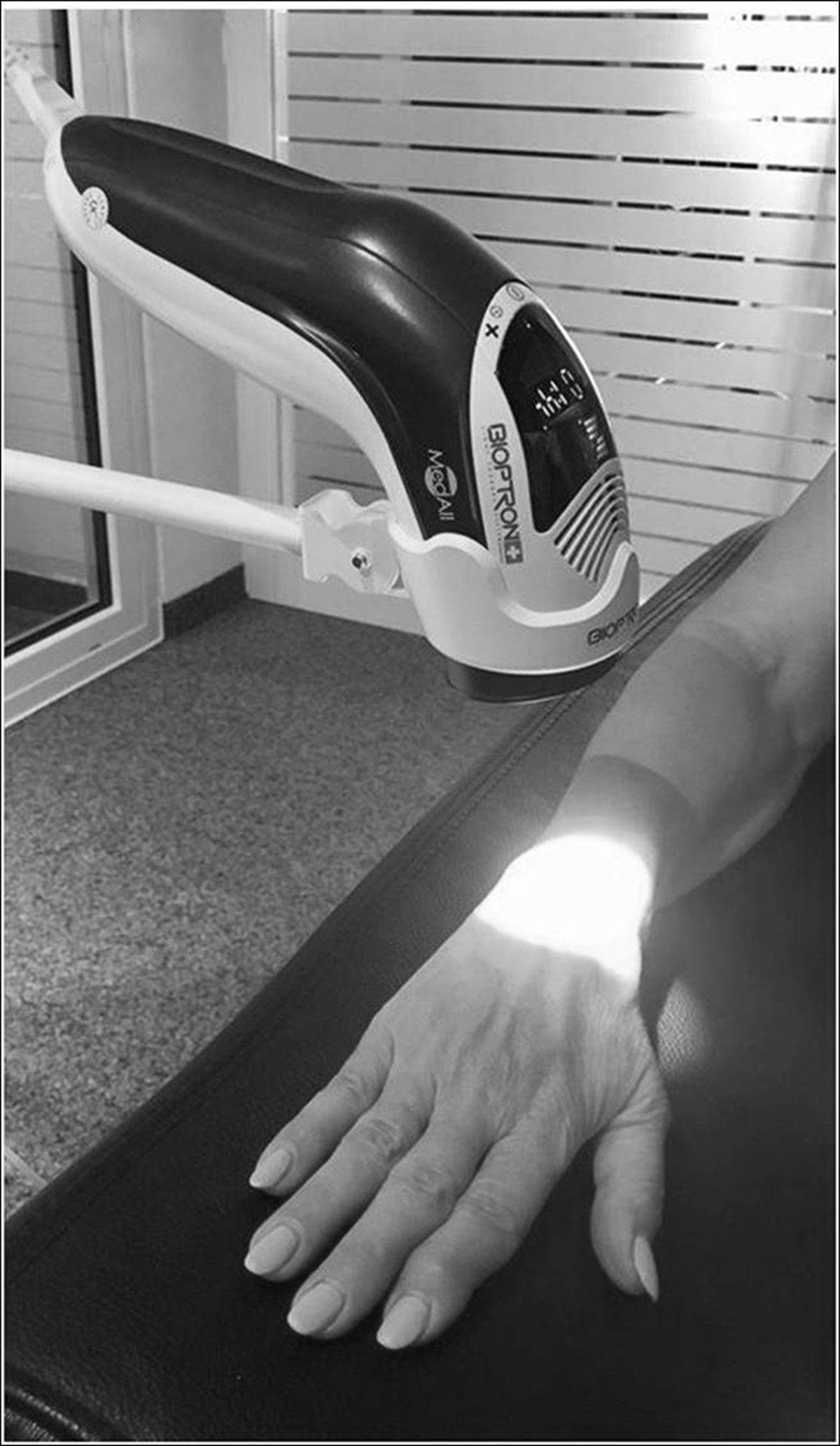
Patient set-up before Bioptron light therapy (simulated patient).

Schematic representation of the light therapy device (Bioptron MedAll, Bioptron AG, Wollerau, Switzerland). The device used a Brewster mirror to create polarized light of low-energy levels. The polychromatic, incoherent wavelengths, excluding ultraviolet radiation, induce primary, biostimulatory effects on the skin.
Parameters of Light Therapy Device
Model: Bioptron MedAll, Bioptron AG, Wollerau, Switzerland.
Outcome measures
Pain was assessed at D0, D7, and D15; supination and pronation were measured at D7 and D15. Pain was assessed using the VAS, which is a unidimensional measure for pain intensity, performed on a 100-mm line. Patients were asked to draw a vertical mark on the line, expressing the level of their pain, on a scale from 0 to 100.
Range of wrist motion was assessed for pronation and supination movement capacity, expressed in degrees. Ninety degrees for supination and pronation are considered the full range of motion. Supination is defined as rotation from the neutral position of the hand and forearm so that the palm faces upwards. Pronation is defined as rotation of the hand and forearm from the neutral position so that the palm faces downwards. These measurements were not taken at baseline (D0) because of the inability of the wrist to perform such movements right after removing the plaster.
Patients were evaluated for the hand fist-forming capacity at the follow-up, because of the inability of the wrist to form a fist within the first weeks after injury.
All patients were followed up for 6 months for CRPS occurrence and hand fist-forming capacity. The main criteria for CRPS were chronic, intensive pain of the hand, limited range of movement, with or without diffuse swelling of the hand, and changes in skin temperature.
Ethics
The study was approved by the Gerontology Institute Ethical Committee. All subjects gave signed informed consent to participate. Patients were able to drop out from the study at any stage and without reason.
Statistical analysis
Results were analyzed by descriptive methods of statistics, as well as with nonparametric Mann-Whitney U-test for independent samples and Wilcoxon signed rank test using SPSS 20.
Results
The average VAS values and range of motion, measured in the form of supination and pronation, are given in Table 2. Baseline (D0) VAS scores did not differ between groups before treatment. All values (VAS scores, supination, and pronation) improved during the course of treatment, independent of the treatment group, but light therapy (group 2) accelerated pain relief (p < 0.05) and supination improvement (p < 0.05) at D15, compared with cryotherapy and exercise treatment alone (group 1). The range of motion for supination was already significantly improved at D7 and D15 for the light therapy-treated group compared with the control group (group 1; p < 0.05). Although pronation improved over time, no difference was found for pronation between treatment groups (p > 0.05).
Visual Analogue Scale Values, Range of Motion (Supination and Pronation) in Group 1 (Cryotherapy and Exercises) and Group 2 (Cryotherapy, Exercises, and Light Therapy) at Baseline, 7, and 15 Days of Therapy
p < 0.05, ** p < 0.01.
Independent samples Mann-Whitney U-test.
Related samples Wilcoxon signed rank test.
VAS, Visual Analogue Scale.
At the 6-month follow-up period after completion of therapy, CRPS occurrence was significantly reduced in the light therapy-treated group compared with the control group (p < 0.05), 0% and 15.4%, respectively. Furthermore, at the follow-up, complete hand fist-forming capacity was achieved in 16 control group patients (group 1; 61.5%) and in 19 light therapy-treated group (group 2; 73.1%), although this did not reach statistical significance (p = 0.375).
Discussion
The aim of this study was to evaluate Bioptron light therapy (polarized, polychromatic, noncoherent, low-energy radiation) application combined with cryotherapy and optimal exercises in patients after DRF and to investigate the prevention of CRPS. We found that light therapy significantly accelerated pain relief and improved supination in elderly patients, compared with conventional treatment (cryotherapy and optimal exercises) alone. In addition, we found that the risk of CRPS could be minimized with light therapy, providing evidence that light therapy has significant benefits when used in combination with already existing therapy options for elderly patients with DRF.
The combination of light therapy, cryotherapy, and exercise showed good pain control and significant improvement of the wrist motion range. After therapy completion, none of the light therapy-treated patients developed the CRPS within the 6-month follow-up period, whereas 15.4% of patients treated with only cryotherapy and exercise did.
While this study has specifically selected the target group of elderly women with DRF, the higher age of participants and the specific minor trauma fracture are the current study limitations, so that the results cannot be directly extrapolated to all patients and patients with major or accidental trauma. Because of the limited number of subjects included in the study, it is also not clear whether light therapy not only reduces the incidence but also completely prevents CRPS development in elderly patients.
According to the literature, CRPS mostly occurs within the first 4 months after wrist fracture, with variations in incidence rates. Thomson McBride et al. 33 reported incidences of 20% within the first 10 weeks; Atkins et al. 34 reported 37.2% within the first 4 months, whereas Demir et al. 35 reported incidences as high as 58% for the first 3 months. This highlights the effective reduction in the risk and prevention option of light therapy with polarized, polychromatic, and low-energy properties.
More importantly, in the absence of efficient CRPS treatment for the elderly, finding patient-friendly therapy that aids its prevention is extremely vital. 9 CRPS treatment is complex and limited, as there is no consistent information about efficiency of pharmaceutical agents, or effectiveness of other methods. 36 In fact, research synthesis of randomized controlled clinical trials found no significant analgesic effect for inhibiting sympathetic activity, including agents such as ganethidine, regional sympathetic blockers, calcitonin, codeine, magnesium chloride, propranolol, lorazepam, intravenous phentolamine, epidural clonidine, and intravenous regional blocks. 35
So far, only one prevention mechanism was explored by several randomized controlled trials, which included vitamin C usage after limb surgery with limited success. 37 Thus far, laser and other cold light sources have not been evaluated in DRF treatment and CRPS prevention therapy. Further studies on CRPS laser therapy and other cold light source treatment would be beneficial, especially in the light of possibilities for CRPS prevention. In line, exact protocols on dosage regimens should be evaluated.
Our results suggest that Bioptron light therapy strongly reduces the incidence rate of CRPS within the 6-month period after therapy, suggesting a long-lasting effect of low-energy light therapy. Polarized light penetrates deeper into the skin than other light sources, and the polychromatic wavelength properties ensure effective biostimulation of a variety of processes from different wavelengths. 38 –43
Changes that occur and that may contribute to the therapeutic benefits observed in this study may include changes in membrane permeability of cells, 44,45 stimulation of mitochondria for increased availability of adenosine triphosphate, 27 increased microcirculation through the stimulation of the synthesis of nitric oxide, 18,32 stimulation of immune parameters and the human defense system (systemic effect), 22 –24 increased collagen synthesis from fibroblasts 46 –48 through the stimulation of macrophage-stimulating growth factors, 49 and alterations in pain perception. 28 –30 Due to polychromatic stimulation, and therefore the wide-ranging effects, the applications of this device are not only limited to wound healing and pain relief.
Evidence for the practical and clinical application of polarized, polychromatic light and its biostimulatory effects in sports medicine have also been investigated. 50 –54 Furthermore, polarized light therapy has also been associated with normalization of autonomic imbalance, and a shift in the balance from the sympathetic to parasympathetic autonomic homeostasis. 55 In patients with chronic glomerulonephritis, a single 10-min application of Bioptron light therapy led to improvements in the cardiac rhythm and a drop in the systolic and diastolic arterial pressure. 55
Recently, the use of polarized light in sympathetically mediated neuropathic pain, 56,57 including CRPS, 58 revealed normalization of sympathetic functions, including decreased sympathetic hyperactivity and the integration of sympathovagal balance. 59 This form of treatment has been used as a noninvasive clinical application for managing a sympathetic blockade without any reported complications or side effects in the past for other indications. 60 Therefore, it is feasible that the observed analgesic effects and reductions in the occurrence of CRPS in our present study in patients after a distal radial fracture are associated also with a sympathetic blockade achieved by polarized polychromatic light therapy.
The low energy and incoherent properties of the light therapy device used in our study also ensures safe treatment of patients without side effects. Most importantly, this type of light therapy does not interfere with other treatment choices and is ideal for combining treatment regimes.
In summary, low-energy, polarized, and polychromatic light therapy combined with conventional therapy (cryotherapy and kinesiotherapy) in patients with DRF appears a better choice and treatment option for pain control improvement and a range of motion achievement; it also significantly reduces CRPS occurrence after DRF in gerontology.
Footnotes
Acknowledgments
The authors would like to thank the patients for their trust in the therapists, as well as the multidisciplinary team for the care of their patients.
Author Disclosure Statement
M.I.Z.-S., D.M.P., and B.L. declare they have no conflict of interests and that they were not funded for this work. Dr C.L., Medical Director of Bioptron, was consulted after data collection and supported the write-up only.