




Abstract
Objective
: To evaluate apical extrusion during a novel erbium-doped yttrium aluminum garnet (Er:YAG) laser-activated irrigation (LAI) modality.
Background data
: A novel double-pulse Er:YAG modality (AutoSWEEPS) was introduced recently, replacing a single laser pulse with two micropulses that are separated by a varying time delay (which is continuously “swept” between 300 and 600 μsec). Although the proposed method demonstrated increased efficacy, no data were yet available on extrusion.
Methods
: The extrusion was evaluated on simulated canals (n = 6) using particle imaging velocimetry. In the first two groups, the irrigation device was a syringe coupled to either a 30-G open-ended or side-vented needle, with flow rates of 1, 2, 5, and 15 mL/min. In the second two groups, irrigant activation was performed with an Er:YAG laser, using either a super-short pulse (SSP) or AutoSWEEPS modality. The pulse energies were 5, 10, 20, 30, and 40 mJ and the frequency was 10 Hz.
Results
: The measured extrusion was most prominent during the open-ended needle irrigation, followed by the vented needle irrigation. Compared with the conventional needle irrigation (CNI), all the studied LAI modalities resulted in ∼3–20 times less extrusion. The AutoSWEEPS modality induced the smallest extrusion rate, which was always <1.5 mm3/sec and was also independent of the laser energy.
Conclusions
: Within the limitations of the study, our results demonstrate that the SSP and AutoSWEEPS laser-assisted irrigation methods exhibited less extrusion in comparison with CNI methods.
Introduction
Irrigation has an indispensable role in chemomechanical root canal preparation. Irrigants are most commonly delivered using conventional needle irrigation (CNI), with an open or closed-ended tip applied to a syringe. This technique is widely used because of its low cost, easy manipulation, and good control of the delivered irrigant volume. 1 Nevertheless, the efficacy of this method is limited only up to 2 mm from the needle tip. 2,3
To enhance the efficacy of CNI, sonic or passive ultrasonic activation (PUI) methods have been proposed. 4 Recently, several modes of laser-activated irrigation (LAI) 5 and photon-initiated photoacoustic streaming (PIPS) 6 were proposed and reported to be equal to or more efficient than PUI. The greater efficiency of LAI techniques has been explained by the generation of microcavitations and shock waves. 5 This is achieved through the high absorption of a short erbium-doped yttrium aluminum garnet (Er:YAG) laser pulse in the irrigant, which initiates the rapid formation of a vapor bubble at the fiber tip (FT) while it is immersed in the irrigant. 7,8 The vapor bubble rapidly expands and subsequently collapses after reaching its maximum volume. The collapsing bubble then initiates the growth of secondary small cavitation bubbles throughout the canal, inducing a turbulent fluid movement within whole canal volume. 9 This flow generates strong shear stresses against the root canal walls and improves the efficacy of chemomechanical debridement. 6,10,11
A further improvement of LAI, namely the shock wave-enhanced emission photoacoustic streaming (SWEEPS) method, was reported to improve the efficacy of the PIPS technique. This is achieved by replacing a single super-short pulse (SSP) mode laser pulse (duration 50 μsec) with two ultra-short pulse mode laser micropulses (duration 25 μsec), separated by an optimal time delay. 12,13 The first micropulse creates the primary bubble, whereas the second micropulse (that occurs just before the spontaneous collapse of the primary bubble) increases the pressure and thus accelerates the collapse of the primary bubble. This results in stronger shock wave emission and further enhancement of the cleaning effect compared with the conventional SSP modality. 13 As the oscillation time of the vapor bubble depends on many parameters, such as the geometry of the access cavity and root canal including the laser pulse energy, the optimal time delay of the SWEEPS pulse pair cannot be exactly determined by the clinician. To overcome this limitation, a new AutoSWEEPS modality was developed to automatically generate a clinically relevant range of time delays, which was found to be between 300 and 600 μs. In the AutoSWEEPS modality, the time delay between the pulses is repeatedly swept across this range, aiming to achieve the optimal time delay during each sweep, resulting in a maximized irrigation effect. 12
In addition to cleaning efficacy, the patient's safety and the reduction of postoperative pain must also be considered. One of the most crucial safety considerations associated with irrigation is the extrusion of the irrigant through the apical constriction, which can cause serious complications. 14 –16 However, there was no data for irrigant extrusion with the AutoSWEEPS mode that would demonstrate its safe clinical use.
The aim of this study was to develop a measurement technique and to measure apical extrusion under simulated conditions during CNI and LAI.
Material and Methods
Measurement of apical extrusion
Figure 1 shows the experimental system for the measurement of apical extrusion. The needle or FT was inserted into the simulated root canal that was completely filled with distilled water.
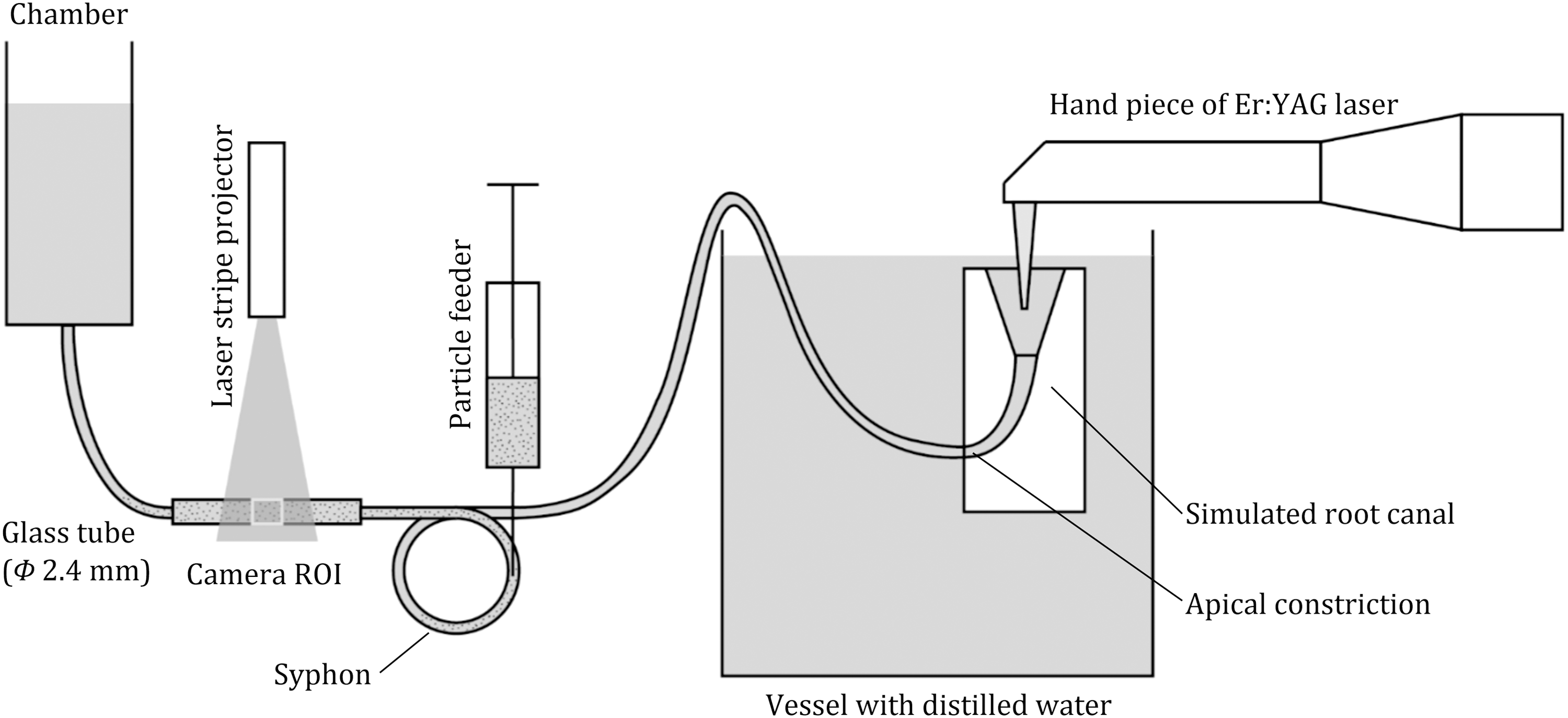
Schematic view of an experimental system for the measurement of apical extrusion using the PIV technique. PIV, particle image velocimetry.
The measuring principle was based on collecting all the irrigant extruded through the apical constriction and guiding it into a transparent glass tube. In this section a particle image velocimetry (PIV) technique was used to measure the extruded volume. 6,16 After the glass tube, the liquid was streamed into a second vessel, with a height equal to the first vessel, and which could be adjusted to simulate tissue pressure. 17
The simulated canal was submerged into the first vessel to enable the constant replenishment of irrigant. PIV particles (10 μm hollow glass spheres; Dantec Dynamics, Skovlunde, Denmark) were injected before each measurement sequence in the last of four circular loops of the connection pipe. These loops prevented the particles from flowing back into the root canal where they could block the apical constriction.
The PIV measurement subsystem consisted of a laser line projector (MINI 635 nm, 10 mW; Coherent, Inc., Santa Clara) that generated a laser plane (50 μm thick) through the center of the glass tube (diameter 2.4 mm). A digital camera (Chameleon3, 1.3 MP; Point Grey, Richmond, Canada) with a macro lens (1:1 optical magnification, 1X Mitutoyo Compact Objective; Edmund Optics) was positioned perpendicular to the laser plane to acquire the region of interest (ROI) of size 2.3 × 6.4 mm in the center of the glass tube.
The image ROI was set to 1280 × 464 pixels, capturing 312 frames per second. The average flow rate along the glass tube was measured and calculated by a custom-developed program using graphical programming software (LabVIEW 2016; National Instruments, Austin). The PIV algorithm was based on finding the highest cross-correlation between subsequent images that were partitioned on seven stripes. Thus, the velocity profile over the glass tube was extracted in seven points, and the flow rate was calculated as the surface integral over the velocity profile. The duration of each measurement was ∼40 sec.
Simulated root canals
A total of six J-shaped simulated root canals in acrylic blocks, with a length of 18 mm and curvature of 65° (VDW, München, Germany), were prepared using reciprocating endodontic instruments (Reciproc blue; VDW) to a size of 40 with a 0.06 apical taper. The diameter of the entrance conical shape of the access cavity was 2.4 mm. Instrumentation was performed up to the working length (WL) of 17 mm, established at 1 mm short of the apical foramen. A size 10 K-file (Dentsply Maillefer) was used for recapitulation and confirmation of apical patency throughout the instrumentation. Apical constriction was standardized with a size no. 15 Hedstroem file, inserted to the whole length of the canal to create a standardized constriction with a diameter of 0.15 mm, length of 1.0 mm, and 0.02 taper.
Experimental procedure
In the study, four irrigation protocols were used (Table 1). In the first two groups CNI was performed with a 30-G open-ended (CNI-OE) or side-vented (CNI-SV) needle (Transcodent, Kiel, Germany), which was inserted without binding to the canal walls 3 mm short of the WL at 14 mm, in the center of the simulated root canal. Flow rates of 1, 2, 5, and 15 mL/min were achieved by actuating the piston of a syringe with a motorized linear stage. For each flow rate value and type of needle end, six sets of measurements were performed, separately.
Irrigation Protocols and Parameters, Used in the Study
SSP, super-short pulse.
In the last two groups, LAI was performed using an Er:YAG laser (LightWalker ST-E; Fotona d.o.o., Slovenia) in SSP (LAI-SSP) and AutoSWEEPS (LAI-ASWEEPS) modality (Table 1). The laser was equipped with an articulated arm and a dental handpiece (R14-C; Fotona d.o.o.) optically coupled with an interchangeable FT. In all LAI measurements, the FT was placed in the center of the access cavity, with its ending 2 mm deep below the entrance to the access cavity (Fig. 1).
In the LAI-SSP group, the LAI was performed with the PIPS modality of irrigation, using a single Er:YAG laser pulse with duration of 50 μsec (SSP modality) and a 14 mm long conically ended FT with a 400 μm diameter (Xpulse 400/14; Fotona d.o.o.). 11
In the LAI-ASWEEPS group, the LAI was performed with AutoSWEEPS modality, where the time delay between the micropulses was continuously varied between 300 and 600 μs with steps of 10 μsec. 12,13 The corresponding FT for AutoSWEEPS was an 8.5 mm long tapered tip with a diameter of flat termination of 600 μm (SWEEPS 600/8; Fotona d.o.o.). This particular FT geometry was chosen because previous research showed that a conical FT breaks much faster during the SWEEPS or AutoSWEEPS modalities. 13 In both LAI groups, the effect of the pulse energy on extrusion was evaluated at five different pulse energies (5, 10, 20, 30, and 40 mJ). To better understand how the extrusion rate varies during an AutoSWEEPS pulse delay “sweep,” we also measured the influence of the time delay between micropulses on extrusion during a normal fixed-delay SWEEPS modality. The FT for SWEEPS was identical to the corresponding FT for AutoSWEEPS. Therefore, the set of measurements were made at fixed time delays from 300 to 600 μsec with 20-μsec increments. It is important to note that the time delay during each measurement was constant in this modality. The pulse energy, measured as the sum of both micropulses, was fixed at 20 mJ.
Data analysis
Statistical analysis of the results was performed using one-way analysis of variance and the Tukey–Kramer test. A correlation between flow rate or pulse energy and extrusion was calculated for each experimental group. A significance level of 0.05 was considered as statistically significant.
Results
Conventional needle irrigation
Extrusion ranged between 1.2 and 63 mm3/sec for the CNI-OE needle and between 0.5 and 48.2 mm3/sec for the CNI-SV type. A high correlation was found between the CNI flow rate and extrusion for both needle types (R 2 = 0.99; p < 0.001) (Fig. 2).
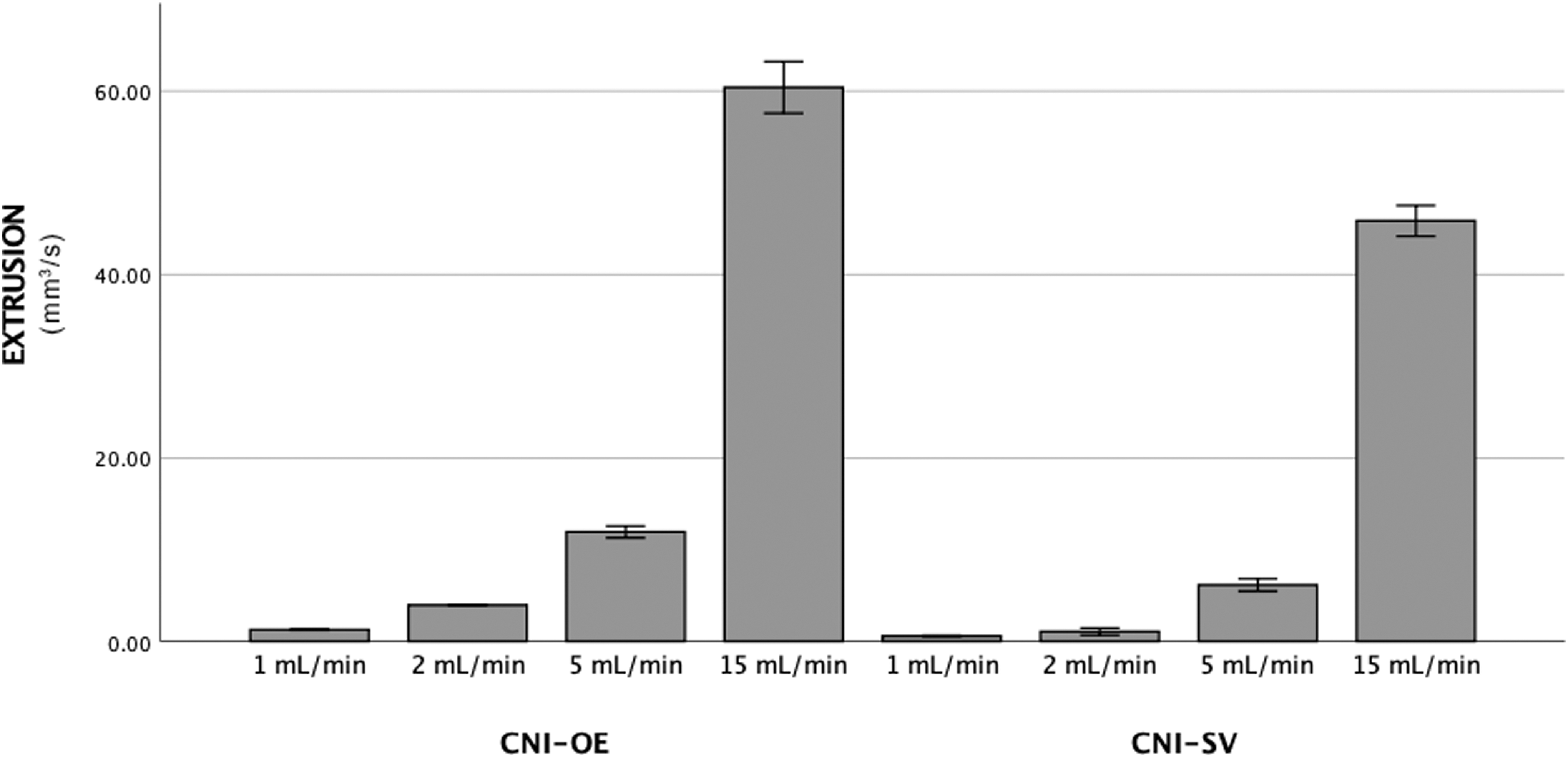
Mean values of irrigant extrusion in groups using CNI with OE or SV, using flow rates of 1, 2, 5, or 15 mL/min. CNI, conventional needle irrigation; OE, open-ended needle; SV, side-vented needle.
Laser-activated irrigation
All modalities of LAI exhibited less extrusion than CNI. The highest extrusion rate for the LAI-SSP modality was <5 mL/min for both CNI-OE and CNI-SV. Similarly, the highest extrusion rate for the LAI-ASWEEPS modality was <1 and 2 mL/min with CNI-OE and CNI-SV, respectively.
For the LAI-SSP, a high correlation was found between pulse energy and extrusion rate (R 2 = 0.99; p < 0.001), whereas no correlation was found for the LAI-ASWEEPS modality (R 2 = 0.21, p = 0.278), with values of 0.66 and 1.03 mm3/sec, respectively.
LAI-ASWEEPS exhibited a lower extrusion rate than LAI-SSP for all energy values at 20, 30, and 40 mJ (Fig. 3). The extrusion flow rate during LAI-ASWEEPS never exceeded the extrusion flow of the LAI-SSP modality at 10 mJ (0.76 mm3/sec). At 10 mJ, the extrusion was similar between both laser modalities, whereas at 5 mJ LAI-SSP exhibited a lower extrusion rate compared with LAI-ASWEEPS at the same energy.
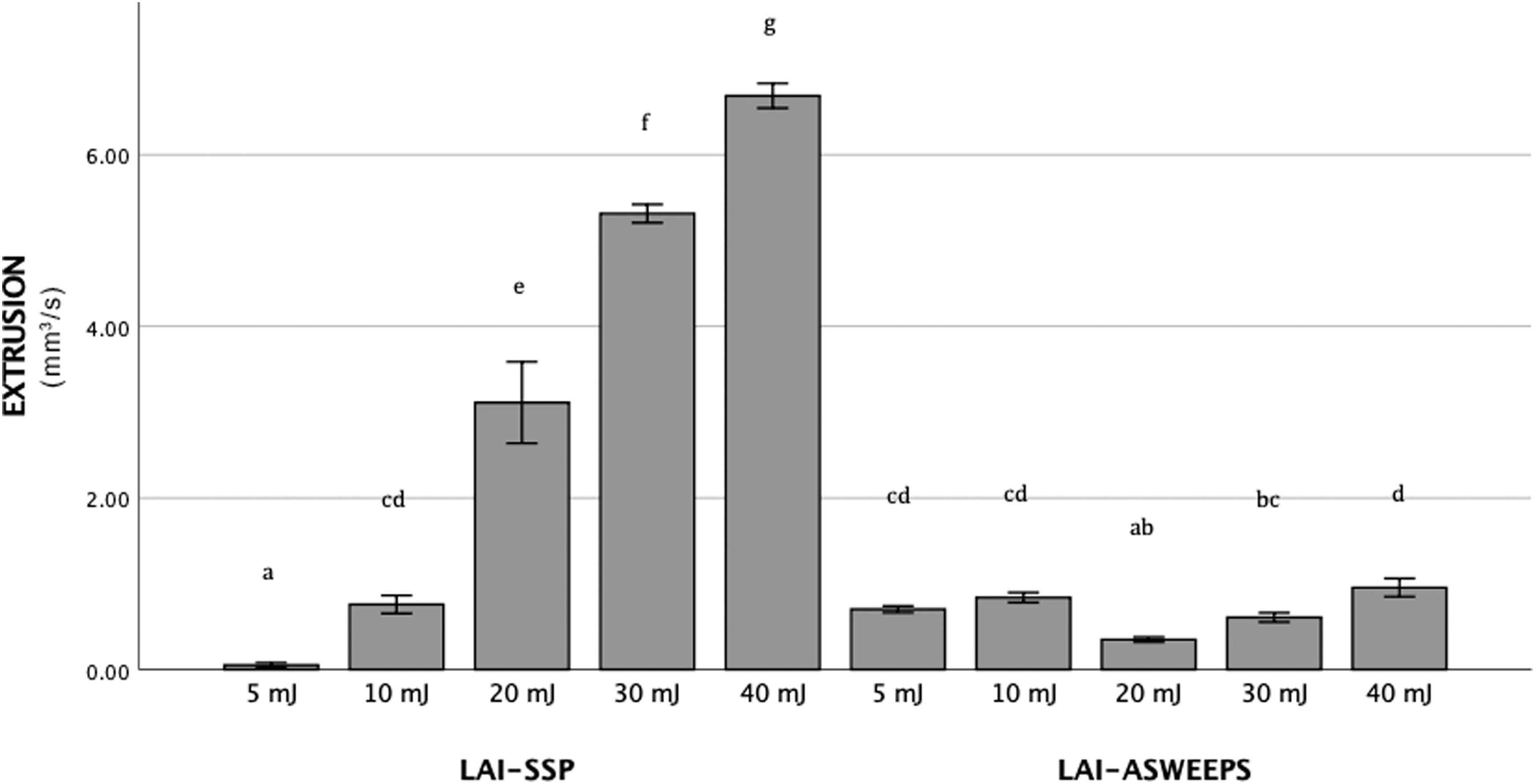
Mean values of irrigant extrusion using LAI (SSP and AutoSWEEPS) at pulse energies of 5, 10, 20, 30, and 40 mJ for each modality separately. Different superscript letters indicate statistically significant differences (One-way ANOVA and Tukey–Kramer test, p < 0.05). SSP, super-short pulse; LAI, laser-activated irrigation; ANOVA, analysis of variance.
The extrusion measurements for the fixed delay SWEEPS modality exhibited a highly nonlinear dependence of the extrusion on the micropulse delay (Fig. 4). A maximum of ∼0.9 mm3/sec was observed with a micropulse delay of ∼450 ± 20 μsec. The extrusion rate averaged over the complete range of delays was ∼0.4 mm3/sec. The extrusion rate thus varied during each AutoSWEEPS cycle within approximately ±30% of the average extrusion rate.
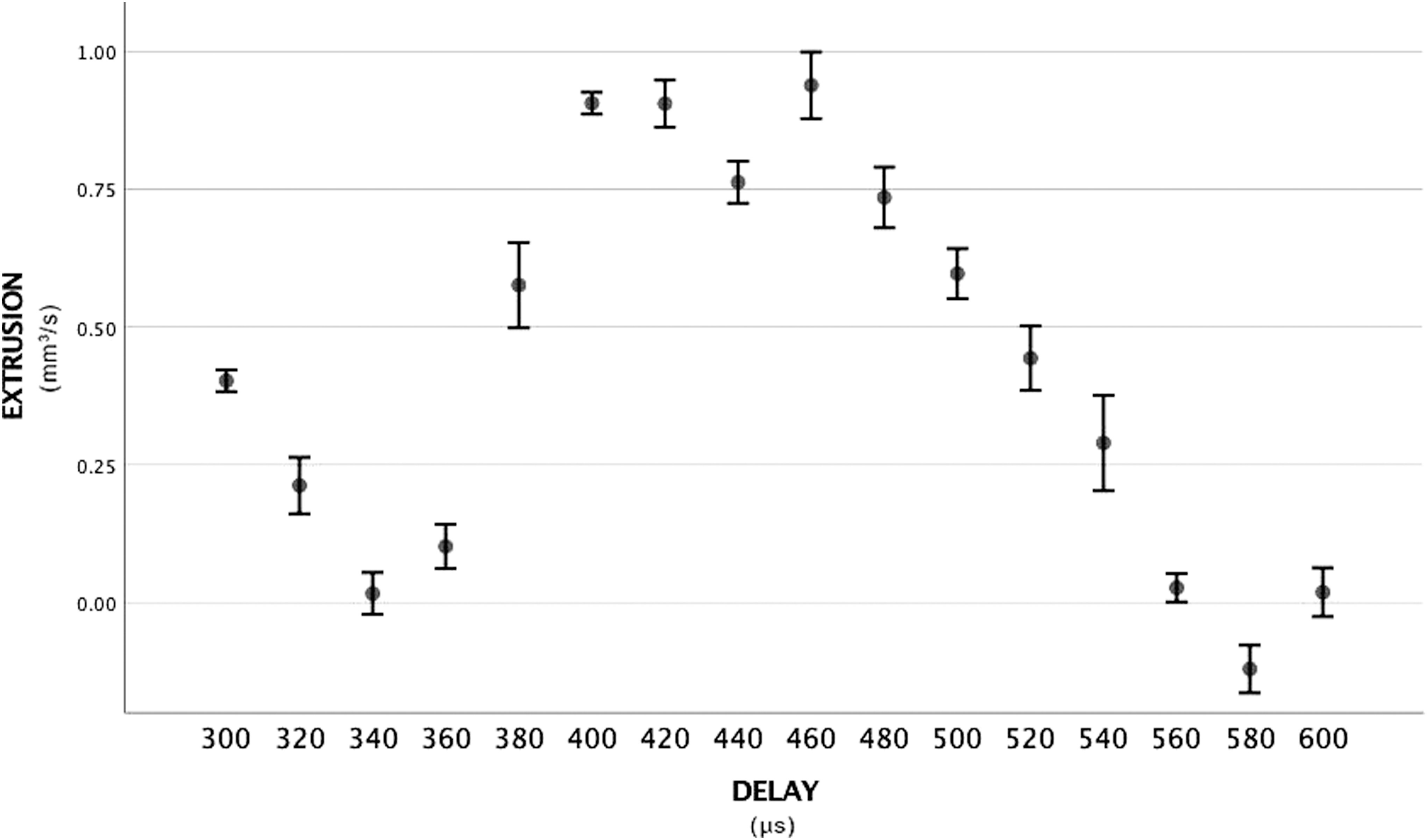
Effect of the pulse delay between laser micropulses on the irrigant extrusion rate during the fixed-delay SWEEPS modality, for a pulse energy of 20 mJ. SWEEPS, shock wave-enhanced emission photoacoustic streaming.
Discussion
The results of our study clearly indicate that all tested LAI modalities exhibited significantly lower extrusion rates than both CNI modalities at 5 mL/min. The LAI-ASWEEPS modality presented itself as the safest method of irrigation than CNI and LAI-SSP. Although both CNI and LAI-ASWEEPS exhibited a high correlation between the flow/pulse energy and extrusion, the AutoSWEEPS modality exhibited nearly constant extrusion, regardless of pulse energy.
In the first part of the research, measurements with CNI were performed using an open-ended or side-vented needle, and revealed increased irrigant extrusion with an increase of the irrigant flow rate for both types of needles. In clinical practice, irrigant is being delivered mostly by CNI, which needs to be closely placed to an apical constriction to achieve efficient debridement and effective disinfection of this area. Considering the fact that its effect is limited to the area of 1–2 mm beyond the needle tip for CNI-OE, 2 a further increase of irrigant flow increases not only the potential efficiency but also poses a risk for extrusion into the periapical tissues. It should also be noted that the CNI procedure is highly variable and depends on the endodontist's experience. Clinically relevant irrigation flow rates were measured by Boutsioukis et al. 18 and ranged from 8.4 to 15.6 mL/min, which is within the range used in our study. Comparison between CNI and LAI reveals that both LAI modalities induce much lower apical extrusion. The extrusion rates in a CNI-OE group, associated with flow rates >5 mL/min, were always higher than both laser modalities, even at the highest laser pulse energies. According to our measurements, it seems that any laser modality is a much safer irrigation technique in comparison with CNI, regardless of the needle type used.
When comparing both LAI activation modalities, the results demonstrate a high correlation between pulse energy and extrusion flow only for LAI-SSP. This phenomenon was similar to the relationship between flow rate and extrusion with both CNI modalities, although at considerably lower values, that is, extrusion at 40 mJ was comparable with CNI at 1–5 mL/min. Of interest, the AutoSWEEPS modality revealed an almost constant flow rate for pulse energies between 10 and 40 mJ and the flow rate values were similar to the values of LAI-SSP at 10 mJ pulse energy and were eightfold lower than LAI-SSP at 40 mJ. This indicates the superior safety of AutoSWEEPS regardless of the pulse energy.
In addition, the fixed-delay SWEEPS modality, using an operator-determined time delay between the consecutive micropulses, showed a highly nonlinear relationship between pulse delay and the extrusion, with the extrusion rate varying within approximately ±100% around the average extrusion rate value. The extrusion averaged over all SWEEPS delays was found to be similar to the extrusion for the AutoSWEEPS modality, indicating that the automatically varied time delay in LAI-ASWEEPS has an averaging effect on extrusion. This renders the AutoSWEEPS modality safer than the SWEEPS modality, as the extrusion is lower than it might be if the delay between the pulses was adjusted by the operator.
For assessment of extrusion rates in this study, we used an optical mechanism for flow visualization with a PIV measurement technique. This was coupled with a simulation of tissue pressure, which was achieved by the adjustable height of a second vessel in the testing equipment's measurement of the high-speed dynamics that are present during LAI. The measurements were performed on artificial root canal models, which may have some limitations such as the fact that the frictional resistance of the irrigant to polymethyl methacrylate can be different to that of a dentinal root canal wall. 19 Although canals in acrylic blocks can never completely mimic canals in real teeth, they are often used in research because of the transparency of the material and standardized anatomy. Both water 17,20,21 and NaOCl 22,23 were used as irrigants in the extrusion studies and are used in clinical practice as well. A recent study reported no difference in laser light absorption between them, rendering our results applicable to both irrigants. 24
Several factors affect the amount of apically extruded irrigant, such as the instrument kinematics, early flaring of the cervical region, instrument design, and the type of irrigation system. 16 For accurate estimations of the extrusion phenomena in endodontics, the periapical tissue that surrounds the tooth apex and the conditions defining this barrier must be taken into consideration. 23 Moreover, efforts to adequately quantify the amount of extrusion and comparisons of such results with different types of irrigation methods are pointless if the periapical conditions are not mimicked in the laboratory setup. 25 Omission of the periapical tissues simulation might lead to an overestimation of the extruded volume. 26 The most commonly used value for the pressure of periapical tissues is central venous pressure (CVP), with a value of 5.88 mmHg. 27 It is assumed that if the pressure of the irrigant delivery method exceeds this value, extrusion occurs. 27 Unfortunately, no consensus has been reached regarding this issue, but the CVP value seems to be set too low, especially regarding the pressures reported in the bone and periodontium (∼20–30 mm Hg). 26,28 Consequently, interpretation of these studies might result in overestimation of the extruded volume. Further, of the studies measuring the periapical pressure generated by different irrigation methods, the volume of extruded irrigant can neither be measured nor calculated. 19
LAI has been reported to be more effective at removing intracanal debris compared with other classical irrigating and activating methods. 5 Although further research is needed to determine the exact amount of extruded irrigant, extrusion should always be minimized and irrigation should be confined to the root canal space to minimize the risk of postoperative symptoms or even severe complications.
Conclusions
Within the limitations of the study, our results demonstrate that the LAI-SSP and LAI-ASWEEPS laser-assisted irrigation methods exhibit lower extrusion in comparison with the CNI methods. Although the LAI-SSP shows strong dependence of extrusion on laser pulse energy, the extrusion during the AutoSWEEPS modality appears to be relatively insensitive to laser energy.
Footnotes
Acknowledgments
This research was supported by the Ministry of Education, Science and Sport, Slovenia, under grants L3-7658, P2-0392, and Fotona d.o.o.
Author Disclosure Statement
Two of the authors (N.L. and M.L.) are affiliated also with Fotona d.o.o., Ljubljana, Slovenia.