




Abstract
Background and objective:
The object of this study was to analyze the oral health-related quality of life (OHRQoL) of patients with temporomandibular disorders (TMDs) who were treated simultaneously with ultrasound (US) and photobiomodulation therapy (PBMT).
Materials and methods:
This study included 13 patients of both genders, with diagnosis of TMD according to the Research Diagnostic Criteria for Temporomandibular Disorders. The patients were treated with equipment consisting of US and PBMT in the same system. The treatment was applied to the left and right sides of the face in the masseter muscle, anterior temporalis muscle, and temporomandibular joint, two sessions per week for a total of eight sessions. The OHRQoL was assessed by the Oral Health Impact Profile (OHIP-14) at three moments: pretreatment (T0), after the eight treatment sessions (T1), and 30 days after termination of treatment (T2). The Wilcoxon, Mann–Whitney U, Kruskall–Wallis, and Spearman's correlation coefficient tests were applied, with a significance threshold of 5%.
Results:
Psychological discomfort, physical pain, and psychological limitation were the domains where the highest scores were obtained at T0. The total OHIP-14 scores at T1 and T2 were significantly lower than at T0. No statistical differences were observed between T1 and T2.
Conclusions:
We conclude that synergistic treatment was effective in improving the OHRQoL of patients with TMDs, and that its beneficial effects persisted at 1 month after termination of treatment.
Introduction
Temporomandibular disorders (TMDs) are characterized by alterations that affect both the temporomandibular joint (TMJ) and the masticatory muscles. 1 It is estimated that ∼39.2% of the Brazilian population between the ages of 15 and 65 years present at least one symptom of TMD, and that pain associated with TMD is present in 25.6% of the population. 2 Pain, restricted movement, muscular sensitivity, and articular noises may affect physical and mental health, with a negative impact on the individual's quality of life (QoL). 3 According to WHO, QoL is “individuals' perception of their position in life in the context of the culture and value systems in which they live and in relation to their goals, expectations, standards and concerns.” 4 Oral health-related QoL (OHRQoL) is an evaluation of the individual's perception of oral health and how it impacts on daily activities, 5 and the Oral Health Index Profile (OHIP) is one of the most widely used instruments for evaluating it. 6 The short version of the OHIP is OHIP-14, which presents good psychometric qualities and collects information related to the gravity, extension, and prevalence of the negative impacts of a disease in relation to OHRQoL. 7
In patients with TMDs, the degree of chronic pain is strongly associated with a worse perception of OHRQoL; 8 it is, therefore, important to find a treatment that can reduce pain, offering these patients a better QoL. Various treatment modalities have been proposed to diminish the signs and symptoms of TMDs, including ultrasound (US), photobiomodulation therapy (PBMT), electrotherapy, and transcutaneous electrical nerve stimulation. 9 PBMT has anti-inflammatory, analgesic, and biomodulatory effects; it is easy to apply and has few contraindications. 10 Earlier studies have indicated that PBMT is not only effective in reducing pain but that it also re-establishes function, producing a significant improvement in mouth aperture in patients with TMDs. 11 Therapeutic US is a noninvasive method that includes vibrations at a frequency >16,000 vibrations/s or 16 Hz. The frequency used for treatment (1.0 and 3.0 MHz) accelerates cicatrization, reduces joint rigidity, relieves pain, and increases the extensibility of the collagen fibers, as well as reducing muscular spasm. 12 Studies in patients with TMDs have shown that treatment with US was effective in diminishing muscular pain and increasing mouth aperture. 13 Considering that US and PBMT are effective in reducing pain and improving mandibular movement, the object of this study was to analyze the OHRQoL of patients with TMDs treated simultaneously with US and PBMT.
Materials and Methods
This study was approved by the ethics committee for studies in human beings of Irmandade da Santa Casa de Misericordia de São Carlos, decision number 3.244.307. All the doubts expressed by the participants were clarified orally, and it was explained that participation in the study was voluntary. All the participants read and signed an informed consent.
The study included 13 patients of both genders, 3 males and 10 females, aged between 23 and 66 years. Patients of the Dental Office of the Biophotonics Laboratory at the São Carlos Institute of Physics, University of São Paulo (IFSC-USP), were invited to participate in this study. The patients included were adults with diagnosis of articular, muscular, or mixed TMDs, according to the “Research Diagnostic Criteria for Temporomandibular Disorders (RDC/TMD).” 14 Patients undergoing any other type of physical treatment or using analgesics or anti-inflammatories were excluded. Table 1 shows the basic characteristics of the patients (gender, age, RDC/TMD diagnosis, and main complaint).
Basic Characteristics of the Patients
RDC/TMD, Research Diagnostic Criteria for Temporomandibular Disorders; SD, standard deviation.
Treatment protocol
The patients were treated with a prototype consisting of US and PBMT in the same system (Fig. 1). The Ultralaser prototype was designed at the Technological Support Laboratory of IFSC-USP, São Carlos, Brazil. All the patients received the same treatment. The treatments applied were laser diode at 808 nm, power 100 mW, and spot area 1.76 mm2; and US with frequency of 1.0 MHz, intensity 1 W/cm2, 50% pulsed work cycle, and effective radiation area of 1.6 cm2. Transparent water-based gel was used as the transmission medium for US. The US treatments and PBMT were applied simultaneously for 120 sec per region to the masseter muscle, anterior temporalis muscle, and TMJ on the left and right sides of the face, with gentle slow circular movements. Patients attended two sessions per week for 4 weeks, a total of eight sessions (Table 2). The frequency and number of sessions were stipulated based on the protocol used in previous studies by our research group. 15,16 Both patient and operator used protective glasses for the 808 nm wavelength throughout the whole treatment. Evaluation of TMDs by RDC/TMD was always carried out by the same investigator (V.H.P.), and simultaneous treatment with PBMT and US was always applied by the same professional (physiotherapist). Because the equipment emits light and sound, it was not possible to blind the patient and the operator of the prototype during the treatment session.
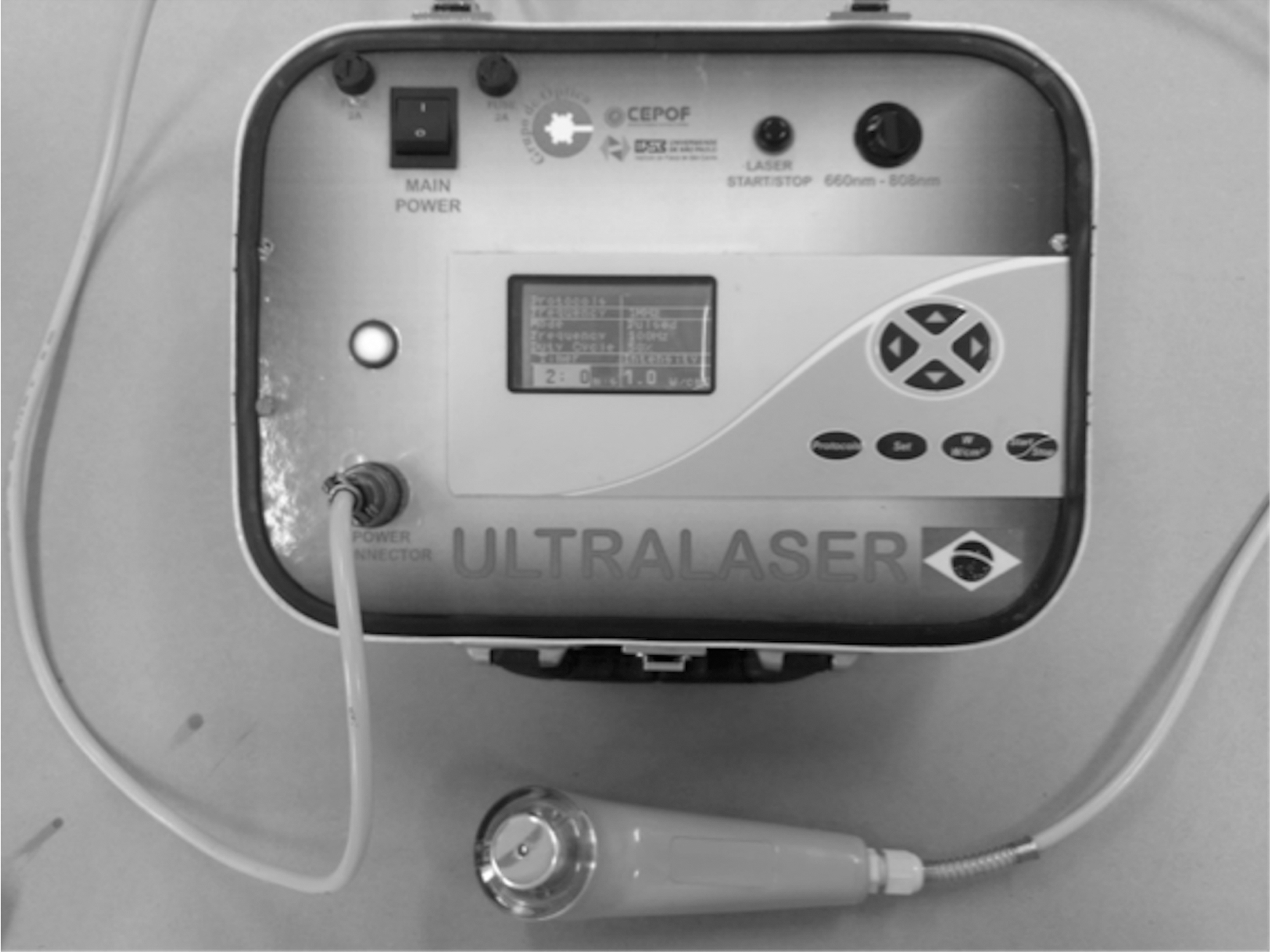
Prototype of the Ultralaser equipment consisting of US and PBMT. PBMT, photobiomodulation therapy; US, ultrasound.
Photobiomodulation Therapy and Ultrasound Parameters Used in Synergistic Treatment
PBMT, photobiomodulation therapy; US, ultrasound.
During treatment, patients were told to contact the dentist responsible if they suffered pain or other discomfort, and also whether or not they could apply any pain-reducing measures.
Evaluation of QoL
The Oral Health Impact Profile (OHIP-14), validated for Portuguese, was used for the QoL analysis. 17 This instrument consists of 14 questions that assess 7 domains: functional limitation, physical pain, psychological distress, physical limitation, psychological limitation, social limitation, and disability. The score is determined using a 5-point Likert scale: 0 = never, 1 = rarely, 2 = sometimes, 3 = often, and 4 = always. The maximum score of all the answers to the 14 questions is 56 points; the higher the score, the lower the QoL. The instrument was applied at three moments: T0 = pretreatment, T1 = post-treatment, and T2 = 30 days after termination of the treatment.
Statistical analysis
The Shapiro–Wilk test and Levene's test were applied for homogeneity of variances. Wilcoxon's test was used to compare the total score and to compare the seven domains of OHIP-14 over the following periods T0–T1, T0–T2, and T1–T2. The Mann–Whitney U test was used for comparison between genders and the Kruskall–Wallis test to compare the RDC/TMD diagnosis of each patient. Spearman's coefficient of correlation was used between age versus total score and between age and OHIP-14 domains, classified into five categories: very weak (0.00–0.30), weak (0.30–0.50), moderate (0.50–0.70), strong (0.70–0.90), and very strong (0.90–1.00). The significance threshold was set at p < 0.05. Data were analyzed using the SPSS software v. 22.0 (SPSS, Inc., Chicago, IL).
Results
The statistical power of the study was calculated with the G*Power 3.1 software, requiring a minimum of eight participants; the statistical power was found to be 94% (effect size = 1.46, error α = 0.05, power = 0.90).
All patients presented at least one type of discomfort assessed by OHIP-14. The mean total score obtained was 26.54 points at T0 (standard deviation [SD] = 13.11), 5.92 at T1 (SD = 4.60), and 4.25 at T2 (4.097). It was observed that the mean total score was significantly lower between T0 and T1 and between T0 and T2. No statistically significant differences were observed between T1 and T2. The mean total score for women was 25.40 at T0 (SD = 13.57), 5.80 at T1 (SD = 4.59), and 4.40 at T2 (SD = 2.30); the mean total score for men was 30.33 at T0 (SD = 13.20), 6.33 at T1 (SD = 5.68), and 4.00 at T2 (SD = 6.92). No statistical differences were found between genders at T0, T1, and T2. The total pre- and post-treatment scores presented no differences between RDC/TMD diagnoses (p > 0.05).
Psychological discomfort, physical pain, and psychological limitation were the domains with the highest scores before treatment (T0), and functional limitation was the domain with the lowest score before treatment (Table 3). On completion of treatment (T1) and 30 days after the last session (T2), the domains with the highest scores were physical pain and psychological limitation. In the seven domains of OHIP-14, no differences were found between genders or between RDC/TMD diagnoses pre- or post-treatment (p > 0.05). We observed that the total score presented by all the domains was significantly lower at T1 and T2 than at T0 (Tables 3 and 4). No statistically significant differences were observed between T1 and T2 (Table 4).
Mean Score Obtained for Each Domain of Oral Health Impact Profile-14 at T0, T1, and T2
OHIP, oral health impact profile.
Confidence Intervals and p-Value Presented Between T0 and T1, Between T0 and T1, and Between T0 and T1
In the seven domains of OHIP-14, no differences were found between genders or between RDC/TMD diagnoses pre- or post-treatment (p > 0.05) related to the percentage of patients with positive responses. At T0, T1, and T2, physical pain and psychological distress were the OHIP-14 domains that affected the highest percentage of patients. Functional limitation was the domain that affected the smallest number of patients at T0 and T2, and disability had the smallest impact at T1. A reduction in positive responses was observed between T0 and T2 and between T1 and T2 (Table 5).
Percentage of Positive Answers for Each Question of Oral Health Impact Profile-14 at T0, T1, and T2
It was observed that at T0, age presented a strong positive correlation for functional limitation and a moderate positive correlation for physical limitation, psychological limitation, social limitation, and disability. At T1, age presented a moderate positive correlation only for the domain functional limitation (Table 6). We also observed that the analysis between age and OHIP-14 score showed a significant moderate correlation at T0 (p-value = 0.028, ρ = 0.606); the correlation for the post-treatment period (T1 and T2) was not significant (p > 0.05).
Correlation Between Age and the Seven Domains of Oral Health Impact Profile-14 for T0, T1, and T2
ρ, Spearman's rho.
No damage of any kind was caused to the patients by simultaneous treatment with US and PBMT. No patient contacted the dentist to report any kind of pain or discomfort during the treatment period.
Discussion
Chronic pain is the most common symptom of TMDs; it may generate anxiety, stress or depression, social limitation, reduced ability to work, and physical disability. 18 Around 78% of patients with TMDs report exhaustion or maxillary pain on waking in the morning, showing that these patients sleep badly; this affects their physical and mental health and has a negative influence on their QoL. 19
Combined analysis of the functional and psychological results of oral conditions with clinical indicators may provide a more complete evaluation of oral health. 4 The OHRQoL is a self-reported instrument that gives a subjective evaluation of the individual's oral health, functional well-being, expectations and satisfaction with care, and self-perception. 5 There is a direct relationship between the worst cases of TMDs and a lower QoL and general patient health; 20 the QoL can be reduced by between two and six times in individuals with TMDs as compared with those who do not suffer the disease. 21 Worse QoL in patients with TMDs may be determined by the chronicity of the disease. 8 Another important point in evaluating QoL is interpersonal variability. Women tend to have a more negative perception of their oral health, which might determine higher scores in their QoL evaluation. 3,22 In our study, men presented higher mean total scores in OHIP-14 (at T0); however, we found no significant differences between genders, corroborating the findings reported by Bayat et al. 21 Blanco-Aguilera et al. 8 found the perception of OHRQoL in women to be 7.6 times higher than that in men, showing that women with TMDs have a worse QoL than men with the same disease. Another interpersonal variable that must be considered is age. In this study, increasing age was associated with a lower QoL at T0; older patients presented higher scores for the domains functional limitation, physical limitation, psychological limitation, social limitation, and disability than younger patients, corroborating the study of Rodrigues et al. 23
In this investigation, the prevalence of some limitation related to OHIP-14 and the mean total score were both higher than those reported by Blanco-Aguilera et al. 8 and Bayat et al., 21 who reported a total mean score of 20.57 (SD = 10.53) and 18.0 (SD = 9.8), respectively. The OHIP-14 domains with the greatest impact on the patients' OHRQoL were physical pain and psychological distress, corroborating the studies of Rodrigues et al. 23 and Lemos et al. 24 Disability was the domain that presented the lowest scores and determined the least impact on the OHRQoL of patients with TMDs, corroborating earlier studies. 25,26 Physical pain was the domain that affected patients with TMDs most severely, 25,26 therefore, treatments intended to reduce pain are essential for promoting increased QoL in these patients. Pain reduction after PBMT treatment has been reported by many authors; 27 –29 pain reduction persisted 30 days after the last PBMT application. 27 In the present investigation, the domain physical pain presented a mean score of 5.62 at T0 and fell by more than four points after treatment; this shows an improvement in QoL related to the diminution of physical pain.
PBMT acts through its anti-inflammatory and analgesic effects. These occur only in the affected tissue, which explains the importance of muscle and joint palpation to identify which points cause pain in the patient. 29 US treatment helps reduce pain and muscular spasm, accelerates cicatrization, and improves mobility. 12 Mohl et al. 9 suggest that for US treatment to be effective, it must be applied in combination with another type of therapy. In a more recent study, Gray et al. 30 compared the effectiveness of four techniques: US, PBMT, shortwave diathermy, and megapulse. The authors observed that all the treatments determined a reduction in pain, with no significant differences between the different therapies. 30 In another study, Ravi et al. 31 carried out a clinical trial comparing the effect of PBMT with US in the treatment of patients with TMDs. These authors indicated that both treatments were effective in diminishing sensitivity to palpation and in increasing maximum mouth aperture; however, PBMT was more effective than US. 31 In a case report, 15 our team investigated the effectiveness of synergistic treatment to reduce pain and improve the QoL of a patient with TMD; it was observed that the combined therapy improved the patient's QoL and reduced pain. According to Panhóca et al., 15 the therapeutic effect of synergistic treatment is related to the interaction of photoacoustic (photons+acoustic wave) energy with biological tissue, determining pain reduction and improved QoL in the patient. The findings of this study corroborate those reported by Panhóca et al., 15 and we also showed that the beneficial effects of the treatment persisted for 30 days after termination.
Conclusions
Synergistic treatment with US + PBMT improved the OHRQoL of patients with TMDs, and its beneficial effects persisted 1 month after termination of treatment.
Footnotes
Acknowledgments
The authors acknowledge scientific contributions and helpful advice from Larissa Biason Lopes.
Funding Information
Financial supports by Financier of Studies and Projects (FINEP)—Grant No. 01.13.0430-00; São Paulo Research Foundation (FAPESP)—Grant Nos. 2013/14001-9 and 2013/07276-1 (CEPOF—CEPID Program) are acknowledged.
Author Disclosure Statement
No competing financial interests exist.