




Abstract
Objective:
The aim of the study was to evaluate the characteristics of dentin ablation with a high pulse repetition rate Q-switching 2.79 μm laser.
Materials and methods:
Dentin was ablated using a homemade Q-switching Er:YSGG laser with a high pulse repetition rate. Er:YSGG radiation was applied with a pulse energy of 1 or 10 mJ for 100 or 3 Hz pulse repetition rate, respectively. A scanning electron microscope (SEM) was used to observe the microstructures of dentin samples after ablation. Teeth were irradiated in vitro with a 100 Hz pulse repetition rate under two different modes: free running and Q-switching. A thermocouple was applied to measure the temperature in the pulp cavity during ablation.
Results:
A 100 or 3 Hz Q-switching laser was used to irradiate dentin for 30 and 100 sec, respectively. There was no significant difference in ablation mass loss between the two conditions. The SEM photographs showed more dentinal tubules and no damage in the ablation area when using the 100 Hz Q-switching laser. The temperature of the pulp cavity was maintained below 41°C when using a Q-switching laser.
Conclusions:
The Q-switching Er:YSGG laser with a high pulse repetition rate exhibited greater ablation efficiency and better morphology than the low pulse repetition rate Q-switching laser. The experimental results also demonstrate the significant advantage of the Q-switching laser over free-running lasers for protecting dental pulp tissue. The Q-switching Er:YSGG laser with a high pulse repetition rate is expected to become an efficient new dental tool.
Introduction
Er:YSGG laser crystals can generate a 2.79 μm laser that overlaps well with the infrared absorption bands of water and hydroxyapatite. Therefore, Er:YSGG lasers have potential biological and medical applications. In many medical applications, the pulse repetition rate of 3 μm lasers has an important impact on the ablation performance. 1 Experiments show that the smoothness and morphology of the ablated areas can be significantly improved by increasing the pulse repetition rate of the laser. 2 –4 Therefore, erbium lasers with a high pulse repetition rate have attracted considerable attention and have experienced substantial development in recent years. 5,6
The dental lasers currently on the market are free-running erbium lasers with a pulse duration of hundreds of microseconds. 7 When free-running erbium lasers are used for dental ablation, the carbonization caused by the long pulse laser radiation can lead to significant disadvantages for composite resin restoration and the wound healing process in dental fields. 8 The surrounding tissues can also undergo simultaneous thermal damage by excess heat deposition in the teeth. 9 Water mist should be applied to the ablation area during surgery to avoid thermal damage. 10,11 However, the strong absorption effect of the 3 μm laser by water mist leads to energy fluctuations in laser pulses arriving at the ablated areas. 12 If the rate of water flow becomes higher than necessary, more laser energy is consumed to remove the water film in the ablation area. 13,14 In addition, it becomes more difficult to obtain a stable water film when the pulse repetition rate increases. 13 Therefore, the stability and efficiency of ablation are affected by water mist.
The use of Q-switching laser technology is an efficient method to generate high-peak-power laser pulses with a pulse duration of dozens of nanoseconds. 15 The thermal relaxation time of dental tissue is longer than the pulse duration of Q-switching lasers. 16 The heat is mainly concentrated near the ablation area when using Q-switching lasers. Therefore, thermal damage can be effectively prevented by using a Q-switching laser during surgery. 17 –19 However, Q-switching laser pulses can produce strong stress waves in the irradiated tissue and increase the probability of mechanical tissue damage when the energy of a single pulse is too high. Therefore, the ablation efficiency should be improved by enhancing the repetition rate instead of the pulse energy of lasers. The development of high pulse repetition rate Q-switching erbium lasers that operate at 3 μm has gained attention. 20,21
Although Q-switching 3 μm lasers with a high pulse repetition rate have potential advantages as dental instruments, few studies about their effects on dental hard tissues have been conducted. Hence, the aim of this study was to utilize a precision analytical balance, scanning electron microscope (SEM), and a thermocouple to investigate the effects of dentin ablation by a Q-switching Er:YSGG laser with a high pulse repetition rate.
Material and Methods
Extracted molars were collected from The Second Hospital of Anhui Medical University, China. The teeth used in the experiment were healthy and free of decay and were removed for orthodontic reasons. To avoid the influences of contamination such as blood stains on laser absorption, teeth were thoroughly cleaned using brushes and curettes. The mid-coronal dentin was exposed by removing the crown of the molar. The roots were cut at the cement-enamel junction with a dental turbine under water cooling. Subsequently, the dentin surfaces of the sections were wet grounded with 600-grit and 1000-grit SiC papers until they were flat with no enamel remaining and then were finished with 2000-grit paper.
The samples were dried with absorbing paper and assigned to two groups of equal size, corresponding to two repetition rates. A precision analytical balance was used to measure the quality of the dentin before and after ablation. Dentin mass loss was calculated by subtracting the final mass from the initial mass. The laser ablation efficiency was indicated by the amount of dentin mass removed. After weighing, samples were mounted on stubs for SEM analysis with their treated surfaces facing up, and then they were sputter coated with gold and examined with a Sirion 200 SEM. SEM images of the ablated areas were analyzed by performing a qualitative and visual comparison. The temperature increase in the pulp cavity following laser irradiation of the dental hard tissue without water cooling mist was recorded by a thermocouple. The thermocouple was inserted into the pulp cavity and fixed by heat-conducting silicone grease (thermal conductivity of 11 W/(mK), which was used to fill the cavity.
In the experiment, an acousto-optic Q-switching laser with a high pulse repetition rate and an electro-optic Q-switching laser with a low pulse repetition rate were used for comparison. A homemade laser diode-pumped Q-switching Er:YSGG laser using a TeO2 crystal as an acoustic-optic Q switch was used as a laser source with a high pulse repetition rate. 20 Using a repetition rate of 100 Hz, 76 ns pulses with an energy of 1 mJ were used to irradiate the dentin sample. A self-developed lamp-pumped Er:YSGG laser using a langasite (LGS) crystal as an electro-optic Q switch was used as a laser source with a low pulse repetition rate. 22 Using a repetition rate of 3 Hz, 76 ns pulses with an energy of 10 mJ were used to irradiate the dentin sample (see Table 1).
Table to Report Parameters in Experimental and Clinical PBM Papers
CW, continuous wave; LED, light-emitting diode; PBM, photobio-modulation.
The laser beam was reflected toward the dental sample by a 45° reflector. The laser was focused by a lens (f = 40 mm) and vertically irradiated the surface of the samples. The experimental setup is shown in Fig. 1. The dentin samples were placed on a motorized stage. No air or water spray was used during the experiment.
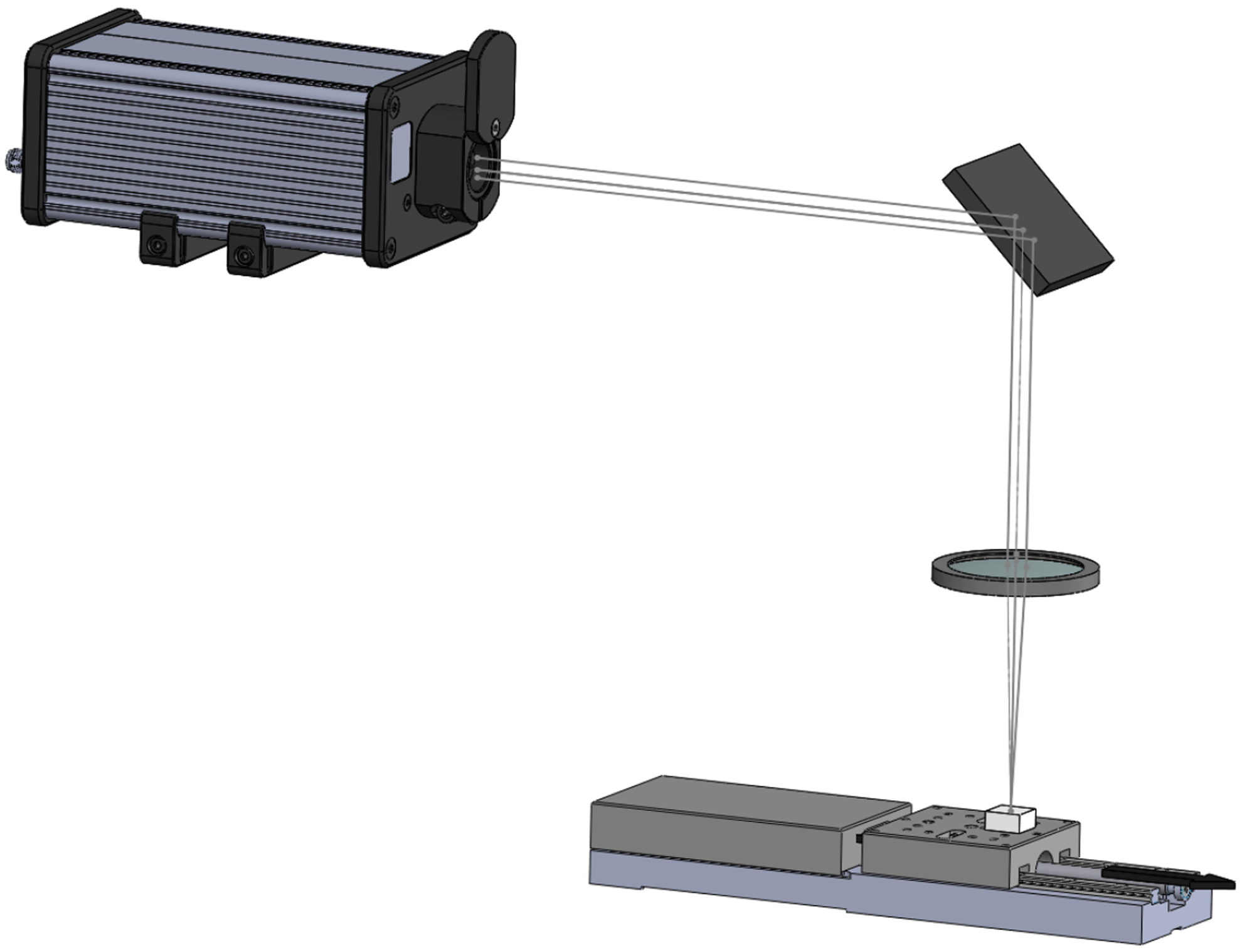
Experimental setup for the dentin ablation study.
Results
To study the ablation characteristics of dentin with a high pulse repetition rate Q-switching laser, two types of Q-switching lasers at different repetition rates were used in the ablation experiment. Studies indicate that the stress transients produced during the ablative process of Q-switching Er:YSGG lasers may result in mechanical damage to dentin. 23 The result shows that the possibility of acoustic-mechanical damage may limit the maximum single-pulse energy when using Q-switching Er:YSGG lasers for hard tissues. Suitable pulse energy should be chosen to avoid mechanical damage to the dentin samples. Therefore, Er:YSGG radiation with a pulse energy of 1 or 10 mJ, for the high pulse repetition rate or low pulse repetition rate lasers, respectively, was delivered to the dentin samples.
Figure 2 shows that the mass loss was not significantly different when the ablation times of the high pulse repetition rate (1 mJ@100 Hz) and low pulse repetition rate (10 mJ@3 Hz) Q-switching lasers were 30 and 100 sec, respectively. The ablation efficiency of the high pulse repetition rate laser was more than three times higher compared with the low pulse repetition rate laser in the experiment. This occurred because the total irradiation energy was the same for both experiments, while the ablation time of the 100 Hz laser was one-third that of the 3 Hz laser. Compared to the low pulse repetition rate Q-switching laser, the high pulse repetition rate Q-switching laser has obvious advantages in ablation efficiency.
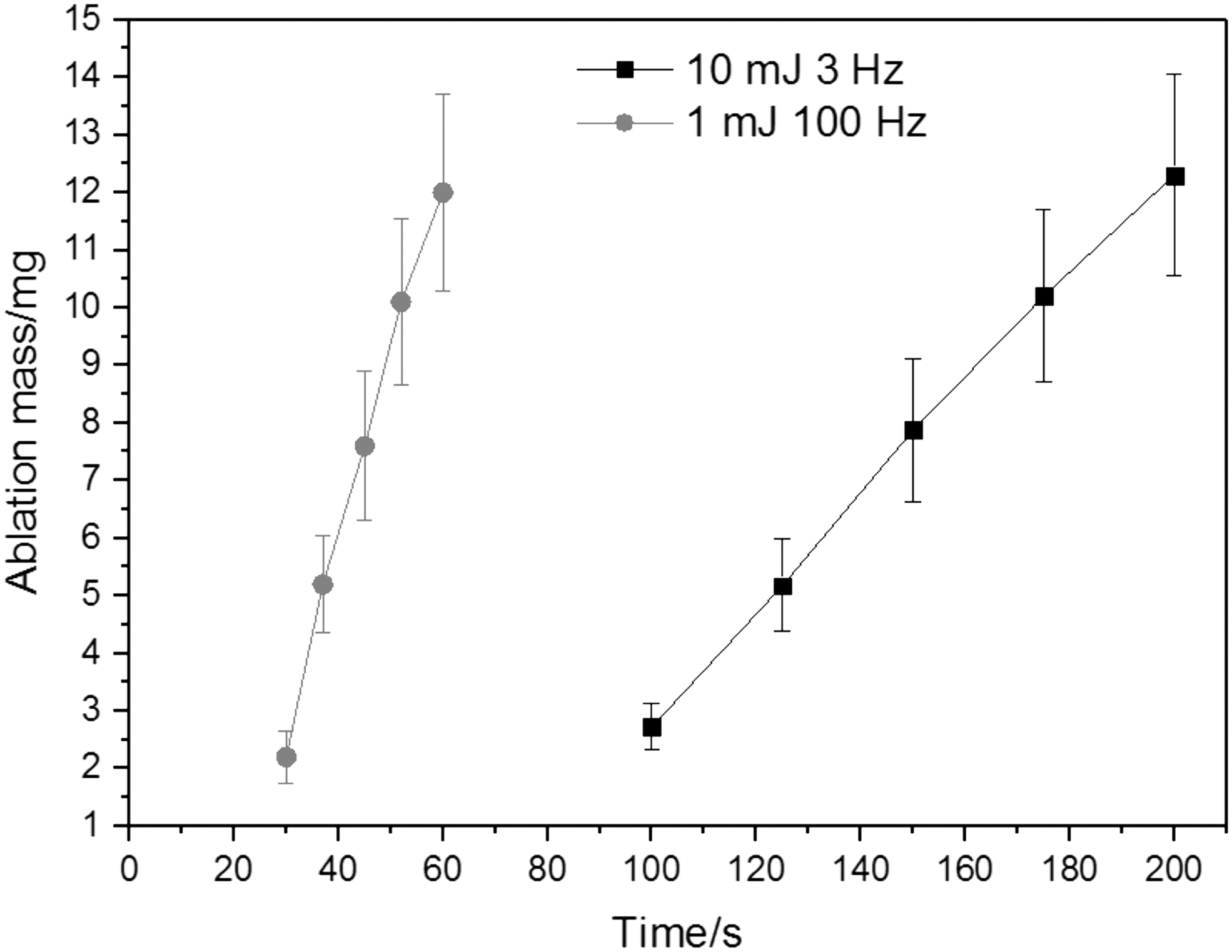
Ablation mass of two types of Q-switching lasers.
Figure 3 shows representative SEM images of typical morphological changes after irradiation by the Q-switching Er:YSGG lasers. A well-organized, very clean dentin structure can be observed in the bar-shaped dental ablation zone. Figure 3b and d show the local details of Fig. 3a and c at higher magnification. More opened dentinal tubules without sealing are present at the bottom of the cavity ablated by the 100 Hz Q-switching laser than by the 3 Hz Q-switched laser. The absence of a smear layer and the opened dentinal tubules are additional factors that help optimize the mechanical and chemical connection between the dentin and composite resin when using the 100 Hz Q-switching laser.
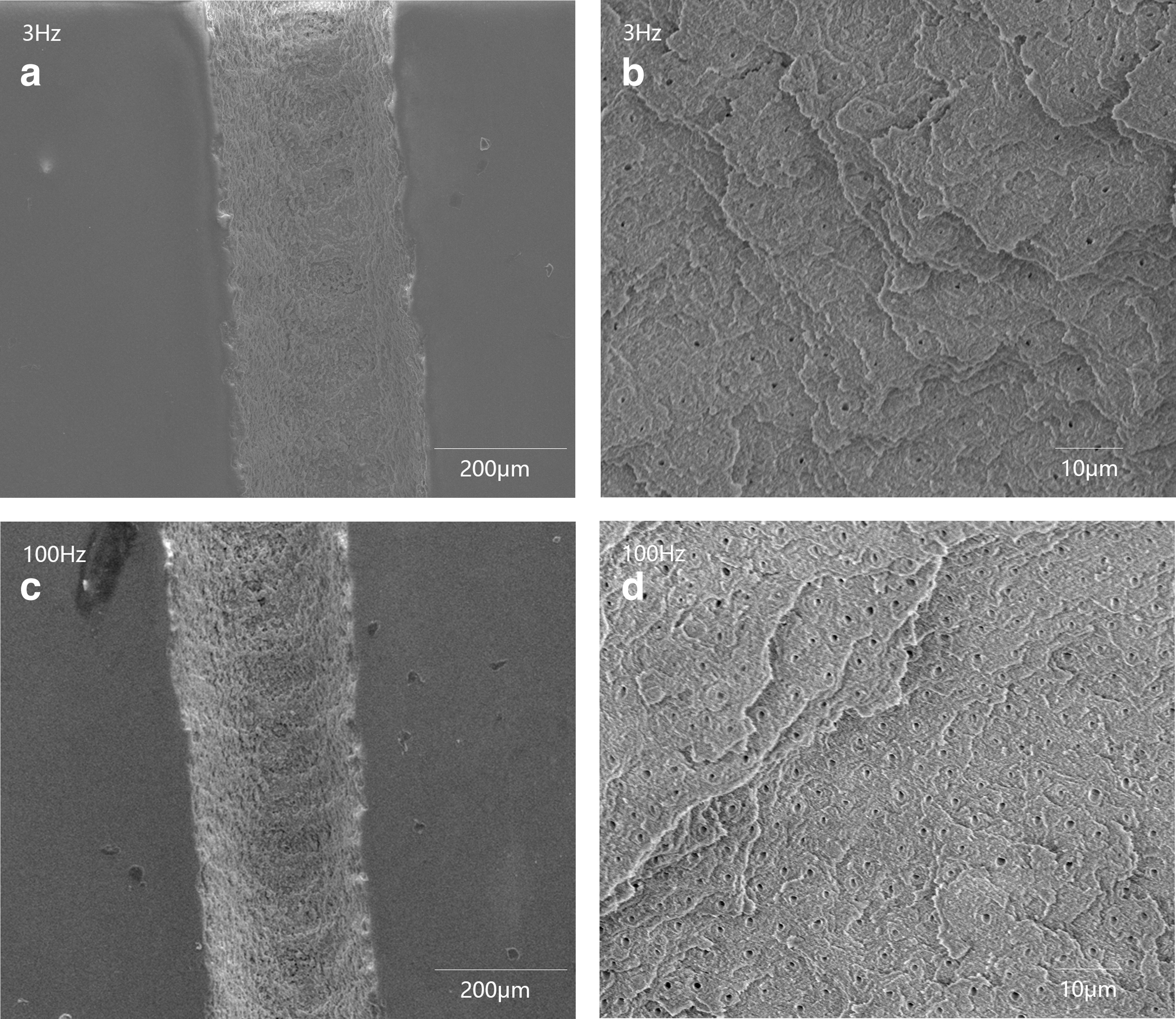
(
Thermal damage to the pulp is often a consequence of the temperature increase in the pulp cavity during dental surgery. Therefore, heat accumulation is a great concern during ablation with various types of lasers. Teeth were irradiated in vitro using the laser system described above, operating in free-running and Q-switching modes with a pulse energy of 1 mJ at 100 Hz. The temperature increase in the pulp cavity during laser ablation is shown in Fig. 4. The temperature of the pulp cavity increased to 52°C during free-running laser ablation. The temperature of the pulp cavity while ablating dental hard tissues was maintained below 41°C when the Q-switching mode was applied. This occurred because, in contrast to that of free-running lasers, the thermal relaxation time of healthy teeth is much longer than the pulse duration of Q-switching lasers. These experimental results demonstrate the significant advantage of the Q-switching laser in protecting tissues in the pulp cavity.
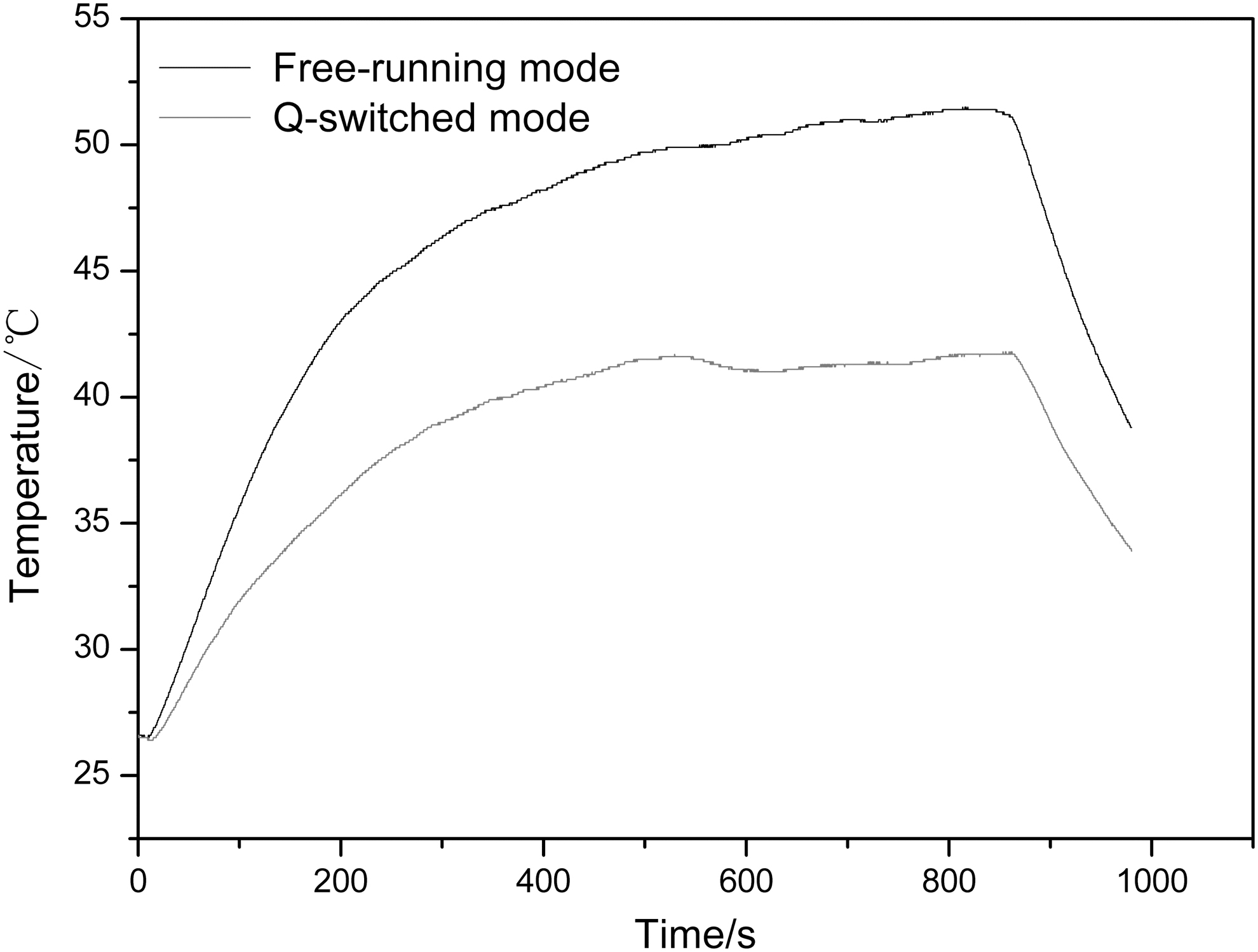
The temperature change process in the pulp chamber.
Discussion
The pulse duration of the Q-switching laser is shorter than the relaxation time of heat conduction; thus, the laser energy cannot be conducted into the interior of the tooth during ablation. 7 Therefore, thermal damage was not observed in the SEM images. The pulse energy and pulse repetition rate affect the ablation efficiency when using dental lasers. Some mechanical damage such as microcracks may occur if the pulse energy of the Q-switching laser is too high. Therefore, the pulse repetition rate, instead of the pulse energy, was increased to enhance the ablation efficiency of the Q-switching laser in our experiment. Dentin has high water content and abundant dentinal tubules, causing it to have relatively low hardness. The laser pulse energy required for dentin ablation is low, meaning that Q-switching lasers with a high pulse repetition rate are suitable for dentin ablation.
The surface morphology of the dental surface, including the cleanliness and roughness, has an important influence on the dental cavity and composite resin restoration. 18 After traditional cavity preparation, a smear layer and sealed dentinal tubules can be found on the dental surface. Consequently, tooth surface conditioning is required before filling. 24 Clean, open dentinal tubules without a smear layer can facilitate optimal micromechanical bonding to the tooth structure. 25 –27 Some microcracks from laser irradiation may hinder adhesion to these surfaces during cavity preparation, 28 and the possibility of microcracks may be reduced by high pulse repetition rate Q-switching lasers because of the low pulse energy. Our experiment showed that the high pulse repetition rate Q-switching Er:YSGG laser helped to improve the morphology without causing any damage to the dentin samples.
Zach 29 demonstrated that dental pulp tissues begin to lose biological activity with a temperature increase of more than 5.6°C relative to body temperature. However, the biological activity of dental pulp tissues is suppressed when the temperature increases above 16°C relative to body temperature. Some dental laser manufacturers claim that lasers with a short pulse duration and a high pulse repetition rate can produce more effective ablation and less thermal damage to dental tissues. 30 The temperature increase in the pulp cavity remained in the safe range during Q-switching laser ablation in our experiment.
The experimental results show that the Q-switching laser with a high peak power can ablate dental tissue with a shortened pulse width and less heat diffusion into the surrounding tissues. This type of ablation is called “cold ablation,” meaning that there is no heating of the surrounding tissue. 30 Although thermal damage could be avoided in this vitro study, the effects of the blood flow in the pulp chamber and the heat conduction of the tooth tissue were not considered. Further studies investigating the ablation characteristics of Q-switching 3 μm lasers should be performed for clinical applications.
Conclusions
A homemade high pulse repetition rate Q-switching Er:YSGG laser operating at 100 Hz and a low pulse repetition rate Q-switching Er:YSGG laser operating at 3 Hz were used to ablate dentin tissues to investigate their ablation characteristics. Compared to the low pulse repetition rate Q-switching laser, the high pulse repetition rate Q-switching laser had advantages in terms of ablation efficiency. SEM images showed no thermal or mechanical damage to the dentin samples. Moreover, no thermal damage to the dental pulp tissue was observed when using a Q-switching laser with a high pulse repetition rate, even without using cooling water mist. Future studies are recommended to determine the safety and effectiveness of high pulse repetition rate Q-switching Er:YSGG laser by ablating teeth in vivo. This laser system is expected to be used as part of a new generation of innovative dental instruments.
Footnotes
Author Disclosure Statement
No competing financial interests exist.
Funding Information
This work was supported by the National Natural Science Foundation of China (NSFC; Grant Number 61675212 and Grant Number 61505224) and the National Key Research and Development Plan (Grant Number 2016YFB0701001).