




Abstract
Carnosine is a neuroprotective dipeptide consisting of β-alanine and L-histidine. It demonstrates a number of useful features, including stimulation of brain and muscle microcirculation and a rejuvenating effect on cultured cells. Its activity is based on its antioxidant and antiglycating action that, in addition to heavy metal chelation and pH-buffering ability, makes carnosine an essential factor for preventing neurodegeneration and accumulation of senile features. Recently, carnosine was successfully used to treat patients after brain stroke or patients with Parkinson disease. We conclude that carnosine can be recommended for patients under oxidative stress as a natural remedy having high efficiency and no side effects.
Discovery of Carnosine in Excitable Tissues of Vertebrates
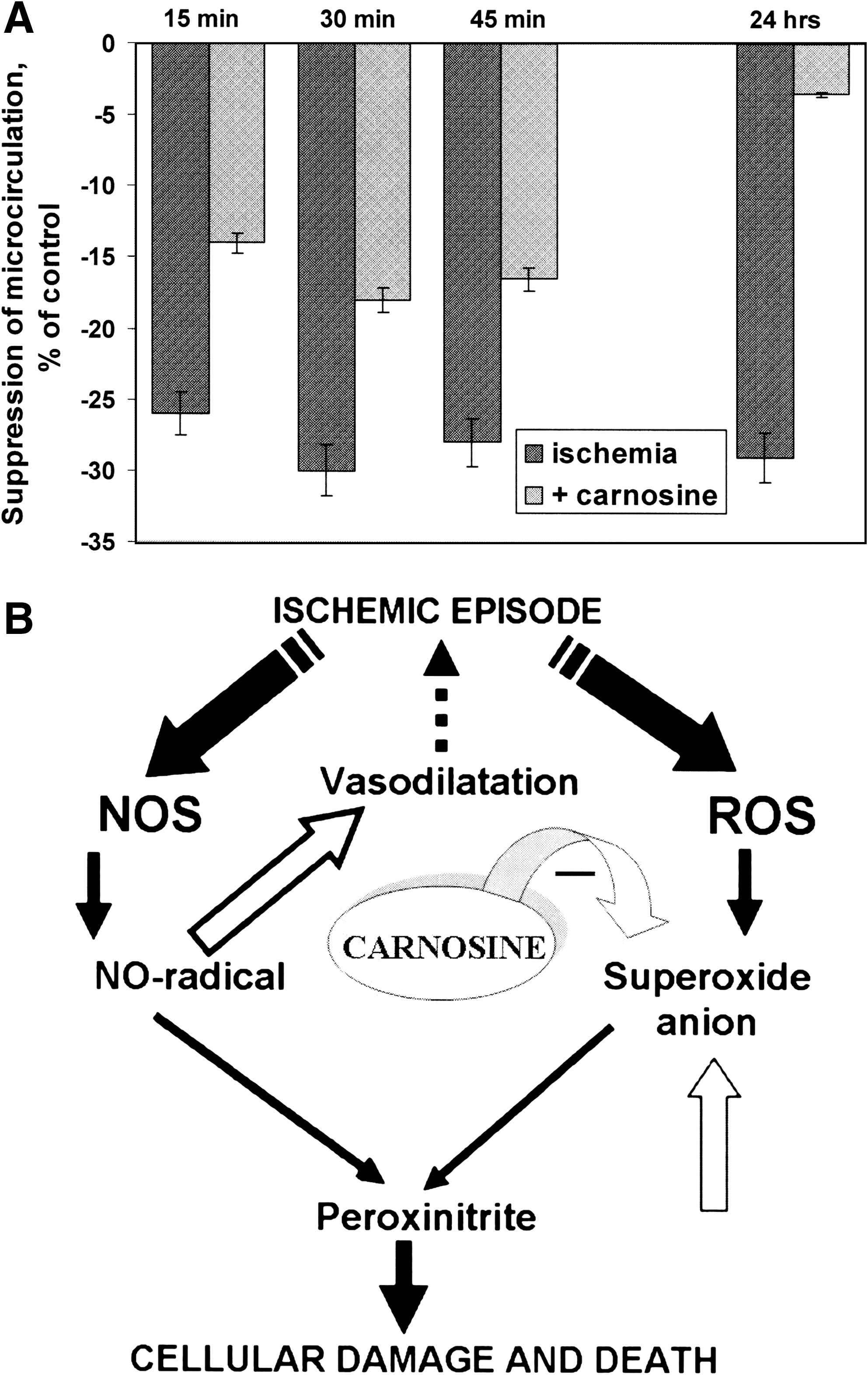
Effect of carnosine on brain microcirculation disordered by experimental brain ischemia (
Carnosine As a Natural Protector against Oxidative Stress
After 100 years of study of the biological activity of carnosine, it is clear that this neuropeptide is a potent natural hydrophylic antioxidant that protects excitable tissues of animals from oxidative stress and can be used successfully to prevent brain function against oxidative injury. 7 Thus, carnosine was suggested to be useful for treating neurodegenerative diseases 8 or preventing accumulation of aging features. 9 In agreement with this, we have demonstrated that carnosine increases the lifespan of mice 10 and fruit flies 11 and protects rats and Mongolian gerbils against the implications of brain ischemia. 12
Thus, it is clear that carnosine possesses a number of useful features, including an ability to neutralize toxic heavy metals, quench an excess of ROS, and bind protons preventing oxidative stress or restricting its consequences. 13 Finally, the ability of carnosine to protect brain memory 7 and to decrease infarct volume in the brain under focal ischemia 14 has provided a reasonable basis for its use as a drug to treat patients with neurodegenerative diseases.
Carnosine As a Component of Complex Therapy
The first double-blind, placebo-controlled trial of carnosine in neurodegenerative patients was performed in 2006, and the results of this study were published recently. 15 Forty two patients with chronic discirculatory encephalopathy took part in the trial. Some of these patients received carnosine in a daily dose of 0.75 g or 2 g in addition to basic therapy. After 21 days, the cognitive functions of patients' brain before and after treatment were compared for each group and between the groups tested; some parameters of oxidative stress were measured as well.
Cognitive functions of brain were characterized using induced P300 spikes. They were not changed significantly during basic therapy or therapy that was combined with the lower dose of carnosine. When, however, the higher dose of carnosine (2 g daily) was used, latency of the cognitive spikes was decreased from 378 ± 21 msec to 345 ± 12 msec (p < 0.05) and the number of responses with low amplitude failed from 60% to 27% (p < 0.01). At the same time, the amplitude of the spikes was unchanged.
In agreement with the positive action of carnosine on cognitive function, the restrictive effect on the oxidative state of the patients was noted. The blood lipoproteins of the patients treated with carnosine were protected from Fe2+-induced oxidation: the lag period was sufficiently prolonged and the rate of oxidation was decreased. Duration of acidic hemolysis of red blood cells was increased from 134 ± 4 sec to 151 ± 6 sec (p = 0.03). Negative side effects of carnosine on the patients' state were not found. The authors recommended including carnosine into the complex therapy of such patients to increase efficiency of the treatment. 15
Another example of using carnosine for human beings is treatment of Parkinson disease (PD). In the clinical trial, 36 PD patients took part compared with 20 apparently healthy donors (control group). Basic therapy consisted of dihydroxyphenylalanine (DOPA)-containing drugs at individually selected doses, depending on the state and severity of clinical manifestation of patients. For half of the PD patients, carnosine was prescribed at a daily dose of 1.5 g. The treatment lasted for 30 days. 16
After basic treatment, the baseline level of neurological symptomatic of patients decreased from 38.9 ± 2.5 to 32.5 ± 2.0 points (measured by the Unified Parkinson's Disease Rating Scale, UPDRS), which corresponded to a 16.4% improvement. Combining basic treatment with carnosine decreased the symptomatology to 24.9 ± 2.1 points (36% improvement). Thus, carnosine that was included in the protocol of treatment significantly improved the neurological state of the patients.
In the carnosine-treated group, an improvement of the locomotor system (rigidity of extremities, and upper-limb movements) amounted to 32–38% (p < 0.05) compared with the basic-therapy group, results that correlated well with improvement of one of the most important clinical signs of Parkinsonism—hypokinesia. The authors noted that the so-called “every-day activity” was also improved better in the carnosine-treated patients, which gave them ability for more independent self-service.
A decrease in the neurological symptomatology of PD patients correlated with a decrease in blood serum carbonyl levels and an increase in resistance to oxidation of lipoproteins in blood plasma, as well as in restoration of red blood cell superoxide dismutase (SOD) activity, which was in a distinct correlation (r = 0.654) with the decrement of neurological symptoms. The authors concluded that combination of carnosine with basic therapy of PD patients might be a reasonable way to improve the results of PD treatment and to decrease possible toxic effects of overloading of DOPA-containing drugs. 16
Alzheimer disease (AD) may be another example of a neurodegenerative disorder in which treatment carnosine is useful, 8 although there is no information about use of carnosine for AD patients.
Conclusion
Thus, present-day medicine has accumulated some experience for using carnosine in complex treatment of neurodegenerative diseases that has resulted in improvement of the neurological state of patients. The effective dose of this remedy is high enough and correlates with the presence of carnosinase activity in serum and kidney.
11
It is interesting to cite some publications of the novel carnosine derivatives constructed from carnosine and trolox-(S)-6-hydroxy-2,5,7,8-tetramethylchroman-2-carbonyl-β-alanyl-
Footnotes
Acknowledgments
This work is supported by Russian Foundation of Basic research, grants # 09-04-00507, 07-04-00755.
Author Disclosure Statement
No competing financial interests exist.