




Abstract
We performed maximal exercise tests on 6 men using a bicycle ergometer and then measured the ferric-reducing ability in plasma to clarify the relationship between antioxidant status and exercise intensity. The ferric-reducing ability showed a rectilinear increase with the increase in exercise intensity, whereas the generation of hydroxyl radicals showed a decrease with the increase in exercise intensity. Also, the generation of hydroxyl radicals showed a symmetrical correlation to lactate level in plasma. These results suggest that antioxidant ability is enhanced with an increase in exercise intensity, and that the lactate level, which increases with physical exercise, may act as a scavenger of free radicals.
Introduction
Accordingly, in the present study we aimed to examine not only the relationship between antioxidant ability in blood and exercise intensity, but also the possibility of lactic acid, which increases with the rise of exercise intensity, functioning as the scavenger of ROS.
Methods
The subjects were 6 untrained healthy men (21 ± 1 year old). Their maximal oxygen uptake (VO2max) was an average of 42.3 mL/kg per min, which is a standard for “untrained” people. The exercise consisted of maximal exercise using a bicycle ergometer. We raised the load from 50 W every 4 min by 25 W and let the subjects exercise until they were not able to maintain a pace of 60 revolutions per minute (rpm). We used the breath-by-breath method for measuring the oxygen uptake. We monitored heart rate continuously during the exercise, and we performed all the tests in the morning. We prohibited the subjects from drinking and eating except for a small quantity of water after supper.
We set the room temperature at 24°C. We collected blood samples from the catheter placed into antecubial veins before the commencement of the test to avoid undue stress caused by the injection needle. Upon arrival of the trial subjects, we allowed the subjects to have plenty of rest before commencing the tests. We collected blood samples at rest, at the end of each load, at all-out, after 10 min, 60 min, and 24 h after exercise, and measured the ferric reducing ability in plasma (Fe3+ → Fe2+; FRAS4; Wismerll) as a barometer of antioxidant ability, 4 total hydroperoxide (d-ROMs [reactive oxygen metabolites] test; FRAS4; Wismerll), plasma lactate (enzymatic method), 8-hydroxydeoxyguanosine (8-OHdG) (enzyme-linked immunoassay [ELISA]), and noradrenaline (high-performance liquid chromatography [HPLC]) levels as a marker of oxidative stress. For accurate evaluation, we used hematocrit measurements and corrected all of the values.
We measured the generation rate of free radicals at each load level using an electron spin resonator (BRUKER ESP300E: BRUKER biospin) by the spin-trapping method. 5 We used 5,5-dimethyl-1-pyroline-N-oxide (DMPO) as a spin-trapping agent and detected the DMPO-OH-adduct.
Results
The ferric-reducing ability showed a rectilinear rise (y = 0.0697x + 17.576) with an increase in exercise intensity, whereas the generation rate of radicals showed a decrease with an increase in exercise intensity (y = −0.0281x + 5.4623) in contrast to the change in ferric-reducing ability. We did not observe any significant change in the values of 8-OHdG and d-ROMs. Plasma lactate concentration increased with the exponential rise of exercise intensity, which was 52% VO2max at the 2 mmol/L point (lactate threshold, LT), and 71% VO2max at the 4 mmol/L point (onset of blood lactate accumulation, OBLA) as an average.
The relationship between the generation rate of radicals and plasma lactate concentration is shown in Fig. 1. The generation rate of radicals was high up to around the LT point and very dispersive, whereas the generation rate of radicals tended to converge at a higher lactate concentration than OBLA.
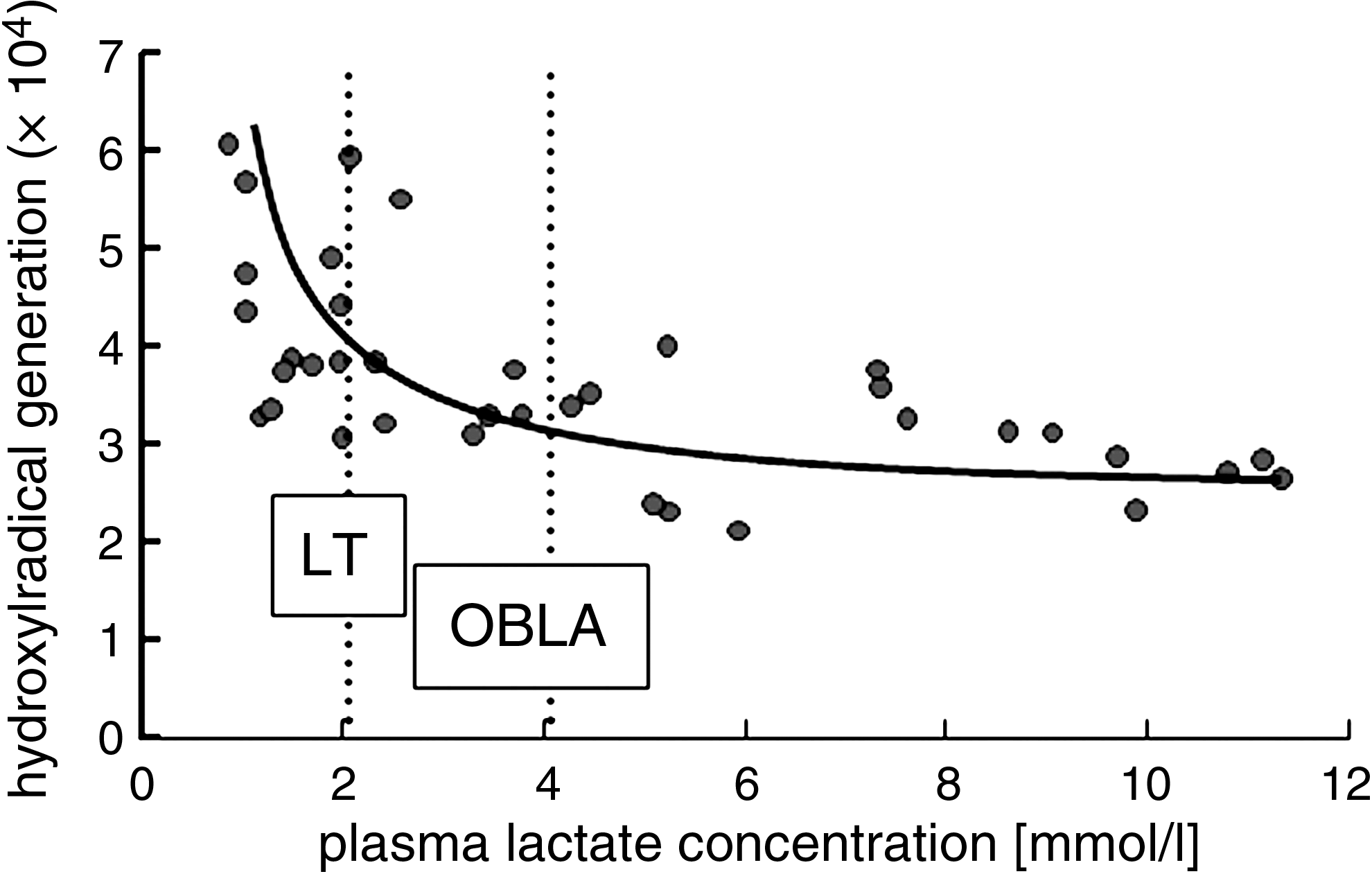
Relationship between plasma lactate concentration and hydroxyl radical generation. The generation rate of radicals (5,5-dimethyl-1-pyroline-N-oxide hydroxide [DMPO-OH] adduct) was high, up to around the lactate threshold (LT) point, and very dispersive whereas the generation rate of radicals tended to converge at a higher lactate concentration than onset of blood lactate accumulation (OBLA).
Discussion
The electron transport system in mitochondria promotes a four-electron reduction to reduce molecular oxygen to water. In the process, ROS are generated, but a small percent of them leak, 2,3 a process that is considered to be one of the causes of oxidative stress. There is a high possibility that generation of ROS may increase with the rise of exercise intensity 6 ; however, physical exercise with the intensity that antioxidant ability surpasses oxidative stress may reduce oxidative stress. Thus, there are many unclear points in relation to oxidative stress in which, on the one hand, the exercise intensity seems to be greatly involved 7 and, on the other hand, the intensity at which the balance collapses is unknown.
Sen et al. 8 had 9 untrained male test subjects exercise for 30 min using a bicycle ergometer with three levels of exercise intensity, equivalent to maximal load exercise, anaerobic threshold, and aerobic threshold, and compared the levels of oxidized glutathione (GSSG), an oxidative stress marker, with the total glutathione (TGSH). They reported that GSSG/TGSH ratio was the highest at the exercise intensity of anaerobic threshold. Sato et al. 9 had 12 untrained male trial subjects exercise for 90 min using a bicycle ergometer with an exercise intensity equivalent to 50% or 55% VO2max, and measured the OCI−, an oxidative stress marker. As the result, whereas no generation of OCI− was observed with 50% VO2max, the significant increase was recognized with 55% VO2max.
In the present study, the ferric-reducing ability increased with the rise of exercise intensity. Because this rise of ferric-reducing ability was accompanied by exercise intensity-dependent attenuation of the DMPO-OH adduct, it was suggested that the ferric-reducing ability in plasma increased with the rise of exercise intensity. Moreover, the ferric-reducing ability was increased rectilinearly and the oxidant/ antioxidant balance appeared to be maintained, even under any exercise intensity.
One of the causes of enhancement of antioxidant ability by exercise might be the rise of lactate concentration in blood.
10
Although there are not a few unclear points about radical scavenging of lactic acid, the involvement of such a chemical reaction as
may be considered. 11 In the present study, plasma lactate concentration also showed an increase with the rise in exercise intensity, but the DMPO-OH-adduct decreased in an opposite manner to this ascending curve (Fig. 1). These results suggested that the lactic acid (which rose with physical exercise) functioned as a radical scavenger during active exercise, possibly preventing any injury induced by ROS, even at high-intensity exercise.
The results obtained here suggest that antioxidant ability in the blood increases with the rise in exercise intensity and that lactic acid, which also increases with exercise intensity, may function as a scavenger of ROS. Further studies are needed to elucidate the role of lactic acid under varying oxidant/antioxidant status during physical exercise.