




Abstract
Most devices assessing body composition harbor a number of drawbacks and hardly assess the phenomena taking place at a cellular membrane level. The present single-frequency bioelectrical potential homeostatic structure analysis (PHoSA) technology requires only a proper hands contact on fixed electrodes and determines the phase displacement between tested current and voltage by using a 50-KHz alternate sinusoidal current. This allows quick testing time with high degree of precision, sensitivity, and specificity of sectorial functional body compartments analysis. Such assessment may prove to be an integrated part of either a diagnostic workup or monitoring tool in tailoring nutritional/nutraceutical, pharmacological, and exercise activity, all being framed within a proactive, preventive, age-intervention management strategy.
Introduction
The rationale of our research study was to test the ability to restore the balance of cellular potentials through specific nutritional, nutraceutical, and pre/prebiotics effectively modifying gut ecology and eventually cellular homeostatis overall. Although there is an abundant array of reliable biomarkers related to this condition, the same does not apply to body composition analytical methods, where a number of drawbacks still exist. 1,2 Among such methodologies, bioelectrical impedance analysis (BIA) has widespread popularity for its easy availability and practical feasibility. The principle of BIA is the application of an alternate sinusoidal current to a human body generating two different feedbacks, i.e., one related to intra/extracellular fluid masses (resistance) and another referred to electric potential-endowed cell membranes (reactive conductors). 3 –7 To reach the two feedbacks, we had to assess and verify the reliability of such predictive analysis as well as the status of phase-angle value when measured in single-frequency bioeletrical impedance analysis (SFBIA) as compared to multifrequency bioeletrical impedance analysis (MFBIA) under specific nutritional challenges. 8,9
Materials and Methods
Background: Principles and limitations
The concept of electrical impedance is more complex than a simple opposition of a biological conductor against an alternate current. Indeed, the main biophysical principle is a ratio between the amplitude of an alternate potential versus the one of an alternate current taking place within a biological conductor. Thus, the impedance of an electrical circuit varies according the relationships within the biological compartments of functional masses at a cellular level that generate a specific phase-angle change between measured current and tension. The exact measure of such “phase displacement” identifies the properties of resistance and capacity of each compartment of the circuit. 10 –13 The most reliable data produced by commonly available BIA are related to hydrated compartments. However, such data are indirectly derived by equations and population-dependent assumptions. Moreover, lean masses that are more metabolically active have not received enough attention. 14,15 A detailed analysis of fat-free mass allowing the separate analysis of crucial components such as proteins, water, glycogen, and bone mass, which are essential for overall health status, would help to improve any interventional therapeutic strategy. To accomplish this, we had to assess and verify the reliability of such predictive analysis as well as the status of the phase-angle value when measured in SFBIA as compared to MFBIA under specific nutritional challenges.
PHoSA methodology
The presently employed SFBIA (potential homeostatic structure analysis [PhoSA]) allows an extremely quick testing time with a high degree of precision, sensitivity, and specificity when applied to individuals who are fully dressed and seated on the chair-shaped device. PHoSA technology requires only a proper hands contact on fixed electrodes and determines the phase displacement between tested current and voltage by the input through the subject of an alternate sinusoidal current set at 50 KHz, with slight, moderate, and severe degree of unbalance of the physiological status between functional masses at a cellular level. The PHoSA device is designed to be an open and module-arrayed system to detect data within the workstation and sent real time to a processing central server. The system is an open and module-arrayed system that integrates nutritional and energy expenditure information with the analysis of body functional masses to finally tailor a functionally effective nutritional plan. It is designed to detect data within the workstation and sent real time to a processing central server, shortening operating and computing time.
Results
In-house data amounting to over a thousands of patients, in particular 100 diabetics, 100 dyslipidemics, and 100 overweight people, analyzed in a double-blind fashion showed a very significant correlation between the data obtained by the dietary questionnaire (reproduced in a fractal-like graph, upper part of Fig. 1) and the sectorial functional body compartments analysis obtained by PHoSA methodology (lower part of Fig. 1) (p < 0.05). When these patients' dietary habits were designed under tailored nutritional-nutraceutical modification as guided by PHoSA analysis, the subsequent follow-up results were significantly mirrored by the related specific functional masses and water distribution modification, unlike routine body mass index (BMI) or conventional body composition scales employed as comparison.
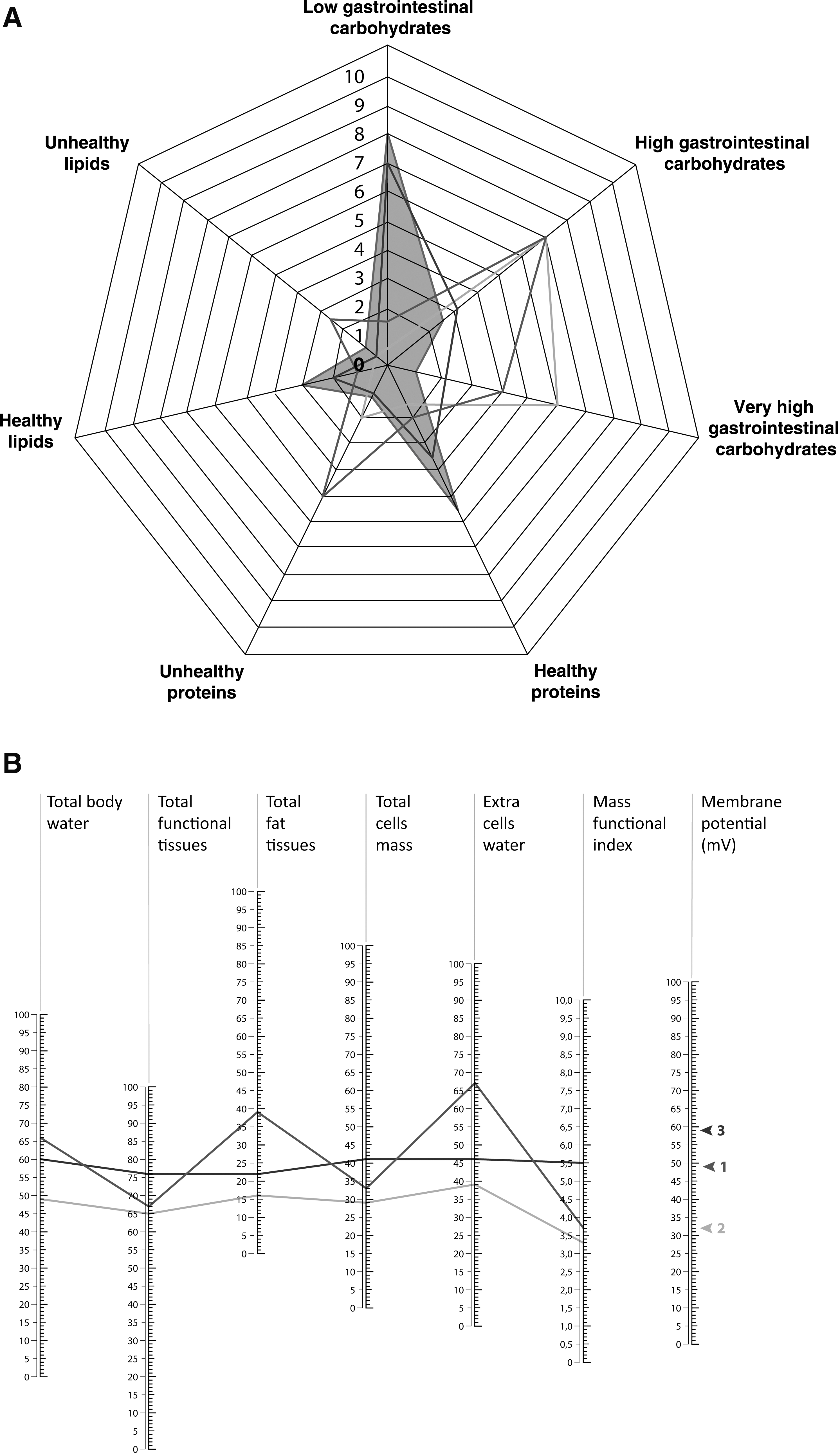
Dietary pattern membrane potential analysis interrelationship. (
Discussion
The novel concept of the methodology devised by Rilevo Bioengineering Lab is based on the targeted analysis of homeostatic balances and their inner structural components. The PHoSA analyzer shortens operating and computing time while offering the analysis of a number of lifestyle and dietary habits (foods components, water distribution, exercise). This information will help in customizing a proper nutritional intervention plan endowed with specific quali-quantitative integrations tailored by the counterpart of individual cellular unbalances tested. Taken overall, the results so far obtained by robust in-house clinical observations lead us to suggest that the present methodology is highly reproducible, with virtually no intraindividual and interobserver variation whatsoever, while finely mirroring basic cellular physiologic status and variation due to dietary habits and interventions. Thus, the assessment provided by this novel dynamic device may prove to be an integrated part of a diagnostic workup and, most importantly, a monitoring tool in tailoring nutritional/nutraceutical, pharmacological, and exercise activity, all being framed within a proactive preventive age-intervention management strategy.