




Abstract
No study has yet determined the anti-wrinkle efficacy of green tea plus lotus in Asian subjects using skin image analysis technique. In this study, the efficacy of two cosmetic active formulations intended for the treatment of facial wrinkles (green tea and lotus extract) has been evaluated in healthy subjects using a non-invasive device, the Visioscan® VC, and software for surface evaluation of living skin (SELS). Thirty-three healthy Asian subjects, all men, were enrolled after consent in a placebo-controlled comparative study with a split face design. One group applied multiple emulsions with green tea. The second group applied multiple emulsions with lotus extract, while a third group applied a multiple emulsion with a combination of both extracts. In all three groups, active formulations were applied to one side of the face and the placebo to the other side, once daily over the 60-day treatment course. Non-invasive measurements were performed at baseline and on days 30 and 60. Interesting and significant improvements were observed for the treatment effects on skin roughness (SEr), scaliness (SEsc), smoothness (SEsm), and wrinkling (SEw). For example, a 49.99% improvement in skin smoothness (SEsm) from baseline value and −23.22% and perfection in facial wrinkles (SEw) substantiated that combined treatment is superior over single treatments. Green tea and lotus combined in multiple emulsions brought a superior synergistic anti-aging effect. We conclude that diverse anti-oxidant constituents in both plants have a potential influence on skin surface parameters, thus indicating these plants as the future of new anti-aging products.
Introduction
Botanicals have been used in cosmetics for centuries and could play an incredible role in skin aging. 4 Their potential to treat different skin diseases and to adorn and improve the skin appearance is well known. Because ultraviolet (UV) radiation can cause sunburn, wrinkles, lower immunity against infections, premature aging, and cancer, there is a permanent need for protection from UV radiation and prevention of its side effects. Botanical preparations have a high potential benefit for these purposes due primarily to their anti-oxidant activity. 5 Botanical extracts used in combination have been assessed recently and proven to be more effective clinically and pharmacologically when compared to single extracts or isolated constituents. 6 Human studies have convincingly demonstrated that topical application of such combinations may result in a sustained anti-oxidant capacity of the skin, possibly due to anti-oxidant synergisms. Topical administration of anti-oxidants might be particularly promising in UV-induced skin alterations. 7
Green tea is now a subject of interest because of its proven anti-oxidant properties and its ability to repair UV photo-damage and photo-toxicity. This activity of green tea is thought to be due to catechins, which are the most important polyphenols in green tea. 8 Recently, the lotus Nelumbo nucifera's leaf, seed, and flower extract were investigated for anti-wrinkle effects and showed 56%, 49%, and 54% inhibition of elastase. 9
The aim of this study was to use a skin bioengineering device, Visioscan® VC 98, and software for the surface evaluation of the living skin (SELS) to explore the effects of green tea and lotus extracts alone and in combination for the improvement in four skin surface parameters, including wrinkles, scaliness, roughness, and smoothness.
Materials and Methods
Subjects
A convenience sample of 33 healthy male volunteers (mean age 25±3.97) recruited in this study was further divided into three groups, each group having 11 volunteers. The reasons for including male volunteers in this study were: (1) They were willing to participate in the study, (2) they remained more exposed to sun and environmental assaults and thus better results could be inferred after the application of such products, and (3) healthy female volunteers are rarely available for such studies due to societal paradigms of this geographical area. Volunteers having hair on the test sites were excluded from this study. All volunteers completed the study effectively. None of them had a pathological condition on the area specified for applying the test products, i.e., split face model. Subjects restricted the use of oral green tea, which may interfere with results. All participants were well informed about the use of products and necessary details about study. Participants were instructed not to use any skin-care products like moisturizers on the test sites 15 days before the study and throughout the study period of 8 weeks. Moreover, they were asked not to change their dietary habits during the study so as to nullify the effects of such changes on study results.
Ethical considerations
This study was approved by the Board of Advance Studies and Research and Ethical Review Committee, The Islamia University of Bahawalpur (No. 942/Acad). The study was conducted in accordance with the ethics principles of the Declaration of Helsinki and was consistent with Good Clinical Practice guidelines. All participants were included in this study after providing written informed consents. They were informed about possible adverse reactions, procedures, protocols, and objectives of this study. They reserved the right to quit the study without informing about reasons for leaving.
Test products
Products tested were water-in-oil-in-water (W/O/W)-type multiple emulsions, loaded with botanical extracts. Multiple emulsions have an excellent ability to hold active ingredients, especially when a large volume of botanical extracts is to be incorporated in these systems. Green tea and lotus extracts were incorporated in these emulsions as functional cosmetic agents. Compositions of products tested are shown in Table 1. Each participant was provided with two vessels containing 30 grams of contents. The vessels with emulsions were marked as “right” and “left” and this indication was associated with the right and left cheeks. The subjects used the products daily at bedtime on respective half of the face. The right cheek was always a control site whereas the left cheek was always a test site. They were instructed about proper application of the products and were reminded regularly about the use of product to ensure 100% compliance in use of these products.
GT, Green tea; L, lotus; GT+L, green tea plus lotus; W/O, water-in-oil; Q.S., quantum satis (as much as is enough); W/O/W, water-in-oil-in-water; HPMC, hydroxypropyl methylcellulose.
Study protocol
This placebo-controlled, split-face, monocentric study was conducted to evaluate the effects of anti-oxidants from green tea and lotus on aging skin. A single expert investigator ensured the proper conductance of Visioscan measurements, considering the experimentation protocols for this skin microtopographic technique. One cosmetic expert continued throughout the study to minimize person-to-person variations. Moreover, the assessor was not informed about the contents of tested products to ensure blindness in study.
Tests were carried out on right and left cheeks of healthy adults who did not know the contents of the formulations. Assessments for objective skin profilometry were performed at baseline and at weeks 4 and 8. A typical image and evidence of the effect produced by treatment are shown in Fig. 1. The exact location of the test area was defined by fixing the camera every time on the same position as for baseline, because microtopography of the skin significantly varies within a few millimeters of skin. Before any measurements, all volunteers had to rest in the Cosmetic Lab, under constant environmental conditions of 20±2°C and 45%±5% relative humidity, for at least 30 min in accordance with the protocols set for these measurements. 10
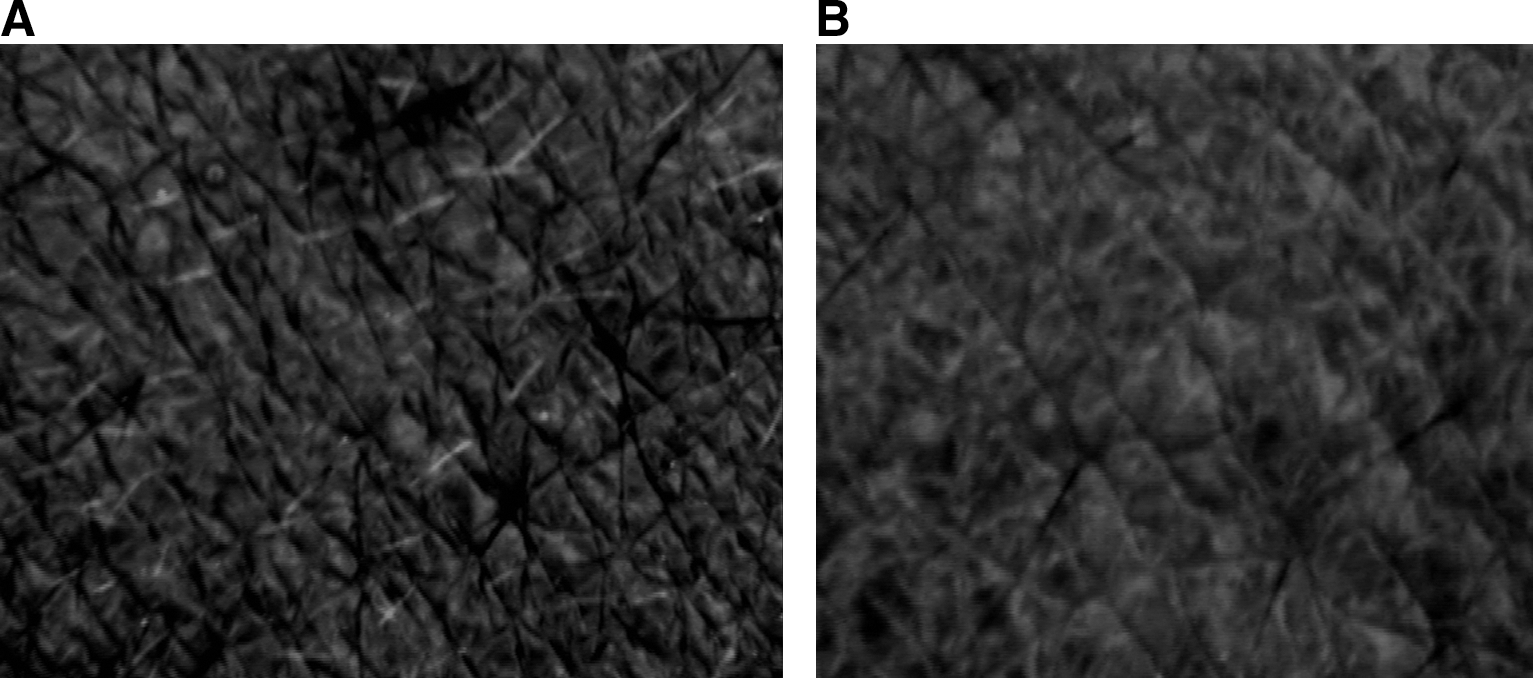
An example of skin surface images through Visioscan® UV camera. (
Surface evaluation of living skin
The four SELS parameters were measured by a special UV-light video camera (Visioscans® VC, Courage & Khazaka). The SELS method is based on evaluation of an image of living skin taken under certain illumination; the picture is electronically processed for quantitative results. Skin surface is described by four different parameters—roughness (SEr), scaliness (SEsc), smoothness (SEsm), and wrinkling (SEw). The measuring device contains two contra-rotating halogen lamps, uniformly illuminating the specific measuring field on the skin. The spectrum, intensity, and location of the lamps allow the skin surface to be analyzed without interfering reflections from deeper layers. A CCD camera in the measuring head records the picture of the skin, and the camera is connected to the computer directly via an enhanced parallel port (EPP). The SELS method was developed by Prof. Tronnier of the Institute for Experimental Dermatology, University of Witten-Herdecke, Germany. The grey-level distribution of the image is used to evaluate four clinical parameters to quantitatively and qualitatively describe the skin surface as an index: SEsm, SEr, SEsc, and SEw. 11
The parameters evaluated were developed in various clinical studies to perfectly characterize the skin surface. A lower numerical value of SEr indicates more smoothness and a higher numerical value indicates more roughness. The parameter SEsc evaluates the hydration level of stratum corneum; the smaller SEsc is, the greater is the hydration level with less exfoliation (scaliness). A higher SEsm numerical value is an indicator of skin smoothness. SEw is the indicator of the number and width of the wrinkles in the skin, and a higher numerical value indicates more wrinkles and wider wrinkles. 12
Statistical analysis
All data measured for SELS parameters were analyzed using statistical Graphpad software.
• The comparisons of the average initial values of SELS parameters between the study groups were determined by an unpaired t-test (to indicate that the study groups are comparative).
• A paired t-test was used for the comparison before and after 30 and 60 days of treatment (to postulate the treatment effect).
• The correlations among the SELS parameters (including all measured values) were determined by applying a Pearson correlation test.
• Percent changes shown in the tables indicate the difference from baseline values at different time intervals and were calculated by the following formula: % Change=[(Dx − D0)/D0]×100, where Dx is the value obtained at the dermatological tests on days 30 and 60 (D30, D60). The absolute values and standard deviation (SD) are shown for each parameter.
Results
All enrolled participants completed the course of interventions. None of the patients reported any discomfort or side effects on long-term use of the interventions. Of the 33 participants, all were completely satisfied with the products usage except for 1 participant, who was not fully satisfied about the consistency of the products given to him.
Comparison of the initial values of SELS parameters
We have compared the initial average values of SELS parameters in all three groups using an unpaired t-test as well as between both cheeks. The initial average values of SELS parameters were not significantly different among the three study groups as well as between both cheeks. The initial average values of SELS parameters are shown in Tables 2 –5.
2 vs. 1, Baseline vs. 30 days; 3 vs. 1, baseline vs. 60 days; 3 vs. 2, 30 days vs. 60 days paired comparison.
If p<0.05 the result is considered significant; if p<0.01 the result is considered very significant; if p ≤ 0.001 the result is considered extremely significant.
NS, Not significant.
2 vs. 1, Baseline vs. 30 days; 3 vs. 1, baseline vs. 60 days; 3 vs. 2, 30 days vs. 60 days paired comparison.
If p<0.05 the result is considered significant; if p<0.01 the result is considered very significant; if p<0.001 the result is considered extremely significant.
NS, Not significant.
2 vs. 1, Baseline vs. 30 days; 3 vs. 1, baseline vs. 60 days; 3 vs. 2, 30 days vs. 60 days paired comparison.
If p<0.05 the result is considered significant; if p<0.01 the result is considered very significant; if p<0.001 the result is considered extremely significant.
NS, Not significant.
2 vs. 1, Baseline vs. 30 days; 3 vs. 1, baseline vs. 60 days; 3 vs. 2, 30 days vs. 60 days paired comparison.
If p<0.05 the result is considered significant; if p<0.01 the result is considered very significant; if p ≤ 0.001 the result is considered extremely significant.
NS, Not significant.
Skin roughness
The absolute values and percent changes in the SEr parameter along with statistical evaluations are shown in Table 2. SEr reduced from baseline to 30 days and from 30 days to 60 days after treatment with active formulations. Green tea alone very significantly reduced skin roughness after 30 and 60 days of treatment (p=0.004 and p=0.008 respectively). Lotus-alone treatment showed significant changes after 60 days of treatment (p=0.032). The green tea plus lotus–treated group showed very significant improvements in the SEr parameter toward baseline values after the 60-day treatment course (p=0.006). When 30 days versus 60 days comparison was assessed, only combination treatment was found to be superior in reducing the SEr (p=0.000).
The placebo side of the face did not show remarkable changes to reduce SEr in any of the three treatment groups (p>0.05). The placebo side of the face treated with green tea and the green tea plus lotus–treated group improved slightly (−4.33% and −4.24%, respectively) after 1 month, but the effects were not sustained enough and changes ended on day-60 measurements. The placebo side of the lotus-treated group did not show changes after 1 month, but slight changes occurred after 60 days of treatment (−6.01%). Changes in SEr produced by green tea, lotus, and green tea plus lotus were −23.20%, −18.10%, and −26.07%, respectively, until the end of the 60-day treatment course.
Skin scaliness
The absolute values and percent changes in the SEsc parameter along with statistical evaluations are shown in Table 3. Results differed from the SEr parameter. The group treated with green tea did not show significant improvements in SEsc compared to the before-treatment values. In the lotus-treated group, single treatment with 5% lotus extract produced significant improvement in the SEsc parameter compared to baseline values, but statistically this effect was produced after 60 days of treatment (p=0.045). On the other hand, the green tea plus lotus combined treatment produced a significant effect on SEsc after 30 days of treatment and a very significant effect after 60 days of treatment (p=0.042 and p=0.001, respectively). It is evident in these results that in all three groups, placebo treatment imparted some of effects on the treated side of the face but these effects were not significant statistically. The placebo treatment effect in green tea plus lotus group was more pronounced than other two groups. The maximum changes produced by green tea, lotus, and combined treatment over the 60-day treatment course were −14.02%, −10.92%, and −20.86%, respectively.
Skin smoothness
The absolute values and percent changes in the SEsm parameter along with statistical evaluations are shown in Table 4. The changes produced by green tea, lotus, and combined treatment over the 60-day treatment course clearly indicate the potential of these formulations on the SEsm parameter. Interestingly, placebo treatment showed effects on SEsm in all three groups, but these effects were shaky rather than sustained compared to active treatments. For example, in the green tea group, changes in SEsm after the 30-day placebo treatment were 4.95%; later on, changes were minimized to 1.58% at the end of treatment. On the other hand, in the green tea plus lotus group, changes produced by placebo treatment were up to 12.58% at the termination of the study. If we look at the changes in SEsm after active treatments, the combined treatment by green tea and lotus produced a major effect up to 49.99% improvement in SEsm to that of baseline value. Statistical evaluations have shown that lotus alone or in combination with green tea is extremely effective in producing changes in SEsm compared to before treatment. On the other hand, green tea treatment brought extremely significant improvement in SEsm when 30 days and 60 days comparison were established (p=0.001).
Skin wrinkling
The absolute values and percent changes in the SEw parameter along with statistical evaluations are shown in Table 5. In this study, results are interesting for anti-wrinkle effects contributed by the single treatments and combined treatment, compared to the baseline. Statistically, single treatments of green tea and lotus significantly perfected the facial wrinkles when baseline values were compared to the 60-day treatment course (p=0.035 and p=0.048, respectively). When we observed the facial wrinkles perfection efficacy of green tea plus lotus combined treatment, the effect was very significantly comparable to that of baseline values at day 30 and day 60 (p=0.005 and p=0.003, respectively). When we look at the changes in wrinkle perfection, green tea offered −2.26% wrinkle perfection after 1 month calculated from the baseline value and −12.38% after 2 months of treatment. Lotus treatment reduced facial wrinkles up to −8.14% after 1 month calculated from baseline values and up to −11.22% after 60 days.
The most obvious results in facial wrinkle reduction were seen after combined treatment with green tea and lotus. Calculated from the baseline value, −16.24% wrinkle perfection was achieved after 1 month of combined treatment (green tea plus lotus), whereas −23.22% wrinkle perfection was achieved after 60 days of treatment. In all three groups, the placebo-treated side of the face showed no improvement toward wrinkle perfection after 1 month. However, over the completion of the 60-day treatment course, placebo treatment offered slight anti-wrinkle effects in all three groups, i.e., −5.07% in green tea group, −4.88% in the lotus group, and −6.68% in the green tea plus lotus–treated group.
The correlation between the SELS parameters in pairs was been determined by the parametric Pearson correlation test. The results along with p values are shown in Table 6.
SELS, Surface evaluation of living skin; SEr, skin roughness; SEsc, skin scaliness; SEsm, skin smoothness; SEw, skin wrinkling.
Discussion
A variety of skin care products are available to optimize skin conditions in which skin structure and function are compromised by endogenous and environmental factors. Our study aimed at evaluating the potential of three cosmetic multiple emulsions loaded with green tea and lotus extracts in a concentration of 5%. A third formulation was a 5% cosmetic multiple emulsion containing green tea and lotus in a concentration of 2.5% each. We found some interesting results for all three formulations in improving various SELS parameters, especially on SEsm and SEw. Mainly when before and after treatment effects were computed through a paired t-test, combined treatment was found to be superior, showing very significant changes in SEr, SEsc, SEsm, and SEw (see Tables 2 –5).
Both green tea and lotus have been known for their medicinal benefits since ancient times, but many of these benefits have not been explored scientifically. Particular to this study, we could discuss various underlying mechanisms by which green tea and lotus alone or in combination have improved various skin surface parameters of living skin. Green tea extract contains potent anti-oxidants. Most of the polyphenolic compounds in green tea are flavanols, known as catechins, which are known to have anti-oxidant properties. Epigallocatechin gallate (EGCG) is the major component and is an effective agent found in green tea. Recently, a wide range of studies have shown that both topical and oral application of polyphenolic compounds from green tea extracts can protect against ultraviolet A (UVA)- and UVB-induced skin damage in animal models. In addition, in vitro studies have shown that bioflavonoids may be beneficial to connective tissue by preventing decreases in dermal collagen because of down-regulation of collagenase messenger RNA (mRNA) in fibroblast culture. Furthermore, these compounds bind to elastin, preventing its degradation by elastases released as a result of inflammation and activating proline hydroxylase, an enzyme necessary for collagen cross-linking. 13
Oxidative damage by reactive oxygen species (ROS) plays a major role in skin aging. A recent study using an in vitro model of normal human skin fibroblasts suggested that pretreatment with high doses of green tea extracts could protect from toxic ROS-induced injury of skin in the clinical setting. 14 But this study unfortunately was not extended up to explore green tea in humans to determine how much it is possible to reverse visible signs of aging after treatment with green tea. We not only explored green tea alone, but also in combination with lotus extract because green tea has been explored for its synergistic/additive effects with some other plant extracts.
Various plants such as Vitis vinifera, Phyllanthus emblica L., Punica granatum, Cinnamomum cassia, and Ginkgo biloba L. have been studied in combination with green tea. Results suggest that a combination of all of these herbs with green tea can synergistically enhance anti-oxidant activity, and thus lower doses of each herb may be used with green tea. 15
The reason behind our study to explore green tea and lotus in combination originated from the concept that both plants have some common potent effects on skin profile. Unfortunately, lotus has been explored in a limited manner in clinical trials for its effects on humans despite its proven potential as functional cosmetic agent. For example, various parts of the lotus plant were studied for in vitro anti-wrinkle effects (elastase inhibition), and results suggest a role of lotus as functional anti-wrinkle agent. 9 Extracts of various parts showed elastase inhibition in the range of 50%–56%. Again, as for green tea, these results were not further established by topical application of these extracts to human facial wrinkles.
Keeping in mind the potential of both plants for treating skin aging, we investigated the application of topical products of green tea and lotus directly to facial wrinkles in healthy adults. Some interesting results found in this study should compel other researchers to explore these extracts further for the development of potent anti-aging products that could truly reverse the visible signs of aging.
Conclusion
With this first of its kind study, we have evaluated three inventive formulations that can perfect the facial wrinkles and associated parameters of skin surface. Interestingly, all three formulations positively influenced some of the SELS parameters. Overall, combined treatment presented superior results compared to placebo treatment in all four parameters of skin surface evaluation either statistically or with respect to percent changes. Another positive aspect concluded from this study is that efficacy of single extracts can be potentiated by combining an extract with another extract possessing desired properties. These three innovative formulations comprising green tea and lotus extracts could be subjected to further research and hence promote the development of a new class of anti-aging products.
Footnotes
Acknowledgment
Authors are highly thankful to Higher Education Commission of Pakistan for laudable support.
Author Disclosure Statement
The authors declare no competitive interests for this work.