




Abstract
The QUEC PHISIS™ technology, based on the theory of coherence domains of water, is the most advanced application of quantum electrodynamics coherence suitable for transferring highly targeted and personalized electromagnetic signals to the living cells. Several experimental studies in aged rats confirm its beneficial action on vital cellular parameters while also optimizing the bioavailability and absorption of fundamental elements in cellular metabolism. Clinical observations have followed and have strengthened its applicability in healthy volunteers and in patients with complex diseases such as cardiovascular, neuromuscular, and metabolic disorders. Our pilot study on severely compromised, frail subjects corroborates its relevance. The delivery of correct frequencies has the potential to become a safe, very affordable, and effective therapeutic modality that is amenable to being integrated with pharmacological drugs, thus representing a substantial innovation in medical practice.
Introduction
I
In particular, the QUEC PHISIS™ technology, based on the theory of coherence domains of water, is the most advanced application of research on quantum electrodynamics coherence suitable for transferring highly targeted and personalized electromagnetic signals to living cells and ordering them in a state of higher coherence. Data supporting the validity of this technology show that it stimulates the biological functions of the cells, rebalances the correct membrane potential, activates the enzymatic processes, reinstates the normal ion exchange of the cellular metabolism, promotes the intra–extra cellular ionic balance, improves better absorption of nutrients at the cellular level, reduces energy demand, beneficially acts on both acute and chronic pain, and rebalances the anti-oxidant system. 7 An in-house study on 43 subjects has shown a significant plasma anti-oxidant improvement after 90 min from the beginning of the first treatment. The values are improved and consolidated at the end of the cycle of treatments, with values well below average after a month.
This technology has been tested for years with success at the Hyperbaric Medicine Center Services Unit operating within the National Health Service with the Venice primary care health system on volunteers suffering from dysmetabolic, osteoarticular, and neurological diseases and to reduce oxidative stress in cancer patients undergoing radiotherapy and chemotherapy. The Department of Clinical Veterinary Science of Padua University is studying the enzymatic activation of the basal metabolism and the metabolism of the fatty acids modulated by this technology. The aim of the present study was to test this device in a series of patients with profound impairment of general health due to chronic diseases and abnormal erythrocyte sedimentation rate (ESR) values.
Materials and Methods
The electronic device used is able to generate waves in the range where the cyclotron frequencies of the ions involved in metabolic processes lie. Electromagnetic fields belonging to a specific frequency range, peaked at 50 KHz, are able to effectively cross the cell membrane. Even if the information directed to the ionic flux control travels at low (less than 100 Hz) frequencies, higher-frequency signals delivered in a biologically compatible form may modulate the intra-cellular milieu and the ionic exchanges. 8 The QUEC-PHISIS QPS1™ device is able to generate an ELF field on a coil aimed at stimulating the motion of selected ionic species through the ion resonance effect. The device generates programmable clusters of signals, bearing the basic information with a superimposed amplitude modulation at 50 KHz. The signal feeds a coil or a stack of coils, which, in turn, generates the magnetic field.
At the first meeting, the operator performs a careful medical history of the subject. The TEST QUEC-PHISIS™ elaborates the best solution for restoring metabolism, constitutional deficiencies, balances of oxidation-reduction (rH2), and acidity (pH) of body fluids. Afterward, according to the subject's needs and ongoing diseases, frequencies are suited to the individual cases. This setting is saved and repeated throughout the treatment period. It can also be stored in an external memory unit to be transferred to the QUEC-PHISIS™ QPS5 device.
The patient lies down on a special bed and is fully clothed. The treatment is completely non-invasive, and the procedure lasts from 30–45 min. Once set by an expert physician, it does not require the presence of an operator throughout the session. The treatments have a progressive and cumulative effect in the course of time, and the control software measures the effectiveness of the treatment in real-time by checking membrane potential parameters. In particular, through bioelectrical impedance analysis, it is possible to check in real time the permeability of ions passing through the tissues and the cell membranes and the intra- and extra-cellular water movement. The technique is non-invasive and checks the passage of a current of very low intensity through the body. With four electrodes placed at the ends of the legs and arms, it is possible to detect the bioelectrical impedance, which is the resistance of an organic conductor (human body) to the passage of a very weak alternating current. During the QUEC-PHISIS™ QPS1 treatment, the bioelectrical values of resistance (through the tissues and fluids) and reactance (through cell membranes) can be revised to obtain clinical data on the health of the person. No side effects have ever been reported from the initial application of this technology.
In this preliminary pilot study, 10 patients were recruited (7 males and 3 females, aged 64–84), all with sarcopenia and severe muscular weakness (in one case, forcing the patient to be bedridden), four with severe bilateral inflammatory bilateral joint disease, two with chronic obstructive pulmonary disease (COPD) and urinary incontinence, two with postural instability and sensory-motor abnormalities in the lower limbs, two with severe peripheral vascular stasis with fluid retention and in one case with ulcerations, and one with post-myocardial infarction chronic cardiac failure with leg edema. All patients were also reporting a moderate-to-severe depression feature, as evaluated by Hamilton Rating Scale for Depression.
Results
As for the remarkable pain-killing effect obtained in our subject, one has to consider that in a resting muscle there is a lowering of muscle contraction for muscle pain related to a reduction in the release of Ca2+ from the sarcoplasmic reticulum induced by an intramuscular accumulation of magnesium levels, adenosine diphosphate (ADP), inorganic phosphate, and hydrogen ions. Thus, the beneficial effect so far recorded may be related to induction of a state of muscle relaxation by the QUEC PHISIS™ QPS1 therapy. On the other hand, during muscle contraction, the QUEC-PHISIS™ QPS1 therapy provokes an increase of muscular activity and improves muscle performance for better recruitment of motor units (Physical and Rehabilitative Medicine Departments, University of Chieti, unpublished data).
Throughout the treatment, all patients experienced a significant improvement of depression, quality of life, and muscular strength (data not shown). There was also a significant reduction of visual activity score (VAS) pertaining to articular and muscular pain (Fig. 1, upper panel), thus confirming prior data, 9,10 as well as a reduction of ESR (Fig. 1, lower panel).
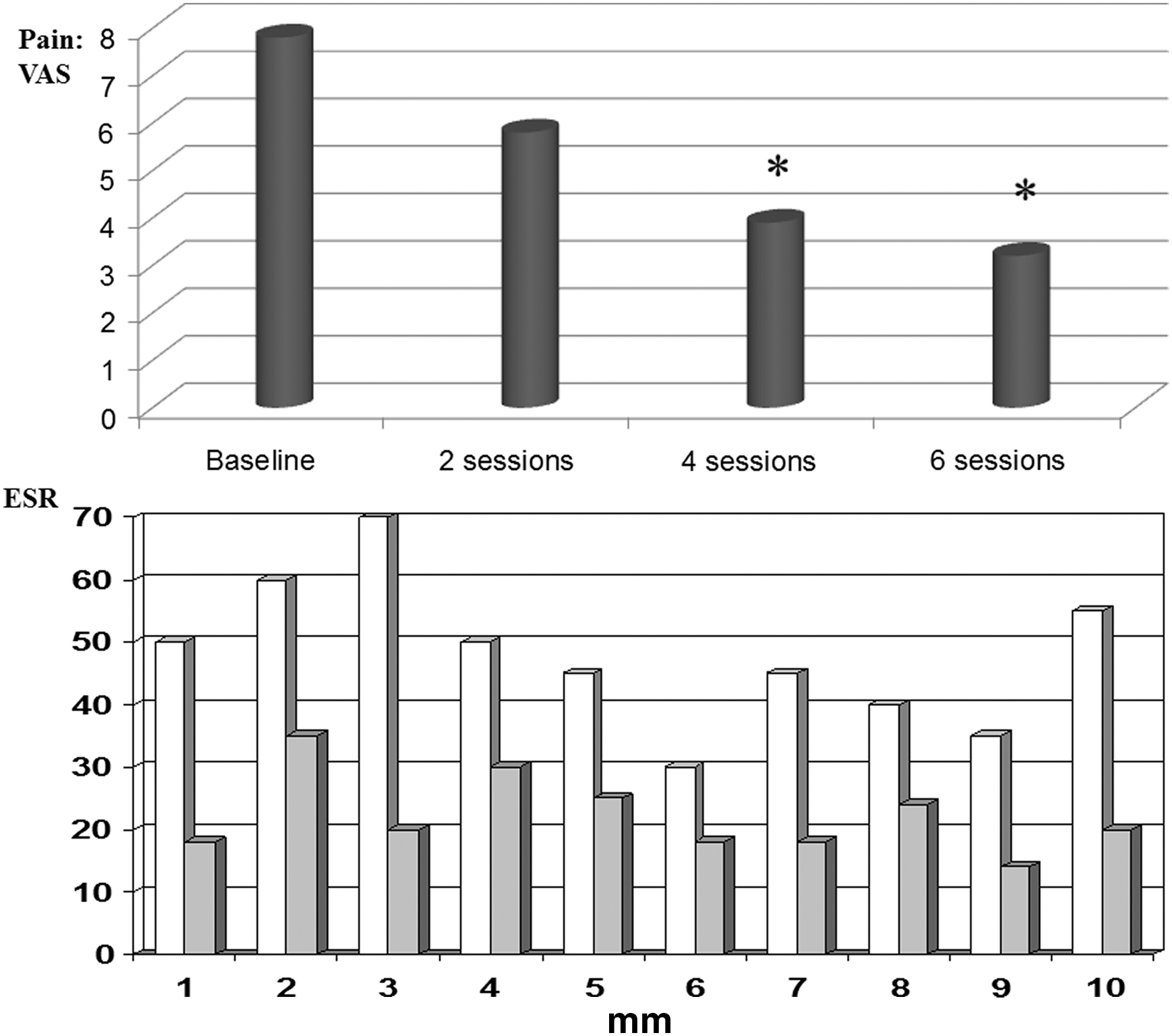
(Upper panel) Time course progression of pain relief in patients undergoing QUEC PHISIS™ treatment sessions. (*) p<0.05 vs. baseline. (Lower panel) ESR modification at baseline (white bars) and after QUEC PHISIS™ treatment (grey bars). VAS, visual activity score; ESR, erythrocyte sedimentation rate.
Conclusion
A remarkable step forward in these studies is the theory of coherence domains of water. 11 Activities and molecular exchanges in the body do not happen by chance, but follow an “order” determined by the magnetic field produced by the water, where all elements fluctuate in phase in regions called coherence domains. The human body consists of 99% water. Whereas 40% of the water is coherent and able to accept and transport electromagnetic information, the remaining 60% is not coherent. However, it is similarly vital for life because it is the solvent for the ions and elements that are fundamental for cellular economy. Nonetheless, only the molecules that react to the frequency of this magnetic field interact with each other, starting in an ordered way for the correct chemical reactions necessary to the life of the cell and of the organism. 12 An imbalance of this “order” jeopardizes the functioning of the cell, thus allowing the appearance of diseases. Thus, water should not be regarded as an inert substance, but it may rather take special configurations and emit electromagnetic waves, potentially acting as a non-pharmacological tool. The DNA of the cell itself emits extremely low frequency waves, from zero to a few hundred Hertz, and imbalance of this “range” is likely to disrupt cellular homeostasis up to a pathological state. These concepts have very recently expressed by the group of Prof. Luc Montagnier, also investigating a novel diagnostic potential application. 13,14
The QUEC-PHISIS™ QPS1 treatment is programmed to emit specific frequencies of electromagnetic waves tailored to study the most proper approach to restoring cellular metabolism and optimizing the redox balance (rH2) and the acidity (pH) of body fluids. Preliminary clinical data suggest a significant and sudden impact of this device on cardiovascular parameters in healthy volunteers (P. Balestra, University of Bruxelles, unpublished data). (The measurements of brachial arteries with the echo color-Doppler before and after a single session with the QPS1 show evidence of a difference in the artery's diameter of about 6%.) Moreover, a stronger and quicker anti-oxidant effect than anti-oxidant drugs, improvement in muscular coordination and performance through better recruitment of neuromotor units in neuromuscular diseases, increase in body (muscular) mass in unhealthy or frail people, and enzymatic activation of the basal metabolism and of the fatty acid metabolism has been shown in aged rats. A significant improvement in wound closure and the bone fractures healing process has also been shown, as well as improved osteogenesis in cases of osteoporosis.
The study of the correct frequencies with QUEC-PHISIS™ QPS1 has the potential to produce a safe, very affordable, and effective non-pharmacological therapeutic modality. The integration of pharmacology, biochemistry, biophysics, and energetic modulation through the use of electromagnetic signals may thus represent an ideal innovation in current medical practice, especially considering the recent results regarding the benefic effect of ELF on the growth and differentiation of mesenchymal, cardiac, neuronal, and bone marrow stem cells. 15 –20
Footnotes
Author Disclosure Statement
No competing financial interests exist.