




Abstract
Today it is clearly evident that genetic background constitutes an integral part of aging and longevity. Many studies on long-lived people have been conducted emphasizing the role of certain genes in long life. Classic case–control studies, genome-wide association studies, and high-throughput sequencing have permitted identification of a variety of genetic variants seemingly associated with longevity. Over the years, aging research has focused on the insulin/insulin-like growth factor-1 (IGF-1) signaling pathway because of its evolutionarily conserved correlation with life-span extension in model animals. Indeed, many single-nucleotide polymorphisms (SNPs) associated with longevity were identified in genes encoding proteins that take part in this metabolic pathway. Closely related to this pathway is the Klotho gene. It encodes a type-I membrane protein expressed in two forms, membrane and secreted. The latter form suppresses oxidative stress and growth factor signaling and regulates ion channels and transporters. In particular, its over-expression seems to be able to suppress insulin/IGF-1 signaling extending life span. Thus, our aim was to assemble the results in the literature concerning the association between the functional variant of the Klotho “KL-VS” stretch, which contains six polymorphisms in linkage disequilibrium, and successful aging to quantify the possible effect of the variants. The results of our systematic review indicate that the Klotho KL-VS variant is associated with healthy aging.
Introduction
A
The candidate gene approach is a hypothesis-driven method widely employed by case–control studies. The genotype and allele frequencies of two populations are compared—one affected and one unaffected by a complex trait, like longevity. If the identified allelic variants are more prevalent in the population in study as compared to controls, these genotypes are associated with the complex trait. 4 The number of reported studies on the association between one or multiple single-nucleotide polymorphisms (SNPs) and aging and longevity is greatly increasing, even though a large number of these studies show inconsistent results (for an extensive analysis of “old” and recent data, see refs. 2 and 5). Consistent replication in different populations has been argued as strong evidence of a true association. However, the genetics of aging and longevity is complex and may alter according to gender and country. The lack of replication may not necessarily imply a false association, but might simply point to the need for more studies in certain populations or more detailed study of the function of a gene, taking into account different gene environment interactions, since, as previously stated, aging and longevity phenotypes are strongly affected by lifestyle and environmental factors and by complex epistatic and pleiotropic effects in several genes. 1,6,7
GWAS consist of scanning whole-genome analysis markers to find variants associated with the trait of interest using a case–control study. It is important to note that the finding of common genetic variants with low allelic frequency across studies is consistently difficult because of the multitude of data that must be analyzed. In addition, population admixture may produce possible false positives due to different genetic backgrounds among ethnic groups. However, GWAS are a useful tool for the identification of complex trait-associated alleles with frequencies above 5%. Each, taken singularly, has a moderate or null effect, but it is possible to speculate that more alleles have, en bloc, a synergic rather than an additional effect. 4 By using a GWAS approach for long-living individuals, several loci have reached a genome-wide level of significance that is not always confirmed in different studies. 3,8
However, some interesting data have been obtained recently, such as those derived by meta-analysis. 9 Meta-analysis provides a mean to quantitatively synthesize association data across studies of the same genetic variant. Thus, the use of meta-analyses has recently become an important part of genetic research, mainly to reconcile previously conducted studies that have given inconsistent results. 4,9
The gene Klotho, aptly named for Clotho, one of the Greek Fates goddesses believed by the ancients to spin the thread of life, encodes a type-I membrane protein expressed in two forms, membrane and secreted. It was discovered about 15 years ago as a gene that, if knocked out in mice, precipitates their accelerated aging, including short life span; its over-expression suppresses aging and extends life span. 10,11 On this basis, some human studies sought to demonstrate an association between the functional variant of the Klotho “KL-VS” stretch that contains six polymorphisms in linkage disequilibrium, involved in modulation of its activity by influencing trafficking and catalytic activity of its secreted form and aging and longevity. However, the results have been inconsistent. 12 –15
The aim of this study was to review the studies available to date on the correlation between the KL-VS variant of the Klotho gene and human aging and longevity. We used a meta-analytic approach to quantitatively synthesize the possible effect of the variant and to reconcile the study inconsistencies.
Methods
Selection of studies
The primary source of the studies addressing the role of Klotho KL-VS variant in longevity was the PubMed database (from January, 2003, to September, 2013) limited to English language literature. The medical subject headings used for PubMed search were “Klotho,” “KL-VS variant,” “aging,” and “longevity.”
The abstracts found were read to identify studies examining the association between the above-mentioned allele and aging and longevity in healthy aged subjects or centenarians. We also performed a manual search of references cited in published articles. The studies were read in their entirety to assess their appropriateness for inclusion in the meta-analysis.
Any human population-based association study, independently on sample size, was included if it met the following criteria: (1) It was a case–control study. (2) There were at least two comparison groups, of which one consisted of healthy aged or long-living individuals. (3) The study tested the association between aging and longevity and the variant.
Data extraction
Extraction of data was independently performed by D.D.B., G.A., and C.V., who compared results and agreed on a consensus. Disagreements were settled by discussion.
Statistical analysis
For meta-analysis, data were analyzed using Review Manager, version 5.1, a statistical software package for managing and analyzing all aspects of a Cochrane Collaboration systematic review (The Cochrane Collaboration, Oxford, UK, 1999). Controls were assumed to be as young or younger subjects compared to aged and long-living individuals, which represented the cases. But the cutoff value between cases and controls varied greatly among individual studies. The overall odds ratio (OR) between the frequencies of alleles in both cases and controls was estimated with models based on both fixed-effects and random-effects assumptions. The fixed-effects model considers only within-study variability. The random-effects model uses weights that incorporate both the within-study and between-study variances. Because of the high heterogeneity between the populations of most of the studies included in this meta-analysis, we have presented the results of random-effects models that are the most conservative ones. 16 The 95% confidence interval (95% CI) of the OR was also calculated.
Results
Characteristics of the studies
Four studies on the association between the Klotho KL-VS variant and aging were identified by our search strategy. 12 –15 The Arking et al. study 12 was performed on three different populations (Bohemian Czech, Baltimore Caucasian, Baltimore African American), thus it was considered as three different studies for the inclusion in the meta-analysis. The other three studies were performed on US Caucasians, 13 Italians, 14 and Indians. 15 The studies were conducted on 2913 aged people (from 199 to 723) and 2206 controls (from 226 to 463) on aggregate. A remarkable heterogeneity is shown in the age of enrolled populations both in cases (range, from 41 to 109 years) and controls (range, from newborn to 65 years). In regard to the Majumdar et al. study, 15 we included only the healthy control population in the meta-analysis. Thus, people 40 years old or less were considered as the control population, whereas people over 40 were considered as aged (Table 1). The frequency of the Klotho genotypes in both cases and controls reported in each of the studies included in the meta-analysis is shown in Table 2. It should be noted that in the Invidia et al. study, 14 a single SNP, 115G→A, was used to tag the KL-VS haplotype because all six SNPs occur in perfect linkage disequilibrium.
Meta-analysis
The effect for the KL-VS variant on aging, suggested as favoring longevity through a putative increase of secreted Khloto levels, was estimated for each study. Five out of six studies 12,14,15 show a little favorable effect on longevity, but only two of these reach statistical significance. 12,14 In contrast, the Novelli et al. study 13 shows a little detrimental effect on longevity. The pooled summary OR for the genotypic comparison between the wild type (wt/wt) versus the heterozygous (wt/KL-VS) variant is 1.14 (OR=1.14, 95% CI 1.00–1.30) with a marginal statistical significance (p=0.05) using the random-effects model (Fig. 1A). In contrast, when we compare the Klotho wt homozygous subjects (wt/wt) versus KL-VS-bearing genotypes (wt/KL-VS+KL-VS/KL-VS), the summary OR is 1.10 (95% CI 0.97–1.25; p=0.13), suggesting that KL-VS homozygous subjects not only do not show any advantage in aging, but seem to have a disadvantage (Fig. 1B), although this comparison does not reach statistical significance. This observation seems to be confirmed by comparing KL-VS homozygous people (KL-VS/KL-VS) versus Klotho wt homozygous+heterozygous subjects (KL-VS/wt+wt/wt) (OR 0.73; 95% CI 0.41–1.30; p=0.29), but, also in this case, with a result that is not statistically significant (Fig. 1C). Notably, the I2 value for heterogeneity in this last comparison is 50%, showing a significant between-study heterogeneity compared to the first two comparisons, which do not show any between-study heterogeneity (I2=0%).
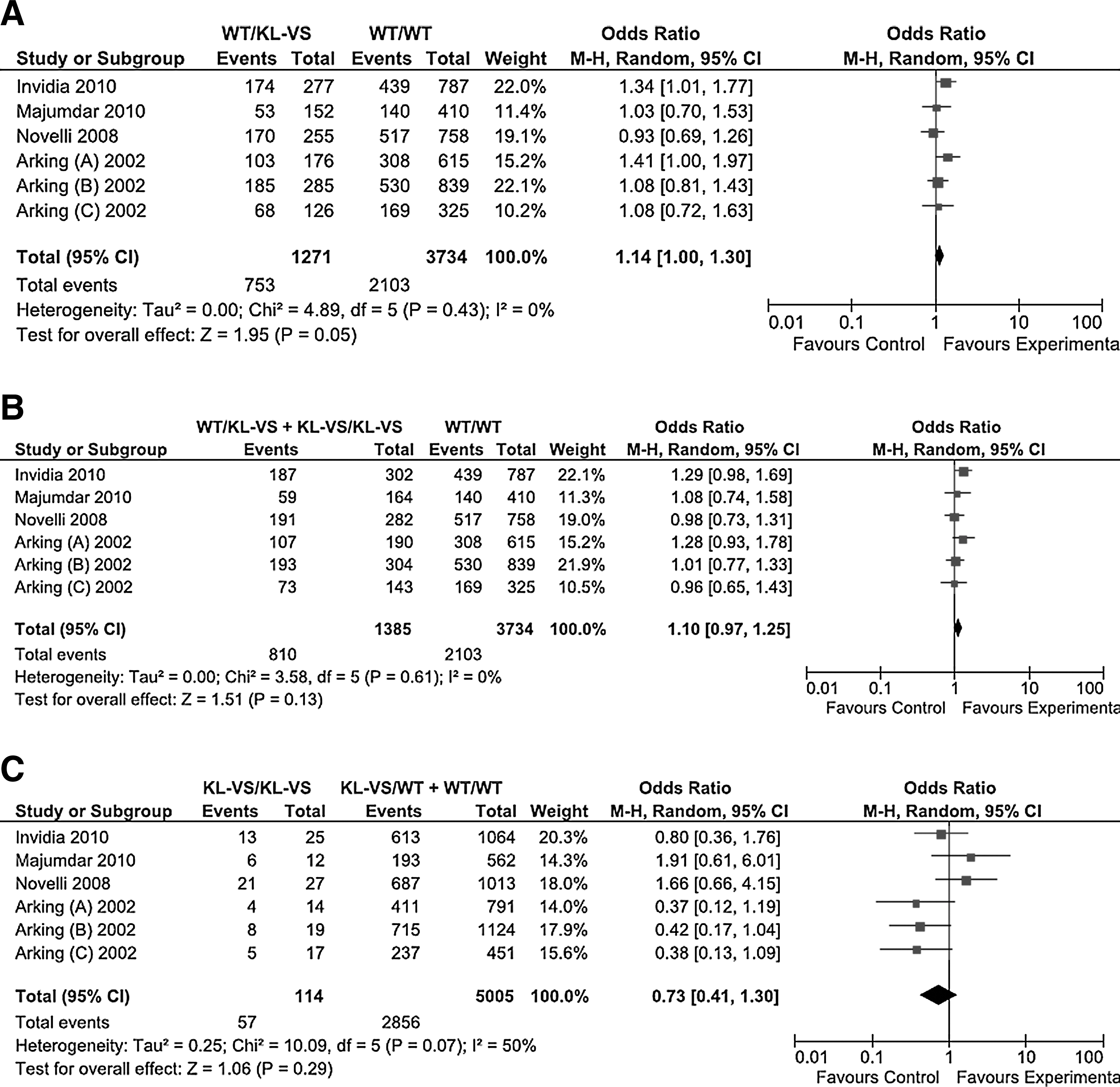
(
Discussion
Our meta-analysis summarizes the evidence to date regarding the association between the Klotho KL-VS variant and aging and longevity, representing a pooled total of 2913 cases and 2206 controls. The results indicate a significant association of the variant with healthy aging and longevity, despite the serious limitations of the study.
The results of this study are subjected to many limitations, which could partially mask the true genetic effect. First of all, it must be emphasized that there is a remarkable heterogeneity between the populations included in the different studies, both in the cases and the controls. In fact, whereas the Arking et al. study. 12 uses the newborn as control group, the other three studies use people under 35, 13 under 40, 15 or between 19 and 65 years. 14 There also are many differences between the aging populations, leading, in some cases, to an overlapping between cases and controls of different studies (Table 1).
The populations included in the analysis are from different ethnicities. However, a subgroup analysis exploring the effect on the Klotho genetic variant on populations of the same ethnic groups cannot be performed, given the low number of available studies. It should be noted, then, that the Arking et al. study 12 shows a genetic effect only in the Bohemian Czech population, suggesting that genetic or environmental factors could influence the observed effect. However, homozygous elderly individuals were underrepresented in the three populations under study (see below).
Although the presence of the KL-VS variant in heterozygosis is associated with aging and longevity compared to the Klotho wild-type gene, the KL-VS variant in homozygosis shows an opposite effect. This could be due to a true genetic effect only in heterozygous people, with a mechanism not related to the gene dose. Alternatively, it could be due to the little sample size of the KL-VS homozygous group (Fig. 1C) that hampers the reliability of the statistical analysis. This latter hypothesis is suggested by the high between-study heterogeneity and the high within-study variance observed in the comparison between KL-VS homozygous group and the KL-VS heterozygous group+wild type (Fig. 1C), with studies showing conflicting results, different from the other comparisons (Fig. 1A, B). However, cross-sectional and prospective studies confirm a genetic model in which the KL-VS allele confers a heterozygous advantage in conjunction with a marked homozygous disadvantage with low levels of high-density lipoprotein cholesterol, high systolic blood pressure, increased risk of stroke, and early-onset coronary artery disease, and mortality. 17,18
Finally, in the Invidia et al. study, 14 it has been demonstrated that the KL-VS variant has been observed to be increased in the elderly, but not in the group of long-living people, suggesting that this KL-VS heterozygous genotype is favorable for survival in old people; its beneficial effect decreases thereafter, becoming no more evident at the extreme ages.
Concerning the function of Klotho leading to such effects on healthy aging and longevity, the soluble form of Klotho, released from cell membranes into the serum, has homology to the family 1 glycosidases that cleave glycosidic bonds in sugars, glycolipids, and glycoproteins. It acts on several targets, including the receptor of insulin/insulin-like growth factor (IGF-1) signaling pathway. 10,11 It is noteworthy that its activity seems inversely correlated with the activity of this pathway: the decreased life span of Klotho knockout mice is rescued by inactivation of the insulin/IGF-1 pathway. 19 Thus, it is possible that secreted Klotho protein may modify glycans of the insulin/IGF-1 receptors, inhibiting their activity and/or altering their cell-surface abundance. 10,11
The inhibition of this pathway has a critical role in the determination of longevity, and several variants that reduce this signaling have been identified; some studies have shown their association with longevity. 9 The bond of insulin/IGF-1 to the specific receptor activates phosphatidylinositol 3-kinase through the insulin-related substrate. It leads to the activation of AKT that, in turn, inhibits Forkhead box O3A (FOXO3A). FOXO3A acts as transcription factor, activating the expression of many homeostatic genes, including anti-oxidant catalase and mitochondrial manganese-superoxide dismutase 11,20 ; hence, the inhibition of this pathway induces resistance to oxidative stress.
We can conclude that the KL-VS variant, which influences the trafficking and catalytic activity of the secreted protein, favors healthy aging and longevity by inhibiting the insulin/IGF-1 signaling pathway. In fact, adequate suppression of this pathway is an evolutionarily conserved mechanism for anti-aging and life span extension because this pathway negatively regulates transcription factors FOXO involved in up-regulation of homeostatic genes. 9 –11,20
Footnotes
Acknowledgments
This meta-analysis has been entirely supported by the authors' respective institutions. G.A. and C.V. are PhD students (Tutor G.C., Supervisor C.C.), and this article is submitted in partial fulfillment of their PhD degree.
Author Disclosure Statement
The authors have no conflict of interest.