




Abstract
Ischemic stroke is the leading cause of adult disability worldwide. The outcome is worse in older patients, especially in terms of disability. Buyang Huanwu decoction (BHD), a famous traditional Chinese medicine formula, has been used extensively in the treatment of ischemic stroke for centuries. However, its pharmacological mechanisms have not been fully elucidated. In this study, 82 putative targets for 411 composite compounds contained in BHD were predicted on the basis of our previously developed target prediction system. On the basis of large-scale molecular docking, more than 80% compound–putative target pairs had medium to strong binding efficiency. The pharmacological networks of BHD were built according to relationships among herbs, putative targets, and known therapeutic targets for ischemic stroke, and 121 major nodes were identified by calculating three topological features—degree, node betweenness, and closeness. Importantly, the pathway enrichment analysis identified several signaling pathways involved with major putative targets of BHD, such as the calcium signaling pathway, vascular smooth muscle contraction, and nucleotide-binding oligomerization domain (NOD)-like receptor signaling pathway, which have not hitherto been reported. These data are expected to help find new therapeutic effects of BHD and optimize clinical use of this formula. Collectively, our study developed a comprehensive systems approach integrating drug target prediction and network and functional analyses to reveal the relationships of the herbs in BHD with their putative targets, and for the first time with ischemic stroke-related pathway systems. This is a pilot study based on bioinformatics analysis; thus, further experimental studies are required to validate our findings.
Introduction
I
Traditional Chinese medicine (TCM), as an important complementary and alternative medicine modality, has been practiced in China for more than 2000 years. Its application to stroke therapy has a long history. The famous Chinese physician Zhang Zhongjing described the symptoms of acute stroke about 2000 years ago. In 1995, the State Administration of TCM of the People's Republic of China issued standards for the diagnosis of stroke and the evaluation of the efficacy of treatments. 5,6 Herbal medicine therapy has been an alternative and promising strategy for the treatment of ischemic stroke. Because herbal formulae are the main clinical patterns in TCM, various herbal formulae, such as Buyang Huanwu Decoction (BHD), Zhengan Xifeng Decoction, and Dahuang Xiexin Decoction, have been employed extensively to relieve the severity of ischemic stroke.
Among these formulae, BHD, originally recorded in the Yilin Gaicuo (Correction on Errors in Medical Classics) written by Wang Qingren in 1830 during late Qing Dynasty, is a famous TCM formula for benefiting qi and activating blood circulation. 7 It has been used clinically in Asia to treat stroke-induced disability for centuries. Accumulating evidence demonstrates that BHD can improve the outcome of ischemic stroke in clinical trials. 8 This formula is comprised of Radix Astragali (Huang Qi), Radix Angelicae Sinensis (Dang Gui), Radix Paeoniae Rubra (Chi Shao), Rhizoma Chuanxiong (Chuan Xiong), Flos Carthami (Hong Hua), Semen Persicae (Tao Ren), and Lumbricus (Di Long), in the ratio of 120:6:4.5:3:3:3: 3 on a dry weight basis, all of which are recorded in the Chinese Pharmacopoeia. 9
Growing evidence has suggested the clinical efficacy of BHD regarding neuroprotective effects. 10 Recent studies on pharmacological and biochemical actions of BHD and its constituents have also reported mechanisms of BHD acting on ischemic stroke. For example, Shen et al. 11 indicated that the neuro-restorative effects of BHD might be associated with angiogenesis and the enhancement of the expression of angiopoietin-1 on chronic brain injury after focal cerebral ischemia. Kong et al. 12 reported that BHD might exert its neuro-protective effects partially by promoting migration of neural precursor cells to ischemic brain areas. Wang et al. 13 also found that BHD could prevent the ischemia-reperfusion–induced spinal injury in rats, and its protective function might be partially linked with the inhibition of cyclin-dependent kinase 5. However, the pharmacological mechanisms of BHD acting on ischemic stroke have not been fully elucidated due to the lack of appropriate methods.
Because herbal formulae with numerous compositive compounds are too complex to be detected solely by conventional methods, there is an urgent need to develop new and appropriate approaches to address this problem. With the development of systems biology, network biology, and polypharmacology, network pharmacology has been proposed by Andrew L. Hopkins. 14 This is a novel research field that is implicated in the application of “-omics” and systems biology-based technologies. 15 It clarifies the synergistic effects and the underlying mechanisms of multi-component and multi-target agents by analyzing various networks of complex and multi-level interactions. 16 –19 As a major tool in network pharmacology, network analysis based on widely existing databases allows us to form an initial understanding of the mechanisms of action within the context of systems-level interactions. The herbal formula has been considered as a multi-component and multi-target therapeutic that potentially meets the demands of treating a number of complex diseases in an integrated manner; therefore, the methodologies of network pharmacology are suitable for pursuing a priori knowledge about the combination rules embedded in formulae. 20
Here we have developed a comprehensive systems approach to investigate the pharmacological mechanisms of BHD acting on ischemic stroke. The steps of our protocol include: (1) Prediction of putative targets for BHD; (2) calculation of the binding efficiency of compound–putative target pairs; and (3) investigation of the relationships of putative targets of BHD with the ischemic stroke imbalanced network and relative signal pathways, which offers a great opportunity for the deep understanding of the pharmacological mechanisms of BHD on reversing this disease-related imbalanced network. The technical strategy of this study is shown in Fig. 1.

A schematic diagram of the systems biology–based strategies for deciphering the pharmacological mechanisms of herbal formula Buyang Huanwu Decoction (BHD) acting on ischemic stroke.
Materials and Methods
Data preparation
Compositive compounds of each herb in BHD
Compositive compounds of each herb in BHD were obtained from TCM Database@Taiwan
21
(
Known therapeutic targets for the treatment of ischemic stroke
Known therapeutic targets for the treatment of ischemic stroke were collected from the DrugBank database
22
(
Protein–protein interaction data
Protein–protein interaction (PPI) data were imported from eight existing PPI databases including Human Annotated and Predicted Protein Interaction Database (HAPPI), 24 Reactome, 25 Online Predicted Human Interaction Database (OPHID), 26 InAct, 27 Human Protein Reference Database (HPRD), 28 Molecular Interaction Database (MINT), 29 Database of Interacting Proteins (DIP), 30 and PDZBase. 31 The detailed information on these PPI databases is described in Supplementary Table S3.
Drug target prediction for BHD
Drug Similarity Search tool in the Therapeutic Targets Database (TTD)
32
(
Molecular docking simulation
To calculate the binding efficiency of putative targets with the corresponding compositive compounds contained in BHD, the molecular docking simulation was performed using the electronic high-throughput screening (eHiTS) docking module, which is a flexible ligand docking system.
33
All the protein structures of putative targets of BHD were obtained from the Research Collaboratory for Structural Bioinformatics (RCSB) Protein Data Bank
34
(
Network construction
Seven herbs contained in BHD, putative BHD targets, and known therapeutic targets for ischemic stroke treatment were used to construct a BHD herbs–putative targets–known ischemic stroke targets network and a BHD putative targets–known ischemic stroke therapeutic targets–other human proteins PPI network, respectively. PPI data were obtained from eight existing PPI databases, as described in Supplementary Table 3. Navigator software (v. 2.2.1) and Cytoscape (v. 2.8.1) were used to visualize the networks.
BHD herbs–putative targets–known ischemic stroke targets network
The BHD herbs–putative targets–known ischemic stroke targets network was constructed by linking the seven herbs contained in BHD, their putative targets, and known therapeutic targets for ischemic stroke treatment that were interacted with putative targets.
BHD putative targets–known ischemic stroke therapeutic targets–other human proteins PPI network
The BHD putative targets–known ischemic stroke therapeutic targets–other human proteins PPI network was constructed by linking BHD putative targets, known ischemic stroke therapeutic targets and other human proteins that have direct interactions with BHD putative targets and known ischemic stroke therapeutic targets.
Defining the network topological feature set
For each node i in the interaction network, we defined three measures for assessing its topological property: (1) “Degree” is defined as the number of links to node i and reflects how often node i interacts with other nodes. Nodes with an extremely high level of degree tend to be essential in interaction network. 37 (2) “Node betweenness” is defined as the number of the shortest paths between pairs of nodes that run through node i. Betweenness centrality reflects the ability of nodes to control the rate of information flow in interaction network. Nodes with high betweenness centrality are recognized as bottlenecks. 38 (3) “Closeness” is defined as the inverse of the farness, which is the sum of node i distances to all other nodes. Closeness centrality refers to a measure of how long it will take to spread information from node i to all other nodes sequentially. Degree, node betweenness, and closeness centrality are the most often cited measures of nodes' topological importance in the network. The larger a node's degree/node betweenness/closeness centrality is, the more important the node is in the interaction network. 39 According to our previous studies, 40 –42 “degree,” “node betweenness,” and “closeness” were calculated to screen major putative targets, the three features of which were higher than the corresponding median values.
Pathway enrichment analysis
We used Database for Annotation, Visualization and Integrated Discovery
43
(DAVID,
Results and Discussion
Putative targets for BHD
On the basis of our previously developed target prediction system, 40,45 252 similar drugs of chemical components in seven herbs contained in BHD and the corresponding 82 known targets of these similar drugs as putative targets for BHD, including 18 for Radix Astragali, 20 for Radix Paeoniae Rubra, 52 for Rhizoma Chuanxiong, 28 for Radix Angelicae Sinensis, 15 for Lumbricus, 27 for Flos Carthami, and 12 for Semen Persicae, were identified. See detailed information on putative targets for BHD in Table S4.
As shown in Table 1, there were different numbers of common putative targets among the seven herbs contained in BHD, implying their synergistic effects. Of note, Rhizoma Chuanxiong and Radix Angelicae Sinensis shared more common putative targets with Radix Paeoniae Rubra (n=15 and 12, respectively; Table 1), Lumbricus (both n=12; Table 1), and Flos Carthami (n=18 and 16, respectively; Table 1), and the two herbs shared the most common potential targets with each other (n=20; Table 1), suggesting their roles in facilitating the effects of other herbs in BHD.
As a structure-based method, molecular docking simulation has been used extensively as an invaluable tool in drug discovery and design, and it may play a crucial role in identification of ligand–protein interactions and elucidation of binding mechanisms. In the current study, we used the molecular docking software eHiTS to evaluate the binding efficiency of 394 compound–target pairs. This software systematically covers the part of the conformational and positional search space that avoids severe steric clashes, producing highly accurate docking poses at a speed practical for virtual high-throughput screening. 33 As a result, four compound–target pairs were deleted either because their structural information was unavailable or negative results were output from eHiTS. The positive docking results for other interactions are summarized in Table S5. According to the evaluation method mentioned above, of 390 compound–target pairs, 46 (11.80%) had strong binding free energy, 268 (68.72%) had medium binding free energy, and 76 (19.49%) had weak binding free energy, suggesting the high potentials of putative targets of BHD to bind with the corresponding compounds.
Generally, drug indication for use is determined by functions of its affected targets. In the current study, we collected the known anti-ischemic stroke drug targets from the DrugBank database 22 and OMIM database. 23 Among 82 putative targets for BHD, 15 (15/82, 18.29%) were known therapeutic targets for the treatment of ischemic stroke. As shown in Table 2, eight putative targets of Rhizoma Chuanxiong and Radix Angelicae Sinensis, respectively, were known therapeutic targets, suggesting the crucial roles of the two herbs for the treatment of ischemic stroke. To investigate the functions of the 15 putative BHD targets/known therapeutic targets, we performed the enrichment analysis based on GO annotation. Interestingly, we found that there were seven putative BHD targets/known therapeutic targets, including ADRB1, ADRB2, ADRA1B, PTGS2, PTGS1, ATP1A1, and NOS2, which were all involved in the regulation of blood pressure and blood circulation (fold enrichment=63.13, p=2.50E−07; Table S6). Hypertension is the most important and common risk factor for stroke. 46,47 Reduction of blood pressure by lifestyle measures and anti-hypertensive drug therapy may reduce the incidence of stroke. Our data implied a possible therapeutic effect of BHD on hypertension. However, the results of our literature retrieval showed that most of the publications in this research field focused on the neuro-protective effect of BHD. Thus, our data may provide a new research direction for investigating the therapeutic effects and pharmacological mechanisms of BHD acting on ischemic stroke.
Network analysis
BHD herbs–putative targets–known ischemic stroke targets network
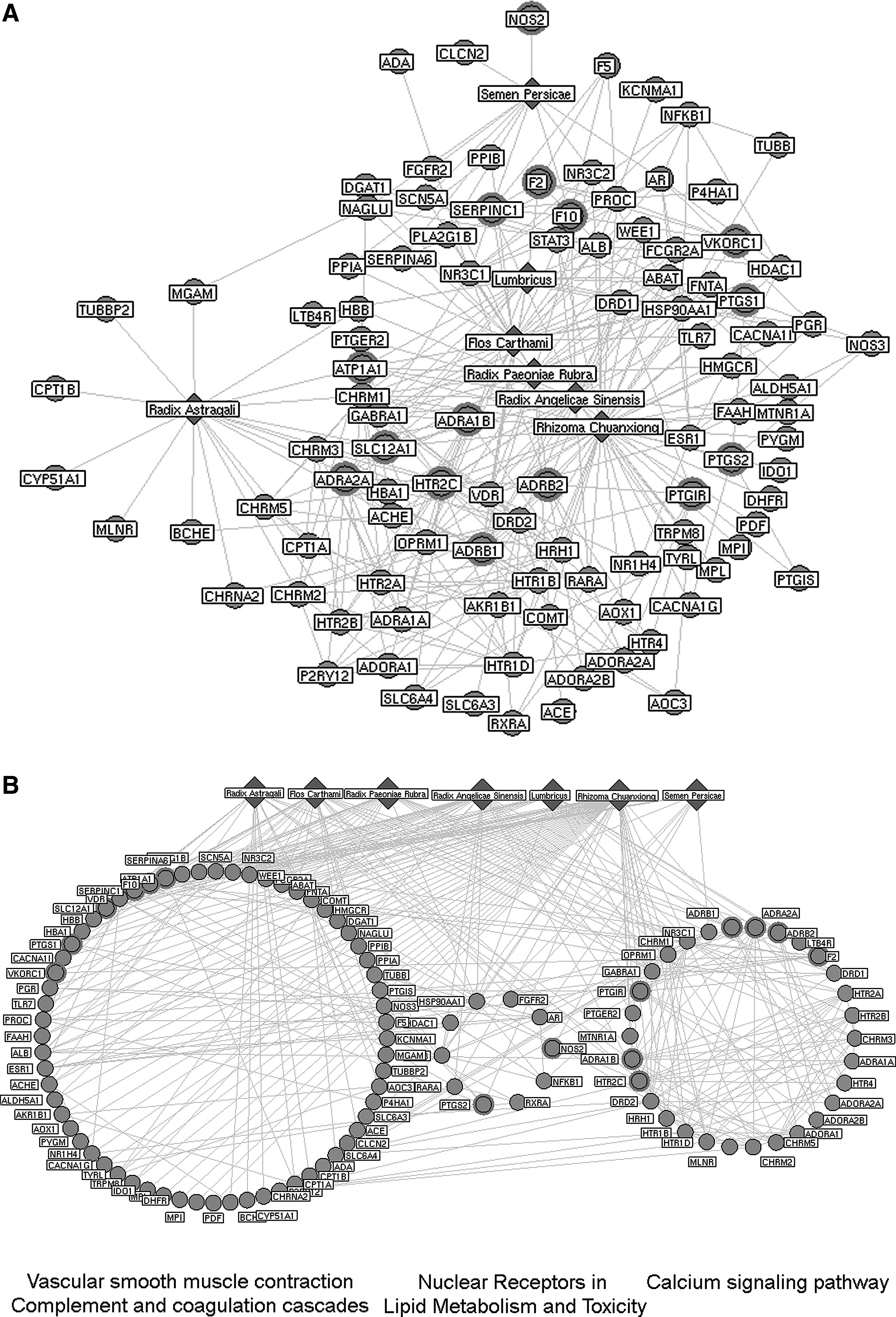
First, we constructed the BHD herbs–putative targets–known ischemic stroke targets network to clarify the relationships of herbs with the corresponding putative targets and known ischemic stroke targets. As shown in Fig. 2A, the network consists of 111 nodes (seven herbs, 67 putative targets, 22 known ischemic stroke targets, and 15 putative targets/known ischemic stroke targets) and 348 edges. Among seven herbs, Rhizoma Chuanxiong had the highest degree distributions following by Radix Angelicae Sinensis, Flos Carthami, and Radix Paeoniae Rubra, the links of which with other nodes were all more than 20. Of note, these four herbs had more interactions with common nodes, leading to their closer distance in the network.
(
Because the herbs with a higher degree in the network have been demonstrated to be more pharmacologically important, our data mentioned above showed that Rhizoma Chuanxiong, Radix Angelicae Sinensis, Flos Carthami, and Radix Paeoniae Rubra might be major herbs in this pharmacological network. In addition, the enrichment analysis, as shown in Fig. 2B, indicated that the putative targets for BHD and known ischemic stroke targets were most significantly associated with vascular smooth muscle contraction (KEGG ID: hsa04270, fold enrichment=6.79, p<0.001) and complement and coagulation cascades (KEGG ID: hsa04610, fold enrichment=5.26, p=0.002). The degree of contraction or relaxation of the vascular smooth muscle cells characterizes the general vasomotor tone, which governs the local blood pressure level and distributes the flow according to metabolic needs. 47 Patients with ischemic stroke often have impaired vasomotor reactivity, especially in the affected cerebral hemisphere, so that they may depend directly on systemic blood pressure to maintain perfusion to vulnerable “at risk” penumbral tissue. Thus, blood pressure variation has been identified as one of the factors that affects the risk of ischemic stroke recurrence and prognosis. 48 Blood coagulation cascades are very important for normal hemostasis and have been reported to play crucial roles in thrombotic diseases, including ischemic stroke. 49 Intravenous thrombolysis remains the mainstay treatment for ischemic stroke, but hemorrhage is one of serious complications of this treatment. 50 BHD has been used for neuro-restorative effects and primary prevention of ischemic stroke. No previous studies have assessed the influence of BHD on the regulation of vascular smooth muscle contraction and coagulation cascades, and this might be worth validating in the future.
BHD putative targets–known ischemic stroke therapeutic targets–other human proteins PPI network
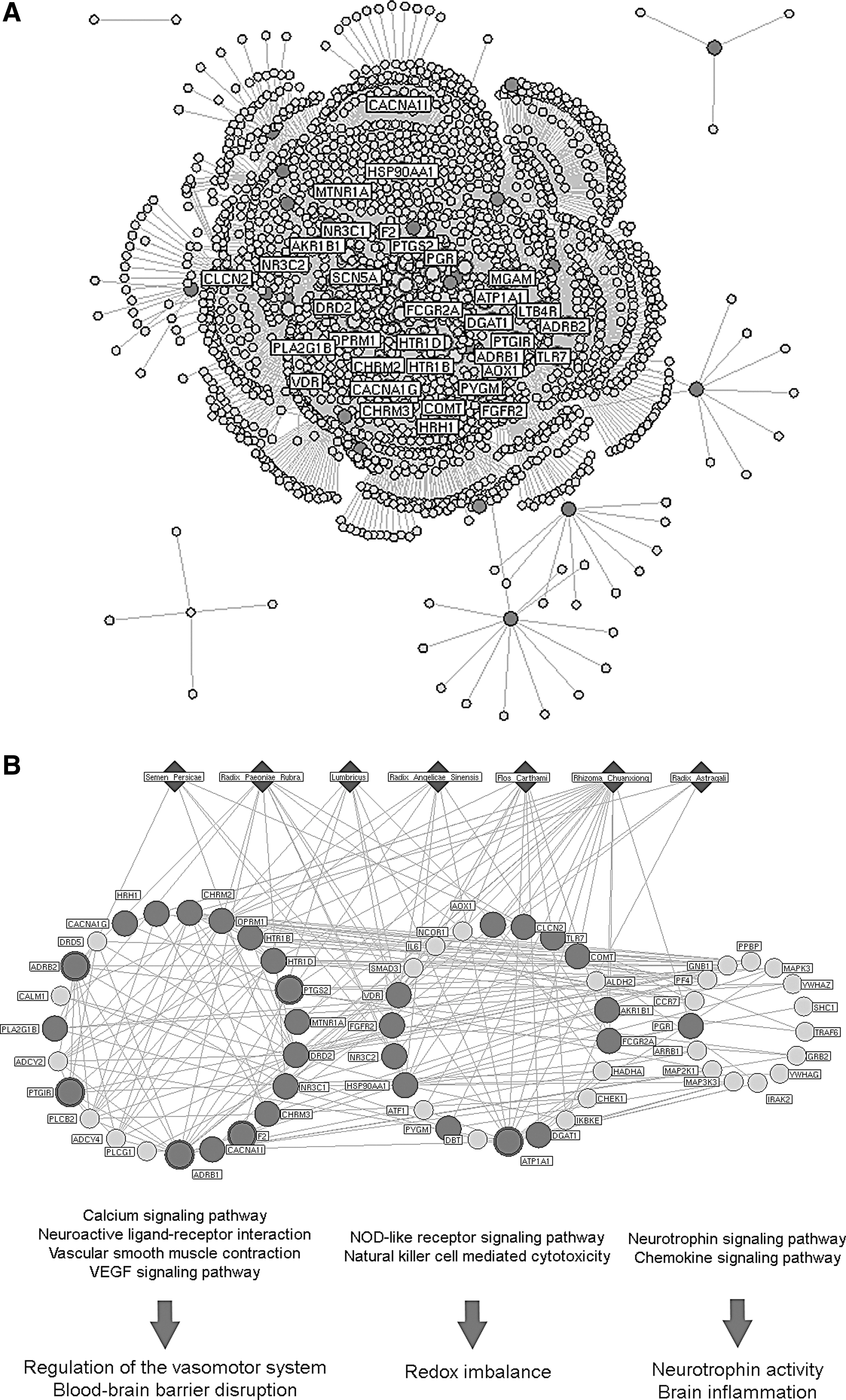
To evaluate the importance of putative targets of BHD, we constructed a BHD putative targets–known ischemic stroke therapeutic targets–other human proteins PPI network, which consists 2272 nodes (67 putative targets, 55 known ischemic stroke targets, 15 putative targets/known ischemic stroke targets, and 2105 other human proteins interacted with putative targets or known ischemic stroke targets) and 4462 edges (Fig. 3A). To screen the major nodes with topological importance, three topological features, “degree,” “node betweenness,” and “closeness” (defined in the Materials and Methods section), were calculated for each node in the network. The median values of degree, node betweenness, and closeness were 4.00, 0.002, and 0.26, respectively. Therefore, we determined that hubs with degree>4.00, node betweenness>0.002, and closeness>0.26 were major nodes. As a result, 121 major nodes were identified (see detailed information on topological features of 121 major nodes in Table S7). After selecting the intersection with putative targets of BHD, 34 major nodes were identified as candidate targets for this formula.
(
Moreover, the network of direct interactions among 121 major nodes was constructed and consisted of 76 nodes (seven herbs contained in BHD, 31 putative targets of BHD, six putative targets/known ischemic stroke targets, and 40 other human proteins interacted with putative targets or known ischemic stroke targets) and 156 edges. According to the associated pathways, the major nodes were divided into different functional modules, as shown in Fig. 3B. Importantly, the calcium signaling pathway (KEGG ID: hsa04020, fold enrichment=6.16, p<0.001), neuroactive ligand-receptor interaction (KEGG ID: hsa04080, fold enrichment=5.01, p=0.001), vascular smooth muscle contraction (KEGG ID: hsa04270, fold enrichment=5.95, p=0.01), and vascular endothelial growth factor (VEGF) signaling pathway (KEGG ID: hsa04370, fold enrichment=5.62, p=0.03) were most frequently involved by the major nodes. The calcium signaling pathway plays an important role in a variety of physiological functions; for example, in vascular smooth muscle cells, it is involved in the regulation of agonist-stimulated contraction and myogenic tone. 51 Changes in vascular smooth muscle calcium handling have been implicated in different vascular diseases. 52 Growing evidence suggests that modification of the calcium signaling pathway may be a novel therapeutic strategy for ischemic stroke. Here, our data found that the major nodes in the pharmacological network of BHD might play a role in the regulation of calcium signaling pathway and vascular smooth muscle contraction, implying that BHD could attenuate ischemic stroke by reversing hypertension-induced cerebro-vascular remodeling, which has not hitherto been reported and should be validated experimentally in the future.
Angiogenesis, the formation of new blood vessels from pre-existing ones, was observed in stroke patients; it correlates with longer survival and positively affects the formation of new neurons, neurogenesis, and functional recovery. 53 It is a multistep process, involving extracellular matrix degradation, endothelial cell proliferation, and new vessel formation. Interactions between VEGF and its receptors play a central role in these angiogenic signaling cascades. 54 Thus, VEGF has been identified as a promising candidate for the treatment of ischemic stroke, 55 but further insight into the regulatory role of BHD in the VEGF signaling pathway is still needed to fully apprehend its therapeutic potential and its relevance for angiogenesis.
Of note, the nucleotide-binding oligomerization domain (NOD)-like receptor signaling pathway (KEGG ID: hsa04621, fold enrichment=4.32, p=0.02) was also a pathway significantly associated with the major nodes in the pharmacological network of BHD (Fig. 3B). NOD-like receptors are a class of pattern recognition receptors that are cytosolic and constitute part of different inflammasomes. 56 These receptors can be activated not only by different pathogens, but also by sterile inflammation or by specific metabolic conditions. Mutations in NOD-like receptors lead to hereditary auto-inflammatory systemic diseases. 57 In recent years, accumulating studies have reported the important roles of NOD-like receptors in different central nervous diseases, such as stroke, because their abnormal changes can cause redox imbalance in the brain, which significantly contributes to ischemic stroke pathogenesis. 58 Thus, further studies should be focused on the roles of BHD in the modulation of NOD-like receptors during the treatment of ischemic stroke, which is still unknown according to our literature retrieval.
The major nodes were also frequently involved in the neurotrophin signaling pathway (KEGG ID: hsa04722, fold enrichment=7.39, p<0.001). Neurotrophins have been recognized as mediators of both neurodegenerative and neuroprotective mechanisms in a number of CNS pathologies. 59 The neurotrophins have been reported to exert angiogenic effects and have been proposed as therapeutic agents for the treatment of neurodegenerative disorders and ischemic injury, especially for stroke recovery. 60 –62 However, the recent clinical trials with several neurotrophins for the treatment of ischemic stroke or neurodegenerative diseases have failed so far, primarily because of their poor blood–brain barrier permeability. To address this problem, a therapeutic strategy that can enhance neurotrophin activity may possibly improve stroke outcome. In the present study, our data showed that one major putative target of BHD interacted directly with genes involved in the neurotrophin signaling pathway; thus, we hypothesize that BHD might provide a neuroprotective effect in the context of ischemic stroke, possibly through increasing neurotrophin activity. This still needs further investigation.
Conclusion and Perspective
Ischemic stroke carries a poor long-term prognosis for death and disability. 1 Due to the limited therapeutic approaches currently available, there is an urgent need for developing novel therapies for this disease. There have been many well-known traditional Chinese herbal prescriptions for the treatment of patients with ischemic stroke. At the molecular level, TCM formulae are multi-component and multi-target agents, essentially acting in the same way as the combination therapy of multi-component drugs, which can produce greater levels of efficacy with fewer adverse effects and toxicities than mono-therapies. 20 The fast development of systems biology affords new possibilities for uncovering the molecular mechanisms related to the therapeutic efficacy of TCM formulae from a systematic point of view.
In the current study, we integrated several algorithm-based and network-based computational methods to predict drug targets, construct the target network, and elucidate the molecular synergy of a TCM formula, BHD, the mechanisms of which for ischemic stroke treatment are still unclear. Our main findings are as following: First, 82 putative targets of seven herbs in BHD were predicted, providing clues to investigate the pharmacological mechanisms of this formula for the treatment of ischemic stroke. Interestingly, more than 80% compound-putative target pairs had medium-to-strong binding efficiency.
The pharmacological network of BHD was built according to the relationships among herbs, putative targets, and known therapeutic targets for ischemic stroke, providing insights into the synergetic effects of herbs in this formula. After that, a multilevel network with a combination of ischemic stroke-related imbalanced network and pharmacological network of BHD has been built and can pinpoint the major putative targets of this formula acting on ischemic stroke and the corresponding molecular pathways.
Last, but not least, several novel signaling pathways involved with major putative targets of BHD acting on ischemic stroke, such as the calcium signaling pathway, vascular smooth muscle contraction, NOD-like receptor signaling pathway, and neurotrophin signaling pathway, have been identified. These data are expected to help find new therapeutic effects of BHD and optimize clinical usage of this formula. This pilot study was performed according to our strategy based on bioinformatics analysis; thus, further experimental studies are required to validate our findings.
Footnotes
Acknowledgments
This study was supported by Beijing Natural Science Foundation (7144228) and Beijing Joint Project Specific Funds and the Fundamental Research Funds for the Central Public Welfare Research Institutes (no. ZZ070831).
Author Disclosure Statement
No competing financial interests exist.
N. Lin participated in study design and coordination, material support for obtained funding, and supervised study; Y.Q. Zhang performed network analysis and statistical analysis, and drafted the manuscript; Q.Y. Guo performed data collection, statistical analysis and literature retrieval, and drafted the  section of manuscript; Haiyu Xu, guide for molecular docking simulation; M.C. Zhong and X. Mao collected data. All authors read and approved the final manuscript.
References
Supplementary Material
Please find the following supplemental material available below.
For Open Access articles published under a Creative Commons License, all supplemental material carries the same license as the article it is associated with.
For non-Open Access articles published, all supplemental material carries a non-exclusive license, and permission requests for re-use of supplemental material or any part of supplemental material shall be sent directly to the copyright owner as specified in the copyright notice associated with the article.
