




Abstract
Objective:
The aim of this study was to evaluate the effects of a water-based exercise program on static and dynamic balance.
Method:
Thirty-six older women were randomly assigned to a water-based training (3 days/week for 12 weeks) or control group. Water level was kept at the level of the xiphoid process and temperature at ∼28–30°C. Each session included aerobic activities and lower limb strength exercises. The medial–lateral, the anterior–posterior amplitude, and displacement of the center of pressure (CP-D) were measured in a quiet standing position (60 sec eyes opened and closed). The dynamic balance and 8-Foot Up-and-Go tests were also applied. Group comparisons were made using two-way analysis of variance (ANOVA) with repeated measures.
Results:
No differences were found in the center of pressure variables; however, the WBT group showed better performance in the 8 Foot Up-and-Go Test after training (5.61±0.76 vs. 5.18±0.42; p<0.01).
Conclusion:
The water-based training was effective in improving dynamic balance, but not static balance.
Introduction
T
Several studies have analyzed the effects of the different exercises programs in the postural control in elderly, such as strength training, 9 power training, 10 and exercise programs combining walking, strength and flexibility, 11 postural exercises, 12 –15 dance, 16 Tai Chi, 17 and water-based exercises. 18 –20 Water-based programs are an interesting exercising alternative for the older adults because they may reduce the fear of falling, are enjoyable and motivating, and have shown a high compliance rate. 18,21 The reduced body weight due to buoyancy can alter the information from the somatosensory system (joint and cutaneous sensors) that may cause instability. 22 In addition, water turbulence may be an additional balance stimulus that increases the challenge of the task. 23,24 Thus, the aquatic environment may be a source of stimulus to challenge and improve the postural control system. 19 –21,24 –26
Although several studies have pointed to beneficial aspects of water-based programs, 27 most of them were conducted using low-velocity movements, which does not fully represent a specific postural control stimulus in which fast muscle actions to reposition the center of mass within the stability limits of the base of support are required. 10,28 A water-based exercise program that prioritizes high velocities of movements may represent a suitable stimulus to improve balance control in older adults. Thus, this study aimed to determine the effects of 12 weeks of water-based exercise in the static and dynamic balance in aging women.
Methods
Participants
Participants included sixty-five volunteers living in the community near the Federal University of Paraná. Participants were contacted between February and July of 2011 using the local media and flyers; the program started from August of 2011. The inclusion criteria were: Subjects were over 60 years old and were able to walk and perform their daily tasks independently. Volunteers who had engaged in other systematic physical activity programs during the 6 months that preceded the study were not included. The subjects received details about aims and protocols involved in the study. A physician screened volunteers for health problems (e.g., heart conditions, severe hypertension, orthopedic surgical intervention 12 months prior to the experiment, and advanced diabetes) and restrictions affecting exercise in the water (e.g., skin problems). Procedures were granted approval by the ethics committee of the Federal University of Paraná under the number 0835.0.000.091-10.
Four volunteers presented restrictions to exercise participation due to health problems (i.e., all presented severe hypertension) and were not included. Eight women were excluded because they were engaged in other physical activity programs, and nine women refused to participate due to personal schedule issues (Fig. 1). Forty-four volunteers were deemed in good physical condition allowing them to engage in the program and were randomly assigned to either the water-based training group (WBG; n=20; 65.5±3.9 years old; 74.5±16.2 kg; 157.0±6.6 cm) or the control group (CG; n=16; 66.2±5.2 years old; 73.1±12.7 kg; 153.3±5.1 cm).
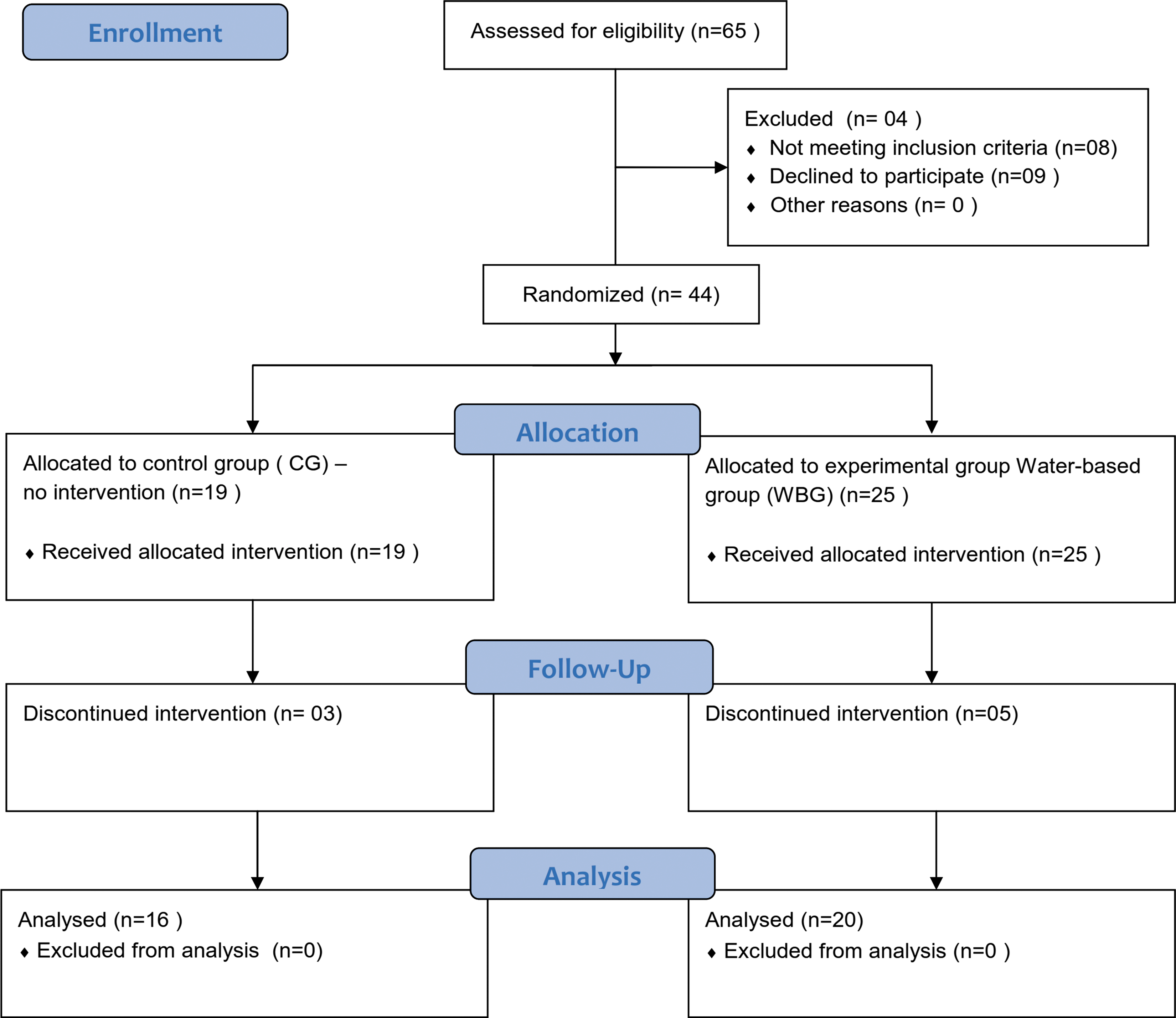
Schematic representation of participant recruitment and allocation. Color images available online at
Materials and procedures
Participants performed two experimental sessions, one to assess static balance and another to assess dynamic balance. The order of the tests to assess static balance was randomly distributed using a computer routine that generated arbitrary numbers applied in the assignment procedure. All tests were conducted by two trained professionals in both test conditions (pre and post), who were blinded to the assignment of the groups. A brief familiarization period (∼5 min) was introduced before measurements. Subjects were instructed to stand as still as possible on the center of a force plate (model OR-06, AMTI, USA) and three-condition stability tests were registered over a period of 60 sec each—narrow stance position (ankle and toes touching) with eyes open (C1), narrow stance position with eyes closed (C2), and tandem position with eyes open (C3). Center of pressure (COP) data were sampled at a frequency of 100 Hz in each experimental condition. A 2-min interval was imposed between each test. Although the present study included only one measurement of balance in each condition (pre and post), a previous study observed high intraclass correlation coefficients (ICCs) (>0.9) that were obtained in comparable experimental conditions, but obtained from three repeated measurements. 29 Data signals were filtered using a second-order Butterworth low-pass filter. The positions of the COP were calculated on the basis of the ground reactions forces and moments in medial–lateral (ML) and anterior–posterior (AP) directions. The following variables were obtained from these analyses: COP path length and the mean velocity sway and the amplitude of COP (ML and AP).
The data were calculated using a customized routine (Matlab v. 6.0). To evaluate the dynamic balance, the 8-Foot Up-and-Go test was applied, in which the participants were required to get up from a seated position, walk 8 feet (2.44 meters), turn, and return to seated position. The best time obtained from two trials was used for analysis. 30
Exercise program
The water-based program was performed during 12 weeks, three times per week (60 min/session) by a qualified instructor (that did not participate in the assessment sessions). Water level was kept at the level of the xiphoid process, and the temperature ranged from 28°C to 30°C. Each session included a 10-min warmup, 20 min of aerobic activities, 20 min of specific lower limb strength exercises, and a 10-min cooldown. Aerobic activities comprised the following exercises: Long-lever pendulum-like movements of the lower extremities; forward and backward jogging with arms pushing, pulling, and pressing; and leaps, kicks, leg crossovers, and hopping movements focusing on traveling in multiple directions. Exercise intensity was controlled using the rate of perceived exertion (RPE; 12–16 on the 15-point Borg scale [6–20 points]) and heart rate (progressing from 40% to 60% of the heart-rate reserve), according to the American College of Sports Medicine's, recommendations. 31 The strength activities involved hip and knee flexion and extension and dorsal and plantar flexion of the ankle (knee extension–flexion, hip extension–flexion and adduction–abduction with extended knee, double knee lifts, and side press kicks) while holding on the pool edge. 21 These exercises were maintained during the final 4 weeks, but exercises without the feet contacting the bottom of the pool were also included in an attempt to increase exercise intensity. Participants performed three sets of 40 sec with a rest interval of 20 sec of these exercises at a moderate speed, at an RPE of 12 during the first 4 weeks. Exercise intensity was increased by augmenting movement speed and by including water-resistive devices during weeks 5–8 (RPE or 12–14). Finally, during the last 4 weeks, subjects were requested to perform each exercise using their highest voluntary speed (RPE 14–16). Stretching exercises were performed in the last 10 min of the session as a cooldown activity. The CG was required to maintain their regular habits and refrain from unusual physical activities during the period of the study, but they were invited to engage in the program at the end of the experimental period.
Data analysis
The Shapiro–Wilk test confirmed data normality of most variables. Variables without normal distribution were transformed to logarithmic values and were tested again. An initial analysis using a one-way analysis of variance (ANOVA) revealed no between-groups differences in the initial values. A two-way repeated-measures ANOVA was applied to determine if training (independent variable) was effective in changing static balance (CP-D) and dynamic balance (8-Foot Up-and-Go) as dependent variables. Time (i.e., pre- and post-assessment) was considered a repeated factor. A Tukey post hoc test was used for multiple-comparison purposes in the case of F significant values. Effect size for all variables was calculated. All statistical analyses were performed using Statistica software (StatSoft, v. 7), and the significance level was set at p<0.05. The power was calculated a posteriori and indicated that 36 participants (total sample size) resulted a power of 0.80 when using an effect size of 0.25 (moderated) and alpha of 0.05 (G*Power 3.1).
Results
The statistical analysis revealed no differences in age and physical characteristics between groups (p>0.05). Due to lack of interest or personal difficulties to continue in the study, seven participants of the control group and three of the exercise group dropped out from the study. The attendance to the water-based exercise program was 94%.
Static balance
The lengths of the CP-D, ML, and AP amplitudes were similar before intervention (pre-test) in all test conditions (p>0.05). No differences were found between groups in the post-training assessments with respect to the length, ML, AP, and CP-D in the narrow stance position with eyes open (p>0.05). The results are shown in Table 1.
Notes: Amplitude of center of the pressure in the medial–lateral direction (ML) and in anterior–posterior direction (AP); mean velocity (Vel) (root mean square [rms]) in ML and in AP; COP length, center of pressure path length. Effect size (ES): C1, narrow stance position with eyes open; C2, narrow stance position with eyes closed; C3, tandem position with eyes open.
WBG, water-based training group; CG, control group; F, the coefficient; P, the significance level.
Dynamic balance
The results to the 8-Foot Up-and-Go test are shown in Fig. 2. The groups were similar before intervention (pre-test) (p>0.05). The experimental group improved the dynamic balance 8.0% after 12 weeks of training (5.59±0.74 vs. 5.14±0.45; p=0.009; effect size [ES]=0.65), whereas the CG remained unchanged (p>0.05).

Performance of the 8-Foot Up-and-Go test (dynamic balance) of the water-based (WBG) and control groups (CG) before and after training program. (*) Differences between pre-test (white bars) and post-test (shaded bars) (p>0.05).
Discussion
The main finding of this study was that the water-based training showed no improvements in static balance in any experimental conditions. However, training in the water increased the dynamic balance performance.
In the present study, no changes were detected in the selected COP measures, even when challenging conditions such as restricting visual information (eyes closed) or reducing the base of support (tandem stance) were tested. Although the COP static measures increased when experimental conditions included more challenging conditions, it was not possible to identify a clear training effect. Previous studies found opposite results and reported gains in some parameter of the COP after a period of aquatic exercises. 24,25 However, caution is required while comparing the outcomes between studies, such as the initial physical conditioning status (active vs. sedentary) and the nature of the training program. For instance, Elbar et al. 24 included a number of static activities in their training routines, which may have an effect on the static nature of the balance tests selected to determine the effects of the training. Oliveira et al. 25 did not present a clear physical conditioning of the participants and also the nature of the stimuli differs from the present study that emphasized fast muscle contractions.
Two arguments can be proposed to explain the lack of differences in the present study. The first one refers to the good physical conditioning of the participants, to whom training effects were likely to produce minimal influence. Indeed, the baseline values of the 8-Foot Up-and-Go test (6.4–4.8 sec) were compatible for subjects of similar age of good physical condition. 30 This indicates that the physical status of our participants was relatively high. In addition, aging effects may not be very pronounced in subjects near their early 60s, especially those who are physically active. 32
Thus, in this case, it may be argued that the training stimulus was not sufficient to cause changes in the postural control system and a clear effect on COP parameters. Perhaps, a more intense training routine could produce positive adaptive responses. The second argument refers to the specificity of the static test with respect to the dynamic nature of the stimulus that was applied during the water-based program. Furthermore, it has been demonstrated that some tests have higher sensitivity in detecting training adaptations when the stimuli involved in the training are also applied in the test. 33 The constant perturbations caused by the water movements and the characteristics of the exercises, which involved dynamic actions of weight transferring and displacement changes, may be more related to the demands of the 8-Foot Up-and-Go test than the requirements needed to sustaining a quiet and unperturbed upright position.
The improvements in the 8-Foot Up-and-Go test have been used to indicate enhancements in agility and dynamic balance. 30 Our results are in agreement with the study performed by Bergamin and colleagues, 26 which also showed improvements in the 8-Foot Up-and-Go test after aquatic training in comparison to a land-based exercise program. The larger gains observed by Bergamin and colleagues in comparison to the present study (19.3% vs. 8.0%) may be explained by the longer duration (12 vs. 24 weeks) and larger number of sessions (32 vs. 48), in which there was a more robust and specific training stimulus. Indeed, several components of the test have been closely related to better postural control, stability, and lower risk of falls. For instance, the greater strength and power of the lower limbs, specifically, the extensor muscles, required to stand from a chair have been proposed as to influence gait speed 34 and balance. 35 Indeed, stronger older subjects have been reported to be less exposed to falls than their weaker counterparts. 36 Fujiwara et al. 37 showed that raising the heels, which mimics several tiptoeing movements performed while exercising in the water, was sufficient to cause hypertrophy and strength increases in the older adults. Thus, it may be assumed that strength and power gains have played a role and allowed subjects to stand and walk faster after the water-based training program. Indeed, our previous studies 38 have shown that a water-based program was as efficient as a resistive training designed to promote muscle function (strength and rate of torque development) gains in older women.
Maintaining and recovering balance in the presence of water turbulence may represent a valuable stimulus for increasing muscle strength in the lower limbs. The actions required to recover balance and to propel the body in several directions require vigorous plantar flexion actions, which may have experienced considerable hypertrophy and increased ability to produce torque. 39 The flexor and extensor muscles of the ankle joint are likely to be well activated to recover balance throughout the water-based sessions due to the constant perturbation caused by the water turbulence, which may have resulted in increased balance control. Indeed, training of the ankle muscles using low to moderate intensities have been described as improving not only strength, but also dynamic responses. 37 Therefore, the water-based program may be viewed as an interesting stimulus for modifying the postural responses by increasing the readiness of the system, i.e., the ability to react promptly to a perturbation. It may be also argued that the dynamic nature of the water-based training program may have influenced the ability to recover balance, but may have no effect on the ability to sustain a quiet static posture over time.
Although static tests are largely applied to assess postural control changes, they hold little similarity with respect to the demands present in dynamic conditions in which a set of fast reactions required to counteract the unexpected perturbation challenges that occur during a trip or slip event. In addition, the ability to produce fast muscular responses, which is a highly relevant component for recovering balance, is barely present when a static posture is sustained.
The improvement observed in the dynamic balance in the present study is in agreement with other studies that involved aquatic exercises. 19 –21 The characteristics of training involving fast movements and body displacements through the water in all directions were shown to be specific to enhance dynamic balance, even in relatively well-conditioned older women. Therefore, the use of water-based training programs to reduce the risk of falls is appealing and warrants future investigation.
The results of the study must be viewed with caution because the physical conditioning of the participants at baseline revealed a good status, which may have reduced the magnitude of the training effects. Applying the same protocol in sedentary or frail elderly may produce a larger impact on balance parameters, even in static balance tests.
Conclusions
Dynamic balance can be enhanced, even in relatively well-conditioned older women, after a water-based training program. It is likely that the static balance test did not represent a sufficient challenge to the postural control system, and the good conditioning of the participants was sufficient to sustain a quiet erect position. Thus, more challenging balance tests (i.e., dynamic tests, disturbance tests, dual-task tests) may be more sensitive for detecting the responses to the stimulus imposed during physical activity or exercise training programs. In the present study, the nature of the stimuli applied during training may have elicited a number of adaptations that matched the demands of the dynamic test that has been largely applied to determine agility and dynamic balance in the elderly.
Footnotes
Author Disclosure Statement
No competing financial interests exist.