




Abstract
Based on experience and the existing limited research literature in biotechnology corporate governance, the authors propose potential attributes of minimum corporate governance standards for biotechnology companies, as a basis for further quantitative and qualitative research. The authors assert that the recent proliferation of biotechnology start-up organizations is substantively changing inter- and intraorganizational cultures throughout the health care sector via a “cascade of governance.” Therefore, governance decisions and actions–both positive and negative–that are instituted in start-up biotech companies may set new norms for other start-up biotech companies, the larger (bio)pharmaceutical companies by which they are acquired and the range of health care subsector actors that interact with biotechnology companies. The authors stress the importance of appropriate, proportionate, and consistent biotech corporate governance throughout company lifecycles, not simply to support value inflection or as a response to a crisis. Fail to govern, fail to succeed–for investors and, most importantly, for patients.
The Criticality of Corporate Governance to All Biotechnology Stakeholders
The context and potential consequences of failing to govern biotechnology companies effectively
The proliferation of biotechnology start-ups has been precipitated, in part, by the decline of conventional pharmaceutical company internal research and development (R&D) and, in part, by shifts in incentives for academic inventors to “spin-out” their technologies. 1 This system-level shift within the sector has brought with it some significant challenges, perhaps most significant of all being corporate governance. 2 Unfortunately, corporate governance is rarely discussed proactively in biotechnology start-ups; instead, it is often viewed as the onslaught of a rather unsavoury series of structures and processes instituted externally when something goes wrong.
Herein, the authors propose–proactively and deliberately–that corporate governance is the most significant challenge to and fundamentally the keystone to developing a durable start-up biotechnology industry. It eclipses the “biotech holy trinity” of good science, good people, and the availability of financial capital. 3 This hypothesis is built upon the reductionist view that in the absence of good biotech corporate governance, only two outcomes for the start-up biotech sector and individual companies within it exist, both existential.
Either the short-term absence of effective corporate governance leads to poor decision-making in the allocation of resources relating to science, people, or financial capital, yielding laggards that are outcompeted gradually by more effectively governed entities. 4 Alternatively, those entities that obtain critical mass and substantial growth without proactively investing in a robust foundation of corporate governance will fail precipitously, often during a significant value inflection or transaction, upon the discovery of a major organizational or technological deficiency that could have been avoided or mitigated by good governance.
The equation is simple–fail to govern, fail to succeed.
Definition of corporate governance
The central aim of corporate governance is to effectively manage the risks of an organization, in particular, the agency relationships between stakeholders, to optimize the outcome of resource deployment by the organization measured against predetermined objectives. 5 For example, in biotech, patients and patient groups may be considered a stakeholder in the context of corporate governance, in addition to conventional stakeholders, such as shareholders and regulators. 6 This is the definition and spirit of corporate governance that will be adopted by the authors herein. However, for completeness, exemplar scholarly, governmental, and industry definitions and explanations are provided in Table 1.
Published Definitions of Corporate Governance
Most notable from Table 1 is how existing definitions of corporate governance are poorly tailored to biotech. In particular, the frequently narrow focus of stakeholder requirements as financially orientated, omitting the absolute requirement for biotech companies to deliver social value, as a minimum, through patient benefits. 14
The existing definitions of corporate governance set forth also fail to refer to unique moral hazards in biotechnology, not least, that all researches are conducted in an ethical manner. 15 Nor do existing definitions convey the need for continuous monitoring and improvement of corporate governance, a principle that is pervasive throughout GxP biotech operations–and implicit within empirical methods upon which biotech is built. 16
Therefore, it is worth considering what exactly these authors mean by biotech. Namely, what is the context of the evaluation and recommendations herein, and to which stakeholders they refer.
Scope of the biotechnology sector pertaining to corporate governance and relationship to life sciences, pharmaceutical, health care, and “other” sectors
Health care, pharma, biotech, and “other healthcare terms” have assumed an erroneous synonymous connotation in specialist and nonspecialist vernacular. This is, in part, due to longstanding mechanisms of exchange between these respective sectors, including intellectual property (IP); human capital; shared third parties, including suppliers and customers; and shared regulations and standards, most notably GxP. For example, tools and technology companies may provide a given reagent or consumable to pharma, biotech, medical device, and hospital clients.
There are two core ways to define health care-related industries, either by their offering (technologies and services) (Fig. 1) adapted from Brindley et al., 17 or by their role(s) within the value chain enabling the development, production, implementation, and distribution supporting the delivery of an offering (technologies and services). Perhaps more elegantly, there is a distinction between organizations that offer a final product or service, and those that assist other organizations in offering a final product or service (Table 2).
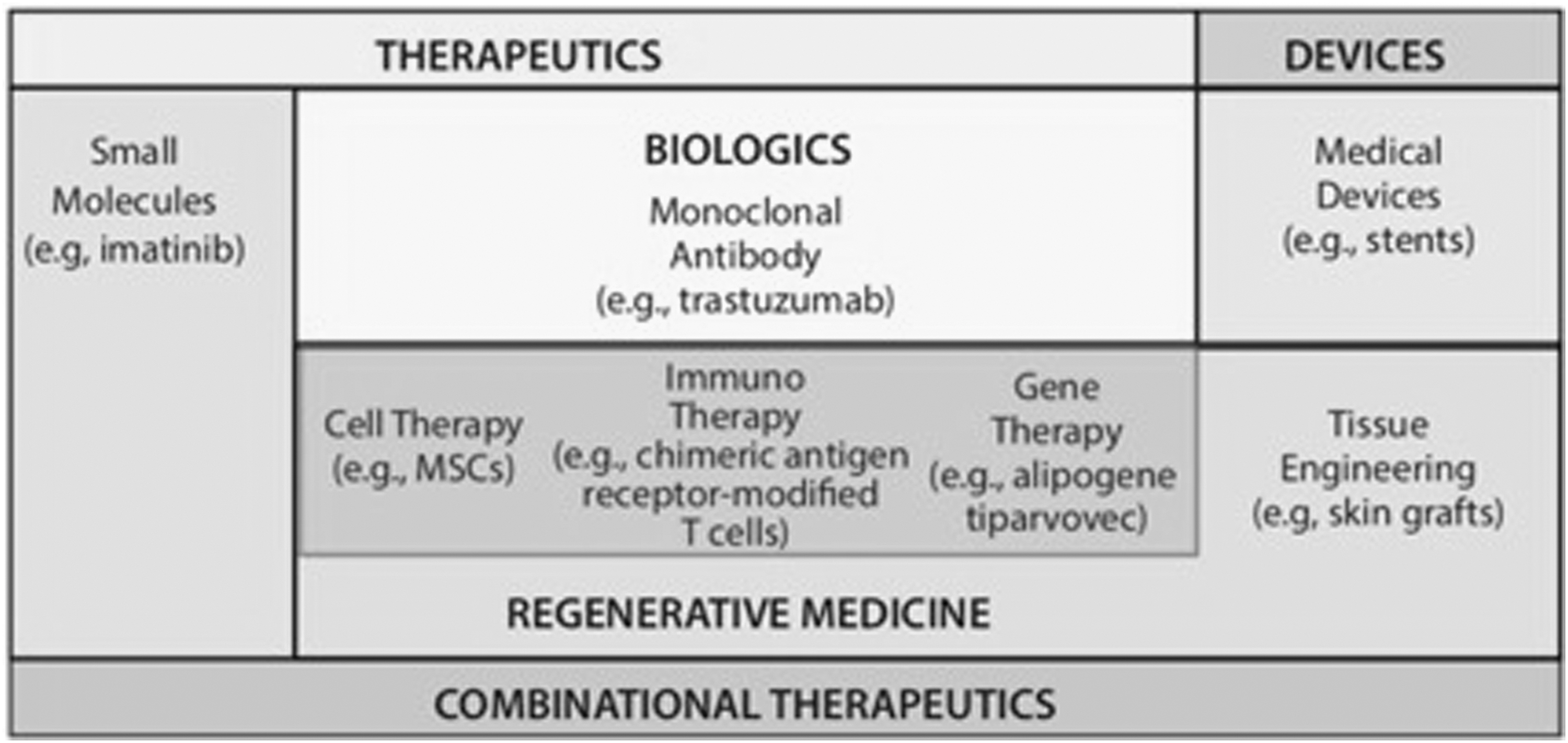
The 21st century pharmacopeia, including the convergence of “regenerative medicine” therapeutic approaches.
Distinction of Health Care Subsectors
The scope and context of corporate governance recommendations provided by the authors herein is focused primarily on biotechnology companies, including start-up or independent vaccine companies. Therefore, it will not include some areas such as drug pricing and distribution that have been subject to previous research. 18 However, the recommendations provided may be applicable–in whole or in part–to other subsectors should the particular entity in question share a significant proportion of classical biotechnology company characteristics.
Characteristics of Biotechnology Companies
Implicit in the necessity for biotechnology minimum corporate governance standards is that biotechnology companies have a number of unique characteristics, and therein specific governance requirements, compared with nonbiotechnology entities. For example, biotechnology companies are inherently R&D intensive, highly regulated, capital intensive, high (investment and execution) risk(s), and technologically complex. 19
These specific governance requirements can be further classified into unavoidable or intrinsic and constant corporate governance challenges in biotechnology–characteristics that cannot be changed by management or governance; unavoidable or intrinsic and variable corporate governance challenges in biotechnology–attributes that it may be possible to change and/or mitigated by management or governance (Table 3). In either category of requirement, it is vital that these inherent characteristics–and associated risks and opportunities–are monitored via a continuous and transparent method such as a risk register that is communicated to stakeholders who can affect appropriate action(s).
Comparison of Constant and Variable Unavoidable or Intrinsic Biotechnology Corporate Governance Challenges
A Proposal for Minimum Standards in Biotechnology Corporate Governance
The authors put forward the following as a proposal for potential attributes of minimum standards in biotechnology corporate governance. These potential attributes are based upon the authors' experiences–not relating to any specific organization(s)–and a review of the research literature in the area, in addition to semistructured workshops among the authors and collaborators.
These potential minimum standards are not intended to be definitive or exhaustive. However, it is hoped that they provide a substrate for more in-depth discussion, research, and future sector-wide engagement. The advent of Web 2.021 brought with it new household names and technologies, including Facebook, Google, Twitter, and UBER. This was not complemented by Web Governance 2.0. In part, as a consequence, we have seen these and other unicorn companies gripped by corporate governance battles and major public failures in key functions, not least in the area of data protection.
While improved corporate governance from the inception of these companies could not have conclusively avoided such public falls from grace and public loss of confidence in the sector, it is axiomatic that it would have reduced the risk of such occurrences, and certainly provided predefined frameworks for management and Board responses to challenges once they occurred. 22 The biotechnology sector must learn from Web 2.0.
The time for Biotechnology Governance 2.0 is now.
Proposed minimum standards in biotechnology corporate governance
Codification and documentation of a corporate governance system, including committee terms of reference. It is not effective or appropriate to rely on “word of mouth” agreements or reverting routinely to Articles of Association to resolve moderate conflicts.
Nonexecutive Directors (NEDs) should be appointed upon company formation, and the number of NEDs and their respective expertise increased throughout the company's lifecycle such that there is a majority upon the achievement of specified major milestones; for example, first-in-human trials.
The (voting) majority of all BoD Committees, including remuneration and audit, should be independent NEDs.
A regular independent review of critical BoD and management decisions should be conducted with defined corrective and preventative actions (CAPAs) executed. This review and CAPAs arising should be shared with shareholders and other interested parties; for example, company legal and financial advisors. Where possible, a governance effectiveness rating or assessment system should be utilized.
Commencing with all corporate functions, an organization with quality management system (QMS) to a recognized, externally validated, and appropriate standard; for example, ISO 9001 and/or ISO 13485 should be implemented and continuously reviewed and adapted to changing organizational needs.
Key BoD appointments (including to BoD committees), BoD member proxies, and NEDs should be finite in duration and a process for review, reappointment, and recruitment defined.
Governance by Design (GbD)–all governance procedures should be appropriate and proportionate to organizational needs, subject to regular review, and updates.
Clear mechanisms should be agreed and defined by management and the BoD to cascade critical BoD decisions to all business functions effectively.
Training should be provided to BoD members to ensure an appropriate common baseline level of technical, regulatory, and governance knowledge is achieved among all BoD members. This should be recorded in a formal training record and requirements for further training reviewed regularly.
BoD and management such seek to identify, adapt, and/or remove obsolete BoD functions that are no longer required at a particular stage in organizational development.
Clear dashboards, balanced scorecards and updates to be exchanged between BoD and management to ensure effective communication and “translation” of decisions and progress of actions throughout organizational functions, thereby ensuring that all parties have access to the same minimum standard of information to inform decision-making.
Traditional internal corporate governance controls, nonspecific to biotechnology, should be implemented. For example, appropriate financial authorization levels, segregation of duties, effective management of conflicts of interest, and so on.
All Advisory Boards, for example, Scientific Advisory Boards, should be regularly reviewed to ensure that skills and expertise appropriate to an organization's stage of development are represented, per GbD. All appointments should be fixed term in nature.
All conflicts of interest among management and BoD members should be documented and effectively managed. For example, per corporate convention in Europe, the Chairman should ask all members of management and BoD to advise on any material changes to their conflicts of interest at the start of all BoD meetings.
Detailed due diligence on all staff and BoD members should be undertaken to ensure that individuals have appropriate qualifications and experience to deliver their functions effectively. If deficiencies are identified, the organization must offer, and the individual concerned must undertake, appropriate training.
BoD must make documented, proportionate, and appropriate efforts to promote diversity and inclusion among the BoD, management, and in vendor selection processes continuously.
Where a shareholder and/or BoD member wishes to appoint a proxy to participate in the BoD on their behalf, mechanisms for appointing the proxy, the scope of the proxy's decision-making authority, direct communication routes between the BoD and the beneficial owner, and procedures for providing feedback to the beneficial owner in regard to their proxy should be defined. All investor proxies should be fixed term in nature.
The Future of Biotechnology Corporate Governance
Among inherent uncertainties in biotechnology development, some constant currents are defining the future of the sector and the organizations within it. First, the technology platforms used to support developments by biotechnology companies will continue to grow in complexity and cost. Second, as technical complexity simultaneously broadens and deepens within specific domains, the availability of appropriately skilled human capital–with an apt blend of technical, management, strategic, and governance expertise–will fail to meet demand at an ever-increasing rate. Third, unmet medical needs will continue to grow as society's ability to pay for novel treatments decreases. Finally, investors with a risk appetite for biotechnology assets will continue to be required to fund all stages of company lifecycles. So, among these sector constants, where is the need for Biotechnology Governance 2.0?
Without appropriate governance and oversight, tool and technology developers will not make the right resource allocation or technical decisions to ensure that therapeutic and diagnostic developers have access to the tools they need, when they need them–without which delays in development and an increase in end product costs will occur. This also increases the likelihood of company failure and investor losses.
These authors have experienced first-hand–and on multiple occasions—growing unmet medical needs, and nonspecialist investors committing capital to biotech for the first time, “burnt” not by poor technology or a lack of market pull, but by a lack of robust, proportionate, and appropriate corporate governance.
If you work in a biotechnology organization, where the BoD regularly reaches nonunanimous decisions due to poor communication, vested interests, or individuals simply “passing the buck”, it is late—but never too late—to institute improved corporate governance. If you work in a biotechnology organization without these aforementioned problems, you should reflect on the governance procedures you have in place and ensure that these are continuously reviewed and implemented to prevent a swift and precipitous transition to the former situation detailed above.
Governance in any form is ultimately about the effective monitoring and accommodation of stakeholder interests. Biotechnology is potentially unique among sectors in the breadth and dynamic nature of its stakeholders at different stages of organizational development. As a consequence, we have potentially all been guilty of focusing too closely on the needs of one stakeholder and/or of omitting the needs of another.
Biotechnology governance is about balancing interests, objectives, and resources in a manner that is not instantaneous but is consistent. These authors urge all members of the biotechnology sector to seize the opportunity to deploy Biotechnology Governance 2.0 as a stabilizing tool in a proactive manner in the inherently high risk, high stakes, and high uncertainty world of biotech. Reactive governance is often akin to shutting the stable door after the genetically reengineered horse has bolted …
Footnotes
Author Disclosure Statement
No competing financial interests exist.