




Abstract
There are three major changes for the human lifespan in the past half decade: the decreased age of sexual maturity, slight increase in age of menopause/andropause, and a trend of increase in life expectancy. The ages of puberty and menopause are the transitions in life stages, such that early puberty leads to loss and late menopause leads to gain in the lifespan. So far, the strategies for increased lifespan have been largely focused on the postreproductive stage. These approaches are challenging and may at some point reach a plateau. It might be interesting to expand this focus to potentially delaying the puberty and extending the period of body growth, which might yield longer reproductive stages as well as the longer and healthier lifespan.
Although we enjoy the fact that life expectancy in many countries has been increased for the past several decades, and in many cases has been doubled in comparing with just a half century ago, we also realize that this upward trend slows down and at some point will certainly reach a plateau. 1 –3 An interesting question emerges on the remaining obstacles to the continuous extension of lifespan and the related set of questions on how to overcome these. To get answers, we must carefully examine the strengths and weaknesses of the past and current approaches. This perspective tackles some of the aforementioned points with the focus on the prepuberty timeline and a notion of extending the organism growth before or even during the reproductive timeline, in parallel or as an alternative to the current approaches for the extension of lifespan in the postreproductive stages. This article intends to bring discussions on these questions by examining the relationship among puberty, menopause, and lifespan.
The Losses and Gains in Ages of Puberty and Menopause, and Aging Stages in Lifespan
Lifespan in prepuberty stage has been shortened, largely due to the modern living standard. Human population underwent a trend in decrease of age of menarche, worldwide. For example, average ages at menarche in Japan were 13.8 years for those born in the 1930s, 13.3 years for the 1940s, 12.8 years for the 1950s, 12.3 years for the 1960s, 12.2 years for the 1970s, and 12.2 years for the 1980s. 4 Similarly, the average ages at menarche in Europe countries went from 14 years in 1900s to the 12.5 years in 2000s. 5 Although the specific ages are different among different races and geographic areas, a similar overall speeding up trend was observed in sub-Saharan Africa. 6 An analysis of 2020 showed that the median age at which healthy girls attained tanner breast stage 2 in Europe, United States, Africa, Asia, and Middle East were from 9.8 to 10.8, 8 to 10.3, 10.1 to 13.2, 8.9 to 11.5, and 9.7 to 10.3 years, respectively. 7
Although there is an earlier onset of reproductive stage, its duration has been also somewhat extended, but not as clearly or as much as might be expected from modern medicine. Namely, the change in the ages of menopause is in the opposite direction as compared with that of the puberty but in an unclear and slow pace. Overall, the ages at menopause have been increased. For example, the ages of natural menopause between 1959 and 1962 in the age groups of 40–49, 50–64, and >65 years were 24.1%, 42.0%, and 33.9%, respectively. Whereas in the years between 2015 and 2018, the percentage of these age groups were 15.5%, 47.9%, and 36.6%, respectively. 8 During the past half century, the mean age at natural menopause increased by 1.5 years in United States. 9 Similar patterns occurred in other places. 6
The increases of menopausal ages have two main features. The first is that the speed of increase is slowing down. For example, in a report of 2006, the authors observed a 17-month increase in the mean age at menopause in a period of <15 years for those born between 1915 and 1939. 10 And the pace of this extension was not further increased in recent years.
The second is that racial and geographic differences continue to manifest in the menopause age, although they become less pronounced in the overall lifespan. A meta-analysis indicated that age at natural menopause was generally lower among African, Latin American, Asian and Middle Eastern countries and higher in Europe and Australia, followed by the United States. 9 And although the lifespan has been extended significantly in the past century, 11 worldwide, the lifespan before the menopause did not keep up the same pace, as the enhancement of the total lifespan. Thus, the doubling of life expectancy is based mostly on the extension of the years of life after the menopause. For example, life expectancy of Americans changed from ∼45 to 77 years between 1900 and 2022. 11
The Complexity and Dynamics Between Life Stages and Lifespan
Lifespan after the reproductive stage is short in organisms living on Earth, and interestingly, all metazoans undergo a depletion after the reproductive stage. 12,13 Some organisms continue to live for years after the reproductive stage, the majority, however, do not live long after the reproductive stage, and there are many examples of reproductive stage being life-ending (Fig. 1A, B). Generally speaking, reproductive activity is the evolutionary goal, which when achieved reduces fitness and lifespan of metazoans. Humans might be one of the few (if not the only) living creatures that have a long lifespan after the reproductive stage (Fig. 1C).
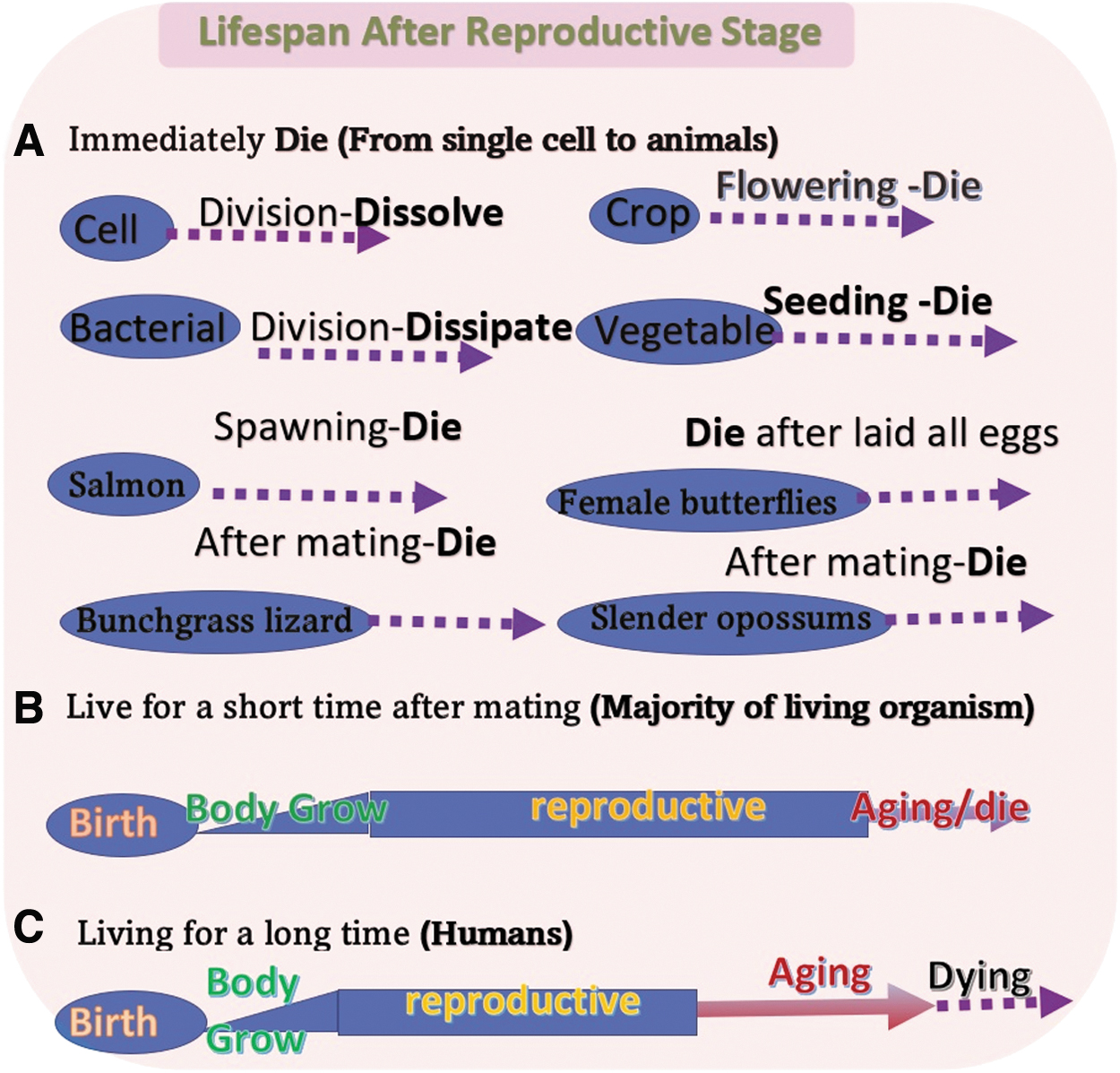
Lifespan of organisms after reproductive stage.
Rapid postreproductive health decline in humans has been well studied and the changes in hormone levels and impact on organs and disease are well documented. 14 The stages of human life are clearly delineated and are governed by the tightly controlled and well-balanced hormone levels. 15 It is well known that the neonatal to the postnatal translation triggered the process of rapid increase of hormones, growth factors, and cytokines that promote body growth and immune, for example, organ systems' maturation (Fig. 2). 16 –18 Although the hormone levels remain relatively stable during the next decades of adulthood, with a slight decrease over time between puberty and menopause, a sharp decrease happens after the menopause, causing the rapid decline in homeostatic health of cardiovascular, immune, for example, systems precipitating the overall worsened health, development, and progression of various diseases (Fig. 2). 19 –21
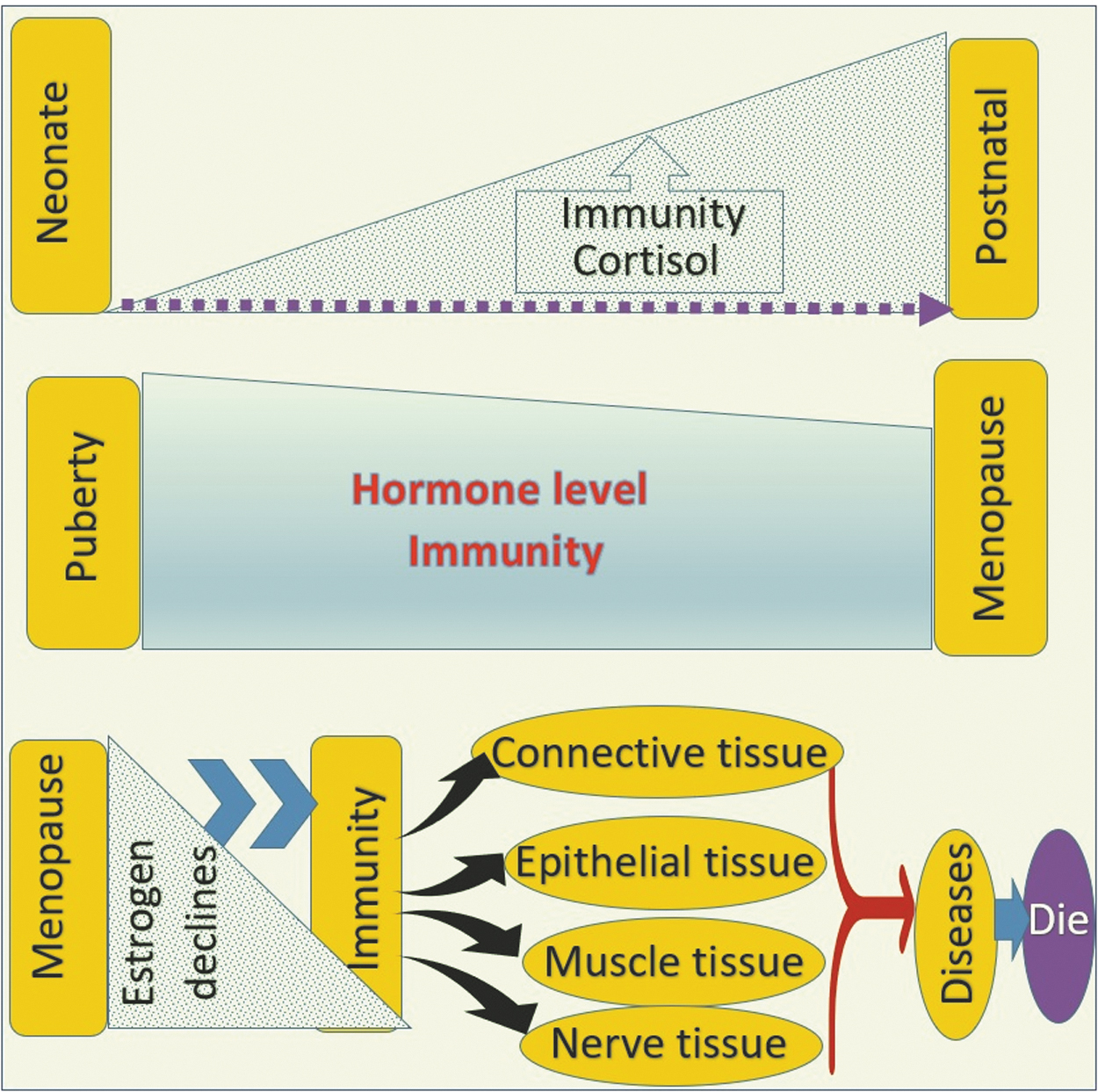
Chronological changes in hormonal landscapes at different life stages.
At this point, multiple organ systems become dysfunctional, and many diseases emerge, yet, treating each specific disease becomes problematic and be ultimately impossible in the background of progressive deterioration of tissues, cells, and molecules.
The attempts and successes with enhancing tissue maintenance and regeneration through calibration of cell–cell signaling to the healthy youthful states might thus be needed for having the possibility to meaningfully treat the age-associated diseases. 22,23 The purpose of such studies is to develop biomedical strategies for rejuvenating many/all human organs and tissues with the closely related goal of preventing or attenuating the pathologies of later years of life. The findings on how the tissues and cells can be switched from aging to young and vice versa importantly helps to decipher the fundamentals of the process of aging. 24 The successes in the direction of multitissue rejuvenation also importantly suggest that human lifespan can be extended, such that people remain healthy for much longer.
Although we understand the differences in life stages and are working on restoring the aging body back to youth, we may ask why not to try extending the lifespan at young and healthy adult stages. Such an alternative might be easier to accomplish than turning the dysfunctional organ systems back to young healthy ones, and both approaches might be synergistic with each other.
The Extension of Lifespan After the Reproductive Stage Is a Cost-Deficient Byproduct of Medical Research
Observations on natural progression of the life stages of Earth metazoans suggest that extending the lifespan of humans is to a degree against the natural cause of events. From unicellular organisms to metazoan animals, all living organisms have three life stages: growth, reproduction, and postreproductive aging (Fig. 3A). For humans, these three stages in females are from birth to the time of puberty, after puberty and before menopause, and after menopause, with senescence being commonly observed through the decline in fertility and then in survival. 25,26

Life stages and strategies for life extension before menopause.
In plants, the end of reproductive stage predicts the death of an organism (Fig. 3B). In insects, laying eggs in most cases signifies the ending of the life cycle. In most animals the life after reproductive stage is either ending or has a predictably short span (Fig. 3B). Some metazoans live longer after the menopause than others, which has been linked to body size and certain lifestyles. 27,28 Thus, a long lifespan after menopause in humans is an exception. If people had similarly extended stages of either body growth or the reproductive stage, a significantly longer overall health span would be anticipated.
Currently, the longer lifespan of people in the postreproductive stage is the byproduct of our civilization. Namely, we live on average longer, thanks to antibiotics, medical technologies, and much better quality of food and water, rather than because of a specific biological phenomenon or an evolutionary event.
If we look at early 1900s, the life expectancy of most countries was between 30 and 40 years of age. Thus, under the natural conditions, most humans die soon after the reproductive stage (Fig. 3C). It could be also hypothesized that the main cause of the elongated lifespan after the reproductive stage is due to the medical technologies that now deal better with the strokes, cardiovascular problems, for example, diseases that afflict people at senescence. At the same time regardless of the medicine, at the life stage of senescence, organs and tissues continue to deteriorate, metabolism weakens and/or diseases emerge and progress.
The original purpose of the biomedical research is to find a specific treatment for a specific disease, and it is clearly justified and saved the lives of many people. Yet, the study of longevity in general or as a branch of the medical research has never paid enough attention to extending the periods of body growth and prereproductive stages, largely ignoring the hypothesis that illnesses of later years might be delayed or averted by such an approach.
Reality check tells us that when there is no disease, there is no need for treatment. But we are so focused on the rapid growth and progression of children through the developmental stages that biomedical research might have missed the childhood as an important for the antiaging research stage of human lifespan. Consequentially, little to no research in experimental animals was focused on prolonging the growth of an organism, preventing it from growing too fast and for only a short time, or on postponing the transition to sex maturity. And interestingly, no research links the early puberty with the reduction of lifespan.
It is possible that as a result of our better living standard and the presence of hormones in the food supply chain, humans have a shortened time of childhood (Fig. 3C). The same conditions could have extended the reproductive stage, but less so, as compared with the rapid shortening of the childhood. In contrast to the relative lack of research on extending the prereproductive life stages, the postreproductive stage was the sought-after goal for extending the years of life, not only with good nutrition and sanitation, but most importantly through the improved medicine. However, such an elongation is costly, and the trend becomes difficult to maintain, because saving lives at the stage of body deterioration is a great challenge. Biomedical research has been doing extremely well on this front, but such a trend soon will reach to a plateau.
It Is Time to Increase the Life Stages Before Menopause
It is important to conduct the research, which aims at increasing the overall lifespan by postponing the ages of puberty and menopause. Such an effort does not disagree with the biomedical research for prevention, diagnosis of treatment of specific diseases, and it might in fact postpone the illnesses of aging, synergizing with the current medicine. The postreproductive stage has been already increased by an enormous ∼300%–500%, assuming that the natural span is 10–15 years after the reproduction. If in the best-case scenario, we are able to extend the reproductive stage by two- or threefolds a significant additional overall increase of the lifespan is anticipated and it is, moreover, likely to be the health span extension.
Although the prepuberty might be more resistant to a large extension, because of the biomedical problems associated with the continuous body growth, a very slow growth might be possible to achieve with little to no side effects. And interestingly, many animals that continue to slowly grow throughout life are very long lived, for example, the bow-head whale or the quahog clam. 29 There are also examples of newts, axolotls, and so on, which live their whole lives as juveniles, 30 but there is little research on the cellular and molecular mechanisms linking this phenomenon to the enhanced longevity.
Remarkably, it is predicted that if reproductive age is postponed by ∼20 years, humans will be able to live on average for 100–150 years (Fig. 3C).
There are also obvious health benefits from extending the life before puberty and reproduction (Fig. 4). To slow down the growth of childhood and postpone the time of sex maturity will elongate the very creative part of our life that we currently call childhood, but when extended could more meaningfully contribute to the future technological inventions and the art (Fig. 4A). The elongation of the reproductive stage should enable a healthy high-quality adult life (Fig. 4C). Currently, much is understood about these two stages, thus a new focus on their extension is expected to be based on a large body of scientific work and such approaches deserve a better exploration than the most rudimentary castration, ovariectomy, and hormone treatments in experimental animals.

Benefits to extend the life before puberty and reproductive stages.
Research clearly focusing on the extension of body growth and reproductive stages will eventually extend the healthy lifespan of humans. It will be an interesting contrast to the extension of postreproductive life also known as aging and it should reduce the cost of health insurance by making people to be less sick for much longer (Fig. 4B). Even if a person lives the same time, but they spend more time in the early two stages rather than the aging stage, higher quality and enjoyment of life are anticipated.
In summary, there are clear difference between the life stages before and after menopause. Extension of life before the postreproductive stage, for example, older age, should enable humans to live disease free for many additional decades. This would be very interesting to study as an alternative to extending the postmenopausal stage and the current attempts to save the body that is undergoing pathological deterioration. It is time to work on the extension of other two life stages.
Footnotes
Author Contribution
W.G. composed this article.
Author Disclosure Statement
No competing financial interests exist.
Funding Information
The study was partially funded by Veterans Administration Medical Center in Memphis (I01 BX000671).